On November 10, 2026, Shopify published a short changelog entry titled "build, grow, then expand." It runs about two minutes long and reshapes how every app company should think about growth.
The headline rule: before a partner can list an additional app, each app they already have on the Shopify App Store needs at least 10 installs from active stores on paid Shopify plans. Shopify paired that gate with a one-app-in-review limit, escalating cooldowns for repeated rejections, mandatory identity verification, and automatic removal of apps that sit at zero installs for six months.
Read narrowly, these are submission rules. Read in context, they are Shopify's response to a year in which AI coding tools made Shopify apps almost free to build, and new listings poured in faster than merchants could adopt them. When anyone can ship an app in a weekend, the code stops being the advantage. Earning merchant adoption becomes the advantage, and that is a distribution problem. This article covers exactly what changed, the role AI played, how developers reacted, and how app teams should adjust their marketing to match.
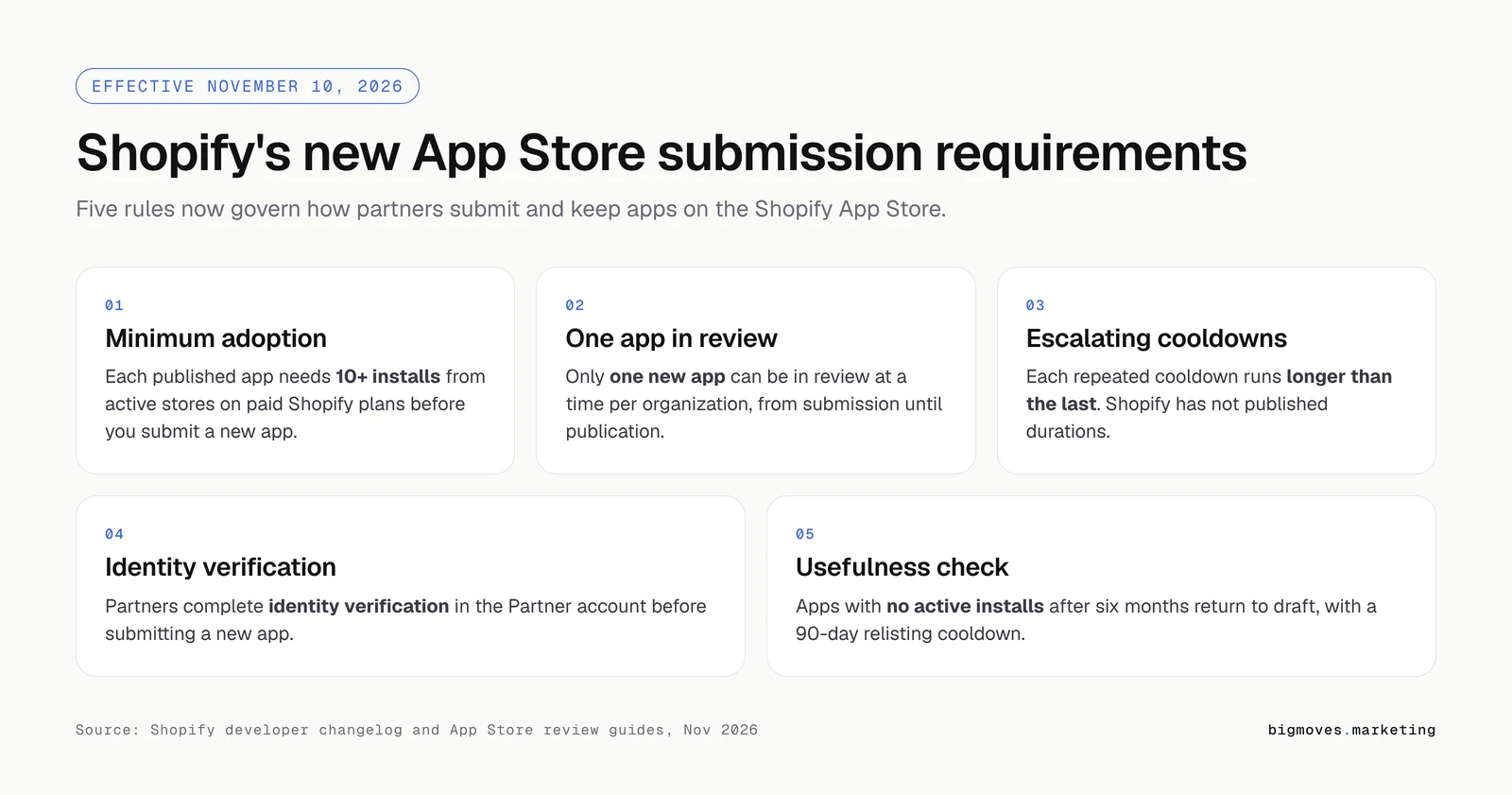
The changelog lists four policy updates, and the App Store review documentation adds the operational detail. Here is the complete picture.
A few details deserve emphasis because they determine how the rule bites in practice.
What counts as an install. The review guide specifies installs from active stores on paid plans and explicitly excludes development stores and stores on a free trial. Third-party coverage, including CedCommerce's summary, reads this as the merchant's Shopify plan rather than a paid app subscription. A developer on the official forum asked Shopify to confirm that reading, noting the changelog says "full-priced Shopify stores" while the guide says "paid plans." At the time of writing, Shopify staff have not answered that question in the thread.
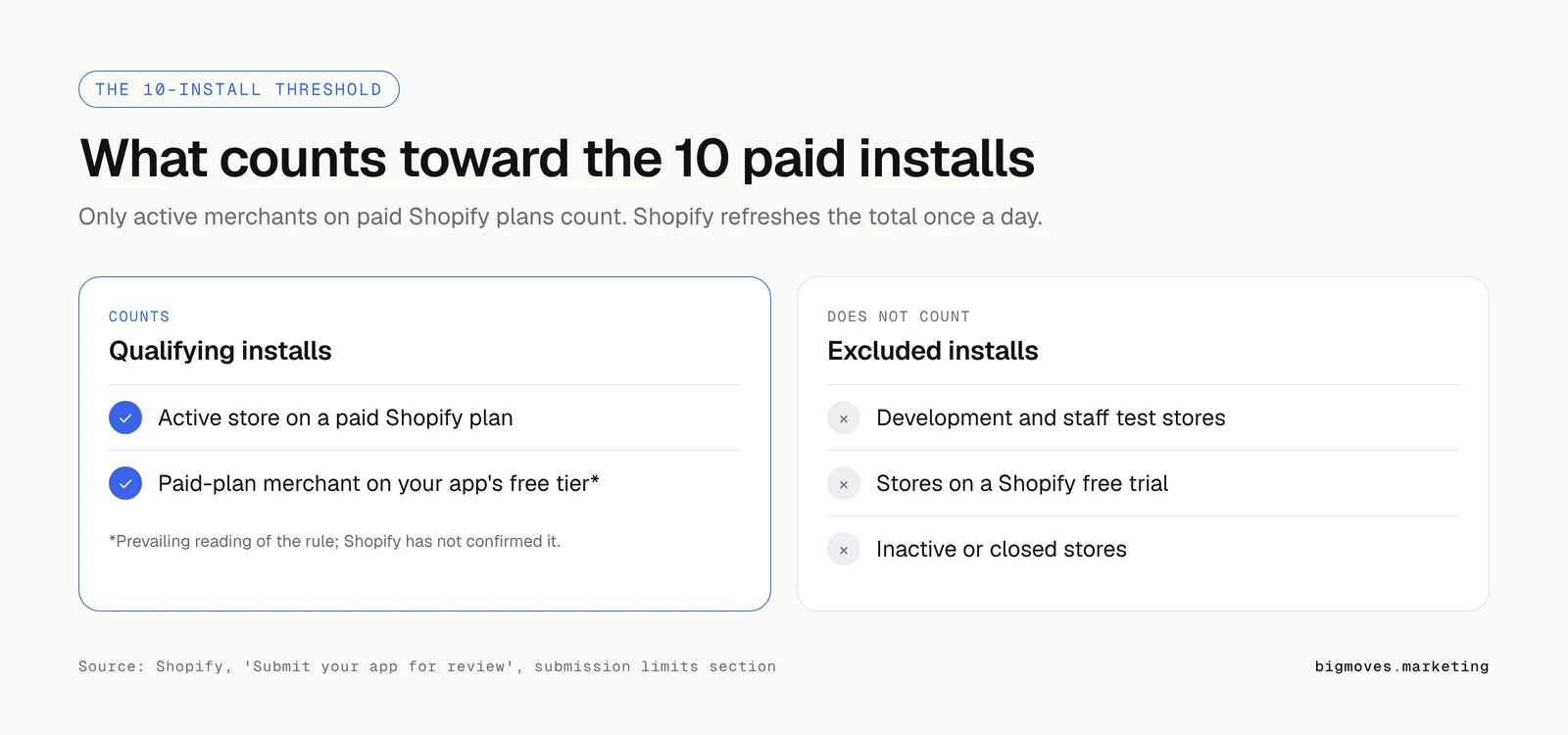
Who it applies to. First-time partners with no published apps are exempt from the install threshold; it activates the moment you have something live. The limits cover any app that has never been published, including withdrawn apps being resubmitted.
What blocked looks like. Apps that fail either requirement show "Submission limited" in the Partner Dashboard. Install counts refresh once a day, so a new qualifying install can take up to 24 hours to register.
No workaround through extra accounts. The quality-checks documentation states that submission limits apply per Partner, not per Partner account, and that using multiple accounts to circumvent them violates the Partner Program Agreement.
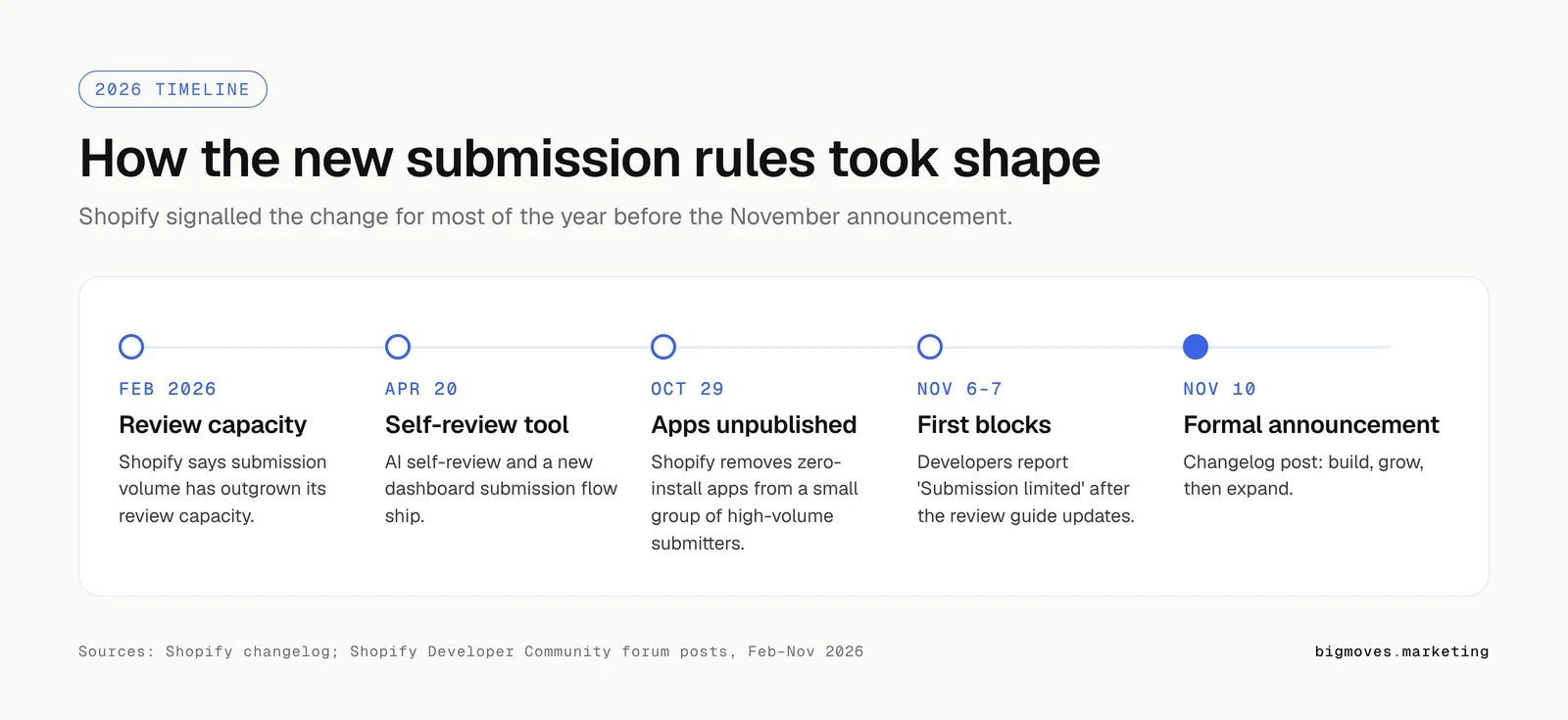
When it started. The submission limits appeared in Shopify's documentation in the first week of November, and developers began reporting blocked submissions on November 6 and 7. The formal announcement followed on November 10.
The rule did not arrive in a vacuum. Three threads of evidence explain it.
Shopify had already started cleaning house. On October 29, 2026, a Shopify staff member named Blair replied to a forum thread titled "How Can Shopify Stop App Store Spam and Unfair Competition?" with a direct statement: Shopify had unpublished hundreds of apps that day. They came from a small group of high-volume submitters and had no merchant installs. The same post promised new restrictions limiting how many apps could be submitted at once. Twelve days later, those restrictions shipped.
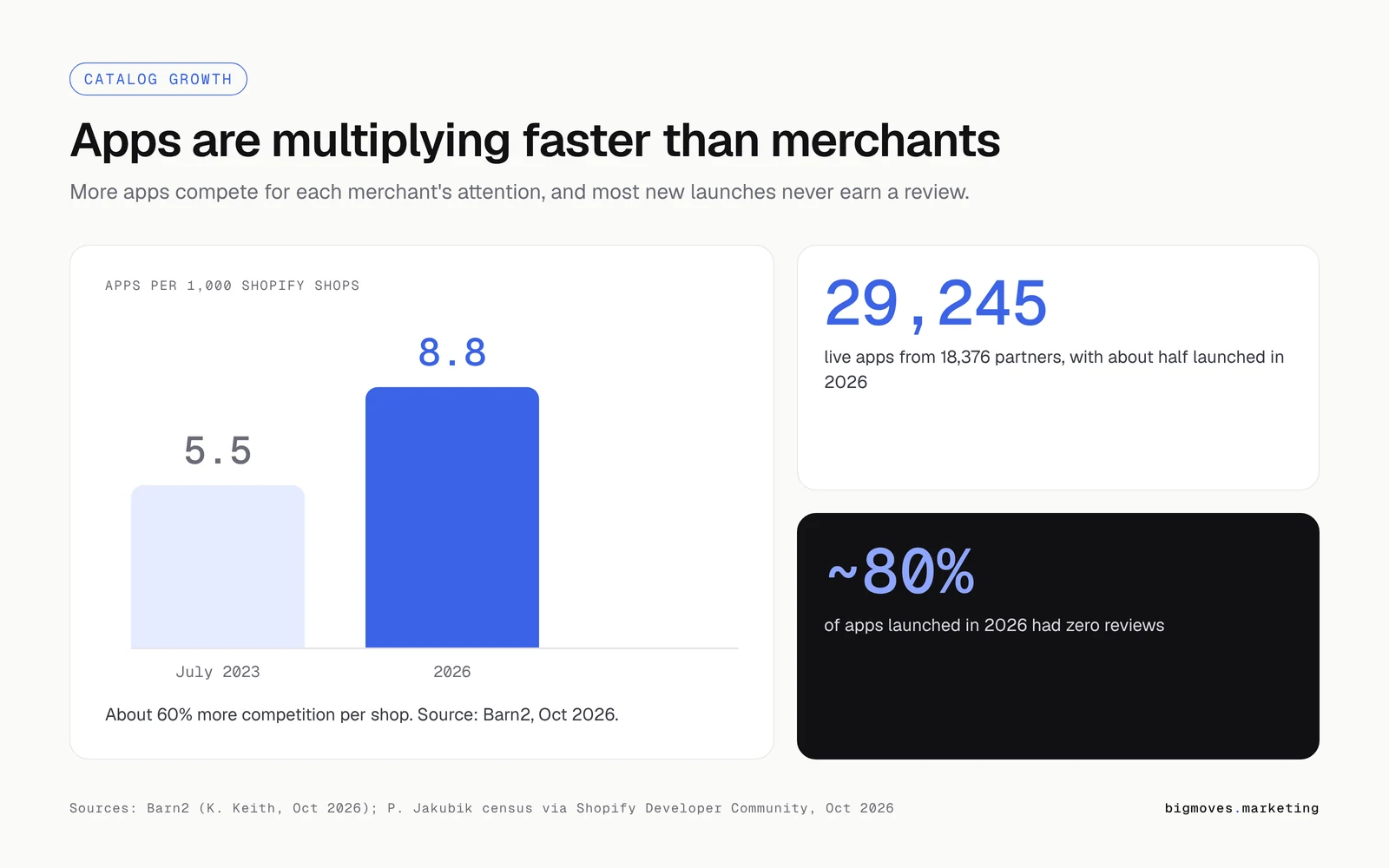
The catalog has outgrown the merchant base. Patrick Jakubik's census of every live listing, shared on the developer forum the same day as Blair's post, counted 29,245 apps from 18,376 partners. About half launched in 2026, and roughly 80% of the 2026 launches had zero reviews. A forum participant pointed out that a single developer, Unreact, operates 201 apps. Barn2 founder Katie Keith reached a parallel conclusion from a different dataset: the App Store now holds 8.8 apps per thousand Shopify shops, up from 5.5 in July 2023, which means roughly 60% more competition for each merchant's attention. App counts grew more than 28% a year while shop counts grew 10% to 14% a year after 2023.
Review capacity is finite. Shopify acknowledged in February 2026 that submission volume had outpaced its review capacity, and forum threads through the first half of the year document 20- to 30-day waits. In April, Shopify introduced an AI-powered self-review tool and a new dashboard submission flow to speed things up. Every mass-submitted template app consumes reviewer time that a serious first-time founder needs.
Put together, the logic is straightforward. Shopify protects merchant trust by making sure every listing reflects real demand, and it protects reviewer capacity by rationing submissions to partners who have proven they can earn adoption.
Shopify's announcement never mentions AI. It speaks of merchant value, mass submissions, and high-volume submitters. The timing and the data, however, point to AI-assisted development as the force that turned a slow-growing catalog into a flood.
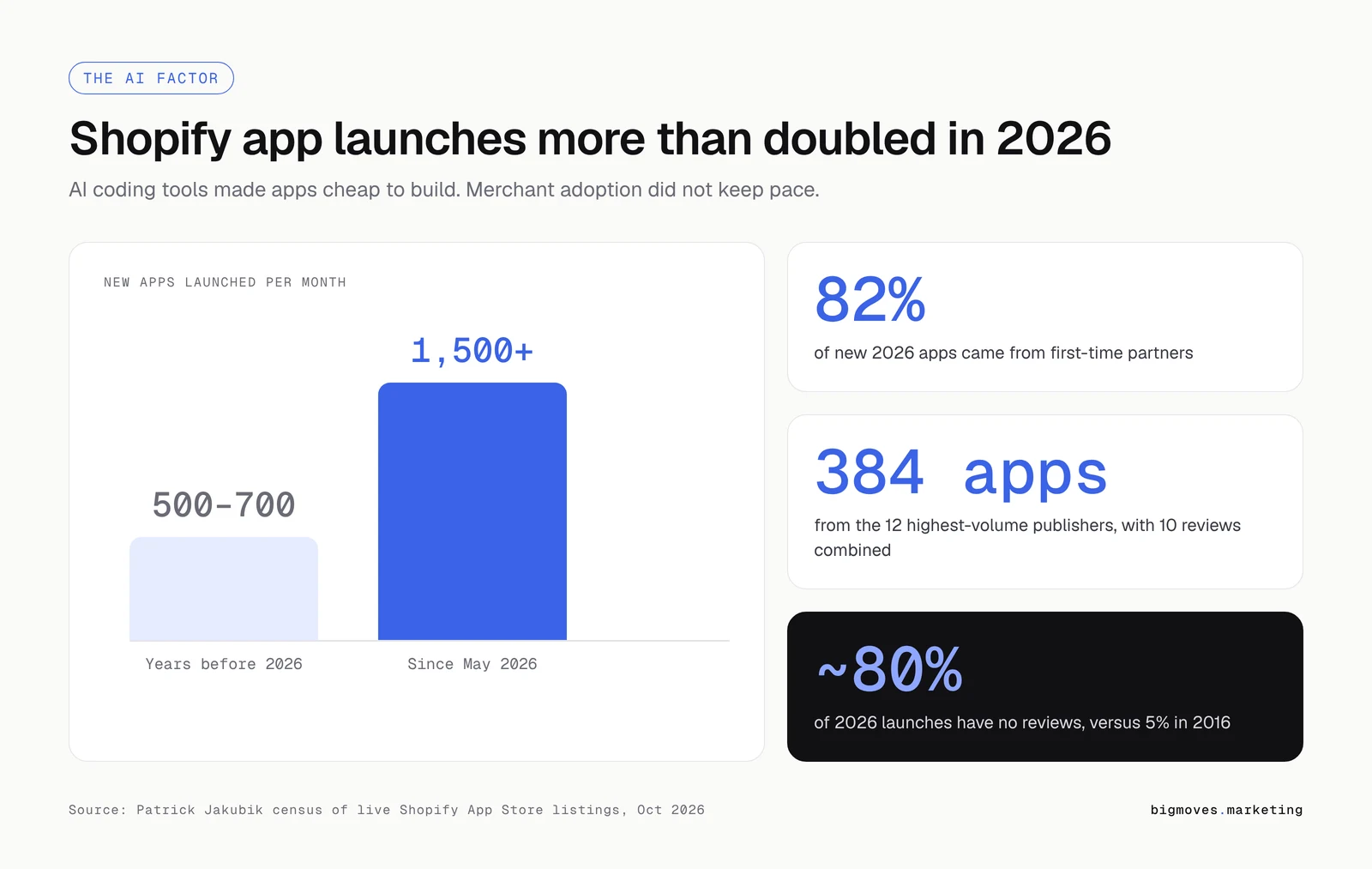
Launch volume broke its historical range. For years, the Shopify App Store added 500 to 700 apps a month. According to Patrick Jakubik's October census, launches have stayed above 1,500 a month since May 2026. Nothing in merchant demand explains that jump. Shopify's store count grew at a steady 10% to 14% a year over the same period, per Barn2's analysis.
First-time partners and high-volume publishers drove it. Jakubik's data shows 82% of new 2026 apps came from first-time partners: 8,964 new partners shipped 11,916 apps in ten months, while existing partners added 2,557. At the extreme, one partner launched 86 apps in 2026 and has a single review, and the 12 highest-volume publishers shipped 384 apps between them while holding 10 reviews combined. Developers on Shopify's forum describe the pattern bluntly, with one post claiming "AI farmers took over."
Adoption did not follow. Roughly 80% of 2026 launches have no reviews, compared with 5% of apps launched in 2016. Building got cheaper; earning a merchant's trust did not.
Apple faced the same wave first. Between January and June 2026, roughly 560,000 new apps were reportedly added to Apple's App Store, a pace that would set an all-time annual record, with much of the growth attributed to vibe coding. After WWDC 2026, Apple updated its review guidelines to emphasize meaningful functionality over repetitive, low-value apps. Shopify's November rules follow the same logic for its own marketplace.
AI products are a separate question. About one in five new 2026 apps puts AI in its name or tagline, and many of them are serious products with AI at their core. The issue Shopify is solving is apps built quickly and launched with no plan to reach merchants, not AI itself.
What this means for app teams. When an AI coding assistant can produce a working Shopify app in days, code stops being a durable advantage. Any feature you ship, a competitor can approximate within weeks. What stays scarce is the ability to put an app in front of the right merchants, convince them to install it, and keep them active. Shopify's 10-install threshold turns that ability into a formal requirement. The apps that clear it consistently will be the ones backed by deliberate distribution: a website that ranks and gets cited by AI assistants, partners who refer merchants, a presence in merchant communities, and a listing that converts the traffic those channels send.
The official announcement thread on community.shopify.dev drew around 30 replies in its first days, and several spin-off threads followed. The sentiment splits cleanly by rule.
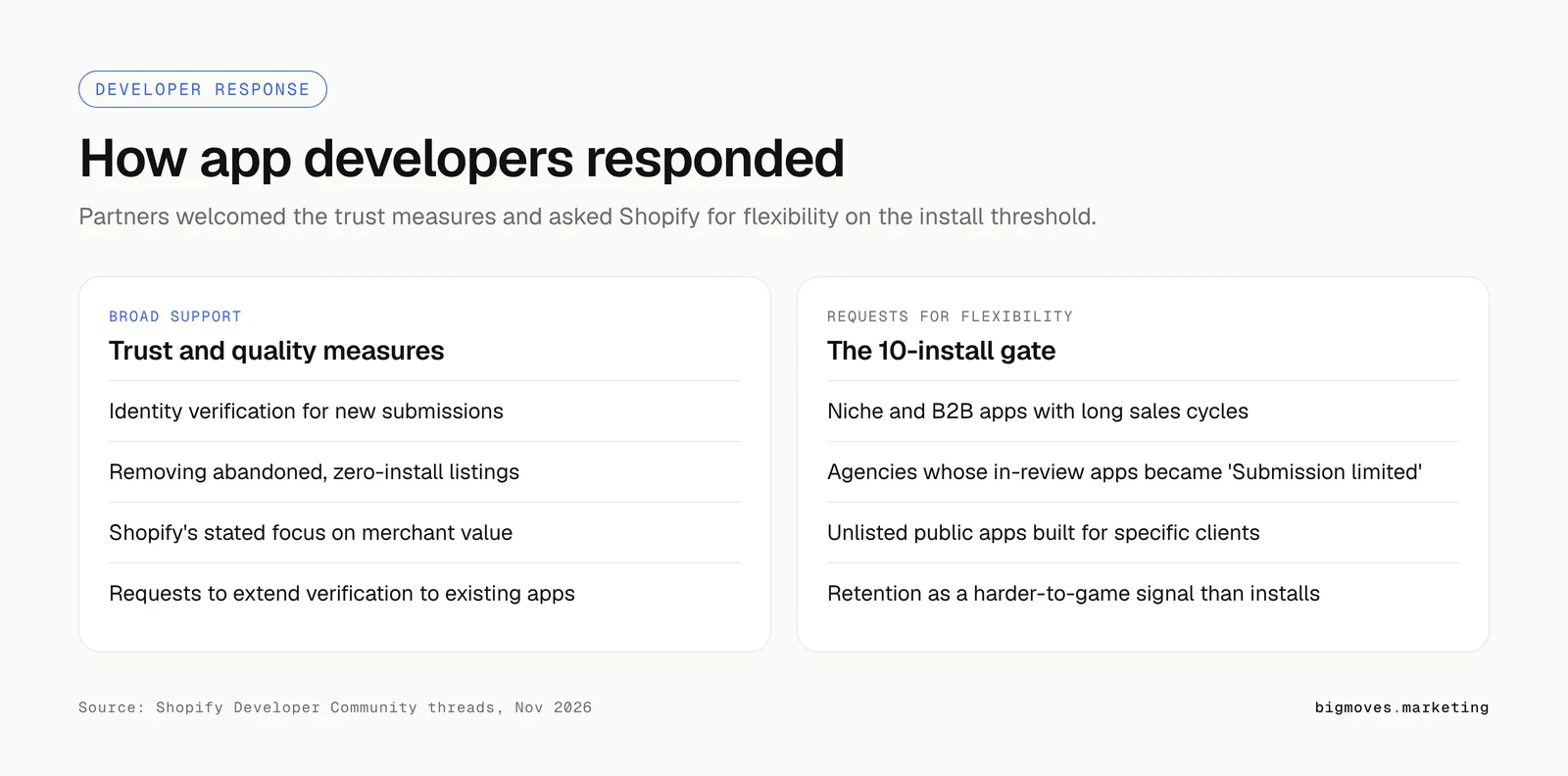
Strong support for the trust measures. Identity verification drew near-universal approval, with some developers asking Shopify to extend it to existing apps. Removing abandoned, zero-install listings also won praise. One developer used the thread to ask for an option to permanently delete delisted apps that still trigger deprecation warnings.
Pushback on the 10-install gate. The objections cluster into four groups:
The wider anxiety: discovery. Running alongside the policy debate is a louder concern about App Store traffic. A thread on Sidekick, Shopify's AI assistant, collects developer reports that it tends to surface only about three apps per category, with several partners describing sharp install declines. Shopify has not published how Sidekick selects apps, and other developers in the same thread attribute the slowdown to broader ecosystem trends that began earlier in 2026. Either way, the effect on strategy is the same: organic App Store discovery is concentrating, and apps outside the top tier need other ways to reach merchants.
A note on sources: the substantive debate has happened on Shopify's developer forum and in trade coverage (Shopifreaks, daily.dev, CedCommerce, Luseri). Reddit discussion of this specific rule is thin so far.
Strip away the mechanics and Shopify is telling partners three things.
Adoption is the entry ticket. The App Store has moved from "anyone can list" to "prove merchants want what you built." Ten paid installs is a low bar for a genuine product and a high bar for a template.
Usage is the currency. The six-month usefulness check, the per-app threshold, and the exclusion of trial and development stores all point the same direction. Shopify measures whether real, paying merchants keep your app installed. This aligns with what experienced growth teams already observe in App Store ranking: behavioral signals such as active-store retention carry more weight than raw install volume, and low-quality installs that churn quickly work against you.
The bar will keep rising. Shopify's own staff described the October cleanup as "a start." Founders should plan as if every future policy will reward depth and penalize breadth.
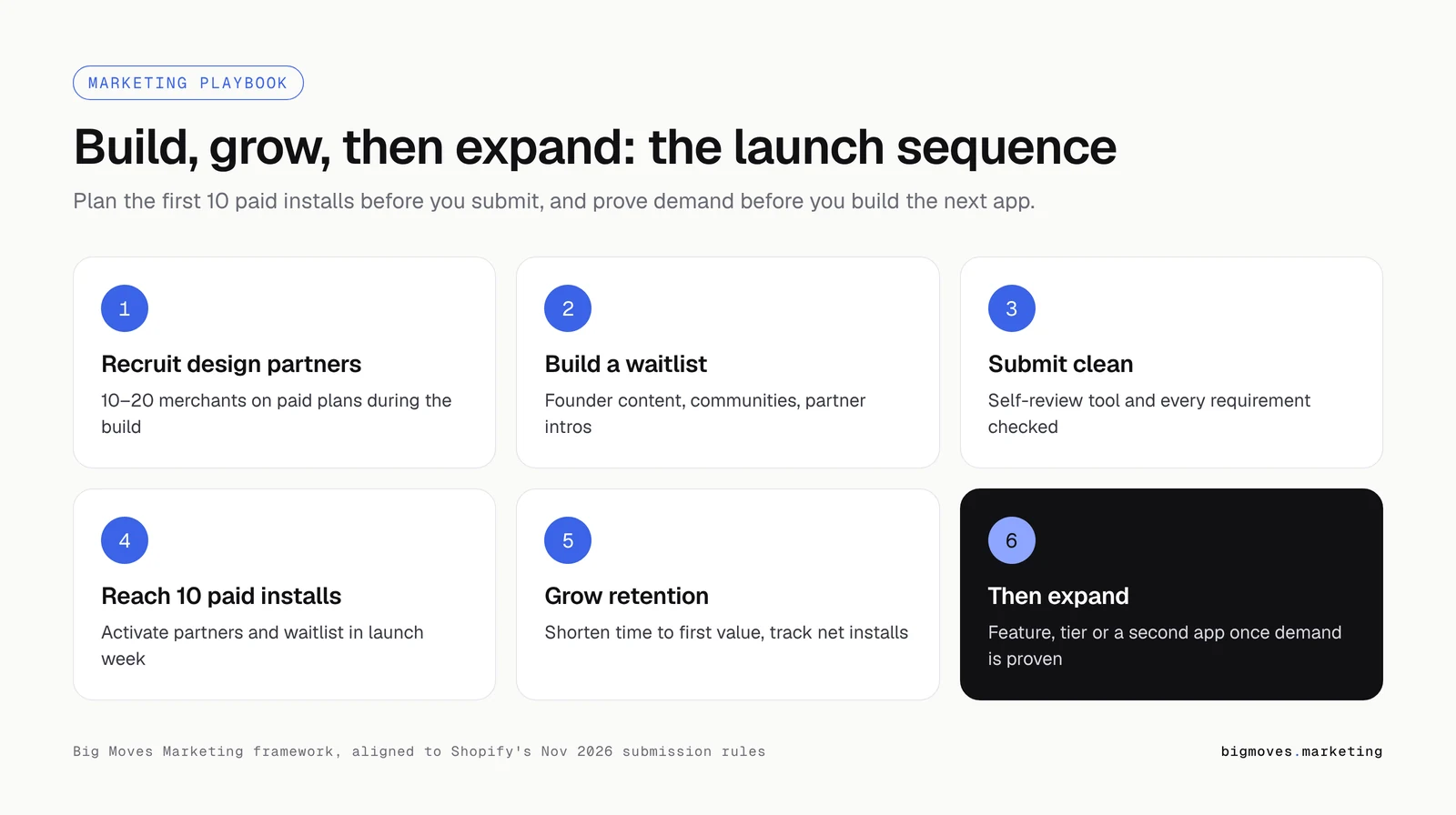
The new requirements reward the same discipline that has always separated durable Shopify apps from forgettable ones. The difference is that Shopify now enforces it. Here is the playbook.
Most founders treat launch day as the finish line. Under the new rules, the first 10 qualifying installs are the finish line, and they should be engineered before the listing goes live.
The one-at-a-time structure forces a question every portfolio publisher should have asked anyway: does this idea deserve its own app, or does it belong inside the one you already have?
Cooldowns now compound. Shopify can pause a submission when a partner fails to resolve reviewer issues after two or more exchanges, resubmits with new or growing issues, or stops responding to review emails, and each additional cooldown lasts longer than the last. A sloppy first submission, the kind that triggers the most common rejection reasons, now costs weeks, and because only one new app can be in review at a time, a paused submission blocks your entire launch pipeline.
The usefulness check removes apps with no active installs after six months. Few serious apps will fall that far, but the principle extends upward: Shopify keeps measuring whether merchants stay.
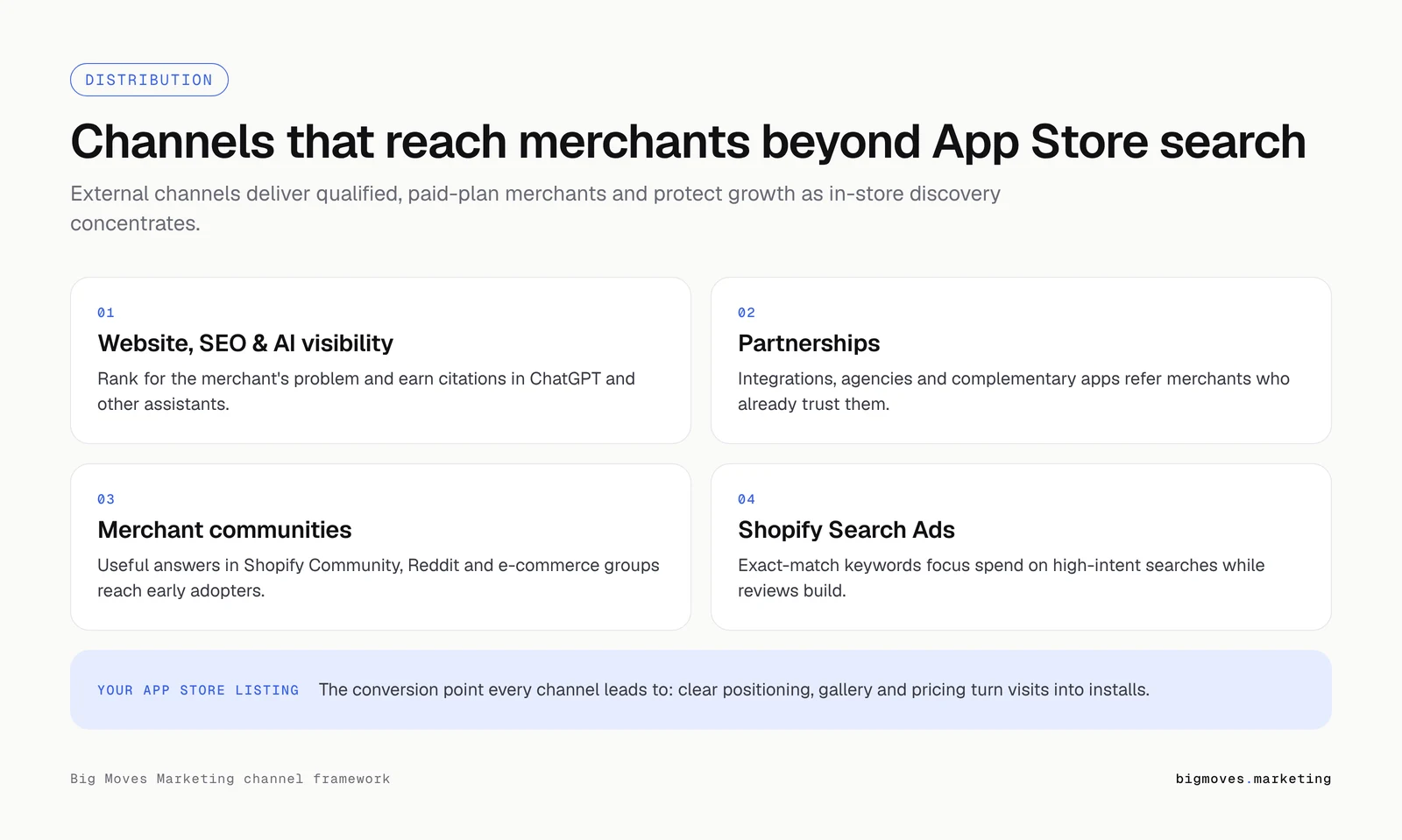
The submission rules arrive at the same moment developers are reporting concentrated discovery inside the App Store and Sidekick. That combination makes external channels a requirement, not a supplement.
Reviews are not part of the new submission gate, but they remain central to ranking and to Built for Shopify eligibility, which requires 50 net installs from paid-plan shops and at least five reviews. Two details matter:
Publishers with several listed apps face the steepest adjustment, because every published app must clear the threshold before any new submission.
Several open questions will shape how this plays out, and app teams should watch for clarifications:
Each app your organization has already published needs at least 10 installs from active Shopify stores on paid plans before you can submit a new app. The requirement applies to every published app, not just one, so a partner with three live apps needs all three to clear the threshold. Development stores and stores on a free trial do not count toward the total. If your organization has no published apps yet, the requirement does not apply to your first submission. Install counts in the Partner Dashboard update once a day, so a new qualifying install can take up to 24 hours to register. If you are blocked, the app you want to submit shows a "Submission limited" status until both the install requirement and the one-app-in-review limit are met.
The prevailing reading, based on Shopify's review guide and third-party coverage, is that the requirement refers to the merchant's Shopify plan rather than your app's pricing. The guide specifies installs from active stores on paid plans and excludes development stores and stores still on a Shopify free trial. That means a merchant on a paid Shopify plan using your free tier would likely count, while a merchant on a Shopify trial would not. The changelog uses slightly different wording, "full-priced Shopify stores," and a developer has asked Shopify on the official forum to confirm the interpretation. Until Shopify answers directly, the safest approach is to build your first cohort from established merchants on standard paid Shopify plans, who qualify under either reading.
No. Shopify's app quality documentation states that submission limits apply to each Partner rather than each Partner account, and that using multiple accounts to get around the limits violates the Partner Program Agreement. Coverage of Shopify staff comments in late October indicates that accounts used this way risk permanent termination, along with every other account involved. The new identity verification requirement also makes this harder, because Shopify now confirms who stands behind each new submission. The better path is strategic: concentrate effort on reaching qualifying installs on your existing apps, consider whether a new idea belongs inside an existing product as a feature or tier, and sequence launches so your next submission is ready the moment your current apps qualify.
Under Shopify's app usefulness check, an app that has been published for six months or more and has no active installs returns to draft status. The six months are counted from the app's most recent publication date. Moving to draft does not delete the app, so your code, listing, and history remain in the Partner Dashboard. Relisting is not immediate: Shopify applies a 90-day cooldown before you can resubmit, and the resubmitted app goes through full review again. For most serious apps this rule is a remote risk, but it reinforces the broader direction of Shopify's policy. Active, retained merchants are what keep an app visible, and teams that track active installs on paid plans will spot trouble long before the six-month mark arrives.
Shopify has not said so directly. Its announcement focuses on merchant value and on mass submissions from a small group of high-volume submitters. The surrounding evidence makes AI a clear contributing factor, however. Independent census data shows monthly launches jumping from 500 to 700 a month to more than 1,500 a month in 2026, with 82% of new apps coming from first-time partners and roughly 80% of 2026 launches earning no reviews. Apple faced a similar surge of AI-assisted apps in 2026 and tightened its review guidelines in response. The practical takeaway is the same either way: when AI makes building cheap, Shopify rewards apps that prove merchant adoption, and that makes distribution the skill that separates durable apps from the rest.
Start marketing before you submit. Recruit design-partner merchants on paid Shopify plans during development so your first 10 qualifying installs are lined up for launch week. Build a waitlist through founder content, merchant communities, and partner introductions. Get the submission right the first time, because escalating cooldowns and the one-app-in-review limit make rejections expensive. After launch, focus on retention: shorten the path to the first moment of value, track net installs rather than gross, and prompt for reviews only after merchants are on paid plans and seeing results. Finally, invest early in channels outside the App Store, including your website, AI visibility, partnerships, and communities, so your growth does not depend on a discovery surface that is becoming more concentrated.
Explore Big Moves Marketing Shopify App Growth services: