%20png%20copy.avif)
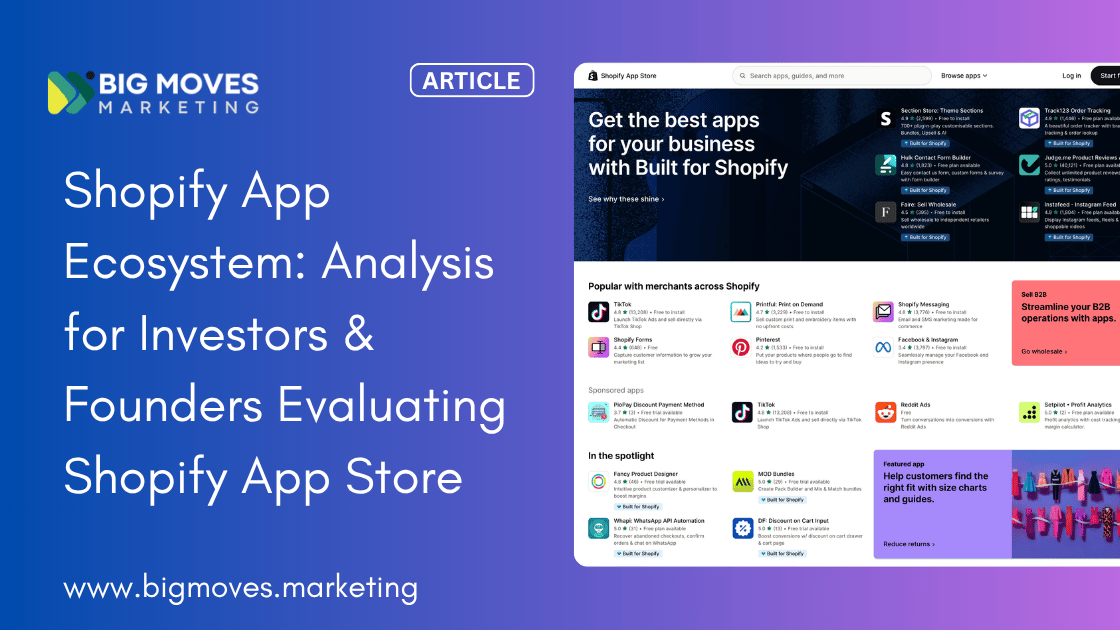
There are over 17,600 apps on the Shopify App Store as of mid-2026. A year ago, that number was closer to 11,600. That 52% surge in twelve months is not a sign of a maturing market — it is a sign of a market in active competition for position before the rules change.
For venture investors conducting ecosystem analysis, this is the environment they're entering. For Shopify app founders building companies in it, this is the landscape in which they will either consolidate their position or get displaced. Either way, the same question sits at the centre of the analysis: what actually makes a Shopify app company defensible, scalable, and worth backing?
The honest answer is that most apps are not any of those things. The same data that shows 17,600 apps also shows that 79.5% of Shopify developers have published only one app, and that approximately 87% of Shopify merchants use apps while installing an average of just six. The arithmetic is unforgiving: a market with 17,600 supply-side offerings serving a demand base where each customer adopts six products is not a market of 17,600 viable businesses. It is a market of six dominant slots — repeated across categories — and thousands of contenders that will never fill one.
That asymmetry is precisely what makes the Shopify app ecosystem worth studying closely. The platform's underlying financials are exceptional — Shopify processed $378.4 billion in GMV in 2025, up 29.5% year-over-year, and generated $11.56 billion in revenue, with $1.3 billion paid out to its partner ecosystem that same year. This is not a shrinking pie. The question is who captures the value as the ecosystem matures — and how to tell the difference between a company that will and one that will not.
This article offers a framework for that assessment. It covers the structural characteristics of the ecosystem, the signals that distinguish durable app businesses from commoditised ones, the implications of the AI infrastructure shift now underway, and the metrics that matter when evaluating specific companies. The lens is primarily that of an investor conducting ecosystem diligence — but the framework applies equally to a Shopify app founder assessing their own position or that of a competitor.
The Shopify app ecosystem has a power-law structure — which is to say it behaves like most software markets, only more visibly so because all the data is publicly observable on a single platform. A small number of apps command a disproportionate share of installs, merchant trust, and category authority. Everyone else competes for the remainder.
The install data makes this clear. Judge.me, the leading reviews app, is installed on 19.9% of all active Shopify stores. Klaviyo, the dominant email and SMS marketing platform, is installed on 14.1%. In a separate market study covering 508,680 stores, Klaviyo was detected on 20.55% of all stores and 34.56% of app-using stores — making it the most penetrated third-party vendor in the ecosystem by a significant margin. Email marketing is the largest category by adoption, present in 35.65% of stores, followed by reviews at 26.85%.
These numbers describe category monopolies, not competitive markets. In page builders, wishlists, notifications, and subscriptions, a single vendor dominates their segment far more than analytics or support leaders do. The pattern is consistent: once a category establishes a clear leader, network effects, review accumulation, and ecosystem integrations compound in that leader's favour and make displacement exceptionally difficult.
Understanding this dynamic requires understanding how Shopify's algorithm allocates visibility. The platform rewards keyword relevance, install velocity, active store retention, review volume and recency, and listing conversion rate. What this means in practice is that ranking improvement is itself a retention signal — apps with stronger merchant retention rank higher, get more installs from organic search, and build a larger review base. The feedback loop favours incumbents. A new entrant competing in a category dominated by an app with 30,000+ reviews, 15% ecosystem penetration, and years of retention data faces a compounding disadvantage that keyword optimisation and good copy alone cannot overcome.
This is not to say new entrants cannot succeed — they can, and regularly do. But the ones that succeed do so by finding a category where the incumbent is weak, a merchant segment that is underserved, or an emerging use case that the market leader has not yet addressed. The most defensible new entrants enter a category before it becomes crowded, establish a review base and retention record early, and use that compounding advantage to make displacement increasingly expensive for any subsequent challenger.
The category mix of the ecosystem is also worth understanding for investors mapping opportunity. Product reviews, SEO, and popups represent the most-reviewed categories by volume. The average app costs merchants $58–67 per month, though this varies significantly by category and value delivered. High-value categories — subscription management, loyalty, fraud prevention, analytics — tend to command higher ARPU and attract stickier merchant cohorts than utility categories where switching costs are lower.
One structural fact that shapes the investment thesis in this market deserves emphasis: Shopify paid out over $1.3 billion to its partner ecosystem in 2025. That number represents real revenue flowing to app developers, theme creators, and service partners — not a projection. For investors accustomed to marketplaces where platform economics squeeze out developer economics, Shopify's model is notable for how deliberately it has maintained developer revenue as a feature of its ecosystem design.
The revenue share model also matters for company evaluation. Shopify now takes 0% on a developer's first $1 million in lifetime gross app revenue (from January 2025), and 15% above that threshold. This is meaningfully developer-friendly at the early stage, and it creates a known margin inflection point for any app company approaching or past the $1 million threshold — a relevant data point when modelling unit economics.
The central question in any Shopify app company evaluation is not whether the product works. It is whether the company has built something that compounds — something that becomes harder to displace over time, not easier.
There are four sources of durable defensibility in this market, and the most valuable companies tend to combine more than one.
Data moats. The apps that have proved most resilient in the Shopify ecosystem are those that generate proprietary data their customers cannot easily replicate or take elsewhere. Klaviyo builds behavioural profiles of end-customers. Gorgias accumulates support interaction history and context across a merchant's entire customer base. Review apps create bodies of social proof that represent years of merchant-merchant trust. These apps are not merely integrations — they are records. Leaving them means starting over, and that switching cost is the most durable moat available in this category of software.
Apps that merely display or reformat existing Shopify data — without creating new insights, records, or proprietary value — are structurally more vulnerable. They provide convenience, not irreplaceability.
Category-specific depth. The Shopify ecosystem has consistently rewarded specialisation over generalism. Apps built specifically for the e-commerce context — with deep awareness of merchant workflows, seasonal behaviour, and Shopify's own data structures — consistently outperform general-purpose SaaS tools attempting to capture the same customer. Gorgias's advantage over Zendesk in the Shopify merchant segment is not primarily a feature advantage; it is a context advantage. Its support agents see order history, shipping status, and customer profiles inside the ticket interface — because it was built for exactly that use case. Intercom's Shopify integration receives 1.5-star reviews by comparison, despite being a better-funded, more widely distributed product.
The same principle applies across categories. Apps that understand the specific shape of merchant pain — not generic customer pain, not enterprise pain, but Shopify merchant pain — tend to have lower churn, higher review scores, and stronger word-of-mouth within the ecosystem.
Review and retention compounding. In the Shopify App Store, reviews are simultaneously a conversion lever, a ranking signal, and a trust infrastructure. Apps with strong review bases convert listing visitors to installs at higher rates, rank higher in organic search results, and create social proof that makes new merchants more confident about adopting a tool they've never used.
The compounding dynamic is important to understand. An app with 500 reviews acquiring 50 new installs per week will build its review base faster, in absolute terms, than an app with 50 reviews acquiring 50 new installs per week — because its higher listing conversion rate generates more installs from the same number of organic impressions. It is not just that incumbents are ahead; they are pulling further ahead with each passing month.
This is why the speed at which a new app reaches its first 100 reviews matters disproportionately to its long-term trajectory. The apps that build early review velocity through founder-led merchant outreach, beta programmes, and onboarding-integrated review prompts do not simply reach their first milestone faster — they enter the compounding phase of the algorithm faster.
Ecosystem integration breadth. Shopify app companies that integrate deeply with adjacent, high-penetration apps create mutual referral surfaces, shared data value, and switching costs that compound across the stack. Klaviyo's integration with Gorgias — where each company's data surfaces inside the other's interface — is an example of a strategic integration that serves both retention and competitive defensibility simultaneously. Merchants using both tools have deeper roots in each; leaving one means losing part of the value created by the other.
Integration breadth also functions as a distribution advantage. Agencies managing multiple Shopify stores — the decision-makers or strong influencers on which apps their clients adopt — are more likely to recommend apps they already know integrate cleanly with the rest of the stack they manage. This is a structural advantage that compounds over time, not a one-time distribution event.
The most consequential change in the Shopify app ecosystem in 2025–2026 is not a new category, a new funding environment, or a new competitor. It is a structural shift in how merchants discover apps and how apps access merchant context — and it has significant implications for which companies are positioned to win.
On the discovery side, Shopify's Winter 2026 "RenAIssance" edition introduced Agentic Storefronts, a system that syndicates merchant product data into AI platforms including ChatGPT, Microsoft Copilot, and Google's Gemini. This is primarily a merchant-to-shopper commerce feature, but it signals the direction of Shopify's platform strategy clearly: the discovery layer is moving from search-based to agent-based, and Shopify is positioning itself as the backend infrastructure for that transition.
The more directly relevant development for app companies is Sidekick App Extensions — a developer preview released alongside the Winter 2026 edition that allows third-party apps to expose data and functionality directly to Shopify's Sidekick AI assistant. This means merchants will increasingly interact with app data through natural conversation inside the Shopify admin, rather than navigating to individual app dashboards. For app companies, this is both an opportunity and a threat. Apps that integrate well with Sidekick become more accessible and more embedded in the merchant's daily workflow. Apps that do not participate risk becoming invisible in the layer where merchants increasingly make operational decisions.
The discovery shift extends beyond the Shopify platform itself. Orders originating from AI searches increased 15X between January 2025 and January 2026, according to data from Shopify's own merchant base. Merchants are now turning to tools like ChatGPT and Perplexity to answer questions like "what is the best Shopify app for inventory management" before they open the App Store. These AI platforms pull answers from publicly indexed content — blog posts, FAQ pages, comparison articles, and review sites. An app company with no presence in that content layer is invisible to an increasingly large segment of the merchant discovery funnel.
This convergence of ASO and content marketing is not a trend — it is an irreversible structural shift. The apps and companies that are establishing authoritative content about their categories now are building a compounding asset that improves both AI citation frequency and the trust signals that convert merchants arriving from any channel.
For investors conducting diligence on specific companies, the AI infrastructure shift creates a new evaluation dimension: does this company have a strategy for the AI discovery layer? Is it investing in content, API accessibility, and Sidekick integration? Or is it relying entirely on the organic App Store algorithm for visibility — a channel that is increasingly complementary to, rather than sufficient against, AI-mediated discovery?
The companies that will benefit most from this shift share a common characteristic: they have deep enough product expertise and category authority that AI platforms cite them by name in response to merchant queries. That authority is not purchased. It is built through sustained, specific, honest content about how their category of problem works — not promotional copy, but genuinely expert material that AI platforms treat as credible.
There is no shortage of metrics available when evaluating a Shopify app business. The challenge is not access to data — it is knowing which metrics are leading indicators of durable value and which are lagging indicators of past performance that may not persist.
The following framework reflects the metrics that consistently differentiate strong Shopify app businesses from mediocre ones — organised by the evaluation dimension they address.
Active stores, not installs. This is the single most important distinction in evaluating a Shopify app company at a glance. The Shopify App Store displays active store counts on every listing — this is the live, retained user base. Total installs tell you how many merchants have ever installed the app, including those who churned last week. The Shopify algorithm itself weights active store retention over raw install volume, meaning a high install count with low active stores is worse than the numbers imply — it signals both a product problem and a ranking headwind.
For investment diligence, the ratio of active stores to historical installs is a crude but directional proxy for retention quality. A company with 50,000 total installs and 40,000 active stores tells a very different story than one with 50,000 installs and 8,000 active stores.
Churn rate and its cohort profile. Monthly churn rate for a Shopify app is the percentage of active stores that uninstall in a given month. A rate below 5% is generally considered healthy at the early stage; below 3% is strong for an established app. But the raw number matters less than the cohort shape. When does churn occur — in the first two weeks (an activation and onboarding problem), at a pricing event like the end of a free trial (a value communication or friction problem), or after three to six months (a product depth or competitive displacement problem)? Each scenario has a different root cause and a different fix. Investors evaluating a company without cohort-level churn data are working with incomplete information.
There is also a useful distinction between involuntary churn — merchants closing their stores entirely — and voluntary churn — merchants actively choosing to uninstall. Annual Shopify merchant churn is approximately 28%, with only 10% of new stores remaining active after 90 days. Some portion of any app's churn is therefore attributable to the underlying merchant base churning from Shopify itself, not to failures of the app. Disentangling these two components is critical to understanding whether a churn problem is addressable.
Review trajectory, not review count. The absolute number of reviews tells you about accumulated trust. The trajectory of new reviews tells you about current merchant satisfaction and onboarding quality. An app with 2,000 reviews adding 100 per month is in a different position than an app with 2,000 reviews adding 5 per month — even though both show the same total on their listing. Declining review velocity, particularly in the context of flat or growing install rates, is an early indicator of merchant dissatisfaction that often precedes visible churn.
ARPU and pricing architecture. The average Shopify app costs merchants $58–67 per month, but this average obscures enormous variance. Apps in subscription management, analytics, and fraud prevention command $200–500 per month from high-volume merchants. Apps in utility categories — notifications, basic popups, simple image tools — may average $10–15 per month. ARPU tells you both the value the app delivers and the ceiling on the business's economics. An app generating $10 ARPU can still build a large business, but it requires far more active stores to reach the same ARR as an app at $100 ARPU, which has significant implications for CAC payback and growth capital requirements.
The pricing structure also matters for competitive assessment. Apps with usage-based or revenue-tiered pricing models tend to expand revenue as their merchant base grows — creating a net revenue retention dynamic that compounds over time. Apps on flat monthly fees capture no upside from merchant growth and are more vulnerable to competitive displacement when a similar-featured competitor offers lower entry pricing.
Built for Shopify status. This is a trust and ranking signal that merits specific attention in any evaluation. The Built for Shopify badge is awarded to apps that meet Shopify's technical, design, and performance standards — embedded app architecture, Polaris design compliance, high review scores, low support ticket rates. Apps with the badge receive preferential placement in certain App Store category highlights and editorial recommendations, positions inaccessible to non-badged apps regardless of keyword optimisation. In competitive categories, this represents a structural ranking advantage that translates directly to lower customer acquisition costs and higher install conversion rates. An app company without Built for Shopify status competing in a high-competition category with multiple badged incumbents is structurally disadvantaged — a risk factor that should be explicit in any investment analysis.
LTV:CAC ratio and payback period. Shopify app businesses have a well-defined set of benchmarks for unit economics. A healthy LTV:CAC ratio is 3:1 or above, with a CAC payback period under 12 months considered suitable for sustainable growth. The burn multiple — how much is spent to generate each dollar of new ARR — has become a critical investor metric. These numbers are directionally useful but need to be interpreted against category context: a subscription management app targeting Shopify Plus merchants with $300 ARPU can justify a longer payback period than a $12/month notification app targeting all merchants.
One of the structural features of the Shopify app market that receives insufficient attention is the degree to which the gap between leading and lagging companies is not static — it is actively widening.
The mechanism is straightforward. The Shopify algorithm weights active store retention as a ranking signal. Higher-ranked apps receive more organic impressions. More impressions generate more installs. More installs generate more reviews, which improve listing conversion rates, which generate still more installs. The leader's review base and retention track record make their listing inherently more trustworthy to cold traffic than a newer competitor with equivalent features. The compounding cycle does not pause.
The same dynamic plays out in the AI discovery layer. Apps cited by name in response to merchant queries on ChatGPT or Perplexity receive more inbound traffic, more installs, and more merchant experience data — which generates more reviews, more content mentions, and higher AI citation frequency. Authority compounds.
This has a specific implication for investors: timing matters significantly in this market. A company that established category leadership three or four years ago is not merely ahead — it is in a structurally different position than a company that launched last year. The gap is not closed by funding, by features, or by marketing. It is closed, if at all, by finding the incumbent's genuine weakness and building specifically for the merchant segment they are failing.
The 2024 decline in total app count — when the number of App Store listings dropped 8.15% as Shopify removed apps that no longer met quality standards — is a signal in this direction. Shopify is not passively hosting a long tail of indistinct apps; it is actively curating the ecosystem toward quality. The quality bar will continue to rise, and the companies positioned for long-term survival are those building to that bar, not beneath it.
The exit opportunity in this market is real, but it concentrates among the leaders. Klaviyo IPO'd at a valuation touching $9.5 billion after reaching more than $1 billion in ARR — built primarily on Shopify's merchant base, with approximately 77.5% of its ARR at the time of its S-1 coming from Shopify customers. Gorgias reached a $530 million Series C valuation in May 2024 at approximately $60 million ARR, serving over 15,000 online merchants. These are not outliers in a market full of similar outcomes — they are the outcomes that define what ecosystem leadership looks like when it compounds over seven to ten years.
For investors, category selection is a first-order decision. The ecosystem analysis described above suggests that certain categories are already structurally closed to new entrants building general solutions — email marketing, reviews, and basic loyalty are the clearest examples. The investment opportunity in these categories lies not in backing a new market entrant but in identifying a category-specific gap: a merchant segment (e.g., Shopify Plus enterprise accounts), a geography (e.g., APAC or LATAM, where Shopify's international revenue grew 36% in 2025), or an emerging use case (AI-native features, subscription commerce, cross-border operations) that the incumbent has not yet addressed with depth.
The most interesting investment opportunities in 2026 are in categories that are growing faster than the incumbents are building — AI-powered analytics, post-purchase intelligence, agentic customer service, and apps that integrate directly with Shopify's Sidekick infrastructure. These are not guaranteed outcomes, but they represent the areas where compounding advantage has not yet locked in.
Platform dependency is a risk that deserves honest analysis. Every Shopify app company is, to a meaningful degree, a leveraged bet on Shopify's platform health. The revenue correlation between Klaviyo and Shopify — a 0.7 stock correlation coefficient driven by 78% revenue dependency on Shopify's merchant base — quantifies the exposure at the most prominent end of the market. Companies with more diversified merchant bases (supporting WooCommerce, BigCommerce, or headless commerce alongside Shopify) carry structurally lower platform risk. The trade-off is that depth of Shopify specialisation is typically what creates the competitive moat — so diversification and defensibility are in genuine tension.
The revenue share model change is a margin event that warrants attention. Shopify's 2025 revision to its partner revenue share model — moving from an annual $1 million exemption to a lifetime $1 million exemption — changes the economics for mature apps above that threshold. Apps earning $50,000 per month will hit the $1 million lifetime threshold approximately 20 months after January 2025, at which point the 15% revenue share applies to all subsequent earnings. This is a known cost structure that should be built into any financial model — and it is a more significant drag at lower ARPU than at higher ARPU, which reinforces the investment case for apps targeting higher-value merchant segments.
For Shopify app founders, the ecosystem analysis has three practical implications. First, the time to establish category authority is not after achieving scale — it is now. The algorithm, the review compounding, and the AI discovery layer all reward early movers with a structural advantage that is expensive to close later. Apps in growing categories that have not yet attracted a dominant player should be investing aggressively in review velocity, content production, and integration breadth today, not when growth slows. Second, product marketing and positioning are underweighted functions in most Shopify app companies relative to engineering. Merchant discovery is increasingly happening in AI-mediated environments where clear, specific, expert positioning determines whether your app is cited or ignored. Third, churn is a product problem before it is a marketing problem. Every point of improvement in active store retention compounds through the algorithm, the review base, and the unit economics simultaneously.
The Shopify app ecosystem in 2026 is not a difficult market to understand at the surface level. The platform's financial performance is exceptional. The developer economics are genuinely favourable at the early stage. The merchant base is large, growing, and increasingly dependent on apps for core operational functions.
What is harder to see — and what this analysis has tried to surface — is the structural logic underneath the surface-level numbers. This is a market that rewards concentration: a small number of apps, companies, and categories command the majority of the value. It is a market where the compounding mechanisms of the algorithm, review accumulation, and AI discovery are accelerating the gap between leaders and laggards. And it is a market undergoing a platform shift — toward AI-mediated discovery and Sidekick-embedded functionality — that will reorder the competitive map within the next two to three years in ways that are not yet fully priced in.
For investors, that means category selection, timing, and a rigorous assessment of moat quality are the primary variables. For founders, it means the question is not whether your product is good but whether your position in the ecosystem is compounding.
The apps and companies that survive and lead in this environment will be those that understood early that the Shopify App Store is not a distribution channel — it is an operating environment with its own physics. Winning requires understanding those physics, not just building a good product.





%20-%20white.svg)