

Shopify App Store Optimisation (ASO) is the process of improving your app's visibility, ranking, and conversion rate within the Shopify App Store.
While SEO focuses on ranking pages on search engines like Google, ASO focuses specifically on ranking your app listing within Shopify's own search algorithm.
The core mechanics overlap — keyword research, copy optimisation, and conversion signals all matter in both — but ASO has unique factors that SEO doesn't: install velocity, active store retention, review volume and recency, and in-platform behavioral signals like listing click-through rate and trial activation rate.
You also have far less real estate to work with. Your app title, subtitle, and description carry most of the keyword weight, so every word needs to earn its place.
Effective ASO combines technical optimisation with positioning and conversion strategy in a way that standard SEO work rarely requires.
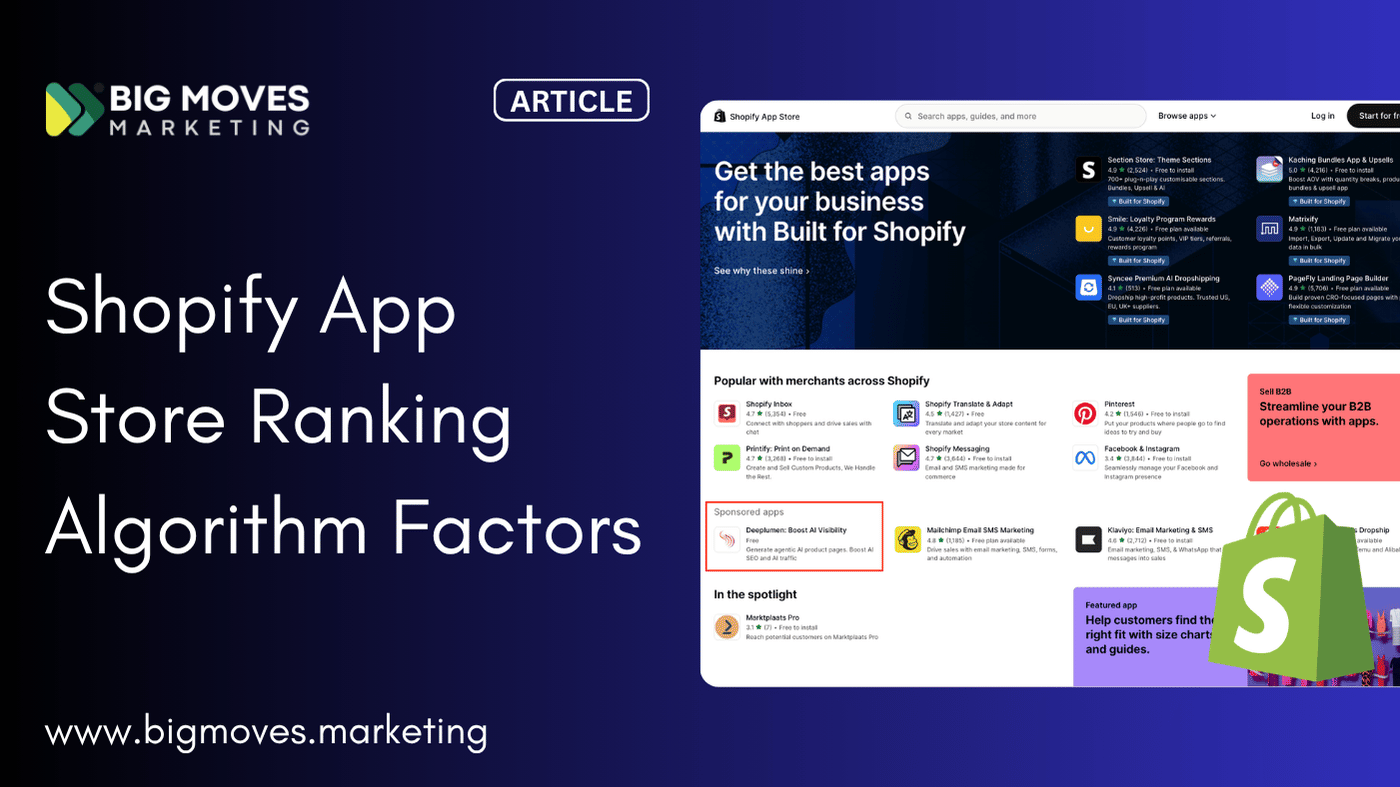
Shopify's App Store algorithm determines which apps appear at the top of search results and category listings based on a combination of signals.
While Shopify does not publish the exact formula, the factors that consistently influence ranking are: keyword relevance in your app title and description, install volume and velocity, active store retention rate, review volume and recency, average star rating, and conversion rate from listing page to install.
Critically, the algorithm rewards quality installs over quantity. An app that acquires merchants who stay active and engaged will outperform one with high raw install numbers but poor retention.
This means your App Store ranking is deeply connected to your onboarding experience and product quality — not just your listing copy.
Understanding this relationship is fundamental to building a sustainable growth strategy on the Shopify App Store.
Shopify uses a combination of relevance and quality signals to rank apps in search results.
The primary factors are: keyword match between the search query and your app title, subtitle, and description; install volume; active store count; review count and average rating; review recency; and listing conversion rate — how often someone who views your listing actually installs your app.
Secondary factors include install velocity (how quickly you're gaining new installs), uninstall and churn rate, and behavioral signals from how merchants interact with your listing.
Paid Shopify Search Ads can accelerate install velocity and indirectly support organic ranking by generating early traction and keyword data.
Apps with the "Built for Shopify" badge also receive preferential treatment in certain category placements, making technical compliance with Shopify's standards a growth lever in its own right.
Getting more Shopify app reviews requires a systematic, policy-compliant approach built into your onboarding flow.
Shopify prohibits incentivising reviews with discounts or credits, and disallows review-gating — showing the review prompt only to satisfied users.
Within those rules, there is still significant room to drive review volume.
The most effective approach is timing. Triggering a review request at the moment a merchant has just experienced a clear win — their first successful use of your app's core feature — dramatically increases response rate.
In-app prompts after key activation milestones outperform email follow-ups. Personalised outreach from a founder or customer success team member for early or high-value merchants also converts well.
Responding professionally to every existing review, positive or negative, signals to prospective merchants that your team is active and trustworthy, which indirectly improves conversion and encourages more reviewers to engage.
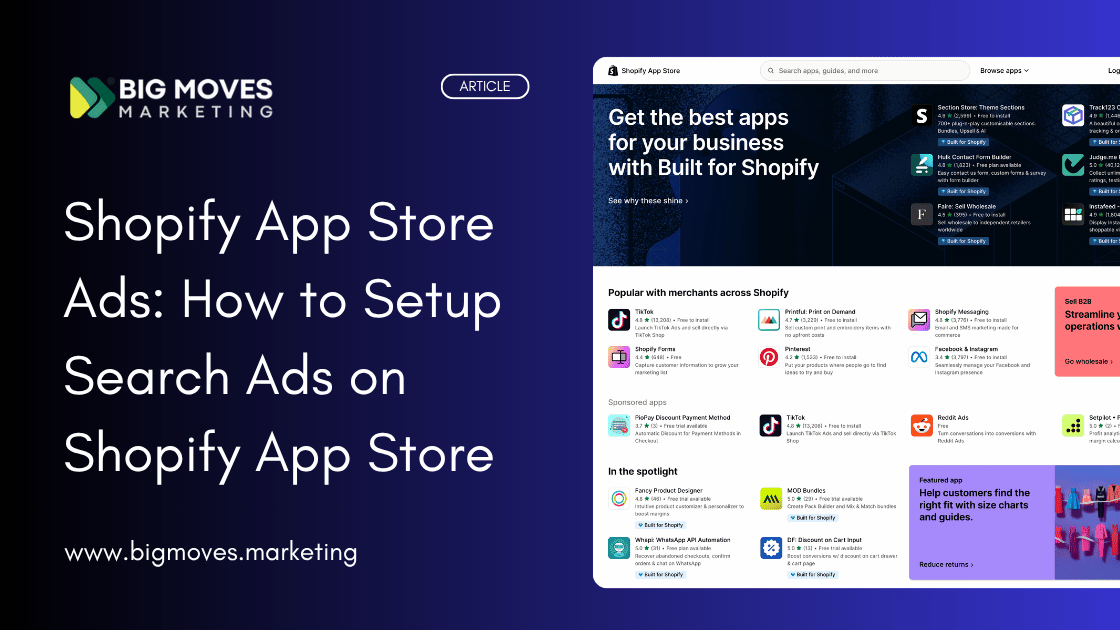
Shopify Search Ads are a paid advertising channel available exclusively within the Shopify App Store. They allow app developers to bid on keywords so that their app appears at the top of search results when Shopify merchants search for those terms.
Shopify Search Ads function similarly to Google Search Ads - you set a budget, choose keywords, and pay on a cost-per-click or cost-per-install basis.
For app discovery, Shopify Search Ads are particularly valuable because the merchants clicking them are already inside the Shopify ecosystem, actively searching for a solution, and one click away from installing your app. This makes the intent quality exceptionally high compared to most paid channels.
Beyond direct installs, Search Ads are a powerful keyword research tool — the performance data from paid campaigns reveals which search terms convert best, informing your organic ASO keyword strategy simultaneously.
For most early-stage Shopify apps, Search Ads are worth running — but the goal should be learning, not scale.
In the early stage, your listing conversion rate, onboarding, and pricing are likely still being refined.
Running a modest Search Ads budget across a targeted set of keywords generates real install data, reveals which merchant segments convert and retain best, and accelerates the install velocity that supports organic ranking improvement.
The risk of running Search Ads too early is spending budget on installs that churn quickly, which sends negative retention signals to the algorithm.
The right approach is to get your listing copy, key benefit messaging, and onboarding experience to a reasonable baseline first, then use Search Ads to test and validate.
Even a small budget of $500–800 per month in the early stage can produce meaningful keyword and conversion data that would take months to gather organically.
Whether to offer a free plan depends on your app's value proposition, category competitiveness, and growth stage.
In highly competitive categories, a free plan significantly lowers the barrier to installation and can drive the early install volume and review accumulation needed to gain organic ranking momentum.
For early-stage apps, this is often the right trade-off even at the cost of near-term revenue.
The risk of a free plan is attracting low-intent installs — merchants who install without genuine need, never activate, and quickly uninstall. This hurts your retention signals and can negatively affect your App Store ranking.
A better alternative for many apps is a time-limited free trial on a paid plan, which attracts higher-intent merchants while still reducing friction.
The optimal pricing structure ultimately depends on your merchant persona, activation rate, and the competitive dynamics of your specific app category.
Install conversion rate on the Shopify App Store refers to the percentage of merchants who view your app listing and go on to install it.
While benchmarks vary significantly by category and how competitive the surrounding results are, a healthy install conversion rate is generally considered to be in the range of 10–20% for established apps with strong social proof.
New apps with fewer reviews typically see rates below 10% until review volume and listing quality improve.
The factors with the greatest impact on conversion rate are: the clarity and relevance of your app title and subtitle, the quality of your first screenshot or preview image, your review count and average rating, and how clearly your listing communicates the primary benefit to the merchant within the first few seconds.
Even a 3–5 percentage point improvement in conversion rate can meaningfully reduce your effective cost per install from paid channels and improve your organic ranking signals simultaneously.
Installs refer to the total number of times merchants have installed your app, including those who have since uninstalled it.
Active stores refers to the number of merchants currently using your app — the live, retained user base. Shopify displays the active store count on your app listing, not your total install count.
Active stores matter far more than installs for several reasons. The Shopify App Store algorithm favours apps with strong retention, meaning a high active store count relative to install history signals quality and relevance.
Merchants evaluating your app also see the active store count directly on your listing — it functions as social proof. A high install count with low active stores can actually signal to both the algorithm and prospective merchants that your app has a churn problem.
Growing active stores sustainably, through better onboarding, clearer value delivery, and reduced churn, is the core metric to optimise for long-term App Store growth.
While the Shopify App Store is the primary acquisition channel for most apps, several external channels can meaningfully drive installs and support overall growth.
Content marketing — particularly SEO-optimised blog content targeting the pain points your app solves — attracts merchants searching on Google before they reach the App Store.
This is especially effective for apps solving problems with established search demand.
Partnerships and integrations with complementary Shopify apps or agencies create referral traffic from merchants already embedded in the ecosystem.
Email marketing to your existing customer base drives upsells and reactivations. LinkedIn and community channels like relevant Slack groups, Reddit communities, and Shopify partner forums work well for apps targeting specific merchant verticals.
For apps with a strong ROI story, Google Ads targeting Shopify-specific search queries can drive direct App Store installs cost-effectively.
The best external channel depends on your merchant persona, app category, and budget — but content and partnerships consistently deliver the strongest long-term return.
Your app title and subtitle are the most valuable keyword real estate on your entire Shopify App Store listing.
Shopify's algorithm weights these fields far more heavily than the description body, which means every word you place here directly influences which search queries your app appears for.
The app title has a 30-character limit and should lead with your primary keyword — the core search term that best describes what your app does.
A title like "Restock Alerts: Back in Stock" will consistently outperform "BrandName App" for organic search visibility in that category.
The subtitle gives you a further 80 characters to cover secondary keywords and reinforce your primary benefit. This is where you address the merchant's outcome, not just the feature: "Notify customers automatically, recover lost sales, grow your email list" covers three keyword clusters while communicating clear value.
Avoid keyword stuffing. Shopify's algorithm can identify unnatural keyword strings, and more importantly, merchants can too - a listing title that reads like a keyword list destroys the trust your app needs to convert. The goal is a natural sentence that happens to contain your highest-priority search terms in the highest-weight positions.
You should revisit your title and subtitle every time you run Shopify Search Ads, because paid campaign data will reveal which exact search terms are generating installs.
That data is the most reliable signal for organic keyword prioritisation you can get - far more actionable than any third-party keyword research tool.
Built for Shopify badge is a quality designation awarded by Shopify to apps that meet a specific set of technical, design, and performance standards.
It signals to merchants that your app is deeply integrated with Shopify's infrastructure, follows Polaris design principles, and has been reviewed for reliability and merchant experience quality.
To qualify for Built for Shopify status, your app must meet requirements including: using Shopify's embedded app architecture, passing a performance review, maintaining a high review score, and demonstrating low support ticket rates.
Meeting these standards is non-trivial, but the commercial upside is significant.
Apps with the Built for Shopify badge receive preferential placement in several areas of the Shopify App Store — including category highlights and certain editorial recommendations — meaning they appear in positions that non-badged apps cannot access regardless of keyword optimisation.
This is a structural ranking advantage, not just a conversion signal.
On the conversion side, the badge functions as trust infrastructure.
Merchants — particularly those at larger stores who are more risk-averse about apps affecting their checkout or storefront — specifically filter for Built for Shopify apps when evaluating solutions. In competitive categories, the badge can meaningfully shift conversion rate on its own.
If you are investing in long-term App Store growth, pursuing Built for Shopify status should be on your roadmap.
The compliance requirements also tend to improve your core product quality and onboarding experience, which benefits retention and review volume simultaneously — compounding the ranking benefit over time.
Getting to 100 active stores is the first meaningful proof-of-concept milestone for a new Shopify app — and the path to it is very different from how you grow from 100 to 1,000. In the early stage, you are not optimising for efficiency; you are optimising for signal quality and review accumulation.
Before running any paid acquisition, your listing needs to be in a state where it can convert. That means a clear, keyword-optimised title and subtitle, a first screenshot that communicates your core value proposition within two seconds, at least a basic pricing structure, and an onboarding flow that gets a merchant to their first win quickly.
Installing to a confusing experience is worse than not installing at all — early churns hurt your retention signals before you have the review volume to offset them.
For the first installs, warm outreach consistently outperforms paid channels. If you have any existing audience — a waitlist, a community, beta testers, agency partners, or even personal networks in the Shopify ecosystem — activate them first.
A handful of highly engaged early merchants who review your app and stick around are worth far more algorithmically than dozens of cold installs that churn in two weeks.
Once you have 5–10 genuine reviews and a stable listing conversion rate above 10%, a modest Shopify Search Ads budget of $500–700 per month can accelerate you to the 100-store milestone significantly faster. The reviews provide social proof that converts cold traffic, and the ads generate install velocity that supports early organic ranking improvement.
The 100-store milestone matters beyond the vanity metric. It gives you enough cohort data to understand your retention curve, identify activation drop-off points, and validate your pricing — all of which you need to make confident growth decisions for the next phase.
Churn rate for a Shopify app is typically measured as the percentage of active stores that uninstall within a given month.
While benchmarks vary significantly by category and price point, a monthly churn rate below 5% is generally considered healthy for an early-stage app, and sub-3% is strong for an established app with a defined merchant base.
High-ticket apps solving mission-critical problems — like fraud prevention or subscription management — should target even lower churn than apps in more discretionary categories.
It is worth distinguishing between involuntary churn (merchants closing their Shopify store or churning from Shopify itself) and voluntary churn (merchants actively choosing to uninstall your app). Shopify's overall merchant churn is relatively high at the micro-merchant level, so some of your churn will always be outside your control. What you can influence is the voluntary component — and that is almost always a product or onboarding problem before it is a marketing problem.
The most common driver of avoidable churn in Shopify apps is a failure to reach the activation moment — the specific in-app milestone where a merchant experiences your app's core value for the first time.
If your onboarding flow requires too many steps, too much configuration, or doesn't surface a visible win quickly enough, merchants disengage before they become dependent on your app.
Mapping and shortening the time to that first value moment is the single highest-leverage churn reduction activity for most apps.
Secondary churn drivers include pricing friction (a merchant hitting a plan limit unexpectedly and choosing to uninstall rather than upgrade), poor support responsiveness, and competitive displacement when a better alternative enters the category.
Each of these has a different fix, which is why cohort analysis — tracking when in the merchant lifecycle churn occurs — is essential before committing to a specific intervention.
A lower churn rate also compounds through the Shopify App Store algorithm.
Active store retention is a ranking signal, meaning apps that hold merchants longer gradually build an organic ranking advantage over higher-churn competitors, even if those competitors have more raw installs.
Retention is simultaneously your most important growth lever and your most important product metric.
Screenshots are the first thing most merchants process when they land on your app listing — and they form a judgment about your app within seconds, often before reading a single word of your description.
In competitive categories, visuals can be the deciding factor between an install and a back-click, making them one of the highest-ROI optimisation surfaces on your entire listing.
The first screenshot carries disproportionate weight because it is visible in search results as a thumbnail, not just on your listing page. It needs to communicate your core value proposition at a glance — a clear headline benefit, a representative UI element, and enough visual polish to signal product quality.
An app that looks well-designed in its screenshots creates an implicit assumption that the product itself is well-built. This directly affects conversion rate and review propensity.
A common mistake is treating screenshots as UI documentation — showing feature screens without contextualising what problem they solve.
Merchants do not care what your dashboard looks like in abstract; they care what outcome it produces. Screenshots that frame the UI around a specific merchant pain point ("Never miss a restock request again", "Recover abandoned carts automatically") consistently outperform screenshots that just show product UI.
The number of screenshots you provide also matters. Shopify allows up to three images plus a video in most listing formats. Using all available slots with a logical narrative flow — problem, solution, key features, social proof — increases the time a merchant spends on your listing, which is itself a positive conversion signal.
An app with one or two screenshots signals an unmaintained listing, which undermines trust regardless of how strong the product is.
If you are running Shopify Search Ads, your screenshots are directly influencing your cost per install.
A listing with higher visual quality converts at a better rate from the same paid traffic, meaning better screenshots reduce your effective CPI without changing your bid or budget.
Treating screenshot optimisation as a one-time task is a mistake — it should be revisited every time you launch a significant product update or enter a new competitive phase.
Cost per install (CPI) on Shopify Search Ads is the amount you spend on paid advertising to generate a single app install.
Benchmarks vary considerably by app category, keyword competitiveness, and listing conversion rate, but a CPI in the range of $3–8 is typical for moderately competitive categories, while high-competition categories like email marketing, reviews, or loyalty apps can see CPIs of $15–30 or higher as established players defend high-volume keywords aggressively.
Raw CPI is often the wrong metric to optimise against.
An install that costs $12 from a high-intent keyword like "automatic restock notifications" and converts to a paying merchant with $30 monthly ARPU and 18-month average lifetime has a completely different economic profile from a $4 install from a broad keyword that churns within two weeks.
The ratio of CPI to LTV is the number that actually matters, and it is what should determine your bidding strategy.
In the early stage, CPI from Search Ads is typically higher than it will be at scale, for two reasons. First, your listing conversion rate is lower — fewer reviews and less established social proof means more paid clicks are needed to generate each install.
Second, you are likely testing a broader set of keywords before knowing which ones drive your best merchants.
Both of these factors bring your effective CPI down as your listing matures.
The most practical benchmark is to compare your CPI against your current trial-to-paid conversion rate and ARPU.
If your average paying merchant generates $25/month, stays for 12 months, and your trial-to-paid conversion is 30%, your allowable CPI to break even at 12 months is roughly $90 — meaning a $10 CPI is excellent economics.
Apps that calculate this ceiling tend to scale their Search Ads spend far more confidently than those optimising against an arbitrary CPI target.
A declining active store count is one of the most urgent problems a Shopify app can face, because the decline compounds over time: fewer active stores suppress your App Store ranking, which reduces organic installs, which makes it harder to offset ongoing churn — a cycle that is difficult to reverse the longer it runs unchecked.
The first step is diagnosing the source of the decline. Is it accelerating churn from your existing merchant base, a drop in new installs (or both)? These require different interventions. If new installs have dried up, the problem is usually ranking and visibility — your listing has slipped, a competitor has taken your keyword positions, or your conversion rate has declined due to increased competition or an outdated listing.
If installs are stable but active stores are falling, the problem is product or onboarding.
For churn-driven decline, the most immediate lever is identifying the dropout point in your merchant lifecycle.
Cohort analysis will typically reveal whether merchants are churning in the first two weeks (an onboarding and activation problem), at a pricing event like the end of a free trial (a value communication or pricing friction problem), or after 3–6 months (a product depth or competitive displacement problem). Each scenario has a different solution, and treating them as interchangeable wastes time and budget.
For install-driven decline, an aggressive listing refresh — new keyword strategy, rewritten title and subtitle, updated screenshots — combined with a burst of Shopify Search Ads spend is usually the fastest way to reintroduce install velocity and recover algorithmic ground.
The goal is to demonstrate enough install momentum to the algorithm that organic rankings stabilise before the decline becomes structural.
In both scenarios, proactive merchant outreach is underutilised. Reaching out personally to recently churned merchants — even a small sample — provides qualitative data that no analytics dashboard can.
Understanding the real reason a merchant left, in their own words, consistently surfaces product or positioning issues that quantitative cohort data can only hint at.
Integrations and partnerships are one of the most underused growth levers in the Shopify app ecosystem, largely because their impact is indirect and slower to materialise than paid acquisition.
Over a 12–24 month horizon, however, a well-built integration network can become a more sustainable install source than any paid channel.
Native integrations with complementary Shopify apps create mutual referral surfaces. When your app works seamlessly with a high-traffic app in an adjacent category — for example, a restock alert app that integrates with the leading email marketing app — both listings can reference the integration, and the partner's merchant base becomes aware of your app organically.
These merchants convert at higher rates than cold traffic because they already trust the partner they use, and the integration gives them a concrete reason to install your app.
Shopify agency partnerships operate differently but at high leverage. Agencies managing multiple Shopify stores are often the decision-makers (or strong influencers) for which apps their clients install.
A handful of agency partners actively recommending your app to their client portfolios can generate a consistent, low-CAC install stream that requires no ongoing ad spend. The best way to build these relationships is to make your app easy for agencies to recommend — clear documentation, a responsive support team, and partner-friendly pricing or commission structures where appropriate.
Theme partnerships are a more technical but highly effective channel for apps that enhance the storefront.
Getting your app featured or recommended in a popular Shopify theme's documentation or onboarding flow exposes you to every merchant who installs that theme — a passive, recurring install source that compounds with the theme's popularity.
All of these partnership types share a common characteristic: they generate installs with stronger retention signals than paid acquisition, because the merchants arriving through a trusted referral path have higher intent and better product-market fit.
Over time, this improves your active store count, your review velocity, and your algorithmic standing simultaneously.
Yes — organic-only growth on the Shopify App Store is possible, and some well-optimised apps in low-to-medium competition categories have built meaningful active store counts without paid acquisition.
However, organic growth is slower to initiate, harder to control, and significantly more dependent on strong listing fundamentals and category timing.
The primary organic growth mechanism is Shopify's algorithm rewarding apps that demonstrate strong keyword relevance and merchant retention.
If your app title, subtitle, and description are tightly aligned to high-intent search terms, and if merchants who install your app tend to stay active, your ranking will gradually improve — driving more impressions, more listing views, and more installs in a compounding cycle.
This loop works, but it takes time to build momentum, particularly in categories where established apps have years of review and retention data advantage.
Content marketing and SEO on your own website can meaningfully accelerate organic growth by capturing merchants before they reach the App Store. Merchants frequently search Google for solutions to their problems — "how to send restock notifications to customers" — before searching within Shopify.
A well-ranking blog post or landing page that captures that intent and funnels to your App Store listing creates an organic install channel that operates entirely outside the App Store algorithm.
The real constraint of organic-only growth is keyword validation. Without Search Ads data, understanding which specific search terms drive your best merchants — not just any installs, but retained, converting merchants — requires significantly more time and iteration.
Search Ads compress that learning cycle from months to weeks by generating real conversion data across a broad keyword set simultaneously.
A practical approach for founders with limited budgets is to build strong listing fundamentals first, then run a focused, time-limited Search Ads campaign purely for keyword intelligence.
Even two or three months of paid data can inform an organic keyword strategy that outperforms years of organic-only guesswork.
AI-powered discovery is reshaping how a growing segment of Shopify merchants find and evaluate apps — and for app developers, this shift has real implications for how listings, content, and positioning need to be built.
Increasingly, merchants are turning to tools like ChatGPT, Perplexity, and Google's AI Overviews to answer questions like "what is the best Shopify app for restock alerts" or "how do I add a loyalty programme to my Shopify store" before they ever open the Shopify App Store.
These AI platforms pull answers from publicly indexed content — blog posts, FAQ pages, comparison articles, and review sites — and recommend specific apps by name.
An app with no presence in that content layer is invisible to this segment of the discovery funnel entirely.
Shopify itself is also integrating AI into the App Store experience. Shopify's own AI assistant, Sidekick, increasingly surfaces app recommendations to merchants contextually — within the admin, during setup flows, and in response to merchant queries.
Apps that are well-documented, have strong review signals, and maintain active listings are better positioned to be surfaced by these in-platform AI recommendations than apps with sparse or outdated listings.
For app developers, the practical implication is that ASO and content marketing are converging. Optimising your App Store listing for Shopify's search algorithm is no longer sufficient on its own.
Building content assets — detailed FAQ pages, use-case articles, comparison content — that answer the questions merchants ask AI platforms is increasingly part of a complete growth strategy.
The apps that will win the AI discovery layer over the next two to three years are those that establish authoritative, well-structured content about their category now.
AI platforms prioritise sources that are specific, factual, and demonstrably expert.
A Shopify app developer who publishes detailed, honest content about how their category of app works — not just promotional copy — is building a compounding asset that improves both LLM citation frequency and the trust signals that convert merchants who arrive from any channel.
Comments