%20png%20copy.avif)

Most developers come to Shopify App Store ads with a Google Ads reflex, and that reflex is what burns the budget. In Google Ads, the number you enter is a ceiling — you say "up to $5" and the auction often delivers the click for less. On the Shopify App Store, the number you enter is the price. It runs a first-price auction, so the bid you set for a keyword is exactly what you pay every time someone clicks. Set $30, pay $30. No discount for relevance, no second-price mercy.
That single mechanical difference reshapes every decision that follows — how you bid, which match type you start with, how fast you can drain a budget, and whether the spend works for you or against you.
And there's a second thing the "is it worth it?" debate usually misses. Since early 2023, installs you can't retain don't just fail to help your ranking. They quietly hurt it. Paid traffic feeds the same behavioral-signal engine that governs organic rank, which means a campaign pointed at the wrong audience doesn't waste money neutrally — it teaches the algorithm that merchants install your app and leave. The question is not really "should I run App Store ads?" It is: can you retain what you pay to acquire? If you can, ads compound. If you can't, they accelerate a problem you already have.
This is a spending playbook built around that reframe.
The Reddit and forum threads that surface under "Shopify App Store ads worth it" tend to split into two camps: developers who saw early installs and reviews kickstart and developers who watched a daily budget evaporate against irrelevant clicks. Both are describing the same system. The difference is rarely the ads. It's what happened after the click.
Here's the context that makes this concrete. Only about 1 in 10 new Shopify stores remain active 90 days after launch, and across the app ecosystem roughly 2.8% of all installs churn every month as merchants reshuffle their stacks. That does not mean your app is doomed — those are platform-wide figures, not your retention curve. But it does mean the default state of an installed app is at risk, and a merchant you bought through an ad is no more loyal than one who found you organically. Often less, if the keyword that brought them in promised something your app doesn't quite do.
So the worthwhile version of the question has three parts. Does your listing convert a click into an install? Does your onboarding convert an install into an active, retained merchant? And only then: can you buy those clicks at a price your customer lifetime value supports? If the answer to the first two is shaky, advertising is the most expensive possible way to discover that.
Start with the money, because the money behaves differently here.
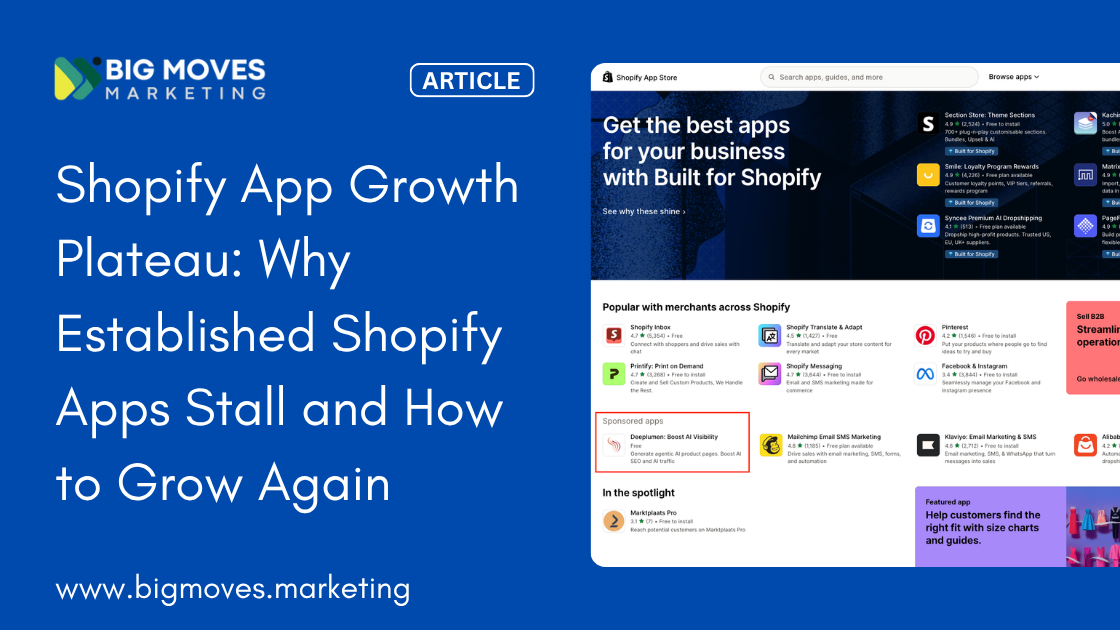
All App Store ads use a cost-per-click model settled by a first-price auction — you pay your own bid amount, billed only when someone clicks. There are three placements: search results, category and subcategory pages, and the homepage. Search is where intent lives, so it's where most developers should concentrate, but the auction logic is the same across all three.
What does the click actually cost? Shopify doesn't publish a rate card, and the often-repeated "$20 to $75 per click" figure floating around AI summaries isn't traceable to a Shopify source. The most credible practitioner data point comes from an agency that ran these campaigns and reported Shopify recommending $7–$35 per click for typical terms and $25–$60 for highly relevant ones. Treat those as observed recommendations, not guarantees — your category, competition, and timing move them. But the order of magnitude is the point. A relevant click in a competitive app category can cost more than ten times a typical ecommerce Google Ads click, which averages a little over a dollar to around five depending on the source.
Now layer the first-price model back on top. Because your bid is the cost, the Google-trained instinct to set a high ceiling and "let the auction sort it out" is exactly wrong. A $40 ceiling on Google might cost you $6 in practice. A $40 bid on the App Store costs you $40, every click, until you change it. This is the single most expensive misunderstanding in the channel.
The redeeming detail: Shopify does fold app relevance into the auction, so a highly relevant app with a lower bid can win placement over a less relevant app bidding more. Relevance doesn't lower the price you set — it improves the odds your set price wins. That rewards listing quality before it rewards budget, which is the through-line of everything below.
Run the math before you run the ads. If a relevant click costs $20, your listing converts clicks to installs at 25%, and a third of installs become paying merchants, you're spending roughly $240 in clicks per paying customer. Whether that's a triumph or a disaster depends entirely on your plan price and retention — a $19/month app that churns in two months can't survive that CAC; a $99/month app that retains for a year can fund it comfortably. Knowing which one you are is prerequisite, not afterthought.
The conventional PPC playbook says start broad, gather data, then narrow. On the Shopify App Store, for most apps — and especially for apps with few or no reviews — that order is inverted in practice.
The reason is the fixed-price model again. Broad match maps to intent and theme rather than exact terminology, so it casts a wide net and shows you where intent actually lives. That's valuable as research. It is dangerous as a standing strategy, because every loosely-related search you match is a fixed-price click you've committed to. Broad match should be a short, low-bid, deliberately time-boxed probe — ten or so keywords at $1–$5, the goal being learning, not installs — not the engine you leave running.
Then you switch. Shopify gives you full search-term data, not just keyword-level data, so you can see exactly which queries drove impressions, clicks, and installs. Once a term proves it converts, move it to exact match and bid aggressively on that specific term. Concentrate budget on the handful of queries you know work rather than spreading it thin across everything that's merely adjacent.
Negative keywords are how you stop the bleed, and Shopify's matching has a trap worth knowing. If you target "shipping" on broad match but add "shipping rates" as a broad negative, the term "shipping" sits inside your negative and can suppress your ad entirely. The fix is to use exact-match negatives for the specific phrases you want to exclude, or negate a narrower token like "rate." Get this wrong and you either pay for junk or accidentally mute yourself.
One reassurance on the budget-burn fear: bot traffic is a real concern in any auction, but Shopify retroactively identifies bot clicks and credits the charges back to advertisers. It's not a reason to skip daily search-term review — you still want to catch irrelevant human clicks — but the worst-case "I paid for a bot farm" scenario has a backstop the AI summaries rarely mention.
An ad buys attention. It cannot buy the install. Between the click and the install sits your listing, and if that page doesn't convert, paid traffic just means you're paying to send qualified merchants to a page that loses them.
This is where relevance pays twice. A tight, specific listing — clear subtitle, accurate category, benefits a merchant grasps in the first scroll — raises your ad's relevance in the auction and converts the click once it lands. The same work that lowers your effective cost to win placement is the work that turns the placement into a customer. There is no version of App Store advertising that compensates for a listing that doesn't earn the install. Spend should follow listing readiness, not precede it.
Practically: before you put a dollar into ads, make sure the keyword you're bidding on and the promise at the top of your listing are the same promise. A merchant who searches "abandoned cart" and lands on a page that leads with "all-in-one marketing suite" feels the mismatch and bounces — and you paid a fixed price for that bounce. Match the message to the query. Then make the install decision easy.
Here is the part that turns App Store advertising from a cost center into a compounding asset — or into a slow self-inflicted wound, depending on retention.
In 2023, Shopify changed how search ranking works. The shift started on February 27, 2023, when Shopify began folding in data about how merchants interact with results after they search, explicitly reducing the impact of keyword stuffing. It was then extended on April 26, 2023, when the algorithm folded in even more post-search behavioral data. (Both dates are real and often conflated — the behavioral shift began in February and was reinforced in April.) The practical effect is that ranking is now driven by what merchants do: clicks, installs, and crucially, whether they keep the app. Apps with high install rates and low uninstall rates signal value and rank higher; apps that get clicks but shed users quickly get read as a mismatch.
This is what links paid and organic. A merchant you acquire through an ad, who installs and stays, produces exactly the behavioral signal the ranking algorithm rewards. Enough of those, and your organic position climbs — which brings free installs that produce more of the same signal. That's the flywheel: paid spend priming an organic engine. It is also why review velocity and rating quality belong inside your growth infrastructure, not bolted on later — apps in the top rating brackets command the majority of organic discovery, and those signals reinforce the same loop.
But run the flywheel backward and you see the trap. If your ads point at a broad, mismatched audience, you buy installs from merchants who churn fast. Now you've fed the algorithm the negative signal — install-then-leave — at a fixed price per click. A real example from the Shopify developer forums makes this tangible: one partner app with a 4.8 rating logged 87 installs against 72 uninstalls in a single 30-day window, 14 of them same-day, and was struggling to understand why its ranking lagged. A high rating doesn't rescue you from a churn signal that strong. Installs without retention are a treadmill, not a flywheel — you spend to stay in place, and the spend makes the underlying problem look like growth right up until it doesn't.
This is the honest answer to "is it worth it?" Ads are worth it when your retention is good enough that buying installs strengthens the organic engine. When retention is weak, ads don't fix it — they fund a faster version of the same decline.
If you're going to run App Store ads, run them in this order.
Shopify App Store advertising is neither the growth hack its proponents sell nor the money pit its skeptics warn about. It's a multiplier — and a multiplier amplifies whatever you point it at. Point it at a tight listing, a price your unit economics support, and an app merchants actually keep, and the fixed-price clicks compound into organic rank through the behavioral-signal engine Shopify has run since 2023. Point it at a broad audience and a leaky funnel, and you'll pay a premium per click to teach the algorithm that merchants leave you.
The bid is the price. The listing converts the click. And retention is what decides whether your spend builds a flywheel or a treadmill. Get those three right, in that order, and the question stops being whether App Store ads are worth it — and becomes how much rank you can afford to buy.



%20-%20white.svg)