%20png%20copy.avif)
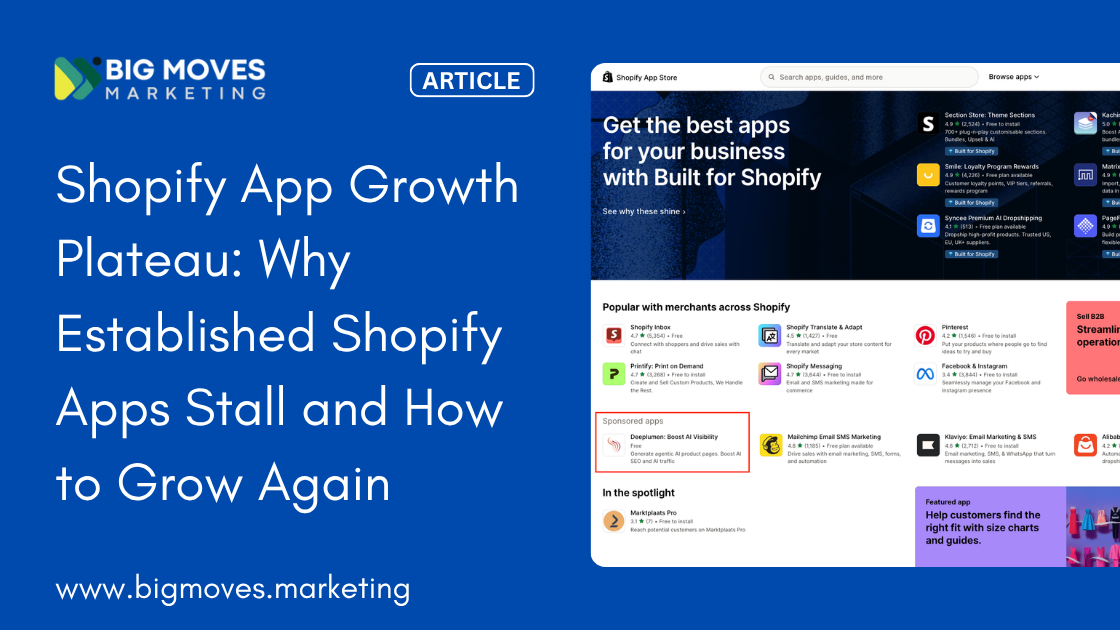
One established Shopify app earned seven figures in net revenue in eight months. Nearly all of it traced back to one channel: the Shopify App Store. Then the channel cooled.
Installs across two comparable periods, two years apart, fell by roughly 90%. Monthly MRR growth swung from about +5% to about −3%. The active merchant count began to shrink.
The diagnosis pointed to distribution. Merchants had spread their app discovery across AI assistants, peer communities and the agencies running their stores. Competitors had spent years earning a place in those conversations. This app had stayed in one place.
The pattern repeats across the ecosystem. Apps that won the App Store in its earlier years built their growth engine for a merchant who searched, browsed and installed. That merchant still exists. That merchant now also asks ChatGPT, asks Sidekick inside the admin, asks a Slack group and asks the agency.
Marketing has one durable job. Be present where your audience makes decisions.
Audiences move. Social habits, business pressure and new technology shift where buyers look and whom they trust. A channel mix built for your market three years ago fits the market of three years ago.
This article breaks the plateau into four forces, shows how they compound, and lays out six shifts that restart growth.
For years, the App Store search bar was the front door. A merchant hit a problem, typed the job ("product bundles", "order tracking"), scanned the results and installed.
That path still works. It now competes with three others.
AI assistants. Business software buyers moved their research into chat, fast. G2 surveyed 1,076 B2B software buyers in March 2026. 51% now start their research in an AI chatbot rather than a search engine. 69% chose a different vendor than they first planned because of chatbot guidance. One in three bought from a vendor they had never heard of before.
Forrester's buyer research points the same way. 94% of business buyers now use AI in their buying process. In Forrester's 2025 survey, generative AI tools were the single most-cited meaningful interaction type for researching purchases.
A caveat belongs here. Neither survey isolates Shopify merchants. Both lean toward larger B2B buying groups. A merchant installing a $29 app moves faster and often alone. The direction still matters: the people who buy business software now open a chat window first.
Sidekick, inside the admin. Shopify brought the same behaviour into its own product. Since September 2025, merchants can find, compare and install apps inside a Sidekick conversation, with app cards built from App Store listing content. Shopify also announced that guided search and comparisons in the App Store would retire.
Merchants are adopting it. On Shopify's Q2 2026 earnings call, the company reported daily active merchants using Sidekick up 3.6x year on year.
This changes the unit of competition. A merchant who asks Sidekick for an app sees a handful of cards. A merchant who searches the store sees a page of results. Some developers on Shopify's community forum report falling App Store impressions and say Sidekick keeps recommending the same two or three category leaders. That is anecdote, not measurement. It is worth testing in your own category.
Peers, experts and agencies. AI answers start the decision. People finish it. Forrester found that buyers use generative AI as a starting point, then turn to peers, experts and providers to confirm what the tools produced. The typical B2B buying decision now involves nine external influencers.
For Shopify apps, many of those influencers are agencies. Shopify's own partner blog has noted that merchants often act on the recommendation of freelance developers, agencies or in-house teams, and that this grows truer as merchants get larger. The merchants worth the most revenue are the ones most likely to arrive with a recommendation in hand.
Communities and AI assistants work as one system.
Peec AI's analysis of 30 million sources ranked Reddit as the most-cited domain across ChatGPT, Google AI Mode, Gemini, Perplexity and AI Overviews. YouTube, LinkedIn, Wikipedia and Forbes rounded out the top five. Review platforms such as G2 appeared often in recommendation queries.
Handle citation studies with care. They disagree on rankings. Evertune's analysis of 200 million prompts found that even the most-cited domain rarely exceeds 5% of total citations, which leaves most of each answer to a long tail of sources.
The practical read holds anyway. The conversations merchants have in public become the raw material for the answers other merchants get in private.
6sense studied nearly 4,000 B2B buyers in 2025. The winning vendor sat on the day-one shortlist 95% of the time, and the pre-contact favourite won four deals in five.
App installs are faster and cheaper than enterprise deals. The shortlist logic still transfers. A merchant opens the App Store already holding two names from ChatGPT, a Reddit thread and their agency. The store's job shifts. It confirms a choice. Apps missing from those earlier conversations compete for the merchants who arrive with an empty shortlist. That pool gets smaller every quarter.
Shopify's own shopper data adds useful nuance. AI-driven traffic and orders to Shopify stores tripled year on year in Q2 2026, and Shopify described AI as a complement to search. Traditional search sessions still grew 1.3x over two years and hold roughly a third of storefront traffic.
App discovery likely follows the same shape. The App Store keeps its role. It shares the decision with new places.
What this means for you: your addressable demand now lives in four places. The App Store. AI assistants, including Sidekick. Communities and review sites. The agencies and partners around your merchants. A growth plan built for one of them reaches a shrinking share of the decision.
Counts vary by method. StackDex put the catalogue at 16,846 apps in February 2026. AppstorePulse counted 21,509 live public apps, with 2,713 launched in May 2026 alone. A July 2026 sitemap analysis found 22,571 apps from 14,410 developers.
The direction is consistent. The shelf keeps growing.
AI shows up most clearly in how new apps sell themselves. In AppstorePulse's May data, 23.8% of new launches mentioned AI in their name, tagline or description, against 14.7% of the installed base. That measures marketing language, not engineering.
No public data shows how many apps were built with AI coding tools. The logic is still strong. When building an app gets cheaper, more apps get built, and more of them look alike. The July sitemap analysis found 86 groups of identically named apps from different developers.
Here is a less-discussed shift. Merchants now build their own tools.
On the same Q2 2026 call, Shopify said merchants used Sidekick to create more than 36,000 custom apps in the quarter, up from 12,000 in Q1.
Most of those are likely simple internal utilities. No data yet shows how many replace a paid public app. Still, for apps that solve a narrow, well-defined job, the competitive set now includes a prompt inside the admin.
On February 27, 2023, Shopify began folding more data about merchant behaviour after a search into App Store rankings. Apps merchants find most relevant rank higher. Keyword stuffing lost much of its effect.
Be precise about what Shopify documented. It confirmed post-search behaviour as a signal. Practitioners widely observe that retention and uninstalls also influence rank, though Shopify has not published those details.
The safe operating assumption follows. An install that churns in a week does your ranking no favours. Volume bought with loose targeting can cost you twice: once in spend, again in signal.
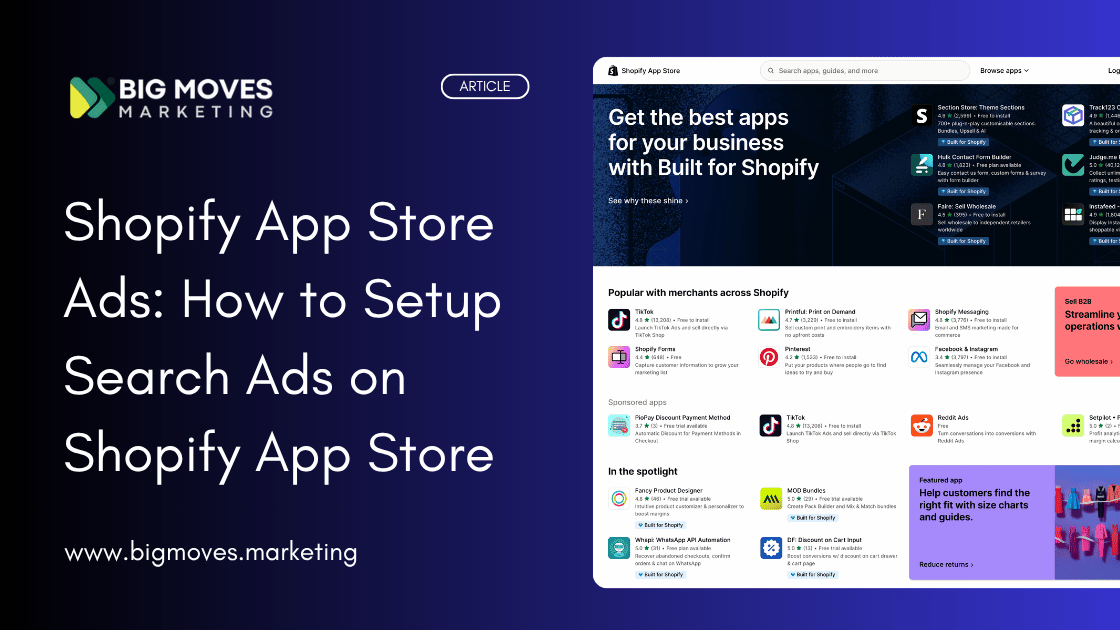
Ads follow the same logic. Shopify prices relevance into its ad auction. Less relevant ads pay more to compete, and very irrelevant ads never display, whatever the bid. In February 2026, Shopify added a relevance column to App Store ads reporting. Fit now sets the price of reach.
Built for Shopify now works as a visibility tier. In May 2026, about 1,497 apps carried the badge, roughly 7% of the catalogue, and only one of the ten most-reviewed apps lacked it. Shopify's Winter '26 Edition went further: Built for Shopify apps are featured more prominently on the App Store homepage and in recommendation sections.
Reviews tightened twice.
From December 11, 2024, merchants on any trial plan, paid trials included, lost eligibility to leave App Store reviews.
In July 2026, Shopify introduced a dedicated requirement against incentivised reviews and expanded its authenticity signals to existing reviews as well as new ones. Shopify expects a meaningful number of reviews to be unpublished.
Each change serves merchants well. Together they reshape the game for developers. The store rewards apps that earn genuine demand, genuine usage and genuine reviews. It pays less every year for tactics that imitate those things.
What this means for you: the App Store now amplifies strength you build elsewhere. Merchants who arrive knowing your name install at higher rates, stay longer and review more honestly. Those behaviours lift rank. The store has become a multiplier on outside demand.
Keyword research. Listing optimisation. Search Ads. Review prompts.
Every one of these captures a merchant who is already looking. That work is valuable. It also aims at a small slice of your market.
John Dawes of the Ehrenberg-Bass Institute, writing for the LinkedIn B2B Institute, estimated that businesses switch providers of services such as software roughly every five years. That puts about 20% in the market in a given year and about 5% in a given quarter. The other 95% are your future buyers.
Shopify apps turn over faster than banking or legal contracts. Your ratio will differ, so calculate it. If merchants in your category replace their tool every three years, about a third enter the market each year and about 8% each quarter.
The principle holds. Most merchants who will choose an app in your category next year are busy with other work today.
When they start looking, they reach for names they already know. Jenni Romaniuk's research in the same series found that a lack of brand awareness is a far bigger problem for B2B brands than negative perception. Merchants rarely reject an app they dislike. They skip the app that never came to mind.
Les Binet and Peter Field's work with the B2B Institute found that B2B brands should balance long-term brand building and short-term activation at roughly 50/50. Binet has also described the average B2B split as 46% brand and 54% activation.
Treat the ratio as direction. It comes from campaign effectiveness data, and a ten-person app team runs very different campaigns. For an app, brand building looks like this:
Brand used to be the slow bet that finance teams questioned. AI gave it a second job.
AI assistants assemble recommendations from what the web says about you. An app with a rich public footprint of reviews, mentions, comparisons and useful content gives those systems plenty to work with. An app known only through its listing gives them one page.
The effect compounds. G2 found that 85% of buyers think more highly of a vendor when an AI chatbot mentions it in a recommendation. Brand builds the footprint. The footprint earns the mention. The mention builds the brand.
What this means for you: under-investing in brand used to cost you future demand. Now it also costs you presence in the fastest-growing discovery layer.
Brian Balfour's product-channel fit framework explains why so many apps grew on the App Store alone. He argues distribution follows a power law: at any given moment, a company with product-channel fit gets 70% or more of its growth from one channel.
For a self-serve app at a modest price point, the App Store was an ideal channel. High intent. Low friction. Billing built in. Concentrating there was the right call.
Balfour adds the warning in the same essay. The fit that makes a company can also kill it.
Andrew Chen named the pattern the Law of Shitty Clickthroughs. The first banner ad, for HotWired, drew a click-through rate above 70%. Two decades later, average rates sat around 0.05%. Channels crowd. Audiences habituate. Efficiency falls.
Balfour extends the idea in Growth Is Never Done: every growth tactic moves through a lifecycle from peak effectiveness to fatigue.
The App Store is moving along that curve. More apps compete for the same searches. Ranking and review rules reward the leaders. Part of discovery moved into Sidekick and outside the store entirely. The channel still works. It returns less growth per unit of effort than it did a few years ago.
Balfour has also argued that concentrating on marketing channels beats diversifying across them. He is right, and the point matters. A small team spread across eight channels builds eight weak ones.
Timing resolves the tension. Concentrate at any given moment. Evolve the mix over time. Build the next channel while the current one still funds the experiment.
Plateaued apps usually made the first decision well. They delayed the second.
Watch for these before revenue shows the damage:
Each force slows growth on its own. Together they form a loop.
Discovery moves outside the App Store. Fewer merchants arrive with your app on their shortlist. Your install rate from search softens. Behavioural signals weaken, so rank slips and ads cost more. Fewer installs bring fewer reviews, and stricter review rules make those harder to replace. AI assistants and Sidekick find less evidence to recommend you. Shortlists tilt further toward the category leaders.
Competitors who invested in content, communities, partners and brand watch the same loop spin the other way. Their outside demand arrives pre-sold. It converts well, retains well and reviews well. The App Store amplifies them.
The plateaued app responds inside the store. It rewrites the listing again. It raises bids. It adds keywords. It waits for rank to recover.
Each move works harder on a shrinking share of the decision.
The growing app treats the App Store as the checkout. It builds demand where merchants now decide, then lets the store convert and defend that demand.
For established apps in competitive categories, this inverts the traditional hierarchy. External channels become the growth engine. The App Store becomes the conversion and defence layer.
Early-stage apps with few reviews still start in the store. The inversion applies once you have product-market fit, real social proof and a category leader's problem: a market that stopped arriving on its own.
Plateaus look alike from the revenue line. The symptoms underneath point to different forces, and each force calls for a different first move.
What you seeLikely forceFirst moveListing traffic steady, installs fallingShortlists forming outside the storeAttribution survey and AI prompt auditRank slipping on core termsCompetitors earning stronger behavioural signalsOnboarding and early-retention fixesCost per install risingCrowded auctions or weaker relevanceConcentrate spend on high-relevance keywordsReview velocity slowingFewer eligible reviewers, fewer new merchantsTime review requests after trial and after a success momentLarger merchants choosing competitorsAbsent from agency recommendationsPartner outreach to agencies that match your best merchantsMissing from ChatGPT or Sidekick answersThin public footprintJob-based content, comparisons and third-party mentions
Most plateaued apps show three or more of these at once. That is the loop at work. Start with the symptom closest to the merchant's decision, usually the first row, because it shapes every row below it.
Start with evidence.
A prompt audit works best with structure. Build a fixed set of 15 to 25 prompts across three types:
Score each answer on four points. Do you appear? Where in the answer? Is the description accurate? Which sources does the tool cite? Those cited sources become your target list for Shift 3 and Shift 4.
Expect variation. Assistants draw on different source pools, and answers shift between runs. Judge the trend across months.
The store still closes the install. Keep it sharp, and optimise for quality over volume.
Your website becomes a primary asset again.
The merchant's advisers now shape the shortlist.
Prioritise agencies with care. A long list of loose partnerships produces little. Rank agencies by how closely their clients resemble your best merchants: same verticals, similar store size, similar app stacks. Your highest-retention merchants are the template. Start with the ten agencies whose client lists look most like them.
Then give each agency a reason to recommend you that serves their business. Faster implementation. Fewer support tickets for their team. A feature that makes their client work look good. Agencies tend to recommend the tools that make them look good to their clients.
Brand needs its own budget line. Otherwise it gets the leftovers.
Diversification works in sequence. Scattered effort produces scattered results.
Six shifts can feel like a year of work. The first 90 days need only a clear order.
Days 1 to 30: Diagnose.Interview 15 to 20 recent installs and churned merchants. Put the attribution question live in onboarding. Run the baseline prompt audit across the major assistants and Sidekick. Map where merchants decide against where your effort goes. Close the month with one written diagnosis and one chosen next channel.
Days 31 to 60: Fix the base.Tighten the listing for Sidekick. Move review requests to post-trial success moments. Fix the biggest drop-off in onboarding. Narrow ad spend to keywords where your app is the clearest answer. Name an owner for the next channel and agree on its leading indicators.
Days 61 to 90: Open the next channel.Ship the first set of job-based pages and one honest comparison page, or hold the first ten agency conversations, depending on what the audit showed. Re-run the prompt audit. Read the attribution data for early movement.
Expect leading indicators to move first. Citations, partner conversations and attribution mentions show progress before installs do. Revenue comes last. Judge the channel on its leading indicators until then.
The fundamentals held steady. Be present where your audience makes decisions. Be memorable before they need you. Be easy to choose when they do.
The execution environment moved. Merchants now consult an assistant, a peer group and an agency, often before they open the App Store. The store itself rewards the apps that already win those conversations.
A plateau is a signal. It tells you your merchants moved faster than your channel mix.
The apps that grow again this year will do three things. They will learn where their merchants decide now. They will build presence there while shortlists are still forming. They will run the App Store as the place those decisions close.
Start with the audit. Ask your last twenty merchants where they first heard your name. Their answers point to your next channel.

%20-%20white.svg)