%20png%20copy.avif)
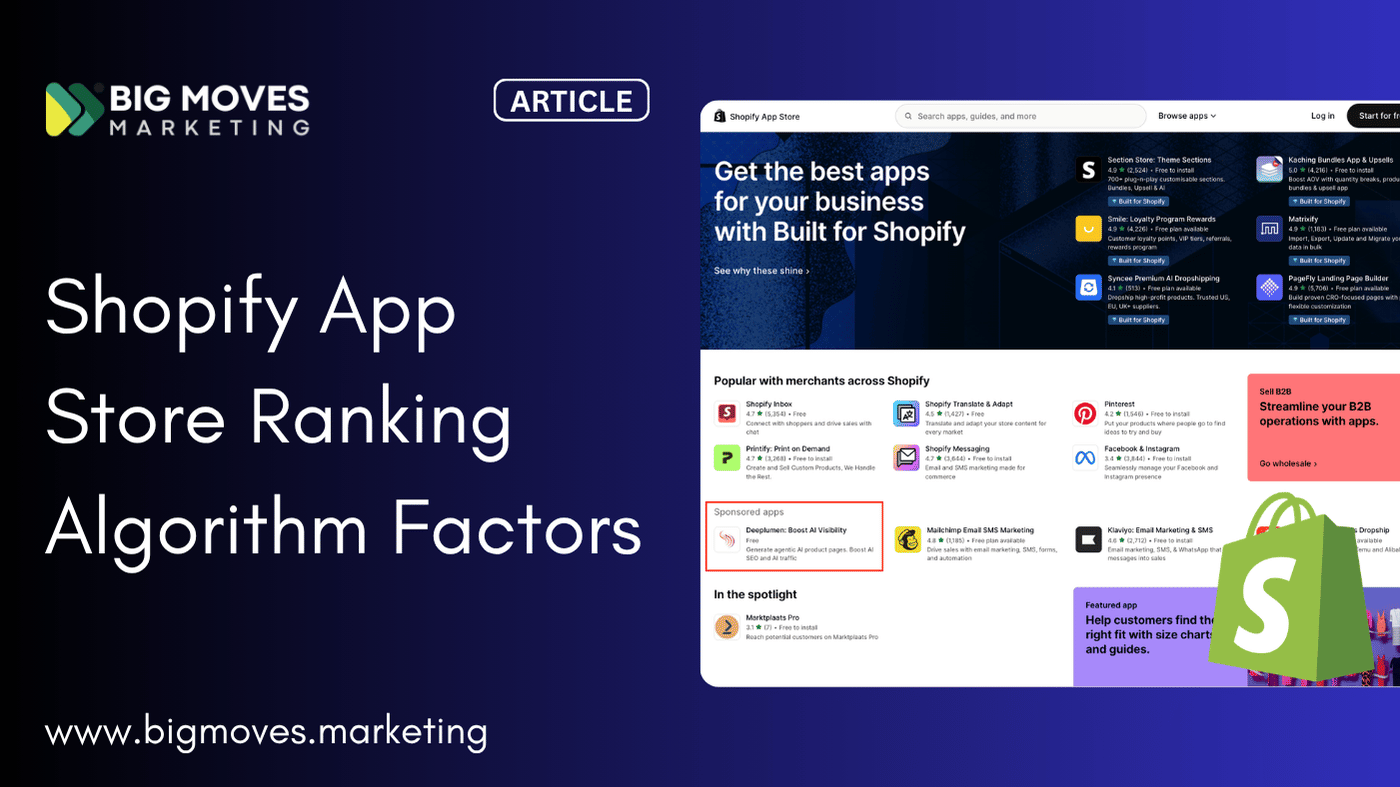
There are roughly 12,000 apps competing for merchant attention inside the Shopify App Store. Most of them are invisible.
The difference between an app that generates a steady stream of organic installs and one that sits dormant on page seven isn't usually product quality. It's ranking — and most app developers don't have a clear picture of what actually drives it. The Shopify App Store algorithm is not publicly documented in the way that, say, Google Search Console guidance is. Shopify has made deliberate choices about what it reveals and what it withholds. But a combination of official announcements, changelog disclosures, and observable signals has made the architecture of the ranking system legible enough to act on.
This article breaks down the Shopify App Store ranking algorithm as it currently operates: the structural signals that have always mattered, the behavioral shift that changed the rules in 2023, the role of reviews and review quality, and where Search Ads fit into an organic growth strategy. The goal isn't to help you game the system — it's to help you understand it well enough to build for it deliberately.
Before getting into what changed in 2023, it's worth establishing the baseline — the structural signals that have always contributed to App Store placement, and that continue to matter today.
The Shopify App Store algorithm operates in two sequential stages. First, it determines eligibility: can this app be considered relevant to a given search query? Second, it evaluates relative ranking: how does this app compare to all other eligible results?
Metadata — your app title, app listing description, and the keyword fields available in the Partner Dashboard — primarily governs the first stage. An app that doesn't include the right language in its listing simply won't surface for the corresponding searches. This is the eligibility gate, and it's entirely within a developer's control.
Keyword placement within the title carries the most weight. An app named "Loyalty Rewards Program" will rank more easily for the term "loyalty rewards" than an app named "TrustLoop" with those words buried in a paragraph of description text. The closer a keyword sits to the front of the app title, the stronger its signal — a pattern that holds across the App Store and mirrors the mechanics of most search algorithms.
The description field matters, but not as a direct keyword-stuffing surface. Shopify's own developer documentation recommends writing app listings that "clearly communicate what your app does, how it helps the merchant, and what makes it unique." That guidance reflects how the algorithm now weighs description text — less as a raw keyword match and more as a contextual signal that supports or undermines the relevance judgment made by behavioral data. A description that reads naturally and addresses genuine merchant pain points performs better than one loaded with comma-separated keyword strings.
Shopify provides five keyword fields in the Partner Dashboard specifically for ranking purposes. These are indexed by the algorithm and give developers an additional surface to target terms that may not fit naturally into their title or description. The order of keywords within these fields has a negligible effect — but the relevance of the terms chosen has a significant one. Selecting keywords that map to actual merchant search behaviour rather than aspirational terms you wish merchants were searching for is the first discipline of effective App Store optimization.
Built for Shopify is Shopify's certification program for apps that meet its highest standards for performance, design, merchant experience, and platform integration. It was introduced as Shopify's signal to merchants that a given app has been independently verified as trustworthy.
From a ranking perspective, Built for Shopify apps receive preferential placement in search results, functioning as what practitioners describe as a bonus multiplier in the algorithm. It doesn't override behavioral signals — an app with a Built for Shopify badge but poor retention and weak reviews will not sustain a high position — but all else being equal, the badge grants a structural advantage that compounds over time. For apps with the technical maturity to pursue the certification, it is one of the highest-return investments in App Store visibility available.
The algorithm treats recent updates as a proxy for active development and merchant commitment. Apps that ship regular improvements — bug fixes, feature additions, performance upgrades — tend to maintain or improve their rankings relative to dormant competitors. The mechanism isn't merely algorithmic; apps that update frequently are signalling quality to Shopify's systems, and those systems weight active development as a positive indicator.
On February 27, 2023, Shopify published a post to the Partner Blog titled Search Improvements on the Shopify App Store that most developers underestimated at the time. It was, in retrospect, the most consequential change to the App Store's ranking architecture since the platform launched.
Starting February 27, Shopify announced that its search algorithms would begin folding in more data about how merchants interact with results after they search. In Shopify's words: "apps that merchants find most relevant, given what they're searching for, will rank higher overall." A companion changelog update went live on April 26 of the same year, confirming the full deployment.
This shift moved the algorithm from a predominantly metadata-driven model to one where post-search merchant behaviour carries significant weight. It is not merely an incremental tweak. It is a structural reorientation of what it means to rank.
Behavioral signals, in the context of the App Store algorithm, are signals derived from what merchants do after they see your app in search results. They include — based on the documented guidance and observable patterns — click-through rate on search result listings, install rate from the listing page, active usage and retention post-install, and engagement quality over time.
Each of these signals asks a version of the same question: did the merchant who searched for this term find your app genuinely useful? An app that gets clicked often but installed rarely is signalling a conversion gap — the listing is attracting attention it can't convert. An app that gets installed frequently but uninstalled quickly is signalling a product-market fit gap — the listing is overpromising relative to the actual experience. Both patterns depress ranking over time.
Shopify's extensive testing showed that incorporating behavioral data markedly improves the relevancy of results for merchants. The business logic is straightforward: Shopify's App Store is a growth lever for merchants. When merchants find the right apps and use them successfully, Shopify's platform becomes more valuable. The algorithm, from Shopify's perspective, should optimise for merchant outcomes — not for developer visibility.
The February 2023 announcement included an explicit statement that keyword stuffing would "now have less of an impact." The update was designed to reduce the influence of keyword manipulation while increasing the influence of genuine relevance.
This was not a minor signal. It means that an app with a technically optimised listing but poor merchant engagement — one that ranked via keyword density rather than genuine relevance — will now be outranked by an app with a cleaner listing but stronger behavioral signals. The app that merchants actually find useful, stay with, and return to is the one the algorithm increasingly rewards.
The practical implication for developers is this: metadata work and listing optimisation remain necessary — you still need to clear the eligibility gate — but they are no longer sufficient. The ceiling for how high metadata alone can lift you has been fundamentally lowered.
One of the more significant and underreported aspects of the February 2023 announcement was this: the updated algorithm includes a built-in mechanism to help smaller trending apps surface higher in results, dynamically increasing the ranking of apps that are gaining traction, especially if they are high quality.
This is consequential for early-stage apps. The old model heavily rewarded incumbency — apps with a long history of installs held structural advantages that were difficult to overcome. The traction boost creates a path for newer, high-quality apps to rise faster if they generate genuine engagement. It also means that ranking is now explicitly dynamic. Shopify confirmed that search ranking would be more variable day-to-day than it was previously. Developers who monitor rankings closely should expect more movement — and understand that short-term fluctuations are a feature of the current system, not evidence of a penalty.
Reviews have always been visible on app listings, and most developers understand intuitively that more five-star reviews are better than fewer. What's less understood is the specific mechanics of how Shopify weighs reviews, the distinction between review volume and review quality, and how a second major 2023 update changed the way individual reviews are ranked within a listing.
On June 22, 2023, Shopify updated the system by which individual reviews are surfaced within an app's listing page. The update introduced a weighted ranking for reviews themselves, meaning the most prominent reviews a merchant sees are determined by four factors: helpfulness (measured by "helpful" votes from other merchants), meaningfulness (the depth and specificity of the review content), recency (more recent reviews carry more weight), and length of use (reviews from merchants with longer installation tenure receive higher weighting, as their perspective reflects accumulated experience rather than first-impression reactions).
The practical implication is that a high star rating alone is insufficient if the reviews supporting it are shallow, recent-only, or predominantly from short-tenure users. An app with 200 reviews averaging 4.8 stars, where the most prominent reviews are from experienced, long-term users writing substantively about specific workflows, presents a stronger social proof signal than an app with 400 reviews averaging 4.9 stars built on a wave of brief five-word entries.
Beyond the listing page, reviews and ratings form part of the broader signal set that the algorithm uses to assess app quality. The quality and velocity of reviews — including how quickly new reviews are accumulating — functions as a forward-looking indicator of engagement health. Slowing review velocity can precede ranking deterioration, because it often reflects a plateauing of active, engaged installs. Accelerating review velocity, conversely, is one signal the algorithm reads as evidence of an app gaining meaningful traction.
This creates a structural argument for treating review generation as an ongoing operational function rather than a one-time launch activity. Apps that build systematic in-product prompts for reviews — triggered at moments of genuine merchant success rather than as interruptions — tend to build stronger, more distributed review portfolios over time.
One point worth stating plainly: Shopify continuously monitors reviews to detect and remove non-compliant content, including spam and irrelevant submissions. The attempt to inflate review counts through incentivised or artificial reviews — a problem the platform has grappled with since at least 2020 — has never been a durable strategy, and the 2023 quality updates make it less viable than ever. The algorithm now weights review quality over raw volume. Authentic reviews from engaged merchants, particularly those who have used the app for an extended period, are worth significantly more than a larger number of low-quality entries.
Shopify Search Ads are frequently misunderstood as an alternative to organic ranking — a shortcut for apps that haven't yet earned organic placement. That framing misses how the ads system actually functions within the broader ranking ecosystem.
Shopify's own data shows that 60 percent of installs on the App Store come from searches. The distribution of those installs, however, is highly concentrated. The vast majority of clicks go to a small number of apps occupying the top positions in search results. An app ranked sixth or seventh for a competitive category term receives a fraction of the traffic that the first and second results receive — not because the merchants scrolling past it find it inferior, but because attention follows position.
For newer apps, this creates a genuine discovery problem. Organic ranking is partly a function of accumulated behavioral signals — and you can't generate behavioral signals without installs, and you can't get installs without visibility. Search Ads were introduced specifically to break this loop.
The more strategically significant insight is that Search Ads, used correctly, don't just generate paid installs — they generate the behavioral signals that feed organic ranking improvement. One of the first developers to participate in the Shopify Search Ads beta, Tomas Kacevicius of Firepush, noted publicly that his ads doubled app installs and produced a better organic ranking on the App Store as a direct result.
This is the flywheel that makes Search Ads different from most paid channels. On a social platform, paid advertising generates visits that, when they don't convert, simply disappear. On the Shopify App Store, paid installs that result in genuine merchant engagement generate reviews, active usage data, and retention signals — all of which feed the organic algorithm. Shopify acknowledged in the February 2023 update that improving ad relevance could lead to changes in the performance of some campaigns, a confirmation that the paid and organic systems are not fully isolated from each other.
The practical implication: Search Ads are most powerful when treated as a signal generation strategy rather than a pure traffic strategy. The goal isn't to stay permanently dependent on paid visibility. It's to use paid visibility to generate the behavioral data — quality installs, engaged usage, earned reviews — that eventually supports organic ranking without continued ad spend.
There is also a less-discussed benefit to running Search Ads from a keyword intelligence perspective. The keywords that produce quality installs through ads are often the same keywords worth targeting in organic listing optimisation. Paid keyword data functions as validated signal about what merchants are actually searching when they're intending to install — not what they search when browsing passively. That intelligence has direct value for listing metadata decisions, particularly in identifying high-converting terms that may not be obvious from search volume data alone.
Understanding each ranking signal in isolation is less useful than understanding how they interact. The apps that hold the strongest positions in competitive categories aren't winning on any single dimension — they're winning because multiple signals reinforce each other simultaneously.
The losing posture in the current algorithm is a familiar one: an app with a keyword-dense listing, a flat review portfolio built quickly at launch, and adequate but unremarkable retention. This approach produced competitive rankings under the pre-2023 system. Under the current system, it produces a ceiling. The listing clears the eligibility gate. The reviews provide baseline social proof. But the behavioral signals — click-through, installation rate, post-install engagement, usage retention — are undifferentiated from hundreds of competitors. Without meaningful separation on behavioral data, the algorithm has no strong reason to surface this app ahead of its peers.
The winning posture starts with the same eligibility foundation — a well-structured listing with relevant keyword placement — but compounds it with a product experience deliberately designed to generate strong behavioral signals. Onboarding is not treated as a post-install administrative step but as the primary mechanism by which the app earns retention. The first minutes after installation determine whether the merchant stays, and whether they stay determines whether the algorithm observes a quality signal. Reviews are generated through systematic in-product prompts at moments of demonstrated merchant success, producing a portfolio that skews toward experienced users writing substantively. And Search Ads are deployed strategically at launch and during category pushes to generate the early behavioral signal base that organic visibility then builds on.
The distinction that matters: ranking is not a marketing output. It is the accumulated result of product decisions, onboarding design, support quality, and listing craft operating together over time.
Given the algorithm as it currently operates, there are several concrete orientation changes worth making — not because they represent new information, but because the priority hierarchy has shifted significantly since 2023.
Treat onboarding as a ranking investment, not a UX courtesy. The behavioral signals the algorithm measures begin accumulating within minutes of installation. An onboarding experience that gets merchants to first value quickly — the moment they see the app working in their store — produces retention, and retention is now one of the most direct inputs into organic ranking. Every hour spent improving onboarding quality has an equivalent ranking return that no amount of keyword optimisation can replicate.
Write your listing for the merchant who installs, not the merchant who searches. The February 2023 shift means that click-through rate from search results is now only the first behavioral signal. What happens after the click — whether the merchant installs, whether they stay, whether they come back — matters more. A listing that attracts high-intent, well-matched merchants and converts them into engaged users generates better behavioral data than one that casts a wide net and acquires a high proportion of low-engagement installs.
Build a review programme, not just a review prompt. A single in-product review request is table stakes. An app with a consistently high review velocity — one that accumulates substantive reviews from experienced users continuously, not just at launch — is signalling to the algorithm that its user base is growing and remaining engaged. That signal is distinct from raw review count and is weighted more heavily in the current system.
Use Search Ads as a signal-generation mechanism at launch and at category pushes. The most efficient use of Search Ads is not as a permanent subsidy for organic visibility but as a targeted accelerant at specific stages: at launch (when organic signals don't yet exist), when entering a new keyword category, or when a product update warrants driving a fresh wave of high-intent installs. The downstream organic benefit of well-targeted ads that produce engaged installs is measurable — treat it as a core part of the return calculation.
Pursue Built for Shopify if your technical foundation allows it. The ranking boost from certification is real, and the certification process itself often surfaces product quality gaps worth addressing independently. For apps at the growth stage with stable underlying architecture, the combination of the ranking multiplier and the merchant trust signal makes Built for Shopify one of the highest-ROI optimisation investments available.
The Shopify App Store algorithm is not, at its core, trying to rank apps. It is trying to match merchants with solutions that will genuinely improve their businesses. Shopify's commercial interests and merchant outcomes are aligned — the better the match quality, the more value the platform delivers, and the more the ecosystem grows.
The February 2023 behavioral signal update was Shopify making that alignment explicit in the ranking infrastructure. Before that update, a developer who was a skilled marketer could outrank a developer who had built a superior product. The current system makes that arbitrage significantly harder to sustain. The signals the algorithm now prioritises — retention, engagement quality, reviews from experienced users, installation rates from genuinely relevant search traffic — are all proxies for one question: does this app actually help merchants?
That's not a bad question for the algorithm to ask. It's a hard one to fake, which is precisely the point.
Developers who orient their product, onboarding, and marketing decisions around genuinely serving merchant needs will find that the ranking system rewards them progressively. Those who treat ranking as a metadata optimisation problem will find diminishing returns as behavioral signals increasingly determine the ceiling. The architecture of the algorithm has already shifted. The developer strategy that succeeds inside it needs to shift accordingly.





%20-%20white.svg)