SHOPIFY APP MARKETING
I'm Veb, a Shopify App Marketing Expert helping launch and scale apps on the Shopify App Store. Since 2020, I've worked with 30+ Shopify Apps with a mix of Shopify app store optimization, Shopify search ads, and conversion strategy consulting.
I launch and optimise app store listings, run Shopify search ads, and build a conversion funnel - so your app starts pulling in high-value Shopify merchants within the Shopify app store and on other channels.





70+ Happy Founders


With my deep understanding of Shopify App Store algorithm, I'll help you make the right choices and execute on a growth plan.

SHOPIFY APP STORE OPTIMIZATION
I perform deep keyword research tailored to your merchant-buyer persona, then rewrite your title, subtitle and listing copy to align with intent and search visibility.
I also guide visuals (icon, screenshots) and positioning so your listing stands out and clearly communicates your app’s unique value.
Clearly communicate your app value
I create a positioning and messaging plan with copywriting to capitalize on your apps unique value proposition.
Build convincing visuals
I then work with your product team and designers to create impactful images and fine tune your pricing strategy.
SHOPIFY SEARCH ADS
I structure and launch targeted Search Ads inside the Shopify App Store.
I prioritise highly-relevant keywords, monitor CPC/CPI metrics, optimise bids and scale campaigns that deliver installs and valuable merchants - not just clicks or test stores.
Shopify Search Ads
Launch, run and optimize Shopify Search Ads to accelerate early-growth and scale faster
Keyword discovery
Keep discovering new keywords for your app category to drive ongoing optimizations for your organic and paid rankings


SHOPIFY APP STORE CONVERSION CONSULTING
I work closely with your product and onboarding teams to shorten the merchant’s “time to value”, increase activation rate, reduce churn and boost your ARPU.
That means improved onboarding flows, upgrade incentives, review-capture strategies and ongoing growth workflows.
Shopify app growth consulting focuses on increasing high-quality installs, activation, retention, and revenue for Shopify Apps.
When working with me, the project typically includes Shopify App Store Optimization (ASO), listing copy and creative optimization, Shopify Search Ads strategy and execution, onboarding and activation improvements, pricing and monetization analysis, analytics consulting, and ongoing growth strategy.
The goal is sustainable growth, not just more installs.
Most Shopify apps begin seeing measurable improvements within 45–60 days, depending on current traction, category competitiveness, onboarding, and baseline conversion rates.
Early wins often include higher listing conversion rates and improved keyword visibility, followed by sustained growth in installs, activation, and revenue over 90 days as optimizations compound.
Shopify Search Ads are a core acquisition channel for app growth because they capture high-intent merchants already searching for solutions.
I use Shopify Search Ads to test keywords, accelerate install velocity, defend branded terms, and identify opportunities to improve App Store listings.
Shopify Search Ads are continuously optimized based on conversion data and merchant behaviour.
I track metrics across the full funnel, including App Store impressions, listing conversion rate, installs rate, activation rate, trial-to-paid conversion, churn, retention, and revenue per install.
This allows growth decisions to be based on real business impact rather than only top-level metrics.
Engagements typically start with an audit and category assessment, followed by a prioritized roadmap covering App Store optimization, keyword strategy, search ads planning, metrics tracking, and review of your app experience.
I run a pilot for 2 months to understand category-specific opportunities and constraints, keywords, volumes and merchant intent.
After the 2-months period, we can extend the engagement depending on the results or maintain a consulting-only role.
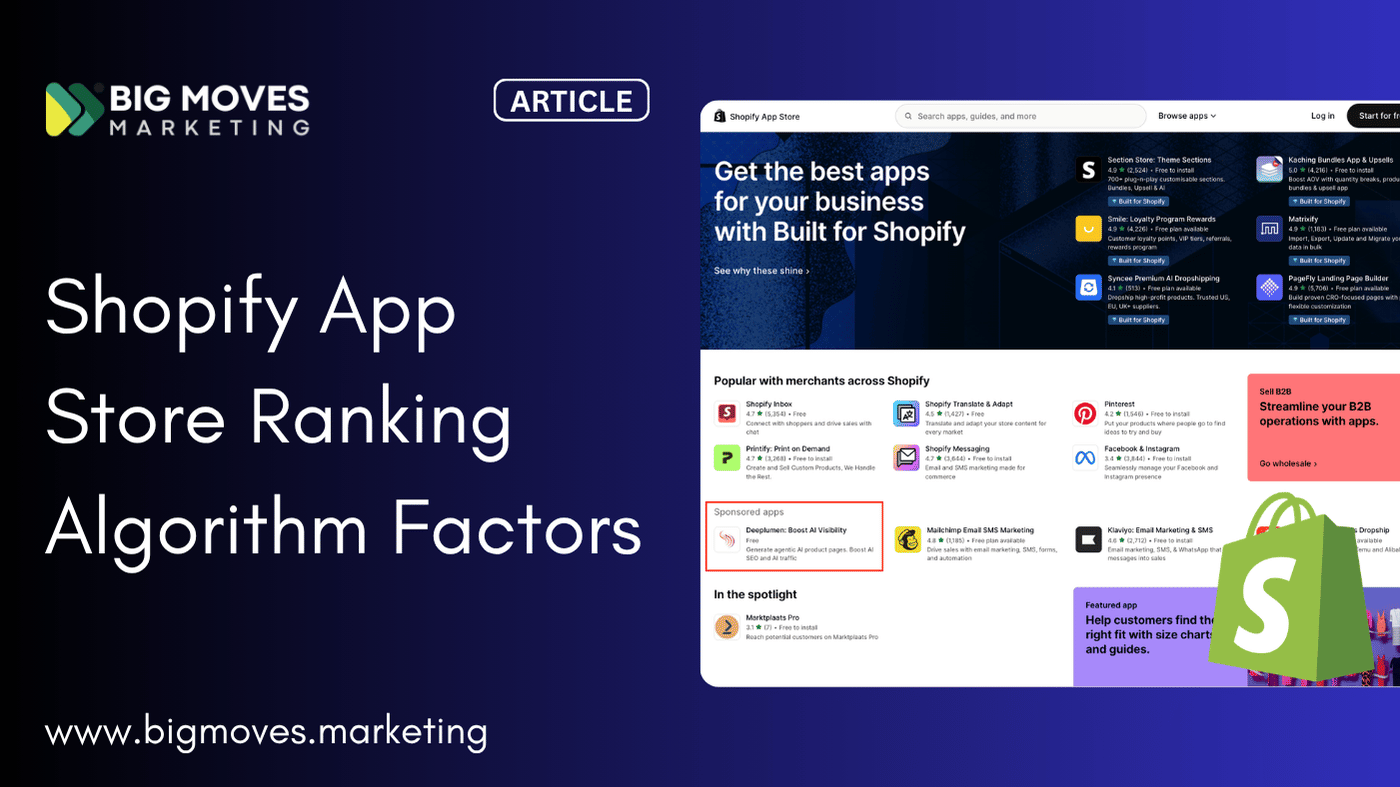
I help improve Shopify App Store rankings by optimizing for the factors Shopify’s algorithm prioritizes, including keyword relevance, conversion rate, install velocity, reviews, and retention signals.
This involves keyword research, optimized app titles and descriptions, visual asset optimization (icons, screenshots, videos), improved onboarding to increase activation, and driving qualified traffic through Shopify Search Ads and other channels.
I've worked with both early-stage and established Shopify apps.
For new or pre-launch apps, I focus on launch positioning, keyword strategy, listing setup, pricing validation, and early traction.
For established apps, I optimize App Store rankings, scale paid acquisition, improve onboarding and conversion rates, and reduce churn to unlock growth opportunities.
Absolutely. Growing installs alone does not drive revenue.
I analyze onboarding flows, in-app messaging, trial experiences, and first-value moments to improve activation rates, trial-to-paid conversion, and retention.
These improvements also positively impact Shopify App Store ranking signals over time leading to better rankings and more installs.
Shopify app growth is platform-specific.
Unlike traditional SaaS marketing, growth is heavily influenced by Shopify App Store algorithms, in-platform search behavior, merchant intent, reviews, and app ecosystem dynamics.
Strategies that work for general B2B SaaS often fail inside the Shopify ecosystem without this specialized understanding of the ecosystem.
Yes, please use the buttons on this page to setup a call with me or email me at [email protected]
Shopify App Store Optimisation (ASO) is the process of improving your app's visibility, ranking, and conversion rate within the Shopify App Store.
While SEO focuses on ranking pages on search engines like Google, ASO focuses specifically on ranking your app listing within Shopify's own search algorithm.
The core mechanics overlap — keyword research, copy optimisation, and conversion signals all matter in both — but ASO has unique factors that SEO doesn't: install velocity, active store retention, review volume and recency, and in-platform behavioral signals like listing click-through rate and trial activation rate.
You also have far less real estate to work with. Your app title, subtitle, and description carry most of the keyword weight, so every word needs to earn its place.
Effective ASO combines technical optimisation with positioning and conversion strategy in a way that standard SEO work rarely requires.
Shopify's App Store algorithm determines which apps appear at the top of search results and category listings based on a combination of signals.
While Shopify does not publish the exact formula, the factors that consistently influence ranking are: keyword relevance in your app title and description, install volume and velocity, active store retention rate, review volume and recency, average star rating, and conversion rate from listing page to install.
Critically, the algorithm rewards quality installs over quantity. An app that acquires merchants who stay active and engaged will outperform one with high raw install numbers but poor retention.
This means your App Store ranking is deeply connected to your onboarding experience and product quality — not just your listing copy.
Understanding this relationship is fundamental to building a sustainable growth strategy on the Shopify App Store.
Shopify uses a combination of relevance and quality signals to rank apps in search results.
The primary factors are: keyword match between the search query and your app title, subtitle, and description; install volume; active store count; review count and average rating; review recency; and listing conversion rate — how often someone who views your listing actually installs your app.
Secondary factors include install velocity (how quickly you're gaining new installs), uninstall and churn rate, and behavioral signals from how merchants interact with your listing.
Paid Shopify Search Ads can accelerate install velocity and indirectly support organic ranking by generating early traction and keyword data.
Apps with the "Built for Shopify" badge also receive preferential treatment in certain category placements, making technical compliance with Shopify's standards a growth lever in its own right.
Getting more Shopify app reviews requires a systematic, policy-compliant approach built into your onboarding flow.
Shopify prohibits incentivising reviews with discounts or credits, and disallows review-gating — showing the review prompt only to satisfied users.
Within those rules, there is still significant room to drive review volume.
The most effective approach is timing. Triggering a review request at the moment a merchant has just experienced a clear win — their first successful use of your app's core feature — dramatically increases response rate.
In-app prompts after key activation milestones outperform email follow-ups. Personalised outreach from a founder or customer success team member for early or high-value merchants also converts well.
Responding professionally to every existing review, positive or negative, signals to prospective merchants that your team is active and trustworthy, which indirectly improves conversion and encourages more reviewers to engage.
Shopify Search Ads are a paid advertising channel available exclusively within the Shopify App Store. They allow app developers to bid on keywords so that their app appears at the top of search results when Shopify merchants search for those terms.
Shopify Search Ads function similarly to Google Search Ads - you set a budget, choose keywords, and pay on a cost-per-click or cost-per-install basis.
For app discovery, Shopify Search Ads are particularly valuable because the merchants clicking them are already inside the Shopify ecosystem, actively searching for a solution, and one click away from installing your app. This makes the intent quality exceptionally high compared to most paid channels.
Beyond direct installs, Search Ads are a powerful keyword research tool — the performance data from paid campaigns reveals which search terms convert best, informing your organic ASO keyword strategy simultaneously.
For most early-stage Shopify apps, Search Ads are worth running — but the goal should be learning, not scale.
In the early stage, your listing conversion rate, onboarding, and pricing are likely still being refined.
Running a modest Search Ads budget across a targeted set of keywords generates real install data, reveals which merchant segments convert and retain best, and accelerates the install velocity that supports organic ranking improvement.
The risk of running Search Ads too early is spending budget on installs that churn quickly, which sends negative retention signals to the algorithm.
The right approach is to get your listing copy, key benefit messaging, and onboarding experience to a reasonable baseline first, then use Search Ads to test and validate.
Even a small budget of $500–800 per month in the early stage can produce meaningful keyword and conversion data that would take months to gather organically.
Whether to offer a free plan depends on your app's value proposition, category competitiveness, and growth stage.
In highly competitive categories, a free plan significantly lowers the barrier to installation and can drive the early install volume and review accumulation needed to gain organic ranking momentum.
For early-stage apps, this is often the right trade-off even at the cost of near-term revenue.
The risk of a free plan is attracting low-intent installs — merchants who install without genuine need, never activate, and quickly uninstall. This hurts your retention signals and can negatively affect your App Store ranking.
A better alternative for many apps is a time-limited free trial on a paid plan, which attracts higher-intent merchants while still reducing friction.
The optimal pricing structure ultimately depends on your merchant persona, activation rate, and the competitive dynamics of your specific app category.
Install conversion rate on the Shopify App Store refers to the percentage of merchants who view your app listing and go on to install it.
While benchmarks vary significantly by category and how competitive the surrounding results are, a healthy install conversion rate is generally considered to be in the range of 10–20% for established apps with strong social proof.
New apps with fewer reviews typically see rates below 10% until review volume and listing quality improve.
The factors with the greatest impact on conversion rate are: the clarity and relevance of your app title and subtitle, the quality of your first screenshot or preview image, your review count and average rating, and how clearly your listing communicates the primary benefit to the merchant within the first few seconds.
Even a 3–5 percentage point improvement in conversion rate can meaningfully reduce your effective cost per install from paid channels and improve your organic ranking signals simultaneously.
Installs refer to the total number of times merchants have installed your app, including those who have since uninstalled it.
Active stores refers to the number of merchants currently using your app — the live, retained user base. Shopify displays the active store count on your app listing, not your total install count.
Active stores matter far more than installs for several reasons. The Shopify App Store algorithm favours apps with strong retention, meaning a high active store count relative to install history signals quality and relevance.
Merchants evaluating your app also see the active store count directly on your listing — it functions as social proof. A high install count with low active stores can actually signal to both the algorithm and prospective merchants that your app has a churn problem.
Growing active stores sustainably, through better onboarding, clearer value delivery, and reduced churn, is the core metric to optimise for long-term App Store growth.
While the Shopify App Store is the primary acquisition channel for most apps, several external channels can meaningfully drive installs and support overall growth.
Content marketing — particularly SEO-optimised blog content targeting the pain points your app solves — attracts merchants searching on Google before they reach the App Store.
This is especially effective for apps solving problems with established search demand.
Partnerships and integrations with complementary Shopify apps or agencies create referral traffic from merchants already embedded in the ecosystem.
Email marketing to your existing customer base drives upsells and reactivations. LinkedIn and community channels like relevant Slack groups, Reddit communities, and Shopify partner forums work well for apps targeting specific merchant verticals.
For apps with a strong ROI story, Google Ads targeting Shopify-specific search queries can drive direct App Store installs cost-effectively.
The best external channel depends on your merchant persona, app category, and budget — but content and partnerships consistently deliver the strongest long-term return.
Your app title and subtitle are the most valuable keyword real estate on your entire Shopify App Store listing.
Shopify's algorithm weights these fields far more heavily than the description body, which means every word you place here directly influences which search queries your app appears for.
The app title has a 30-character limit and should lead with your primary keyword — the core search term that best describes what your app does.
A title like "Restock Alerts: Back in Stock" will consistently outperform "BrandName App" for organic search visibility in that category.
The subtitle gives you a further 80 characters to cover secondary keywords and reinforce your primary benefit. This is where you address the merchant's outcome, not just the feature: "Notify customers automatically, recover lost sales, grow your email list" covers three keyword clusters while communicating clear value.
Avoid keyword stuffing. Shopify's algorithm can identify unnatural keyword strings, and more importantly, merchants can too - a listing title that reads like a keyword list destroys the trust your app needs to convert. The goal is a natural sentence that happens to contain your highest-priority search terms in the highest-weight positions.
You should revisit your title and subtitle every time you run Shopify Search Ads, because paid campaign data will reveal which exact search terms are generating installs.
That data is the most reliable signal for organic keyword prioritisation you can get - far more actionable than any third-party keyword research tool.
Built for Shopify badge is a quality designation awarded by Shopify to apps that meet a specific set of technical, design, and performance standards.
It signals to merchants that your app is deeply integrated with Shopify's infrastructure, follows Polaris design principles, and has been reviewed for reliability and merchant experience quality.
To qualify for Built for Shopify status, your app must meet requirements including: using Shopify's embedded app architecture, passing a performance review, maintaining a high review score, and demonstrating low support ticket rates.
Meeting these standards is non-trivial, but the commercial upside is significant.
Apps with the Built for Shopify badge receive preferential placement in several areas of the Shopify App Store — including category highlights and certain editorial recommendations — meaning they appear in positions that non-badged apps cannot access regardless of keyword optimisation.
This is a structural ranking advantage, not just a conversion signal.
On the conversion side, the badge functions as trust infrastructure.
Merchants — particularly those at larger stores who are more risk-averse about apps affecting their checkout or storefront — specifically filter for Built for Shopify apps when evaluating solutions. In competitive categories, the badge can meaningfully shift conversion rate on its own.
If you are investing in long-term App Store growth, pursuing Built for Shopify status should be on your roadmap.
The compliance requirements also tend to improve your core product quality and onboarding experience, which benefits retention and review volume simultaneously — compounding the ranking benefit over time.
Getting to 100 active stores is the first meaningful proof-of-concept milestone for a new Shopify app — and the path to it is very different from how you grow from 100 to 1,000. In the early stage, you are not optimising for efficiency; you are optimising for signal quality and review accumulation.
Before running any paid acquisition, your listing needs to be in a state where it can convert. That means a clear, keyword-optimised title and subtitle, a first screenshot that communicates your core value proposition within two seconds, at least a basic pricing structure, and an onboarding flow that gets a merchant to their first win quickly.
Installing to a confusing experience is worse than not installing at all — early churns hurt your retention signals before you have the review volume to offset them.
For the first installs, warm outreach consistently outperforms paid channels. If you have any existing audience — a waitlist, a community, beta testers, agency partners, or even personal networks in the Shopify ecosystem — activate them first.
A handful of highly engaged early merchants who review your app and stick around are worth far more algorithmically than dozens of cold installs that churn in two weeks.
Once you have 5–10 genuine reviews and a stable listing conversion rate above 10%, a modest Shopify Search Ads budget of $500–700 per month can accelerate you to the 100-store milestone significantly faster. The reviews provide social proof that converts cold traffic, and the ads generate install velocity that supports early organic ranking improvement.
The 100-store milestone matters beyond the vanity metric. It gives you enough cohort data to understand your retention curve, identify activation drop-off points, and validate your pricing — all of which you need to make confident growth decisions for the next phase.
Churn rate for a Shopify app is typically measured as the percentage of active stores that uninstall within a given month.
While benchmarks vary significantly by category and price point, a monthly churn rate below 5% is generally considered healthy for an early-stage app, and sub-3% is strong for an established app with a defined merchant base.
High-ticket apps solving mission-critical problems — like fraud prevention or subscription management — should target even lower churn than apps in more discretionary categories.
It is worth distinguishing between involuntary churn (merchants closing their Shopify store or churning from Shopify itself) and voluntary churn (merchants actively choosing to uninstall your app). Shopify's overall merchant churn is relatively high at the micro-merchant level, so some of your churn will always be outside your control. What you can influence is the voluntary component — and that is almost always a product or onboarding problem before it is a marketing problem.
The most common driver of avoidable churn in Shopify apps is a failure to reach the activation moment — the specific in-app milestone where a merchant experiences your app's core value for the first time.
If your onboarding flow requires too many steps, too much configuration, or doesn't surface a visible win quickly enough, merchants disengage before they become dependent on your app.
Mapping and shortening the time to that first value moment is the single highest-leverage churn reduction activity for most apps.
Secondary churn drivers include pricing friction (a merchant hitting a plan limit unexpectedly and choosing to uninstall rather than upgrade), poor support responsiveness, and competitive displacement when a better alternative enters the category.
Each of these has a different fix, which is why cohort analysis — tracking when in the merchant lifecycle churn occurs — is essential before committing to a specific intervention.
A lower churn rate also compounds through the Shopify App Store algorithm.
Active store retention is a ranking signal, meaning apps that hold merchants longer gradually build an organic ranking advantage over higher-churn competitors, even if those competitors have more raw installs.
Retention is simultaneously your most important growth lever and your most important product metric.
Screenshots are the first thing most merchants process when they land on your app listing — and they form a judgment about your app within seconds, often before reading a single word of your description.
In competitive categories, visuals can be the deciding factor between an install and a back-click, making them one of the highest-ROI optimisation surfaces on your entire listing.
The first screenshot carries disproportionate weight because it is visible in search results as a thumbnail, not just on your listing page. It needs to communicate your core value proposition at a glance — a clear headline benefit, a representative UI element, and enough visual polish to signal product quality.
An app that looks well-designed in its screenshots creates an implicit assumption that the product itself is well-built. This directly affects conversion rate and review propensity.
A common mistake is treating screenshots as UI documentation — showing feature screens without contextualising what problem they solve.
Merchants do not care what your dashboard looks like in abstract; they care what outcome it produces. Screenshots that frame the UI around a specific merchant pain point ("Never miss a restock request again", "Recover abandoned carts automatically") consistently outperform screenshots that just show product UI.
The number of screenshots you provide also matters. Shopify allows up to three images plus a video in most listing formats. Using all available slots with a logical narrative flow — problem, solution, key features, social proof — increases the time a merchant spends on your listing, which is itself a positive conversion signal.
An app with one or two screenshots signals an unmaintained listing, which undermines trust regardless of how strong the product is.
If you are running Shopify Search Ads, your screenshots are directly influencing your cost per install.
A listing with higher visual quality converts at a better rate from the same paid traffic, meaning better screenshots reduce your effective CPI without changing your bid or budget.
Treating screenshot optimisation as a one-time task is a mistake — it should be revisited every time you launch a significant product update or enter a new competitive phase.
Cost per install (CPI) on Shopify Search Ads is the amount you spend on paid advertising to generate a single app install.
Benchmarks vary considerably by app category, keyword competitiveness, and listing conversion rate, but a CPI in the range of $3–8 is typical for moderately competitive categories, while high-competition categories like email marketing, reviews, or loyalty apps can see CPIs of $15–30 or higher as established players defend high-volume keywords aggressively.
Raw CPI is often the wrong metric to optimise against.
An install that costs $12 from a high-intent keyword like "automatic restock notifications" and converts to a paying merchant with $30 monthly ARPU and 18-month average lifetime has a completely different economic profile from a $4 install from a broad keyword that churns within two weeks.
The ratio of CPI to LTV is the number that actually matters, and it is what should determine your bidding strategy.
In the early stage, CPI from Search Ads is typically higher than it will be at scale, for two reasons. First, your listing conversion rate is lower — fewer reviews and less established social proof means more paid clicks are needed to generate each install.
Second, you are likely testing a broader set of keywords before knowing which ones drive your best merchants.
Both of these factors bring your effective CPI down as your listing matures.
The most practical benchmark is to compare your CPI against your current trial-to-paid conversion rate and ARPU.
If your average paying merchant generates $25/month, stays for 12 months, and your trial-to-paid conversion is 30%, your allowable CPI to break even at 12 months is roughly $90 — meaning a $10 CPI is excellent economics.
Apps that calculate this ceiling tend to scale their Search Ads spend far more confidently than those optimising against an arbitrary CPI target.
A declining active store count is one of the most urgent problems a Shopify app can face, because the decline compounds over time: fewer active stores suppress your App Store ranking, which reduces organic installs, which makes it harder to offset ongoing churn — a cycle that is difficult to reverse the longer it runs unchecked.
The first step is diagnosing the source of the decline. Is it accelerating churn from your existing merchant base, a drop in new installs (or both)? These require different interventions. If new installs have dried up, the problem is usually ranking and visibility — your listing has slipped, a competitor has taken your keyword positions, or your conversion rate has declined due to increased competition or an outdated listing.
If installs are stable but active stores are falling, the problem is product or onboarding.
For churn-driven decline, the most immediate lever is identifying the dropout point in your merchant lifecycle.
Cohort analysis will typically reveal whether merchants are churning in the first two weeks (an onboarding and activation problem), at a pricing event like the end of a free trial (a value communication or pricing friction problem), or after 3–6 months (a product depth or competitive displacement problem). Each scenario has a different solution, and treating them as interchangeable wastes time and budget.
For install-driven decline, an aggressive listing refresh — new keyword strategy, rewritten title and subtitle, updated screenshots — combined with a burst of Shopify Search Ads spend is usually the fastest way to reintroduce install velocity and recover algorithmic ground.
The goal is to demonstrate enough install momentum to the algorithm that organic rankings stabilise before the decline becomes structural.
In both scenarios, proactive merchant outreach is underutilised. Reaching out personally to recently churned merchants — even a small sample — provides qualitative data that no analytics dashboard can.
Understanding the real reason a merchant left, in their own words, consistently surfaces product or positioning issues that quantitative cohort data can only hint at.
Integrations and partnerships are one of the most underused growth levers in the Shopify app ecosystem, largely because their impact is indirect and slower to materialise than paid acquisition.
Over a 12–24 month horizon, however, a well-built integration network can become a more sustainable install source than any paid channel.
Native integrations with complementary Shopify apps create mutual referral surfaces. When your app works seamlessly with a high-traffic app in an adjacent category — for example, a restock alert app that integrates with the leading email marketing app — both listings can reference the integration, and the partner's merchant base becomes aware of your app organically.
These merchants convert at higher rates than cold traffic because they already trust the partner they use, and the integration gives them a concrete reason to install your app.
Shopify agency partnerships operate differently but at high leverage. Agencies managing multiple Shopify stores are often the decision-makers (or strong influencers) for which apps their clients install.
A handful of agency partners actively recommending your app to their client portfolios can generate a consistent, low-CAC install stream that requires no ongoing ad spend. The best way to build these relationships is to make your app easy for agencies to recommend — clear documentation, a responsive support team, and partner-friendly pricing or commission structures where appropriate.
Theme partnerships are a more technical but highly effective channel for apps that enhance the storefront.
Getting your app featured or recommended in a popular Shopify theme's documentation or onboarding flow exposes you to every merchant who installs that theme — a passive, recurring install source that compounds with the theme's popularity.
All of these partnership types share a common characteristic: they generate installs with stronger retention signals than paid acquisition, because the merchants arriving through a trusted referral path have higher intent and better product-market fit.
Over time, this improves your active store count, your review velocity, and your algorithmic standing simultaneously.
Yes — organic-only growth on the Shopify App Store is possible, and some well-optimised apps in low-to-medium competition categories have built meaningful active store counts without paid acquisition.
However, organic growth is slower to initiate, harder to control, and significantly more dependent on strong listing fundamentals and category timing.
The primary organic growth mechanism is Shopify's algorithm rewarding apps that demonstrate strong keyword relevance and merchant retention.
If your app title, subtitle, and description are tightly aligned to high-intent search terms, and if merchants who install your app tend to stay active, your ranking will gradually improve — driving more impressions, more listing views, and more installs in a compounding cycle.
This loop works, but it takes time to build momentum, particularly in categories where established apps have years of review and retention data advantage.
Content marketing and SEO on your own website can meaningfully accelerate organic growth by capturing merchants before they reach the App Store. Merchants frequently search Google for solutions to their problems — "how to send restock notifications to customers" — before searching within Shopify.
A well-ranking blog post or landing page that captures that intent and funnels to your App Store listing creates an organic install channel that operates entirely outside the App Store algorithm.
The real constraint of organic-only growth is keyword validation. Without Search Ads data, understanding which specific search terms drive your best merchants — not just any installs, but retained, converting merchants — requires significantly more time and iteration.
Search Ads compress that learning cycle from months to weeks by generating real conversion data across a broad keyword set simultaneously.
A practical approach for founders with limited budgets is to build strong listing fundamentals first, then run a focused, time-limited Search Ads campaign purely for keyword intelligence.
Even two or three months of paid data can inform an organic keyword strategy that outperforms years of organic-only guesswork.
AI-powered discovery is reshaping how a growing segment of Shopify merchants find and evaluate apps — and for app developers, this shift has real implications for how listings, content, and positioning need to be built.
Increasingly, merchants are turning to tools like ChatGPT, Perplexity, and Google's AI Overviews to answer questions like "what is the best Shopify app for restock alerts" or "how do I add a loyalty programme to my Shopify store" before they ever open the Shopify App Store.
These AI platforms pull answers from publicly indexed content — blog posts, FAQ pages, comparison articles, and review sites — and recommend specific apps by name.
An app with no presence in that content layer is invisible to this segment of the discovery funnel entirely.
Shopify itself is also integrating AI into the App Store experience. Shopify's own AI assistant, Sidekick, increasingly surfaces app recommendations to merchants contextually — within the admin, during setup flows, and in response to merchant queries.
Apps that are well-documented, have strong review signals, and maintain active listings are better positioned to be surfaced by these in-platform AI recommendations than apps with sparse or outdated listings.
For app developers, the practical implication is that ASO and content marketing are converging. Optimising your App Store listing for Shopify's search algorithm is no longer sufficient on its own.
Building content assets — detailed FAQ pages, use-case articles, comparison content — that answer the questions merchants ask AI platforms is increasingly part of a complete growth strategy.
The apps that will win the AI discovery layer over the next two to three years are those that establish authoritative, well-structured content about their category now.
AI platforms prioritise sources that are specific, factual, and demonstrably expert.
A Shopify app developer who publishes detailed, honest content about how their category of app works — not just promotional copy — is building a compounding asset that improves both LLM citation frequency and the trust signals that convert merchants who arrive from any channel.
A Shopify App Marketing Agency or App Growth Expert will bring a lot of expertise and experience of growing other apps across multiple Shopify App Store categories.
It's all about how fast you want to grow or how much runway you have.
This can speed up your time to growth and help you achieve your active store targets faster.
However, if you are not in a rush and If you build these skills internally, there is probable long-term value but the reality is that it can take much longer and at the expense of costly growth mistakes.
It's not an easy decision, so feel free to contact me and I can advise you on the best way forward based on your specifics.
A Shopify app marketing agency specialises in growing the install base, active store count, and revenue of Shopify apps — not Shopify merchant stores. This is a meaningful distinction because the two disciplines operate in entirely different channels, against entirely different algorithms, with entirely different success metrics. Conflating the two is one of the most common mistakes founders make when hiring external marketing support.
A Shopify store marketing agency focuses on driving traffic to a merchant's storefront and converting that traffic into product sales. Their toolkit is built around Google Ads, Meta, email marketing, SEO for the merchant's own domain, and conversion rate optimisation for product pages. None of these disciplines transfer directly to growing a Shopify app, because the primary distribution channel for an app is the Shopify App Store itself — an internal search engine with its own algorithm, its own keyword mechanics, and its own behavioural ranking signals.
A Shopify app marketing agency, by contrast, works on App Store Optimisation (ASO) to improve organic ranking and listing conversion, Shopify Search Ads to drive paid install volume, retention strategy to reduce churn and improve the active store signals that sustain ranking, review acquisition to build social proof within Shopify's policy constraints, and external content marketing to capture merchant intent that originates on Google before it reaches the App Store. These are specialised skills that require direct experience inside the Shopify app ecosystem — not just general digital marketing knowledge adapted for the channel.
The practical risk of hiring a generalist Shopify agency or a broader SaaS marketing firm for app growth work is that they will often optimise for the metrics they know: clicks, impressions, MQL volume. These metrics are not wrong, but they are not the metrics the App Store algorithm responds to. An agency that drives 500 installs per month with 60% first-month churn will damage your organic ranking and your revenue simultaneously — a pattern that is difficult to reverse once it becomes established in your retention cohort data.
When evaluating any agency or consultant for Shopify app growth, the most useful qualifying question is: have they worked on the growth of actual Shopify apps, not Shopify stores? The two experiences are not interchangeable, and the distinction separates practitioners from generalists claiming adjacency.
Community discussions — Reddit threads, Shopify Partner forums, Slack groups for app developers — are among the most valuable but least structured sources of information when evaluating a Shopify app marketing provider. They reveal things that agency websites and case studies will never show: honest assessments of whether results materialised, how communication worked in practice, and whether the provider's expertise held up under real campaign conditions. Knowing how to extract useful signal from these discussions is worth the time investment.
The most credible signals in community discussions are specific and outcome-oriented. A comment that says "we hired X and our active store count grew from 200 to 600 in nine months" is meaningfully different from "they were great to work with and had good communication." Both may be true, but only the first tells you something about whether the provider is capable of delivering what you actually need. When reading reviews or discussions, weight specificity heavily — vague positive sentiment is easier to manufacture or misremember than specific growth data over a defined period.
Negative signals in community discussions are often more informative than positive ones. Critical comments about an agency overpromising results, applying generic playbooks without App Store-specific knowledge, or confusing Shopify store marketing with app marketing are substantive red flags. These complaints describe a capability gap that is structural, not incidental — a provider who does not understand the difference between App Store ranking mechanics and web SEO will not develop that understanding mid-engagement. A single well-articulated critical review describing this pattern is often more predictive of your experience than several generic positive ones.
The absence of any community presence is itself a signal worth noting. Shopify app marketing is a niche enough discipline that the practitioners with genuine depth in it tend to be visible in the communities where app developers congregate — not just because they are promoting themselves, but because they have knowledge to contribute. A provider with no identifiable track record in Shopify Partner forums, no published content about App Store mechanics, and no clients willing to give a named reference in community contexts may simply lack the operational experience their website implies.
Formal review platforms — G2, Clutch, DesignRush — are worth checking but should be read with some scepticism. The providers most aggressively pursuing review volume on these platforms are not always the ones with the deepest specialist expertise. Cross-reference any formal review platform profile against community discussions, LinkedIn presence, and published content before drawing conclusions. The total picture across multiple sources is more reliable than any single channel in isolation.
The pre-engagement conversation with a Shopify app marketing agency or consultant is the single most important point of quality control available to you, and most founders underuse it by asking process questions rather than diagnostic ones. The goal is not to confirm that the provider has a structured onboarding process or uses a weekly reporting cadence — it is to surface whether they understand the specific mechanics of the channel you need them to work in.
The most revealing question is simply: can you describe how the Shopify App Store ranking algorithm works and what it prioritises? A provider with genuine expertise will give a specific, confident answer that covers active store retention, install velocity, review signals, and keyword placement — and will likely mention the 2023 algorithm shift toward behavioural signals. A provider without genuine expertise will give a vague answer about "ASO best practices," mention backlinks (which do not affect App Store ranking), or describe the App Store algorithm in terms that apply to Google search. The quality of the answer to this single question is highly predictive of the quality of the work that follows.
The second diagnostic question is: can you walk me through a specific result you generated for a Shopify app, and what the intervention was? You are looking for a before-and-after with a clear causal explanation — not a general description of the work. "We worked with a restock app that had plateaued at 300 active stores, identified that their title contained no searchable keywords, rewrote it, and saw organic impressions double in 60 days" is a useful answer. "We've worked with several apps and helped them grow their install base" is not. The specificity of the case study tells you whether the provider is describing recalled experience or constructing a plausible narrative.
Ask explicitly how they approach the relationship between Shopify Search Ads and organic ranking — and whether they recommend running paid acquisition before or after addressing onboarding quality. A provider who recommends scaling ad spend as the first intervention, without asking about your churn rate or activation flow, is working from a paid-growth playbook that may actively damage your organic ranking by driving high-volume installs that churn quickly. The right answer involves a sequencing question: what does your retention data currently look like, and what is the state of your listing before we increase paid install volume?
Finally, ask what they will not be responsible for. Scope clarity on deliverables — what the agency owns versus what the client team owns, what is in scope versus out of scope — is as important as understanding what is in scope. Providers who are vague about their boundaries often expand or contract their remit according to what is working rather than what was agreed. A clear statement of what they will and will not do, and what client-side inputs they require to do their work, is a sign of operational maturity.
The best Shopify app marketing agencies share a small number of defining characteristics that separate them from generalist providers who have adapted their existing playbooks to a channel they do not fully understand. These characteristics are not primarily about size, price, or the number of case studies on their website — they are about depth of channel-specific knowledge, intellectual honesty about what the channel requires, and a track record of results that can be verified and attributed.
The first characteristic is a precise understanding of the Shopify App Store as a distinct distribution channel with its own algorithm, its own keyword mechanics, and its own performance signals. The best providers can speak with authority about how retention affects organic ranking, why review velocity matters more than total review count, how Search Ads quality scores interact with organic positioning, and why the February 2023 algorithm shift changed the relative importance of behavioural versus metadata signals. This level of specificity is not available from a generalist who has read a few articles about App Store optimisation — it comes from operating in the channel repeatedly with real apps and real money at stake.
The second characteristic is an integrated view of the growth system rather than a channel-specific lens. A provider focused only on Search Ads will optimise CPIs without necessarily connecting paid acquisition to onboarding quality or retention outcomes. A provider focused only on listing optimisation will improve conversion rates without asking whether the installs converting are the right merchant segment. The best Shopify app marketing specialists understand that ASO, paid acquisition, onboarding, pricing, and review strategy are interconnected — that optimising one in isolation can create problems in another — and they advise across the system accordingly.
The third characteristic is intellectual honesty about timelines and attribution. App Store growth through organic ranking improvements is a 3–9 month process, not a 30-day sprint. A provider who promises rapid ranking results without qualifying that organic improvements depend on retention quality, competitive density, and the current state of your listing is either unaware of how the channel works or is telling you what they think you want to hear. The most credible providers give conservative estimates of what is achievable and when, because they have seen the cost of overpromising and underdelivering in a channel where reputation in the Shopify Partner community travels quickly.
The practical test — beyond any conversation or case study — is whether the provider can name specific Shopify apps they have worked with, describe what the growth challenge was in that engagement, and explain what they did and what resulted. Named, verifiable client work is the most reliable quality signal available in a niche where it is easy to claim broad expertise and difficult for prospective clients to validate it from the outside.
Keyword research for the Shopify App Store is fundamentally different from web SEO keyword research, and the tools designed for Google — Ahrefs, SEMrush, Google Keyword Planner — provide limited direct insight into how merchants actually search within the App Store. Effective Shopify App Store keyword research requires a combination of in-App Store observation, Search Ads data, and structured competitor analysis.
The starting point is direct observation within the App Store itself. Typing your primary use-case term into the App Store search bar and examining the autocomplete suggestions surfaces the actual query variants that Shopify's search engine is registering — including category modifiers, feature-specific terms, and problem-framed queries that no external tool can reliably replicate. This manual step, done systematically across 20–30 seed terms, builds a keyword map grounded in real merchant search behaviour rather than inferred search volume from Google proxies.
Competitor listing analysis is the second core technique. Examining the titles, subtitles, and descriptions of your top-ranking competitors reveals which keyword clusters they have prioritised — and, more importantly, which high-volume terms they have left uncaptured in their positioning. In many categories, the second or third-ranked app has a meaningful keyword gap in its subtitle that a new entrant can exploit without a head-to-head listing quality competition.
Shopify Search Ads data is the most reliable source of validated keyword intelligence available to any app developer. Running a broad match campaign across 40–60 target terms for 4–6 weeks generates real impression and click-through data that tells you exactly which queries are generating install-intent from actual merchants. This paid keyword test is more actionable than any volume estimate from third-party tools, because it reflects the current competitive landscape and your specific listing's performance against each term. Most keyword research for App Store optimisation should begin with a controlled Search Ads probe rather than a content-first approach.
Keyword prioritisation should be structured around two axes: relevance to your highest-retained merchant segment, and competitive density at the keyword level. A keyword that drives installs from merchants who churn in two weeks is algorithmically damaging even if it drives high volume. Prioritising terms that attract merchants with the clearest fit for your app's core value — even if those terms have lower raw volume — produces better ranking outcomes over time than chasing high-volume generic terms.
This question creates significant confusion because it conflates two distinct ranking systems: Google's search algorithm (which does use external backlinks as a major ranking factor) and Shopify's App Store search algorithm (which does not). Understanding the difference between these two systems — and where off-site activity does and does not matter — is essential before investing in any external link-building strategy with App Store ranking as the goal.
External backlinks have no direct effect on your Shopify App Store ranking. Shopify's App Store algorithm ranks apps based on behavioural signals generated within the App Store itself — keyword relevance in your listing, install velocity, active store retention, review score and velocity, and click-through rate from search results. There is no mechanism by which a backlink from an external website influences any of these signals directly. If someone tells you that building backlinks will improve your App Store ranking, they are either confused about which algorithm they are describing, or they are describing an indirect pathway — not a direct one.
The indirect pathway does exist, however, and it is worth understanding. External traffic to your app's landing page or website that results in conversions to the App Store listing — merchants who read a blog post, click through to your App Store listing, and install your app — contributes to your install velocity, which is a genuine App Store ranking signal. In this sense, external content marketing and SEO can indirectly support App Store ranking by generating a consistent stream of high-intent installs that add to your install velocity total. The effect is real, but the mechanism is traffic and install volume, not the backlink itself.
For Google search rankings of your own website and app landing pages, external backlinks are highly relevant — they remain one of Google's strongest ranking signals, and building a credible backlink profile for bigmoves.marketing or your app's own domain will improve your visibility in Google search for queries like "best Shopify restock app." That Google visibility can then drive external traffic → App Store visits → installs → App Store ranking improvement. This is a real and valuable growth loop, but it operates through two separate algorithms and two separate attribution steps, not a single direct relationship.
The practical implication is that external link-building should be evaluated against the right objective. If you are building links to improve your Google search rankings and drive organic traffic to your app's landing page, that is a defensible strategy. If you are building links because you believe they will directly improve your App Store ranking position, you are investing in the wrong channel for that specific outcome.
Entering a Shopify app category without a structured ecosystem assessment is one of the most common and costly mistakes in app development. The Shopify App Store contains approximately 17,900–18,500 apps as of mid-2026, spread across more than a dozen major categories, and the competitive density and dynamics vary enormously between them. A category that looks underserved from the outside can turn out to have three entrenched players with a combined 15,000 reviews — a position that takes years and significant capital to challenge.
A category assessment should begin with a quantitative inventory: how many apps exist in the target category, what is the distribution of review counts across those apps, and what does the review velocity of the top five look like on a monthly basis? A category with five apps each holding 2,000+ reviews and a combined 200 new reviews per month is structurally harder to enter than a category with ten apps where the leader has 400 reviews and monthly velocity is low. The review distribution tells you not just how strong the incumbents are, but whether the category is mature or still forming.
The second dimension of the assessment is merchant search behaviour: are merchants actively searching for solutions in this category using specific, high-intent keywords, or is the category driven primarily by editorial discovery and word of mouth? Categories with specific, high-volume search terms (like "restock alerts" or "loyalty programme") are more accessible to a well-optimised new entrant than categories where merchant discovery is dominated by relationships, agency recommendations, or featured placements that favour established partners.
Pricing dynamics are the third indicator. A category where the top apps are priced at $9–19 per month signals low merchant willingness to pay, which in turn implies thin developer economics and commoditised positioning. A category where established apps command $49–199 per month with strong review scores signals that merchants derive measurable ROI — a much more attractive economics profile for a new entrant with genuine product differentiation to offer.
The output of a proper ecosystem assessment should be a clear-eyed view of three things: how much install velocity and review accumulation you need to become competitively visible in organic search, how much you should expect to spend on Search Ads to reach that threshold, and whether the category's pricing ceiling supports the economics of that investment. Categories that look attractive on the surface frequently fail one or more of these tests, and the assessment saves founders from committing development and marketing resources to a market position that is structurally unprofitable to defend.
As of mid-2026, the Shopify App Store hosts approximately 20,000+ public apps, depending on the source and methodology of measurement. Daily tracking services such as AppNavigator and Public Apps show the count has grown rapidly, with roughly 550–865 new apps launching each month through early 2026 — a year-over-year increase of approximately 55% from the start of 2025. This follows a brief contraction in 2024, when Shopify implemented stricter quality review standards that removed a significant number of underperforming and policy-violating apps from the store.
The raw count understates the competitive reality for most app categories. Shopify's App Store is not uniformly competitive — a significant proportion of listed apps have fewer than 10 reviews, are functionally inactive, or occupy highly niche sub-categories with limited merchant demand. The realistic competitive set for most developers is concentrated in a much smaller pool of 20–100 actively maintained apps within their specific category. The distinction between "there are 18,000 apps" and "there are 40 serious competitors in my category" is significant for how you plan your positioning and growth strategy.
What the growth rate does reveal, however, is that App Store positioning is deteriorating as an asset if you are not actively investing in it. An app that held a strong organic ranking in 2023 with limited ongoing investment faces an increasingly crowded search environment in 2026 — more apps competing for the same keywords, higher review counts needed to maintain competitive social proof, and greater design quality expected in listing visuals. The apps that will hold positions over the next three years are those investing actively in ASO, not those coasting on historical momentum.
The more commercially significant number is the revenue distribution across the App Store. Independent analysis of the ecosystem consistently shows that average monthly revenue per app is high in absolute terms — one 2026 estimate citing $20,037 — but that median monthly revenue is approximately $725. This is a heavily skewed distribution where a small number of category leaders capture the majority of revenue, and a long tail of apps generate marginal returns. Entering a category with strong differentiation and a credible growth investment is the only reliable path to the upper distribution; incremental improvements to an underdifferentiated product rarely close that gap.
Growth benchmarking for Shopify apps is more nuanced than simply tracking month-over-month install counts, because the same install number can represent either healthy growth or a deteriorating business depending on what is happening to active stores, churn, and revenue simultaneously. A complete growth benchmark requires four data points: new installs per month, active store count trend, monthly churn rate, and trial-to-paid conversion rate. These four numbers together tell a more accurate story than any single metric in isolation.
In terms of directional benchmarks: an early-stage app in its first 12 months is performing well if it is adding 50–150 net new active stores per month with a monthly churn rate below 5%. An established app with 500+ active stores should be targeting net monthly active store growth of 3–8% and monthly churn below 3%. These are not universal figures — category, pricing, and target merchant segment all shift the benchmarks — but they provide a starting framework for assessing whether current performance reflects underlying product-market fit or structural growth constraints.
The growth metric that most apps underreport is net active store growth — the difference between new installs and churned stores in a given period. An app adding 200 installs per month but losing 180 active stores to churn has net growth of 20 stores, which is a fundamentally different business trajectory from an app adding 100 installs per month with 20 churning. Most founders optimise for install volume because it is the more visible and satisfying metric; the active store growth rate is the one that determines whether the business is actually building something durable.
Revenue growth benchmarking should incorporate ARPU trajectory alongside active store count. An app with growing active stores but flat or declining ARPU may be growing its low-value cohorts through pricing promotions or free plan expansion while its high-value paying cohort stagnates. The healthiest growth trajectory is active stores and ARPU both growing simultaneously — signalling that new installs are converting to paid at stable rates and that existing merchants are upgrading as they derive more value from the product. Apps that show this pattern consistently are well-positioned to defend their App Store ranking because their retention signals compound over time.
The Shopify App Store ranking algorithm has undergone at least one significant structural shift since the platform's early days, and understanding its direction of travel is as important as understanding its current state. The algorithm has moved progressively away from static listing signals — metadata, keyword density, description completeness — toward dynamic behavioural signals that reflect real merchant experience. This shift has profound implications for how app developers prioritise their growth investments.
The most significant documented change occurred in a two-phase update during early 2023, with changes first observable around February 27 and then extended or reinforced around April 26 of that year. Before this update, apps with strong keyword optimisation and high historical review counts could maintain competitive rankings even with modest recent retention performance. After the update, active store retention and recent install velocity became substantially more influential, meaning an app's ranking began to reflect its current quality — not its historical reputation. Apps with strong legacy positions but deteriorating product-market fit saw ranking drops that their historical review counts could no longer offset.
The practical consequence of this shift was severe for apps running high-volume install campaigns without addressing onboarding and activation quality. Paid installs that generated quick churn — a common early-stage pattern — began creating a measurable negative ranking signal rather than a neutral one. The algorithm, in effect, started penalising growth strategies that prioritised install volume over install quality. This inverted the conventional wisdom that "more installs is always better" and forced a rethink of how Search Ads budgets, onboarding flows, and pricing trials interact with algorithmic outcomes.
The direction of subsequent updates has been consistent with this trajectory. Shopify's incentive as a platform operator is to surface apps that genuinely serve merchants well — apps that merchants keep, use actively, and recommend. Every algorithmic refinement since 2023 has moved further in that direction, making retention-quality the central determinant of long-term organic ranking health. The developers who adapted to this shift early — by investing in activation quality, onboarding flows, and churn reduction before scaling paid acquisition — are consistently the ones holding strong organic positions in 2025 and 2026.
One of the most useful frameworks for App Store growth strategy is separating ranking factors into those within your direct control and those that are either partially within your control or entirely outside it. Most growth investments should be concentrated on fully controllable factors, with a clear-eyed understanding of what cannot be managed and what can only be indirectly influenced.
The factors you control directly are: keyword placement in your title, subtitle, and description; the quality, narrative flow, and visual polish of your listing screenshots; your review response rate and response quality; the copy and structure of your onboarding flow; the design of your pricing architecture; and the timing of your review solicitation strategy. All of these can be changed, tested, and optimised without dependency on Shopify, market conditions, or merchant behaviour patterns outside your product.
The factors you partially control are: review score and velocity (you cannot make merchants leave reviews, but you can improve review propensity through experience quality, timing, and direct outreach); install conversion rate (dependent partly on competitive context and partly on your listing quality); and click-through rate from search results (dependent on your first screenshot, review score, and pricing tier as signals in the search thumbnail, which you can optimise but not entirely engineer). Each of these responds to your actions but is not fully under your command.
The factors outside your direct control are: competitor actions (a well-funded competitor improving their listing or increasing their Search Ads spend will affect your relative ranking regardless of what you do); Shopify's editorial placements and featured selections (algorithmic and relationship-driven, not purchasable); the underlying demand volume for your category (you cannot create merchant interest in a problem that doesn't exist or isn't actively searched for); and macro Shopify platform growth or contraction (more or fewer active merchants affects your total addressable install volume). These factors should be monitored and scenario-planned for, but not invested against as if they were within reach.
The most effective growth strategies are those that fully exhaust the controllable factors first — listing quality, onboarding, pricing, review strategy — before increasing spend on channels that amplify whatever is already working. Scaling paid acquisition into a listing with a poor conversion rate or into a product with high early churn is the most common way to waste growth budget in the Shopify app ecosystem.
Shopify's App Store algorithm does not treat new and established apps identically, and the ranking dynamics that apply to an app in its first six months are meaningfully different from those that govern an app with two or three years of install history. Understanding this distinction prevents new app developers from benchmarking themselves against established competitors in ways that produce misleading conclusions about their own performance.
New apps benefit from what is commonly referred to as a "new app window" — a period in which Shopify's algorithm appears to give recently launched apps some degree of additional visibility to help them accumulate initial install data. This window is not officially documented by Shopify, but it is consistently observable: new apps often see stronger initial search impressions than their review score and install count alone would predict. The practical implication is that the first 60–90 days after launch are the most leverage-rich period for generating installs, reviews, and retention data, because your listing is receiving more algorithmic exposure per unit of competitive quality than it will once the window closes.
For established apps, the ranking algorithm becomes increasingly weighted toward momentum maintenance. An app that reached a strong position partly through new app visibility must now hold that position through sustained install velocity and retention performance. Historical review counts provide a degree of inertia — a large review total creates a trust signal that is difficult for a new entrant to overcome quickly — but that inertia is not indefinite. An established app with 3,000 reviews but six months of flat install velocity and declining active stores will gradually lose ground to a newer app with 200 reviews and strong recent growth momentum.
The most important difference between the two stages is what the algorithm is measuring and how recent that measurement window is. New app rankings are often driven by a short, recent window of performance data. Established app rankings are driven by a longer history, but with recency weighting applied — meaning the last 30–90 days of install and retention data matter more than the aggregate total. This recency weighting is what makes the App Store ranking dynamic rather than static, and why established position requires ongoing active management rather than passive maintenance.
If you had to isolate a single ranking factor as most influential in Shopify's App Store algorithm, the weight of evidence points to active store retention — the rate at which merchants who install your app continue using it over time. This is not the most intuitive answer; many developers assume that review score or total install count is the dominant factor because those are the most visible numbers on the listing page. But retention is the signal that most directly reflects merchant satisfaction, and it is what the algorithm is ultimately trying to measure.
The reason retention carries this weight is structural. Shopify's commercial interest is in surfacing apps that make merchants successful, because successful merchants stay on Shopify longer and spend more. An app with high retention is evidence of genuine merchant value — it is, in effect, the App Store's version of organic product-market fit. No amount of listing optimisation, Search Ads spend, or review accumulation can fully substitute for a product that merchants keep using, because those other signals are either temporary (paid installs) or correlated with retention anyway (high review scores are much easier to accumulate when merchants are having a good experience).
The interaction between retention and the other ranking factors is what makes the algorithm difficult to game in isolation. High retention supports review velocity, because merchants who keep using an app are more likely to leave a review when prompted. Strong review velocity supports click-through rate, because a recent, high-quality review score converts more search impressions into listing visits. Higher listing conversion rate supports install volume, which supports install velocity. And sustained install velocity compounds organic ranking over time. Every factor in the ranking system is ultimately downstream of or correlated with retention — making onboarding quality and activation rate the strategic levers that sit furthest upstream in the growth chain.
The practical implication is that the sequence of investment matters. The highest-leverage order of operations for any app trying to improve its App Store ranking is: first, ensure the onboarding flow reaches the activation moment quickly; second, ensure your review solicitation captures positive sentiment at the peak of merchant satisfaction; third, use Search Ads to amplify install volume into a listing and product that can retain those merchants. Reversing this sequence — scaling paid acquisition before fixing the retention problem — is the most common and most costly strategic mistake in Shopify app growth.
Comments