%20png%20copy.avif)
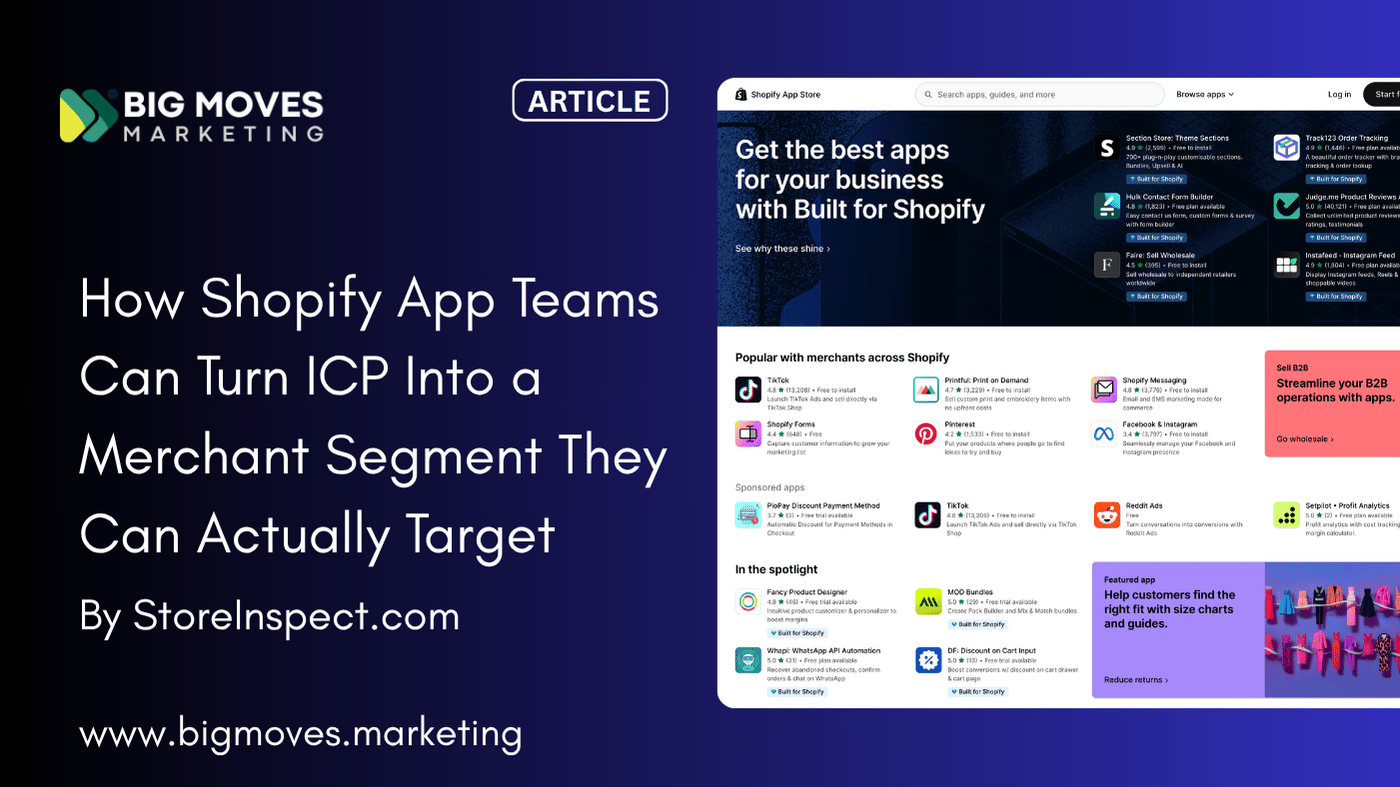
Most Shopify app teams have an ICP. The problem is that it is usually too abstract to operate against.
"Shopify Plus brands," "fast-growing DTC stores," and "beauty merchants doing meaningful volume" are useful strategic labels. They do not tell a founder, marketer, or growth lead which stores to target this week. They do not tell you what keywords to prioritize, which partnerships to pursue, which merchants should see your outbound, or which objections your positioning needs to answer.
For a Shopify app team, a useful ICP needs to go beyond buyer description. It has to become a merchant segment you can identify.
That usually requires observable store-level signals: traffic range, category, app stack, missing app categories, pixels and acquisition signals, store maturity, competitor or complementary app usage, and signs that the merchant has the problem your app solves.
When you can identify those accounts, go-to-market decisions get sharper. Keyword research becomes less generic. Partnerships become more obvious. Outbound gets more relevant. App Store positioning becomes less about claiming a category and more about speaking to a specific merchant state.
This is a guest post from StoreInspect:Shopify store intelligence for agencies and operators.
Broad ICPs are usually built for internal alignment, not execution.
"We sell to Shopify Plus brands" may be directionally true, but it still leaves too many unanswered questions:
Without those answers, the ICP does not guide action. It only gives the team a theme.
This is where Shopify app teams often get stuck. They know the kind of merchant they want, but they cannot turn that into a workable list or a focused marketing motion. So the team defaults to broad channels:
That creates noisy top-of-funnel activity. More impressions, more clicks, maybe more installs, but not necessarily better-fit merchants.
For app growth, the more useful question is not "who is our ICP?" It is:
Which merchant segment has the problem we solve, shows evidence of that problem, and can be identified before we spend time or money reaching them?
A usable merchant segment needs three things:
Here is a simple test:
If you gave the segment definition to a growth person, could they build a list of 100 target stores from it?
If not, the ICP is still too abstract.
For Shopify app teams, the strongest segments usually combine several signals instead of relying on one. Each signal answers a different qualification question:
No single signal is perfect. The useful work comes from combining enough signals to get a more practical market definition than "DTC brands."
The easiest way to see the difference is to compare abstract ICP language with usable merchant segments.
Data note: the examples below use data from StoreInspect's April 2026 Shopify store dataset, including the State of Shopify report. StoreInspect detects storefront-visible apps, pixels, themes, and other client-side signals. Server-side tools, private apps, and apps without visible storefront signals may not appear in the data.
Common ICP: "Growing Shopify brands spending on ads."
Targetable segment: stores with both Meta Pixel and Google Ads tracking detected, but no storefront-visible dedicated ecommerce analytics or attribution app.
Why it works: The segment connects a visible behavior to a likely problem. These stores have tracking infrastructure in place, but no detected specialist analytics layer such as Triple Whale, Elevar, Northbeam, or Littledata.
In StoreInspect's April 2026 dataset, 111,153 Shopify stores had both Meta Pixel and Google Ads tracking detected. Only 5,637 of those also had a detected storefront-visible dedicated ecommerce analytics or attribution app.
That does not prove every remaining store is actively spending on ads today. Pixels can stay installed after campaigns stop, and server-side analytics may not be visible from the storefront. But as a targeting signal, it is still much sharper than "Shopify stores that run ads."
How an analytics app could use this:
Common ICP: "Brands that care about conversion rate."
Targetable segment: stores with an Instagram presence but no detected reviews or social proof app.
Why it works: An Instagram-linked store has already invested in social presence or brand-building. If there is no detected reviews or social proof layer, the store may be collecting attention without fully converting trust into on-site proof.
In StoreInspect's April 2026 dataset, 364,701 stores had Instagram linked. Of those, 252,605 had no detected reviews or social proof app.
That gives review apps, UGC apps, social proof tools, and CRO agencies a more specific wedge than "all Shopify brands."
How a reviews or UGC app could use this:
Common ICP: "Stores that could sell subscriptions."
Targetable segment: food, beverage, beauty, or health stores with enough traffic to show demand, but no detected subscription app.
Why it works: Subscription potential is not evenly distributed across Shopify. A broad subscription-app pitch to every store will waste effort. Category matters.
In StoreInspect's April 2026 dataset, 97.3% of stores had no detected subscription app overall. But Food & Beverage looked very different: 72.4% had no detected subscription app, meaning subscription adoption was materially higher than the overall market.
That does not make Food & Beverage a bad market. It makes it a more informed one. The category has proven subscription behavior and still leaves a meaningful addressable pool. Beauty and Health & Wellness also remain relevant, but the exact segment should depend on price point, product replenishment, traffic, and current stack.
How a subscription app could use this:
Define segments this way and the rest of the go-to-market system changes.
Keyword research should not start with the biggest category term. It should start with the merchant state you are trying to win.
If your segment is "stores using paid-media pixels without dedicated attribution," your keyword universe is not just "analytics." It includes terms around attribution, ROAS, profit tracking, Meta ads, Google Ads, LTV, and channel reporting.
If your segment is "Instagram-linked stores without reviews or social proof," your keywords should connect reviews, UGC, photo reviews, social proof, and conversion.
If your segment is "Food & Beverage stores without subscriptions," your keywords should lean into replenishment, subscription boxes, recurring orders, and retention.
This is where ICP work and keyword research should meet. The segment tells you which merchant problem matters. Keyword research tells you how merchants search for that problem.
Many Shopify app listings describe the category instead of the buyer state: "the best reviews app for Shopify," "powerful analytics for ecommerce brands," or "subscriptions made easy."
Those lines may be true, but they are hard to believe because every competitor says something similar.
A segment-led message is more concrete:
That gives the right merchant a situation they can recognize, not just another category claim.
Cold outreach fails when it sounds like it could have been sent to any store.
Segment-based targeting gives you a reason to reach out:
The message should not sound overly forensic or technical. It should show that the outreach is based on the store's actual situation.
For app teams, the first install is often not won by explaining every feature. It is won by proving you understand the merchant's problem faster than the alternatives.
Partnerships are easier when you know the merchant segment you want.
If you sell attribution, paid-media agencies and analytics consultants are obvious partners. If you sell reviews or UGC, social media agencies and CRO consultants are closer to the pain. If you sell subscriptions, retention agencies and category-specific operators in Food & Beverage, Beauty, and Health & Wellness become more relevant.
Without a clear segment, partnership strategy turns into generic ecosystem networking.
With a clear segment, you can ask:
That is a better starting point than "we should do partnerships."
The mistake is treating a category as if it were a segment.
"Beauty stores" is not a segment.
"Shopify Plus stores" is not a segment.
"Stores using Klaviyo" is still not enough on its own.
Those are filters. Useful filters, but still filters.
A segment combines the account type with the problem state.
Better examples:
That level of specificity makes the market smaller, but it also makes it usable.
Most app teams are uncomfortable with the first part. They worry that a narrower market will limit growth. In practice, the opposite usually happens early on. A narrower segment gives you clearer positioning, better outreach, more relevant content, and faster learning.
You can expand later. But you cannot learn much from a market definition so broad that every merchant looks like a possible fit.
Use this workflow for any app category.
Write the core job in one sentence.
Too broad: "We help merchants grow revenue."
Better: "We help merchants understand which ad channels are profitable."
Also better: "We help merchants collect and display photo reviews."
Also better: "We help merchants turn replenishable products into recurring revenue."
The clearer the job, the easier the segment work becomes.
Ask what would be visible from the outside if a merchant had this problem.
For an attribution app:
Useful signals might be Meta Pixel, Google Ads pixel, GA4, no detected specialist attribution app, and traffic above a practical threshold.
For a reviews or UGC app:
Useful signals might be an Instagram-linked store, a product-led category, no detected review or social proof layer, and enough traffic or product depth to make conversion work matter.
For a subscription app:
Useful signals might be a replenishable category, no detected subscription app, sufficient traffic, and product price or catalog depth that make recurring purchase plausible.
Not every store with a gap is worth targeting.
A zero-app store with low traffic may not be a hidden opportunity. It may simply be too early, inactive, or not ready to buy software.
Maturity filters help separate opportunity from noise. Traffic tier, app count, paid-media pixels, Shopify Plus status, product count, and complementary tools all help answer the same question: is this store likely to care now?
For many app teams, the most useful starter segment is not the largest gap. It is the gap among stores mature enough to care.
Once the segment is defined, apply it across channels. For App Store keywords, ask which terms this merchant state searches for. For listing copy, decide which pain the first screen should address. For content, choose the problem the market needs help understanding. For partnerships, look for people who already have trust with these merchants. For outbound, use the store-specific observation that makes the message relevant. For sales, turn the segment into qualification questions.
If the segment only helps one channel, it may be too narrow. If it helps every channel, you probably have a real GTM wedge.
Shopify app markets move quickly.
Categories mature. Competitors change pricing. App Store rankings shift. Merchants adopt new tools. A good segment today may become less attractive six months from now.
Review the segment quarterly. Check whether the gap is still large enough, whether the best accounts are still reachable, whether competitors are moving into the same segment, whether merchants are using different language for the problem, and whether the segment is producing installs that retain.
This is especially important for app teams using App Store search ads, content, or outbound. A stale segment creates stale messaging.
An ICP is only useful if your team can act on it.
For Shopify app teams, that means moving from broad buyer labels to observable merchant segments.
In practice, the useful version combines the merchant type, the problem your app solves, visible evidence that the problem exists, maturity filters that show the merchant is worth pursuing, and a channel plan for reaching them.
"Shopify Plus brands" is a market description.
"Beauty stores with 50K-200K visits, Instagram linked, and no detected reviews or social proof app" is a segment.
The second version gives your team something to work with: what to build, what to say, where to advertise, who to partner with, and which merchants to contact first.
Visit StoreInspect for more data insights on Shopify Stores. Contact Big Moves Marketing for support on Shopify App Marketing and Growth Execution


%20-%20white.svg)