%20png%20copy.avif)

TL;DR
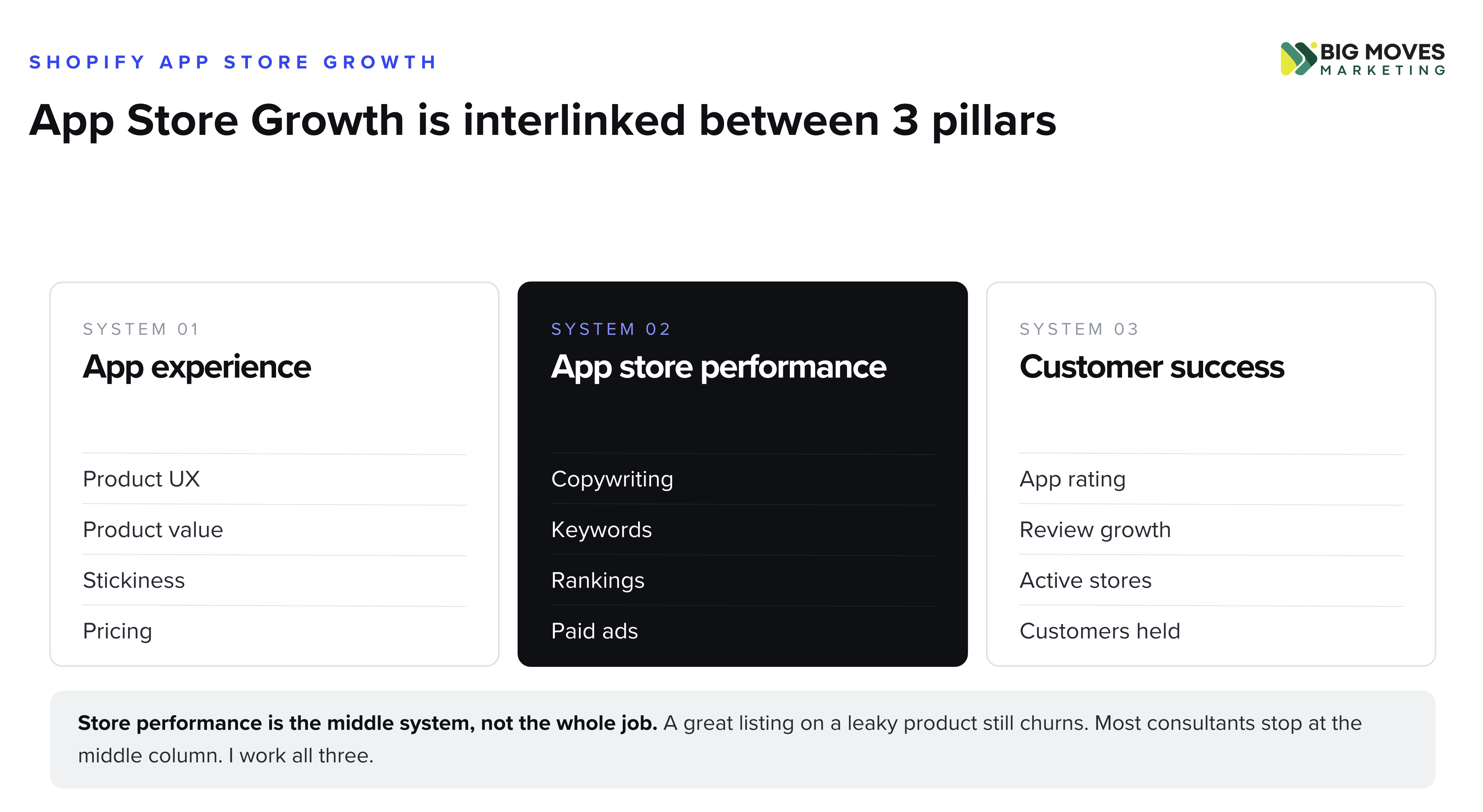
Most Shopify app founders ask the agency question at the wrong moment.
Some hire at $1,500 MRR, hoping a retainer will find the product-market fit they have yet to find themselves. Others wait until $80K MRR, when installs have slid for three quarters and the founder still rewrites the listing at midnight.
Both mistakes cost more than the fee. The early hire burns six months of runway on a product merchants have yet to prove they want. The late hire hands a competitor two years of compounding reviews, rankings and partner relationships.
The useful question is narrower than “should you hire a Shopify app marketing agency?” It is this: what constrains your growth at your current stage, and who is the right person to remove that constraint?
This guide answers in order. It explains what a Shopify app marketing agency does, what stays with you, how an agency compares with the alternatives, and where the hire pays back by stage and MRR. The MRR bands are working heuristics from practice. Shopify publishes no such thresholds. Every platform fact links to Shopify's own documentation.
A Shopify app marketing agency is a specialist firm that markets software to Shopify merchants. Its client is the developer or company behind the app. Its audience is the merchant who searches, compares, installs, pays and stays.
That definition separates it from a far larger group: agencies that market Shopify stores. Store agencies run Meta ads, email and conversion work for brands selling physical products. App agencies sell B2B software to those brands. The buyer, the sales cycle and the channels differ. An agency with fifty store clients and zero app clients is a generalist for your purposes.
The specialism matters because the Shopify App Store is a marketplace with its own rules. Shopify describes the listing as the foundation for all app discovery, and it runs its own ad auction, its own review policy and its own quality program. In the same documentation, Shopify notes that successful developers market their apps both through Shopify and externally. A specialist agency works across both.
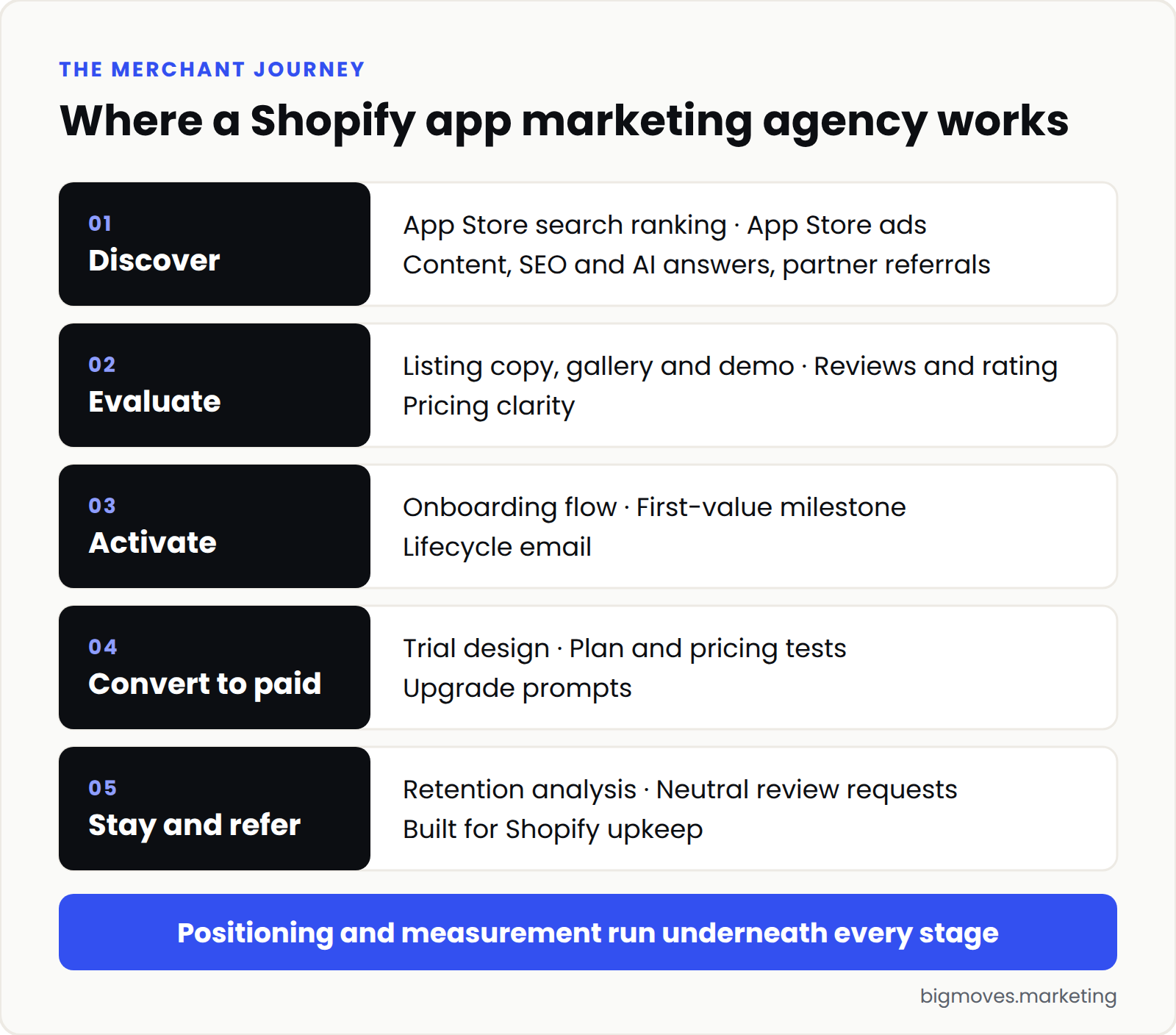
The work falls into eight streams.
Every other stream depends on this one. The agency defines which merchant the app serves best, which problem it solves for that merchant, and why it beats the three alternatives the merchant will open in neighboring tabs. A sharp position narrows the keyword list, shapes the screenshots and decides which reviews to feature. A vague position produces a listing that reads like every competitor's.
The listing does two jobs. It tells Shopify's search which queries the app deserves to rank for, and it persuades the merchant who lands on it. The agency researches the terms merchants type, places them in the app name, subtitle, description and search terms, then rebuilds the gallery and copy around outcomes. Strong listing work reads as merchant language first and keyword placement second.
Shopify sells three ad placements: search results, category pages and the homepage. All use cost-per-click bidding in a first-price auction, so you pay exactly the bid you entered. Relevance counts as well. Shopify states that keywords cost less for highly relevant apps, and an app with low relevance for a term cannot enter that auction at all.
A specialist builds campaigns around this mechanic. Keywords come in two match types, broad and exact, plus negative keywords to block wasteful terms. For a new app with few reviews, exact match on a short list of high-intent terms keeps spend disciplined. Broad match earns its place later, once reviews and install rate support it. That sequencing is a practitioner position, and it runs against the common advice to start broad.
Shopify's documentation says positive reviews help an app appear higher in search results and category pages. The rules around collecting them are strict. You can ask merchants for a review. You cannot ask for a positive one, and you cannot offer a discount or benefit in exchange. Violations can lead to removed reviews, demoted ranking or an unpublished app.
One rule changed the timing of every review program. Since December 11, 2024, merchants on any type of trial plan, paid trials included, cannot leave reviews. An agency that still schedules review requests inside the free trial is working from an old playbook. Current practice places the request after the first paid charge and after a clear moment of value.
An install that never activates is a cost. It consumed ad budget, it will likely uninstall, and it adds nothing to revenue. Specialist agencies therefore treat onboarding as marketing. They map the steps between install and first value, find the step where merchants stall, and rewrite the flow, the empty states and the lifecycle emails around it.
Ad data helps locate the leak. As a working benchmark from Big Moves engagements, category-leading apps convert roughly 20 to 25% of ad clicks into installs, and mid-range apps convert 15 to 20%. Shopify publishes no official figure, so treat these as directional. The diagnostic value holds either way: a strong click-through rate paired with a weak install rate points at the listing page, while healthy installs paired with weak activation point at onboarding.
Built for Shopify is Shopify's quality program. Qualifying apps receive a badge on the listing and in search results, a dedicated search filter, higher search ranking, and the ability to target ads by merchant plan. Shopify reports that apps see an average 49% increase in new installs within 14 days of earning the status.
That figure deserves a caveat. It is an average, reported by Shopify, across apps that were strong enough to qualify. Your result will vary with category and starting rank.
The entry requirements include a minimum of 50 net installs from active shops on paid plans, at least five reviews, and a minimum recent rating, alongside technical standards for performance and design. An agency owns the marketing half: reaching the install and review thresholds and keeping the rating healthy. Your engineers own the technical half. Status is also ongoing. An app that fails automated criteria for 60 days loses the badge, and Shopify reviews certified apps annually.
Merchants now discover apps in more places than the search bar. They ask AI assistants, peer communities and the agencies that build their stores. Shopify's own assistant, Sidekick, recommends apps inside the admin. A specialist agency builds presence across these surfaces: a marketing site that ranks and converts, comparison and use-case content, partnerships with complementary apps and Shopify service agencies, and email to the installed base.
For established apps in crowded categories, this stream often becomes the primary growth engine, with the App Store playing defense. The growth plateau analysis covers that shift in depth.
The final stream ties the rest together. The agency connects Partner Dashboard data, ad reports and site analytics into one scorecard: installs by source, activation rate, trial-to-paid rate, review velocity, churn and net MRR. Install volume alone misleads. Low-quality installs inflate the top line, raise uninstall rates and, in practitioner experience, weaken organic rank over time.
An agency amplifies a working product. Four responsibilities remain on your side of the table, and the engagement succeeds or stalls on how well you hold them.
Product-market fit. Marketing brings merchants to the door. The product decides whether they stay. If paying merchants churn inside two months, more installs deepen the loss.
Technical quality. Performance, embedded admin experience and clean uninstalls sit with engineering. So do the technical criteria for Built for Shopify.
Support. Reviews mirror the support experience. A slow or dismissive reply produces the one-star review that no review program can offset.
Access and decisions. The agency needs Partner Dashboard data, ad account access and a named person who approves copy and pricing changes within days. Engagements slow down when approvals take weeks.
Give honest answers on these four before any discovery call. They determine whether outside help will compound or stall.
An agency is one of five options. Each fits a different constraint.
Two distinctions decide most cases.
The first is strategy against execution. A freelancer executes a task you have defined. A fractional CMO defines the tasks. An agency sits between the two, and the good ones bring both. Ask which one you are buying.
The second is specialist against generalist. A B2B SaaS agency understands funnels, content and paid search. It will spend your first two months learning how App Store ranking, review eligibility and the Partner Dashboard work. A Shopify app specialist starts with that knowledge. For App Store work, choose the specialist. For brand, website or broader content work, a strong generalist can serve well.
The same agency can be the right hire at $25K MRR and the wrong one at $2K. Stage decides. Each stage below names the constraint, the help that removes it, and what to hold for later.
One economic fact frames the budget at every stage. Under Shopify's current terms, developers keep 100% of their first $1,000,000 in gross app revenue earned from January 1, 2025, and pay 15% above that. For most apps in the first three stages, the revenue you see is the revenue you keep, before payment processing fees and taxes.
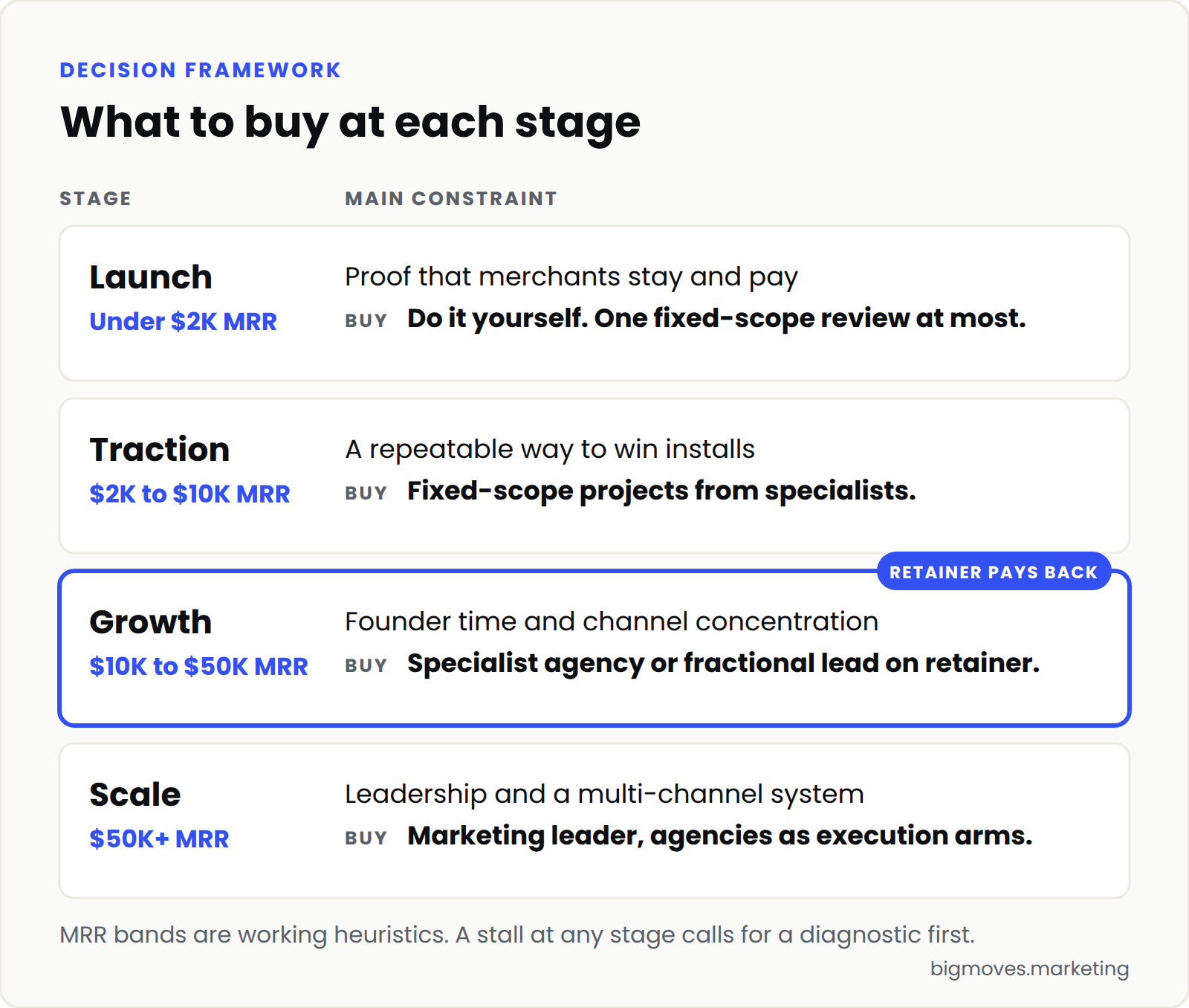
Where you are. The app is live. You have fewer than 50 paying merchants and a handful of reviews.
The constraint. Proof. You are still learning which merchants get value, which feature they came for and what they will pay.
The right help. Yourself. Talk to every merchant who installs. Write the listing from their words. Run a small exact-match ad test on three or four high-intent terms to learn which searches convert. Work toward the Built for Shopify thresholds of 50 net installs on paid plans and five reviews, because that milestone makes every later investment more productive.
Hold for later. Any retainer. At this stage an agency would be optimizing a message you have yet to validate. A single fixed-scope listing or positioning review is the most outside help that pays back here.
Where you are. Merchants pay and stay. Growth arrives in bursts, usually after a listing change or a feature launch.
The constraint. Repeatability. You need a dependable way to win installs and convert them.
The right help. Fixed-scope projects from specialists. A listing rebuild. A Search Ads account structure with match types and negatives set correctly. A review request system timed after the first paid charge. An onboarding audit. Each has a clear deliverable and a price you can weigh against a month of revenue.
Hold for later. A full retainer. The payback math in the next section rarely works at this level, because the fee consumes most of the MRR it is meant to grow.
Where you are. The engine works. Installs come steadily from App Store search and ads. You have one channel and very little spare time.
The constraint. Founder hours and channel concentration. Listing tests, ad management, content and partnerships all need weekly attention, and all of it depends on you.
The right help. A specialist agency or a fractional marketing lead on retainer. This is the stage where the hire pays back most reliably. Revenue supports the fee, the data supports real decisions, and the upside of a second channel is large. Ask for a 90-day plan with a scorecard before you commit to longer.
Hold for later. A full-time senior marketing hire. One person at this stage becomes a generalist stretched across five disciplines.
Where you are. You lead or challenge in your category. Competitors bid on your name. Growth from the App Store alone has slowed.
The constraint. Leadership and system. The business needs someone who owns the marketing number, sets priorities across channels and manages specialists.
The right help. A senior marketing leader, fractional or full-time, with agencies and freelancers as execution arms for ads, content and partnerships. The channel mix widens here. The website, partner referrals and visibility in AI answers move from side projects to primary investments.
Hold for later. Nothing by default. The risk at this stage is fragmentation: four vendors, four reports and nobody accountable for the whole.
When installs or MRR decline for two consecutive quarters, pause before buying execution. Commission a fixed-scope diagnostic first. A two-to-four-week audit of the Partner Dashboard, ad account, listing, onboarding and churn data usually isolates the cause. The stall may trace to ranking, to conversion, to retention or to a market that has moved to other channels. Each cause calls for a different hire.
Stage tells you whether to consider an agency. Arithmetic tells you whether you can afford one. Four steps settle it.
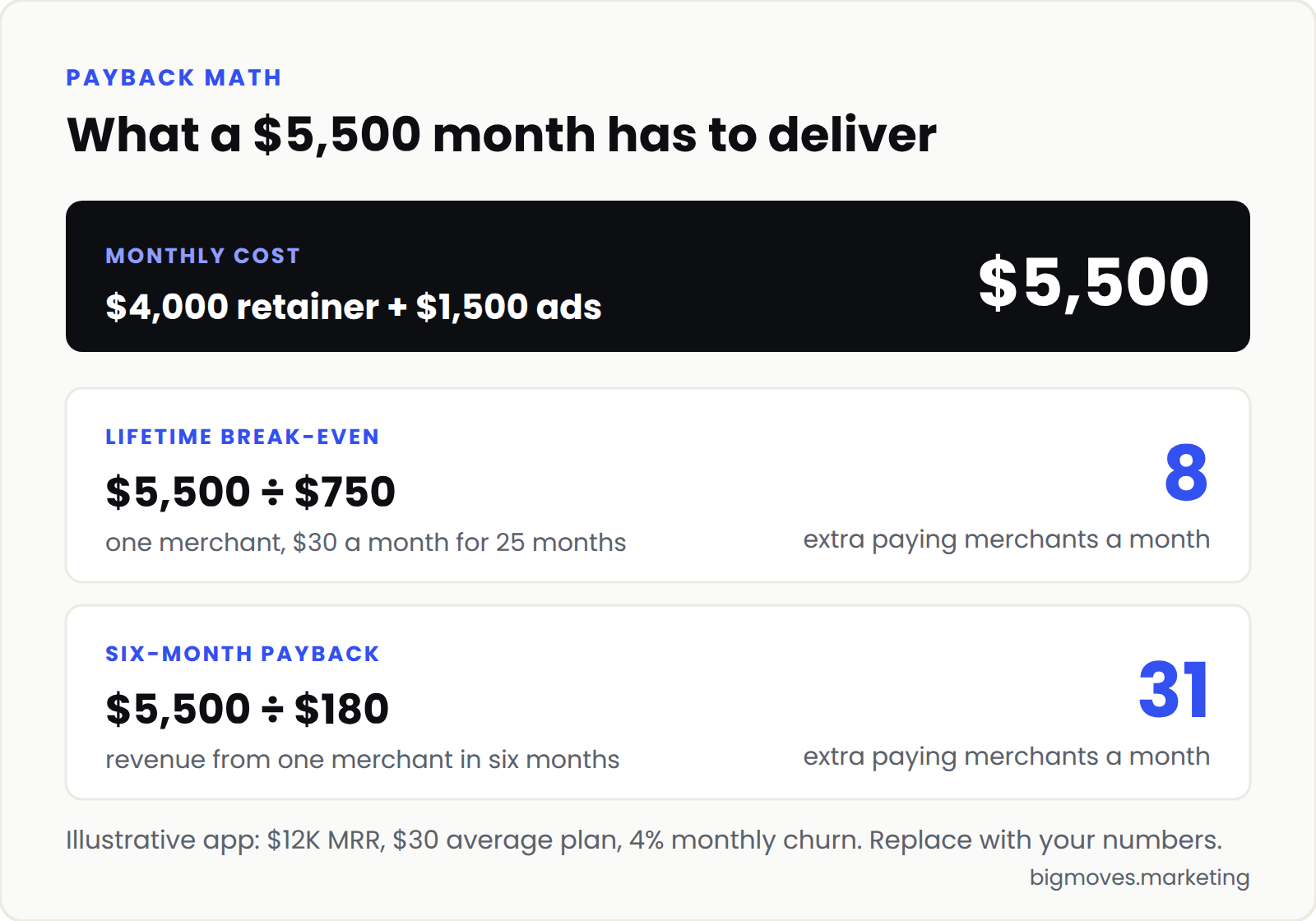
Take an illustrative app at $12,000 MRR with a $30 average plan and 4% monthly churn. That is 400 paying merchants with an average lifetime of 25 months, so each is worth about $750. A $4,000 retainer plus $1,500 in ads costs $5,500 a month.
Lifetime break-even needs $5,500 divided by $750, which rounds up to 8 extra paying merchants a month. Six-month payback needs $5,500 divided by $180, which rounds up to 31.
Now compare those numbers with reality. If the app adds 25 new paying merchants in a normal month, 8 more is a 32% lift. A competent engagement can reach that. An extra 31 means more than doubling paid acquisition, which is a stretch in the first two quarters.
Three cautions keep the model honest. Churn estimates from a young app are fragile, so test the math at a higher churn rate. Marketing results lag, and listing and content work often take a full quarter to show. Attribution inside the App Store is imperfect, so agree in advance on how “extra” will be measured against your baseline.
A practical rule follows. If the lifetime break-even number exceeds the paying merchants you add today in a month, a retainer is premature. Buy a project instead.
Credentials look similar across agency websites. Questions separate them. Ask these eight and listen for specifics.
Six signals call for caution:
A well-run engagement follows a recognizable arc. Use it as a yardstick.
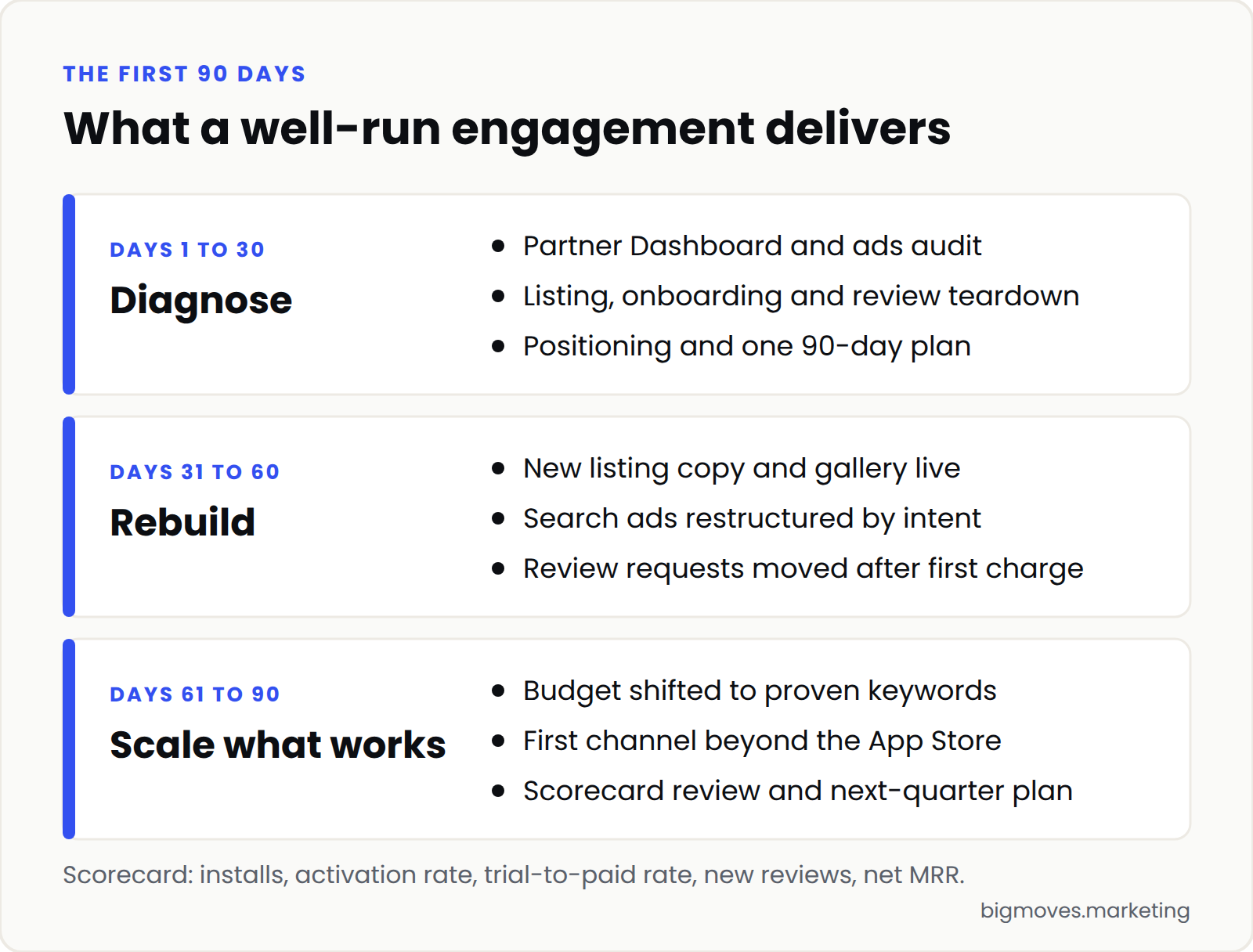
Days 1 to 30: diagnose. The agency audits the Partner Dashboard, the ad account, the listing, the onboarding flow and the review profile. It interviews you and, ideally, a few merchants. The month ends with a positioning statement, a baseline scorecard and one prioritized 90-day plan.
Days 31 to 60: rebuild. The highest-impact fixes ship. New listing copy and gallery go live. Search ads are restructured by intent, with exact match on proven terms and negatives in place. Review requests move to the right moment. Onboarding changes enter your engineering queue.
Days 61 to 90: scale what works. Budget shifts toward keywords and messages that produced paying merchants. The first channel beyond the App Store starts, usually comparison content or a partner program. The quarter closes with a scorecard review against the baseline and a plan for the next 90 days.
By day 90 you should hold three things: a clear record of what was tested, movement on at least one conversion metric, and a sharper view of your merchant than you had at the start. Revenue impact often trails by a further quarter.
A fair guide includes the opposing view. Plenty of successful Shopify apps reached meaningful revenue with the founder running marketing, and their reasons hold up.
Founders know the merchant better than any outsider can in a quarter. In the App Store, product decisions are marketing decisions. A faster onboarding, a free plan or a new integration can move installs more than any campaign. A founder who answers support tickets sees the exact words merchants use, and those words win search queries and write listings.
Shopify's documentation is also unusually complete. The rules for listings, ads, reviews and Built for Shopify are public. A disciplined founder with four hours a week and a simple scorecard can run the fundamentals through the first two stages.
The limit arrives when those four hours stop being available, or when growth requires skills beyond the fundamentals: partnership development, a content engine, lifecycle programs. That moment tends to arrive in the growth stage. It is the honest trigger for outside help.
A Shopify app marketing agency helps app developers win and keep paying merchants. Its core work covers positioning, App Store listing optimization, Shopify App Store ads, review programs that follow Shopify policy, onboarding and activation, and support for reaching Built for Shopify thresholds. Stronger agencies also build channels beyond the App Store, including the marketing website, comparison content, partnerships with complementary apps and service agencies, and visibility in AI assistants. The work is measured against revenue outcomes such as activation rate, trial-to-paid conversion and net MRR, with install volume as a supporting metric. It differs from a Shopify store agency, which markets physical products for merchants and works with a different buyer and channel set.
Cost depends on the model you buy. Fixed-scope projects such as a listing rebuild or an ad account setup carry a one-time fee. Retainers bill monthly and typically run for at least three months, with ad spend paid to Shopify on top. Senior leadership costs more: the Big Moves guide to fractional CMO pricing places typical B2B SaaS engagements at USD 5,000 to 15,000 a month. Quotes vary widely across the market, so a price list matters less than payback. Divide the full monthly cost by the lifetime value of one paying merchant. The result is the number of extra merchants the engagement must add each month to justify the spend.
The strongest case arrives in the growth stage, at roughly $10K to $50K MRR. By then the product has proven that merchants stay and pay, revenue supports a retainer, and the founder's time has become the bottleneck. Earlier stages reward a different approach. Under about $2K MRR, founder-led marketing teaches more than any outside team can. Between $2K and $10K, fixed-scope projects from specialists deliver focused gains at an affordable price. Above $50K MRR, the need shifts toward senior marketing leadership with agencies in an execution role. These bands are heuristics. A stall in installs or MRR at any stage justifies a diagnostic before any larger commitment.
An agency can help with part of it. Built for Shopify requires at least 50 net installs from active shops on paid plans, a minimum of five reviews and a minimum recent rating. Those are marketing outcomes, and a specialist can accelerate them through listing work, targeted ads and a compliant review program. The program also sets technical standards for performance, design and embedded admin experience. Your engineering team owns those. Shopify makes the final decision on every application and reviews certified apps annually, so status is earned continuously. Treat any agency that promises the badge as a guaranteed deliverable with caution.
Choose by the gap you need to close. If you know what needs doing and lack the hands to do it, an agency supplies a team and a playbook. If you are unsure what to prioritize, or you already manage several freelancers without a unifying plan, a fractional CMO supplies senior judgment, a strategy and accountability for the number. Many apps in the growth and scale stages use both: a fractional leader sets direction and manages specialists who execute. Some specialist firms combine the two roles in one engagement. Ask any provider plainly whether you are buying strategy, execution or both, and who will do each.
Expect signals in the first quarter and revenue impact in the second. Search ads respond fastest, often within weeks, because bids and keywords change daily. Listing changes need several weeks of traffic to read clearly. Review programs build gradually, since only merchants on paid plans can review. Content, partnerships and AI visibility compound over two or more quarters. A sound engagement sets a baseline in month one and reports against it monthly, so progress shows in conversion metrics before it shows in MRR. Ask for that baseline in writing. Plan for a 90-day checkpoint with clear criteria for continuing, adjusting or ending the work.
Skip the agency shortlist for now. Start with three numbers from your Partner Dashboard: MRR, new paying merchants per month and monthly churn.
Place yourself on the stage framework. Run the payback math with your own figures. Then write one sentence that names your constraint: proof, repeatability, founder time or leadership.
That sentence tells you what to buy. A founder who knows the constraint hires well, briefs well and measures well. The agency question answers itself from there.
Big Moves Marketing works with Shopify app teams across these stages. The Shopify app growth page outlines how.



%20-%20white.svg)