The most repeated advice in SaaS marketing is to publish more. Post weekly, build topical authority, let compounding do the work. Founders hear it, hire a content lead, and twelve months later own a library that sales never opens and a dashboard nobody trusts.
The advice isn't wrong so much as it's aimed at the wrong problem. Content doesn't create pipeline because of how much of it exists. It creates pipeline when it removes a specific reason a buyer refuses to move forward. A migration note that kills the fear of switching does that. A pricing assumptions page that answers procurement does that. A case study from an account shaped like the buyer's own does that. A thousand-word explainer on an industry trend does not.
That distinction changes what you build, who you build it for, and how you decide whether it earned its budget.
Nearly every SaaS company publishes. The blog exists, the cadence is consistent, and the posts are competent. That's precisely why publishing stopped being an advantage. When the same formats are available to every competitor at the same cost, volume stops differentiating and starts hiding the problem.
The Content Marketing Institute's 2025 B2B trends research quantifies the paradox: 58% of B2B marketers rated their content strategy only "moderately effective." Almost everyone ships. Most know it isn't working.
Three failures explain the gap, and they show up in the same order every time.
One persona, educational posts. The program writes for whoever searched, usually a manager with a named problem. Nobody writes for the security lead who has to sign off, or the finance partner who wants a total cost picture. The article gets read. The deal still stalls.
No defined offer on the page. Every post ends with the same demo request. A reader who wants a comparison, a pricing assumption or an implementation timeline gets nothing to act on, so they leave and ask an AI tool instead.
Reporting on sessions instead of pipeline. Traffic climbs, the dashboard goes green, and nobody can say which page preceded a closed deal. Content then gets budgeted on faith and cut the first time revenue dips.
A founder-led company I'd recognize anywhere has forty well-written posts, one demo form and no answer to "which article touched the last five deals." The writing isn't the problem. The content has no commercial job.
Apply it today: pull ten live assets and write the buying question each one answers. Anything you can't label is a removal candidate, not a rewrite candidate.
Content is a commercial system that supplies the evidence a buyer needs to move a decision forward. Four questions decide whether yours qualifies. Which formats do which job. Who has to be convinced. How search and paid channels earn their budget. How you measure impact when buyers never click through. For teams rebuilding the editorial engine behind that system, this content strategy for SaaS marketing teams is a useful reference on structuring production around intent rather than keyword lists.
Choose the evidence first, then the format. A video earns its production cost when it demonstrates something a buyer needs to see. A case study earns its place when it resolves doubt about execution. Publishing either because competitors do creates activity without a clear commercial purpose.
A global survey of 1,186 B2B marketers, conducted between June and August 2024, reported usage of short posts at 92%, video at 76%, case studies at 75%, long-form articles at 69%, and e-books or white papers at 51%, according to Content Marketing Institute's statistics roundup. Those adoption rates describe format popularity. Use the buying job to decide what deserves your budget.
| Format | Buying-journey job | Evidence it provides |
|---|---|---|
| Short articles or posts | Help buyers discover and name a problem | Relevance to an issue they already recognize |
| Video | Show the product and team in use | Visible workflows and credibility of the people behind the product |
| Case studies or customer stories | Reduce risk during vendor evaluation | Outcomes in comparable accounts |
| Long-form articles | Explain a costly operational problem | A strategic point of view on the category |
| E-books or white papers | Support detailed evaluation | Depth on decision criteria |
| Original research or data reports | Make market change legible | Proprietary evidence buyers can use to assess the problem |
Original research deserves a separate decision. An analysis of 300 B2B SaaS websites found organic traffic growth of 29.7% among sites producing original research, versus 9.3% among those without it, as reported in Shno's content-led growth statistics. That is a traffic comparison, not proof of pipeline impact. Commission research when its findings will help buyers understand market change or defend a decision. Traffic alone cannot justify the investment.
Give these formats different briefs.
According to RevenueZen's SaaS content marketing statistics, 55% of B2B buyers say thought-leadership content has significantly influenced their purchasing decisions, while 70% of B2B marketers consider case studies the most effective format for converting leads into deals.
Thought leadership helps a future buyer understand a problem before a project has budget. It needs a defensible point of view and a reason to reconsider current practice. Product-led copy weakens that job by rushing toward a sale before establishing the problem.
A case study supports an active evaluation. Show the starting problem, the work performed and the outcome so readers can assess whether the experience applies to their account. Praise without execution detail leaves the rollout question unanswered.
Choose the next format by the decision it can advance. If buyers understand the problem but doubt delivery, prioritize a case study over another educational article. For demonstrations and live discussion, B2B experiential content that builds trust explains how videos and webinars can carry evidence beyond brand polish.
Judge that choice by the friction removed and the cost per qualified opportunity. A popular format with no role in advancing evaluation is an expensive publishing habit.
One persona with educational posts is the default because it's easy to brief. It also explains why so many SaaS deals go quiet after a strong first call. Complex purchases get evaluated by a group, and each member of that group is looking for a different kind of proof.
Leadwalnut's analysis of B2B content marketing puts a number on the failure: more than 40% of B2B deals stall because buying groups are misaligned. It also notes that buyers increasingly use AI tools to synthesize vendor research before they ever speak with sales. Your content is being read by people you never meet, then summarized to a committee you never address.

Write for the objection, not the funnel stage. Funnel stages describe where a buyer sits. Objections describe why they won't move, which is the only thing content can solve.
For each major use case, build a buyer-ready evidence bundle: a plain-language business case, an implementation timeline, security and compliance answers, migration risks, integration limits, pricing assumptions, customer proof from a comparable company, and a one-page internal summary your champion can forward without rewriting it.
That summary matters more than many teams realize. The champion is doing internal sales on your behalf, often poorly, often from memory. Give them the artifact and the deal moves.
Contrarian content is the most underused asset in this set. Publishing who should not buy, where a competitor wins, and what adoption typically fails on looks like commercial self-harm. It lowers perceived risk, and lower perceived risk is what unblocks a stalled committee. Feature-heavy thought leadership raises confidence in the product. Honest limitations raise confidence in the vendor.
Regional rule: procurement and regulatory expectations differ by market. A claim backed only by U.S. customer evidence will not satisfy a European buying committee. Publish proof from the markets your buyers operate in.
Messaging is where this starts. If the value proposition is written for one reader, no amount of downstream content fixes it. These B2B messaging examples show how the same product truth gets expressed differently for each stakeholder who has to say yes.
Search gets treated as a traffic line on a dashboard. It's better understood as an asset that appreciates, and as the only channel where a page published this quarter still earns attention in three years.
The numbers from Widelly's SaaS marketing benchmark report show how large that asset can be. Across 312 B2B SaaS companies, organic search generated 33% of total website traffic for the median company, with top-quartile companies reaching 52%. Median visitor-to-lead conversion was 2.1%, while gated-content landing pages converted at 22%.
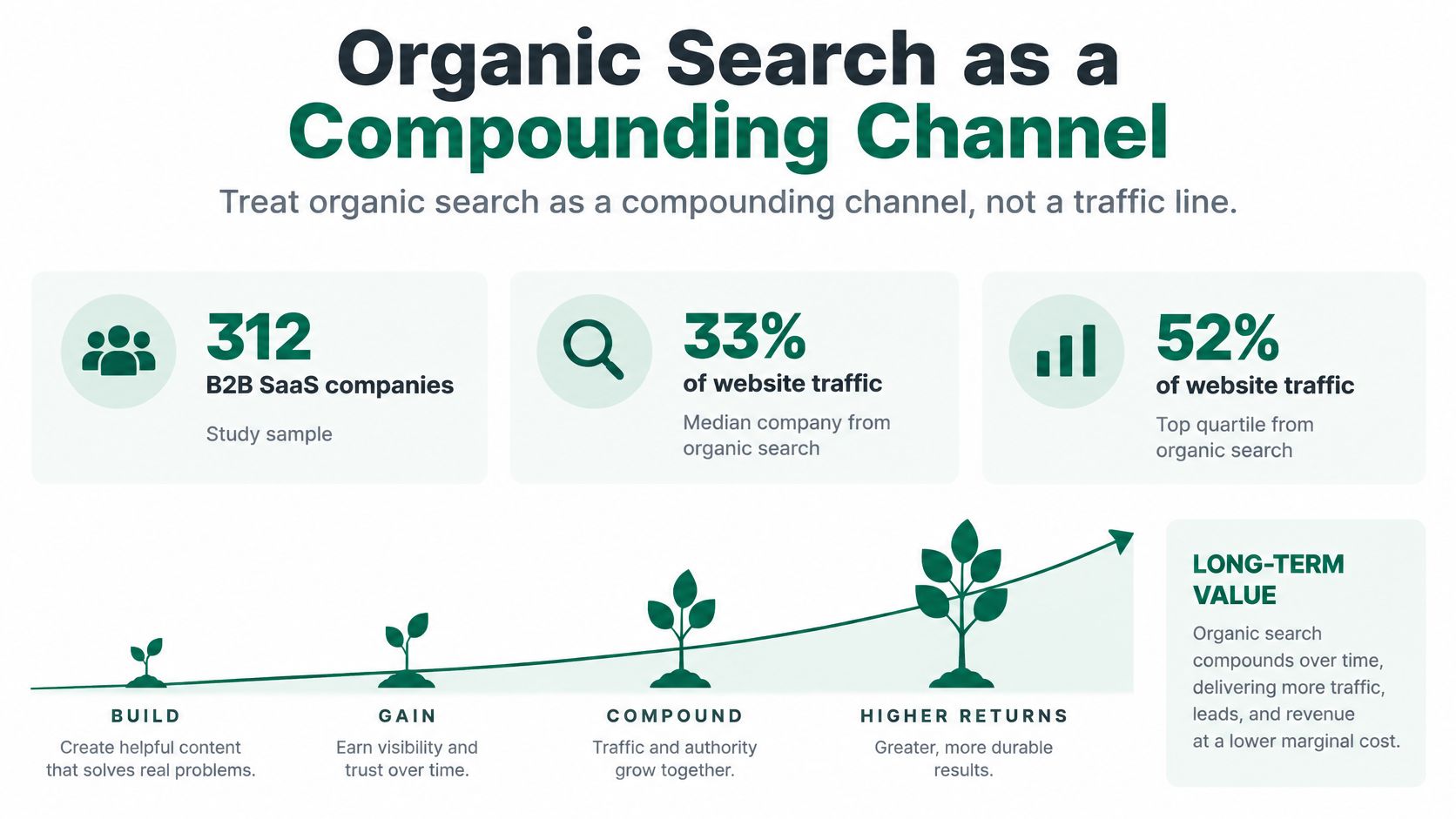
Those two conversion figures are the whole argument. Educational articles pull high-volume, low-intent queries and convert near the median. A gated asset aimed at a reader who is already evaluating converts roughly ten times better. Traffic is not the goal. Traffic reaching the right offer is.
Most programs optimize one layer and wonder why the result doesn't compound.
Search intent. Pick the queries your buyers type when a problem becomes urgent, not the ones with the biggest volume.
Content-to-offer relevance. Move readers from the educational article toward a problem-specific guide, a comparison page, a calculator or a demo-oriented solution page. Internal links do this work, and most sites waste them on "related posts" that lead nowhere.
Lead-capture mechanics. Define the conversion event on every page before it publishes. A page with no event is a page you can't judge.
Aggregate sessions hide everything useful. Report organic performance by query cluster and funnel stage, and track rankings, engaged visits, assisted conversions, visitor-to-lead rate and pipeline influenced for each cluster separately. Treat 2.1% as a directional baseline, then hold high-intent solution pages to a materially higher bar than broad educational content. When that discipline is in place, search stops being a cost center. Our own SEO and content strategy work tripled Drone Industry Insights' quarterly sales, and the mechanism wasn't traffic volume. It was matching pages to the questions buyers ask immediately before they commit.
A channel-level diagnostic helps here. A Lead Spot benchmark report places median B2B website conversion at 2.9%, with organic search at 2.6%, email at 2.4%, paid search at 1.5% and paid social at 0.9%. One blended site-wide rate conceals which of those is broken.
Pilot it narrow. Choose one ICP problem, publish one authoritative cluster around it, and instrument every page with consistent analytics, CRM campaign tracking and defined conversion events before you judge the result.
Distribution is usually treated as paid amplification. Buy a little reach, then ask the content to convert on its own. That's the wrong tool for the job. Paid reach gets an asset in front of strangers. Owned and earned channels get it in front of the people already inside a deal, which is where committees form.
Founder-authored LinkedIn posts do work no blog can. They carry the same argument to executives who already trust the founder's judgment, and they arrive in a feed where those executives are half-listening. Take one long-form argument and split it into five posts over two weeks. Each post should name one buying question and answer it in a paragraph. That's not repurposing. It's putting the argument where the buyer already is.
Email is where a high-intent asset reaches a committee. Send the business case or the security answers to a known contact, then ask the champion to forward the internal summary. One email with the right attachment does more for a stalled deal than another top-of-funnel post ever will.
Partners and integration ecosystems reach buyers who already own the adjacent problem. That's cheaper than syndication and far more credible when the partner co-authors the proof.
Customers will share case studies inside their own networks if you hand them a clean, shareable summary and a reason to be quoted. Many teams publish the case study and never ask.
Operating rule: every asset gets one owned channel, one named internal sponsor and a follow-up sequence matched to the role it serves. No sponsor means no distribution.
The pattern behind weak distribution is a program that can report audience growth but not revenue contribution. That gap almost always means distribution stops at the first click. Somebody published, somebody shared, and nobody carried the asset into the conversation where the decision gets made.
If you want a channel that reaches practitioners where they already argue about tools, the approach in this guide to B2B Reddit marketing is closer to earned distribution than anything a paid media plan buys.
Attribution broke and many teams haven't admitted it. A buyer meets your company inside an AI-generated comparison, forms an opinion, then arrives three weeks later through direct traffic or a sales conversation. Your analytics records a direct visit and credits nothing. Loudface's research on B2B SaaS marketing and AI search reports that 94% of business buyers use AI during the buying process, and that twice as many buyers now name generative AI or conversational search as a meaningful information source compared with other sources.

Last-click reporting can't see any of that, and inventing a precise attribution number is worse than admitting the gap. Treat content as an evidence system and measure the evidence trail instead.
Add one comparative measure: win rates among accounts exposed to content versus accounts that weren't. That's where content earns an argument with finance.
The hard question is sample size. How many accounts, which tagging model, which CRM workflow separates genuine influence from coincidence? For early-stage companies, the honest answer is that low volume makes statistical confidence a fantasy for the first year. Use cohort comparisons and structured sales feedback logged in the CRM instead of pretending a dashboard is significance.
The practical work on an AI search optimization framework helps: fixed prompt sets, monitored monthly, become a leading indicator long before revenue confirms it.
The video below walks through how AI summaries now sit between your content and the buyer.
Content also has to be legible to the systems doing the summarizing. Visible update dates, stated limitations, customer evidence, pricing context and explicit category comparisons are the details an AI tool needs to place you on a shortlist, and they happen to be the same details a buying committee needs. Our breakdown of how Google AI overviews are reshaping the B2B buyer journey covers the page-level changes that make a difference.
Write the measurement plan before you publish the cluster. Later, when someone asks what the content did, you'll have a baseline instead of an argument.
Cost per lead is the most misleading number in B2B marketing because it stops one step too early. A channel that delivers cheap leads your sales team rejects is more expensive than a channel that delivers fewer leads it closes. Lead Spot's benchmark compilation publishes ranges that let you run the comparison properly.
| Channel | MQL-to-SQL conversion | Bottom-of-funnel cost per lead | Where it fits |
|---|---|---|---|
| Events | 7%–15% | $500–$1,500 | Stronger qualification, substantially higher spend |
| Content syndication | 6%–8% | $200–$400 | Scaled distribution that needs careful nurture |
| LinkedIn Ads | 2%–4% | $350–$800 or more | Precise account and role targeting at higher cost |
| Google Ads | 1%–3% | $300–$750 | Capturing existing demand with lower qualification rates |
These are indicative ranges, not universal standards. Run them against your own definitions and they still tell you more than any single-channel report.
Divide cost per lead by conversion rate and you get an estimate of cost per sales-qualified lead. Watch what happens.
Events land between roughly $3,300 and $21,400 per SQL. Content syndication lands between $2,500 and $6,700. LinkedIn Ads land between $8,750 and $40,000. Google Ads land between $10,000 and $75,000.
The channel with the highest cost per lead isn't the most expensive channel. Events look expensive at $500 to $1,500 a lead and often turn out to be the cheapest qualified opportunity in the table, because a third of the range converts at double-digit rates. Paid search looks cheap per lead and can be the most expensive per SQL by an order of magnitude.
That's not an argument against paid search. It captures demand that already exists, which is valuable when a category is mature. It is an argument against choosing channels on cost per lead.
Decision rule: if two channels produce the same number of SQLs, the one with the higher conversion rate usually has the better sales conversation attached. Pay for that.
Operate accordingly. Measure every pilot against agreed MQL, SQL, pipeline and revenue definitions, track source at the lead level, and allow enough follow-up time for a slow deal to close before you judge conversion. Optimizing for cheap leads reliably funds the channels that generate volume without generating qualified opportunities.
Stop planning a calendar. Plan one bet: a single ICP problem, one content cluster around it, and one evidence bundle built for the committee that will evaluate it. A quarter spent building that beats a quarter spent publishing twelve unrelated posts, and it produces something you can judge.
Then stop doing three things. Stop gating every asset by default, because gating a security answer costs you the committee. Stop approving channels sales never accepts, which is a definitional problem disguised as a media problem. Stop treating a founder's LinkedIn post as a substitute for a buyer-ready page. The post creates interest. Only the page closes the gap.
If sequencing matters for your next two quarters, this 2026 demand generation campaign sequence is a workable structure for ordering the work.
We do this alongside product owners, founders and sales-marketing teams: choosing the problem, building the evidence, and instrumenting it so the result is provable rather than arguable. The work is plan and execute together, not a deck that hands off. Multi-channel demand generation took Sastrify from zero leads to 200 qualified prospects, and the reason it worked wasn't creative brilliance. It was picking a narrow problem and building the whole system around it.
Content earns its place when it shortens a deal. Not when it ranks. Not when it fills a form. If your program can't name the deal it shortened this quarter, it hasn't earned a budget increase yet. Fix the evidence before you fix the volume.
If your content library is bigger than your pipeline influence, the problem is positioning and evidence, not output. Big Moves Marketing works as a strategic growth partner with B2B SaaS founders and revenue leaders, building the content system, the committee-level assets and the measurement that proves what each one did. Visit Big Moves Marketing to talk through the first bet worth making.