%20png%20copy.avif)

Publishing more isn't an SEO content strategy. It's a production decision made before anyone has proved that the topic attracts the right buyer, answers a real decision question, or gives that buyer a credible reason to speak with sales.
For a B2B SaaS company with product-market fit, SEO content should do more than earn visits. It should make the company easier to discover, evaluate, and trust, then connect that discovery to qualified pipeline. That calls for an evidence library, not a bigger blog calendar.
The common advice is to publish consistently and let traffic compound. But publishing volume doesn't fix weak positioning, vague audience definition, or content that never reaches a commercial decision. A page can attract attention and still have no useful role in the buyer's journey.
The underlying problem is that teams often treat SEO as a list of keywords rather than a system for making the company discoverable and credible. Product-market fit doesn't automatically give a company a clear category position. A founder-led sales team may still be working out which use cases matter most, while marketing publishes broad explainers that could belong to any competitor.
The result is a library of articles with little original evidence, weak internal connections, and no clear next step. After the initial burst of production, rankings plateau or the pages bring in visitors who aren't in the ICP. The content exists, but sales can't use it to answer the questions that stall a deal.
An Ahrefs analysis of roughly 14 billion pages estimated that 96.55% received no Google organic traffic, while 1.94% received between one and ten monthly visits. Ahrefs cautions that these estimates are directional, not universal benchmarks. The strategic point is clear: publishing a page doesn't make it discoverable, and a high-volume calendar doesn't guarantee demand (Ahrefs' analysis of search traffic).
For B2B SaaS, the job is to create useful, findable evidence for a defined buyer problem. That evidence might be an implementation guide, a direct comparison, an integration page, or a case study that addresses a specific objection. A practical intent-mapped SEO approach for B2B can help teams connect each topic to the buyer's problem and the business outcome the page should support.
The strategic shift: Stop asking how many articles the team can publish. Ask which buyer decisions the company needs to make easier, and what public evidence would help.
A strong SEO content program builds that evidence into a connected, crawlable library. Human buyers can evaluate it. Search engines can find it. AI systems can retrieve and summarize it. The measure of success is not content volume. It's whether the right buyers can verify the company's value and take a meaningful next step.
Keyword research is downstream of the more important question: who needs this page, and what are they trying to decide? If the team can't answer that precisely, search volume won't rescue the brief.
Start with the ICP, but don't stop at firmographics. A useful content decision requires the buying situation: who feels the pain, who evaluates the product, who approves the purchase, and what change would make the investment worthwhile. In a sales-led company, a technical evaluator may care about implementation and security while an executive sponsor cares about operational impact. In a PLG motion, the end user may arrive first and need a fast path to product value.
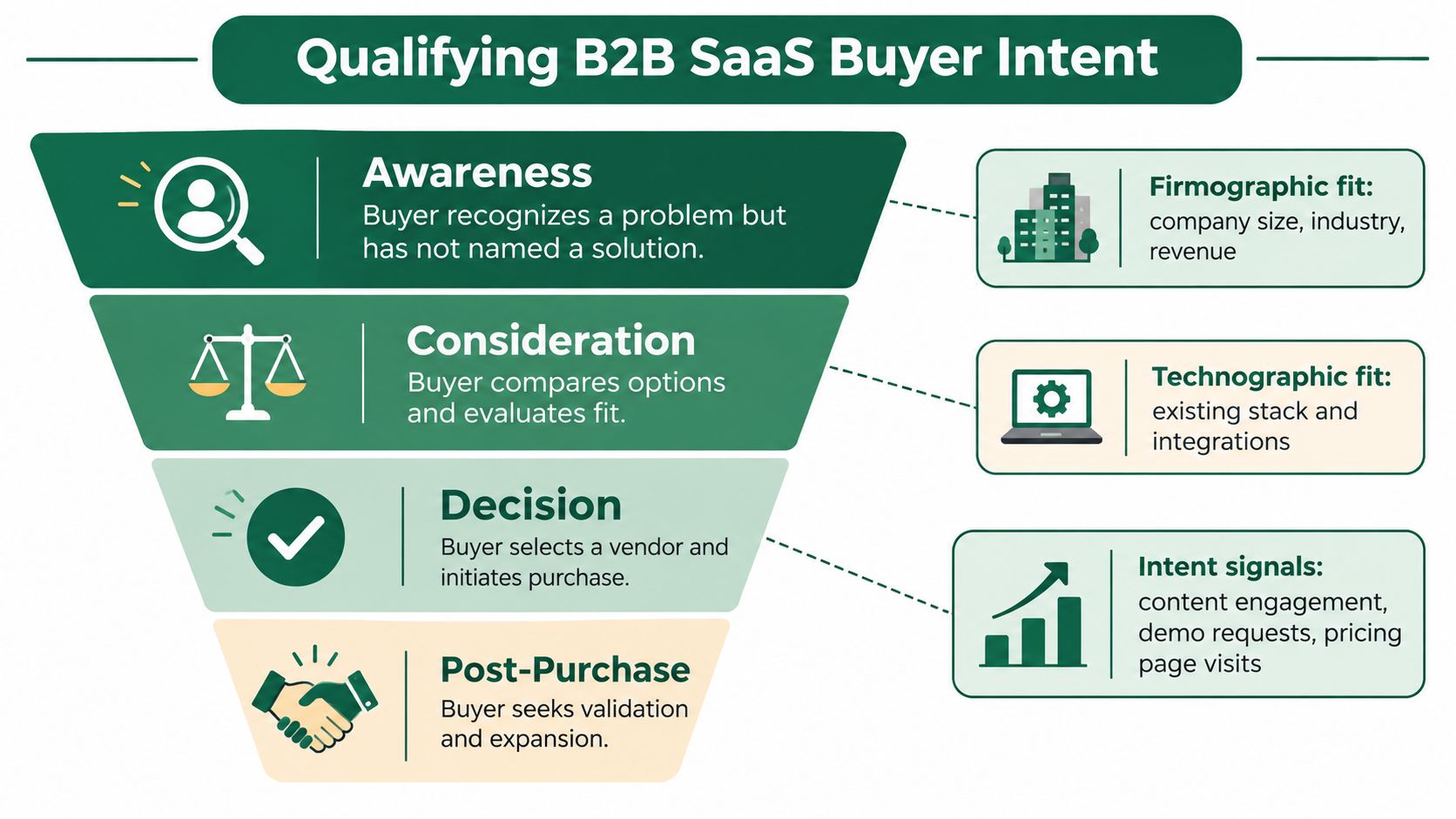
Map each topic to a buyer's actual job. Four categories cover much of the decision journey:
Before approving a topic, write down the audience, buying trigger, likely intent, and the page's intended action. Then ask whether the company has a credible, differentiated answer. If the answer is a generic summary of what every vendor says, don't commission it yet.
Use a one-page worksheet to record the ICP, buying committee role, trigger, business change, intent category, evidence available, and next action. You can build it with a growth lead in a working session, then use it to reject topics that don't fit. For an ICP starting point, adapt this ideal customer profile template.
Google primarily discovers new pages through links from pages it has already crawled. Its guidance also recommends descriptive titles and meta descriptions, and crawlable links that make important pages reachable (Google's SEO Starter Guide). That makes intent and site structure connected decisions: a useful page still needs a clear path into the site and a title that accurately signals what it answers.
A keyword is not a content strategy. It's a clue about what someone wants. The useful work is connecting that clue to a buyer problem, a page that can solve it, and a conversion event that indicates commercial relevance.
Consider a fictional data-platform SaaS company. “AI analytics” may attract broad curiosity, but it doesn't say whether the searcher is a student, an analyst, or a RevOps leader choosing software. A focused comparison page for AI analytics tools used by RevOps teams has a narrower audience and a clearer buying job. If the company has product evidence and customer proof for that use case, the narrower topic may be more commercially useful than the broader term.
A 2025 B2B SEO compilation reports that organic traffic typically produces a lower SaaS cost per lead than paid search, at about $147 versus $280. It also reports that 96.98% of clicks occur within the top ten results (Ahrefs' B2B SEO benchmarks). Those figures aren't a reason to chase every keyword. They're a reason to prioritize attainable, high-intent topics and build pages that can compete.
| Funnel Stage | Primary Intent | Content Format | Conversion Event | Ownership |
|---|---|---|---|---|
| Problem-aware | Understand the issue and its impact | Diagnostic guide or problem explainer | Relevant resource signup | Growth |
| Solution-aware | Compare approaches and requirements | Use-case guide or solution page | Product or integration page visit | Product marketing |
| Vendor-comparison | Evaluate fit against alternatives | Comparison page or selection framework | Demo request or sales conversation | Product marketing and sales |
| Implementation-or-proof | Reduce delivery and adoption risk | Technical guide, case study, or documentation | Technical consultation or qualified demo | Product and customer teams |
Choose the conversion event before production. A problem explainer might lead to a related resource. A comparison page might support a demo request. A technical implementation guide might point to documentation or a technical consultation. Don't force every reader into the same CTA.
Also make ownership explicit. Growth can own the query map and measurement, product marketing can validate positioning and claims, and sales or customer teams can supply the objections and proof that make the page useful. When a topic has no credible evidence or commercial next step, deprioritize it.
For early-stage teams, link-worthy assets can be a more durable investment than publishing another generic post. This overview of backlink tactics for indie products offers ideas for creating assets other sites have a reason to reference. The principle applies to SaaS too: make the evidence worth citing, then connect its reach to a relevant buyer action.
A content library should reflect how the company sells and how buyers evaluate, not how the editorial calendar happens to be organized. The architecture needs to make the relationship between a broad topic and its useful supporting evidence clear to both visitors and crawlers.
Take a SaaS company selling a data platform. A category overview can serve as the pillar, with connected hubs for use cases, integrations, and comparisons. Supporting pages might explain a specific workflow, document an integration, address an implementation concern, or demonstrate customer results. A case study can stand on its own as proof, but it should link to the relevant use case or product page instead of being stranded in a resource archive.
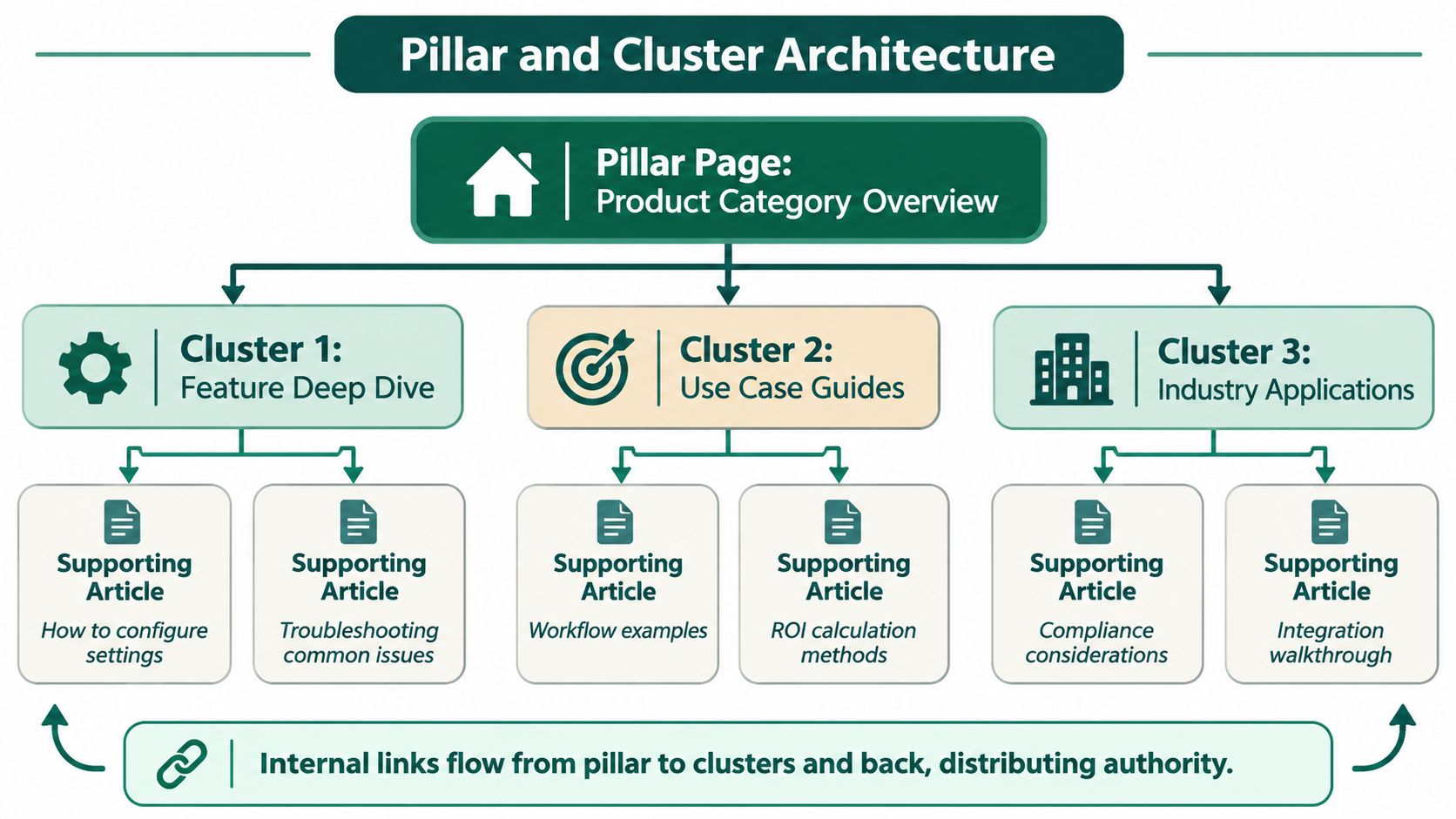
Choose a pillar only when the company has enough useful coverage to support it. A broad category page with little original material won't become authoritative because the team labels it a pillar. Define the topic, identify the distinct buyer questions beneath it, and assign each question one best page.
Then build the internal paths deliberately:
Google recommends that every important page be reachable from another findable page, that links use relevant text or image alt text, and that similar URLs be grouped to help with crawling at scale (Google's guidance on site structure and links). For a growing SaaS site, this means treating internal links as part of architecture, not a last-minute publishing task.
Review the library for overlapping pages aimed at the same intent. Consolidate duplicates, improve pages that contain distinct evidence, and remove or noindex low-value material when appropriate. A resource hub should make the best pages easier to find, not give every URL equal status. Teams developing their own topic structure can use these content pillar examples as a planning reference.
Good production starts with a decision-ready brief, not a blank document and a keyword. The brief should tell the writer what the page needs to accomplish, what it must prove, and what it must not claim. If the writer has to infer the audience, positioning, or conversion goal, the team hasn't finished the strategy work.
Use a reusable template with these fields:
Google's people-first guidance says it has no preferred word count and cautions against publishing large volumes across unrelated topics just to attract search traffic (Google's helpful-content guidance). So don't make length the definition of completeness. The writer should cover the question thoroughly enough to help the reader make progress, without padding the page to meet an arbitrary target.
Growth or SEO should own the brief's audience, intent, internal links, and measurement. Product marketing should check positioning and competitive claims. Product, engineering, customer success, or sales should validate technical details and provide evidence. One editor should resolve conflicts before publication.
The final QA should happen in one pass. Confirm that the title and headings match the page's intent, links work and lead to relevant destinations, schema accurately describes visible content, and the CTA fits the buyer's readiness. Check that the page is indexable and that the next step is obvious.
A marketing brief template can give a lean team a starting structure. Keep the workflow lightweight, but don't remove the evidence review. That's what separates decision-useful content from polished commentary.
AI search doesn't require a separate content universe. It makes a weak one easier to expose. If product claims are vague, proof is thin, and pages contradict one another, rewriting headings for AI won't fix the underlying problem.
The stronger move is evidence architecture: clear page intent, accessible content, accurate structured data, original proof, and consistent product information. Google recommends accessible pages, descriptive titles and meta descriptions, and content that people can understand. Structured data can make a page eligible for richer search appearances, but it doesn't guarantee them. Markup should describe what visitors can see, not claims added solely for a crawler.
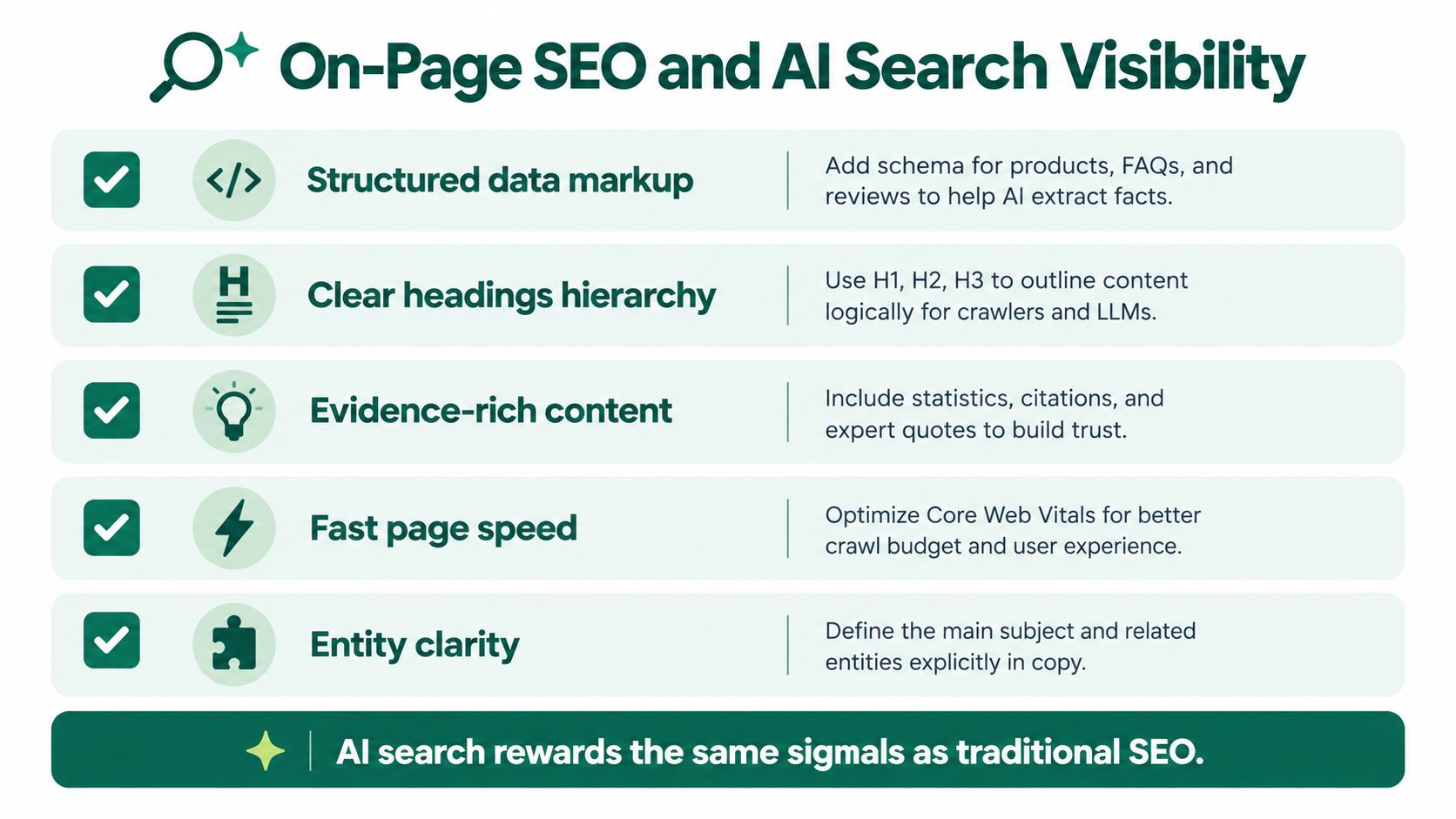
A buyer or answer system should be able to understand what the product does, who it serves, how implementation works, and where its limits are. That requires more than a polished blog post. Publish clear product documentation, comparison criteria, customer proof, implementation details, and author credentials where relevant. Keep product names, use cases, and positioning consistent across pages.
One analysis reported that Google AI Overviews increased impressions by 49% while clicks to cited websites fell by 30%, and that AI referrals replaced only about 10% of traditional search referrals (The Register's report on AI search referrals). Those reported changes reinforce a practical point: impressions alone can conceal a weaker path to site visits and business outcomes.
Track brand mentions, citation inclusion, qualified referral visits, and pipeline influence separately. Pair those signals with branded search, demo requests, and what sales hears from prospects. Don't assume that more visibility means more demand, and don't treat every decline in clicks as proof that the content has stopped influencing buyers.
For a B2B-specific view of AI Overviews and SEO, focus on the underlying question: what can a buyer verify about the company before speaking with anyone? The answer should be present in the site's evidence, not left to a generic article or unsupported positioning.
This video provides additional context for the practical overlap between traditional search visibility and AI discovery:
Publishing is the start of distribution, not the end of it. A useful page still needs people who care about the subject to encounter it, reference it, and use it in conversations with buyers. For B2B SaaS, the durable opportunities usually come from relationships and evidence the company already has, not from sending generic link requests to strangers.

Start with assets that answer a question another organization would want to reference. An integration partner may co-create a technical walkthrough because both teams serve the same buyer. A customer can help produce a case study that explains the problem, adoption process, and business result. Original research can earn attention when it contains a useful finding and the company can explain how the work was conducted. Comparison pages can help buyers evaluate options, but they need fair criteria and specific evidence rather than a disguised sales pitch.
Before producing any asset, ask: Who would share or cite this without being asked, and why? If the answer is nobody beyond your own marketing team, the idea may still be valuable for sales enablement, but don't expect it to build external authority.
Founder-led distribution matters because founders can explain the judgment behind a product decision or market position in a way a generic brand post can't. Give them a clear argument, the supporting evidence, and a link to the relevant page. Then help sales use the same page to answer objections and keep conversations consistent.
A G2-affiliated global survey found that one in three B2B buyers use AI chatbots to discover vendors, rising to more than half in technology. It also found that AI tools draw on public websites, trust centers, case studies, and product documentation (G2's 2025 buyer behavior report). The implication isn't to produce more material indiscriminately. It's to make the company's important evidence public, consistent, and easy to find.
For audience building beyond the company site, this B2B Reddit marketing playbook offers a channel-specific reference. Choose distribution based on where the relevant buyers and practitioners exchange information, not because a platform is currently fashionable.
A practical distribution plan should give each priority page a clear owner and a useful path into the market:
Don't confuse outreach activity with authority. A temporary burst of mentions that produces no lasting references or buyer engagement is a poor substitute for useful assets and credible relationships.
Use Google Search Console to review impressions, clicks, and click-through behavior. Use analytics to understand what qualified visitors do on the site. Use the CRM to connect relevant content interactions with opportunities, sales conversations, and pipeline. Pageviews are useful for context, but they can't tell you by themselves whether the content reached a buyer who could purchase.
Review performance on a regular operating cadence. After a page has enough impressions to evaluate, look for mismatches between its promise and the search snippet. If overlapping URLs compete for the same intent, decide whether to consolidate them. Retire pages that serve no useful audience or business purpose. Expand clusters when they produce qualified conversations or reveal a recurring objection that the current library doesn't answer.
Keep experiments small enough to interpret. Test a page title or conversion path against a specific hypothesis, then compare the result with the page's prior performance and downstream quality. Don't react to every rank fluctuation. The purpose of measurement is to improve decisions, not to keep the team occupied with dashboards.
The operating model is straightforward: build a connected evidence library, distribute the strongest assets through people and partners with a reason to share them, and judge the program by its contribution to qualified pipeline. That's a more demanding standard than publishing on schedule. It's also the one that matters to a B2B company trying to grow.
Big Moves Marketing helps B2B SaaS leaders connect positioning, SEO content, and go-to-market decisions to measurable pipeline. If your content program is producing pages without making the buying decision easier, visit Big Moves Marketing to discuss a more evidence-led growth plan.



%20-%20white.svg)