%20png%20copy.avif)
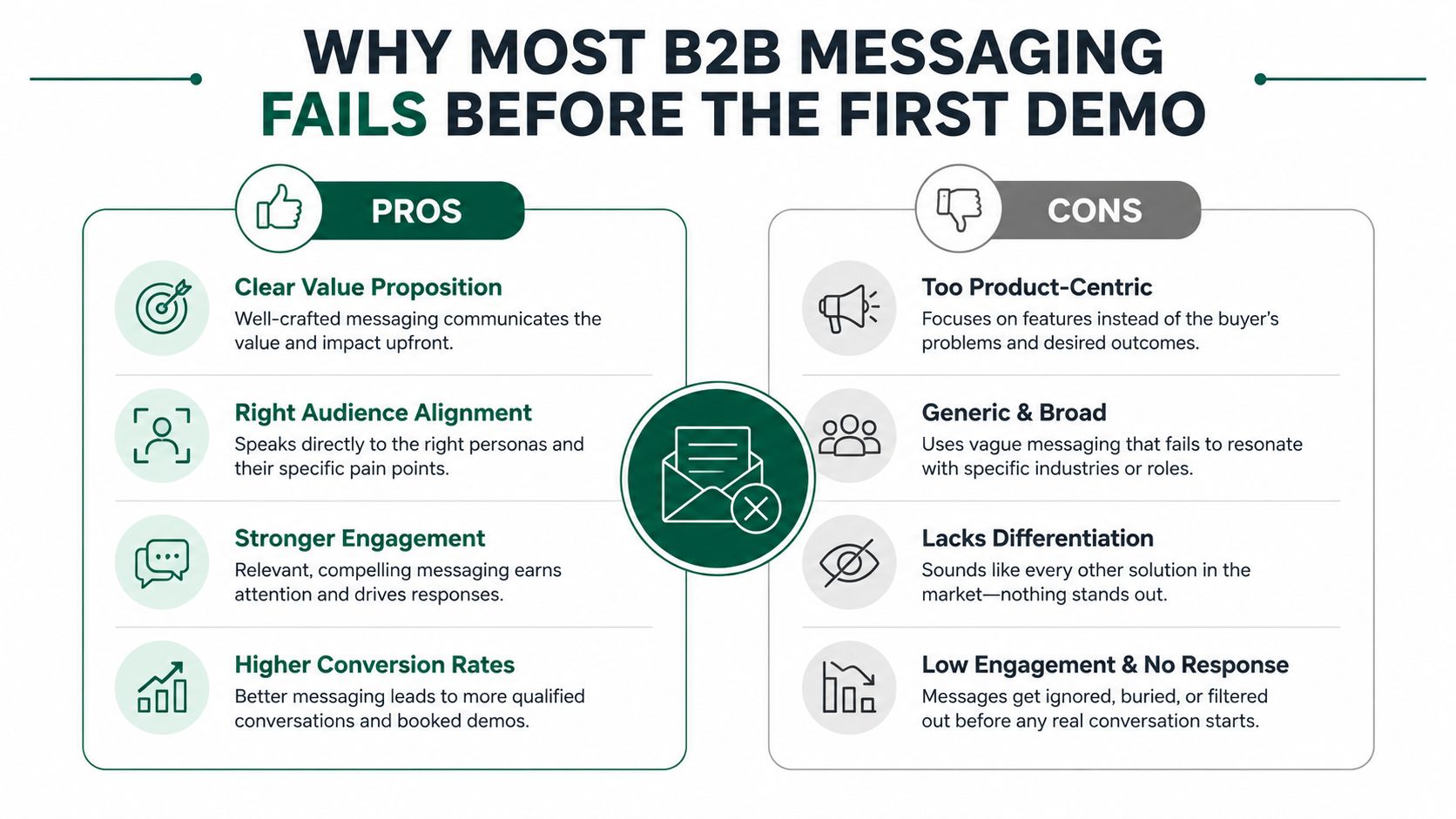
Most B2B messaging advice is wrong about what makes a message convert. Clever headlines, polished brand language, and feature-rich pages don't win when the buyer has to explain your product to someone else. Your message is a decision-making asset, not a writing exercise.
A champion forwards your homepage to finance. A security lead scans your implementation page. An executive sees a screenshot in a Slack thread with no sales context. If the message can't survive those moments, it doesn't matter how good it looks in Figma.
That standard matters because B2B buyers increasingly research without sales involvement. A LinkedIn summary of Gartner research says 61% of B2B buyers prefer a rep-free buying experience (LinkedIn summary of Gartner research). Your messaging has to educate, reassure, and create internal agreement before a salesperson enters the process.
The most popular advice says your B2B message should be memorable. That's incomplete. A message can be memorable and still fail because nobody can defend it internally.
"Unlock your team's potential” sounds harmless until a CFO asks what changes, when it changes, and how the company will know. “The intelligent operating system for modern revenue teams” sounds refined until a VP of Sales asks whether the product replaces a workflow, a tool, or a person. Cleverness creates interpretation. Interpretation creates friction.
The job of messaging is to reduce the amount of translation a buyer must do.
Many SaaS teams write for the first visitor, usually a marketing-aware evaluator. Modern buying rarely stops there. The evaluator copies the page into Slack, sends a link to an executive, or uses the language in an internal recommendation. The message now has to make sense to people who didn't attend your webinar, read your founder's post, or hear the product story from sales.
That is why the 5-second clarity test matters. A senior buyer should understand who the product serves, what problem it addresses, and what business change it creates without navigating three pages. Commentary on the state of B2B messaging in 2026 argues that many homepages fail this basic who, what, and why test while becoming increasingly interchangeable.
Practical rule: If a buyer has to ask what your product replaces, who owns it, or why the problem matters now, the message isn't finished.
B2B messaging also has to work without a guided narrative. Your website, product tour, onboarding documentation, comparison pages, and sales collateral should tell the same story at different levels of depth. The headline creates orientation. The proof creates confidence. The implementation detail removes perceived risk.
The strongest B2B messaging examples aren't the most creative lines. They're the ones that remain useful when the context disappears.
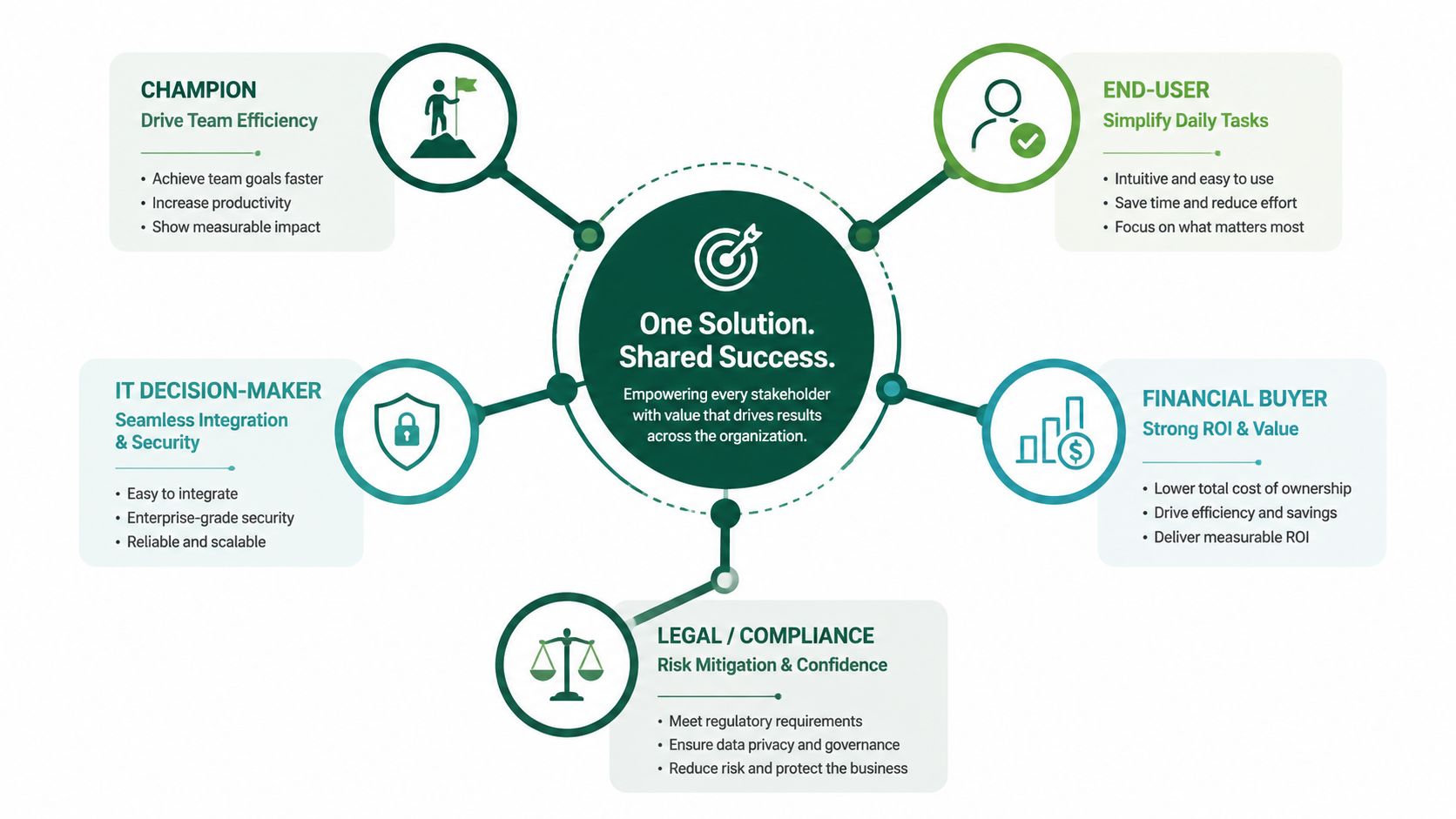
Your ICP has evolved. What used to be a single buyer profile now operates as a coalition of stakeholders, each judging the purchase through a different business need.
Forrester's 2025 Buyers' Journey Survey, summarized in a 2026 industry roundup, reports an average of 13 internal stakeholders and 9 external participants in complex B2B purchases, with public-sector purchases averaging 14 internal stakeholders (B2B buying statistics). Gartner's commonly cited benchmark places the typical B2B buying committee at 6 to 10 people (B2B buyer journey statistics). The precise group changes by deal, but the implication holds: one persona message cannot carry a complex decision.
The champion needs a credible case to share internally. The end user wants less operational frustration. IT looks for integration confidence and security evidence. Finance needs a rational economic argument. The executive sponsor evaluates strategic relevance and controlled risk.
These are different reasons to believe one story. Your messaging should give each stakeholder a usable version of that story, without creating contradictions between roles.
Deal size adds pressure. One 2026 benchmark summary reports a median buying group of 11.2 stakeholders for deals over $50K, up from 9.7 in 2024 (2026 B2B marketing statistics). Another analysis reports an average of 14.4 stakeholders in 2026, compared with 12.8 in 2022 and 11 in 2018, rising to 26.4 stakeholders for deals of $2M or more (B2B buying committee statistics).
| Metric | Earlier benchmark | Current benchmark | Impact on messaging |
|---|---|---|---|
| Complex purchase participants | 6 to 10 people | 13 internal stakeholders and 9 external participants | Build role-specific proof around one shared narrative |
| Buying group for larger deals | 9.7 stakeholders in 2024 | 11.2 stakeholders for deals over $50K | Add objection handling and financial evidence |
| Average buying committee | 11 in 2018 | 14.4 in 2026 | Make the message easy to repeat across functions |
| Very large enterprise purchase | Not specified | 26.4 stakeholders for $2M+ deals | Use layered messaging, not one headline |
The old champion-led model relied on a salesperson to explain the product as the committee expanded. Rep-free journeys remove that safety net. Your content must answer the questions buyers ask one another after the meeting ends, including why the problem matters, who owns the decision, and what evidence supports the recommendation.
Buyer confidence now depends on evidence that travels well between stakeholders. Big Moves Marketing's perspective on trust in the age of AI content offers a practical standard: replace polished claims with proof a buyer can verify and forward.
A high-performing message has a clear order. It starts with the situation, names the capability that changes it, and ends with a business outcome a buyer can evaluate.
The structure is:
The order matters. Leading with a feature forces the buyer to do the reasoning. Leading with context gives the feature a job. Adding evidence gives the claim weight.
“Streamline your workflow” is not a message. It's a category description.
A stronger version might be: “Reduce the manual work involved in preparing weekly project updates, so delivery leaders can identify blockers before they become executive escalations.” It is more useful because it names the situation, the user, and the consequence. If you have a verified customer outcome, add it directly. If you don't, don't manufacture precision.
A behavioral study involving 500 B2B professionals found that messages pairing quantified impact with emotional framing outperformed quantified-rational messages across major evaluation dimensions, while contrast improved recall (B2B behavioral messaging research). The implication is practical. State what changes, then explain why that change matters to the person responsible for it.
Personal value deserves equal attention. A cross-brand study summarized in industry research found buyers were almost 50% more likely to buy when they perceived personal value, with personal value carrying roughly twice the weight of business value (B2B messaging framework). A CFO may approve the business case, but a champion often carries the professional risk of recommending the vendor.
A defensible message connects company outcome, role-level consequence, and individual confidence.
Your headline should establish the outcome and context. The subhead should explain the mechanism and name the audience. The first scroll should provide proof, use cases, implementation information, or a clear next step. Don't hide the evidence in a case study library that nobody reaches.
For teams refining tone as well as structure, these brand voice examples to model offer useful contrast. Voice matters, but voice can't compensate for an unclear value proposition.
Use Big Moves Marketing's B2B copywriting perspective to pressure-test whether your language reflects buyer reality rather than internal product vocabulary.
One value proposition should not appear unchanged everywhere. The underlying pain-to-outcome logic stays stable, but the format must match the buyer's attention, intent, and available context.
Cold email is a low-reply channel at scale. Recent benchmarks report an average cold email response rate of 3.43%, 5.8% across 16.5 million emails in one professionally managed dataset, and about 8.5% receiving any response in a broader benchmark (cold B2B email benchmarks). That environment punishes generic introductions and rewards a narrow observation tied to a plausible business problem.
LinkedIn performs differently because identity and professional context are visible. A 2025 roundup reported a 10.3% average response rate for LinkedIn messages, compared with roughly 5% for cold email, and a 57.8% InMail open rate (LinkedIn B2B marketing statistics). Don't copy your email into a LinkedIn message. Write like a relevant peer, not a sequence engine.
| Channel | Core constraint | Before, weak | After, high-converting | Key shift |
|---|---|---|---|---|
| Cold email | Little trust and limited attention | “We help companies improve productivity.” | “You're hiring across implementation while project updates still depend on manual reporting. We help delivery teams surface blockers earlier.” | Replace broad promise with observed tension |
| Conversational, identity-rich context | “I'd love to show you our platform.” | “Your post on implementation handoffs raised a question. How are you currently tracking blockers across customer teams?” | Start a relevant conversation | |
| Website hero | Must pass the clarity test without explanation | “The future of intelligent operations.” | “Give implementation teams one view of customer risk before renewal decisions.” | Name audience, problem, and outcome |
| In-product prompt | User already has intent, but needs direction | “Explore advanced features.” | “Resolve the open handoff blocking this account. Review the owner and next action.” | Tie education to the immediate job |
The Big Moves Marketing guide to LinkedIn B2B marketing reinforces the central distinction. Channel adaptation isn't message fragmentation. It's the discipline of expressing one strategic idea in the language each buying moment can absorb.
Creating multiple messages is easy. The harder work is keeping them pointed toward the same business case.
Build one core narrative, then give each stakeholder a reason to advance it. A champion needs language to use internally. An end user needs a clear improvement to daily work. IT needs the operational boundary and integration implications. Finance needs an economic case tied to the current process. The executive sponsor needs the strategic consequence in one concise statement.
Keep these angles beside the shared product narrative, proof, implementation detail, and limitations. Do not bury them in separate persona pages. A champion forwarding your page should find the finance argument without waiting for marketing to create it.
Buyer personas earn their place when they describe decisions, risks, and desired outcomes, not demographics. Use this marketing buyer persona guide to ground persona work in practical buying behavior.
The message stays unified. The evidence changes by stakeholder.
Rep-free buying journeys make this structure necessary. Buyers need comparison content, security documentation, implementation expectations, pricing logic, and summaries they can forward internally before they agree to a meeting. Your website now carries part of the sales enablement workload.
Document the shared narrative, stakeholder angles, proof points, objections, and approved language in one working system. A B2B brand messaging framework template gives the team a practical structure for maintaining that system.
Evidence beats adjectives in B2B buying committees. Buyers need claims they can forward without risking their credibility, especially when research happens without a sales representative.
“Accelerate revenue” is only a claim. “Helped a defined customer segment reduce a documented workflow delay within a stated implementation period” gives buyers something to investigate, challenge, and use in an internal conversation.
Use the strongest evidence available:
Place a concise proof point beside the claim, then offer deeper substantiation below it. Do not hide the evidence behind a “Learn more” link. AI can mass-produce fluent language, so generic wording is cheaper while verified evidence carries more weight.
A message gains credibility when it states a boundary. “This won't replace your CRM. It gives revenue operations a reliable layer for reconciling pipeline data before leadership reporting.” The limitation clarifies the category and addresses the wrong objection before it reaches the buying committee.
Rep-free journeys demand proof that survives forwarding. A guide to writing a case study can help turn customer evidence into a reusable asset instead of a decorative logo block. Make each claim easy for a champion to share with finance, security, and operations.
A 30-day messaging rebuild works because it demands clear ownership and customer language from day one. Set a deadline, assign decision-makers, and pressure-test every claim against how buying committees evaluate vendors.
The founder or CMO owns the audit. Capture the homepage, product pages, sales deck, outbound sequences, one-pagers, onboarding screens, and internal enablement documents. Mark contradictions, unsupported claims, vague category language, and unanswered stakeholder concerns.
The Head of Growth or product marketing lead interviews recent buyers, lost opportunities, and active evaluators. Ask what triggered the search, what they repeated to finance, what created doubt, and which alternatives they considered. Store exact wording in a searchable research repository rather than scattered notes.
Marketing owns the core narrative. Sales, product, customer success, and one executive sponsor review it. Test every message against two conditions:
A shared document, CRM notes, call recordings, and a simple message matrix are enough to begin. Do not wait for a new tool.
Update the homepage hero, outbound sequence, sales one-pager, and highest-traffic product entry point first. Track qualified pipeline, stage progression, sales objections, win-loss reasons, and opportunities where stakeholders engage with revised assets. Engagement metrics matter less than whether the message helps buyers advance and helps sales explain value consistently.
A fractional CMO or strategic partner can facilitate the audit, narrative design, stakeholder mapping, and deployment sequence when the internal team lacks distance from the product. Big Moves Marketing provides positioning and messaging support across websites, sales enablement, and focused go-to-market testing.
Big Moves Marketing helps B2B SaaS leaders clarify positioning, build messaging that survives rep-free buying journeys, and connect the narrative across websites, sales, and demand generation. If your team produces activity without a message buyers can repeat, visit Big Moves Marketing to start a sharper growth conversation.

%20-%20white.svg)