%20png%20copy.avif)

Originally published on bigmoves.marketing/blog
A quiet but significant shift is happening at the top of the search results page. For years, B2B marketers have focused on one goal: rank as high as possible on Google. But a new research finding is prompting many of us to rethink what "visibility" actually means in the age of AI-powered search.
According to a TrustRadius study reported by Search Engine Journal, 90% of B2B buyers click on the sources cited inside Google's AI Overviews when they encounter them during their research process. The same study found that 72% of B2B buyers now see AI Overviews regularly during their purchasing research.
These numbers deserve more than a passing glance. They represent a fundamental change in how business buyers discover, evaluate, and trust information online — and they have direct implications for every B2B marketer, startup founder, product owner, and sales team that relies on organic search to generate awareness, leads, and pipeline.
This article breaks down what the research really means, why it matters more for B2B than any other segment, and what you can do — starting today — to position your brand as a trusted AI-cited source in your category.
Before diving into strategy, it helps to understand what we're working with. Google AI Overviews (formerly known as Search Generative Experience) are AI-generated summaries that appear at the top of search results pages for a wide range of queries. Rather than simply listing links, Google's AI synthesises information from across the web, presents a coherent answer, and then provides citations to the sources it drew from.
By October 2024, AI Overviews had rolled out to more than 100 countries, and they now appear on a significant share of commercial and informational queries — particularly those involving research-heavy, multi-step decision processes. That is precisely the kind of searching that B2B buyers do every day.
Unlike featured snippets, which pull from a single source, AI Overviews cite multiple sources simultaneously. That means more brands have the opportunity to gain visibility — but the competition for those citations is growing rapidly.
Let's look at the data more carefully. The TrustRadius study found that when B2B buyers encounter an AI Overview during their research:
The second point is especially meaningful for B2B marketers. The study notes:
"These overviews cite sources, and 90% of buyers surveyed said that they click through the sources cited in AI Overviews for fact-checking purposes. Buyers are clearly wanting to fact-check."
This is different from the behaviour observed in many B2C contexts, where AI summaries tend to reduce click-through rates. A Pew Research study from July 2025 found that general users are roughly half as likely to click links when an AI summary is present. But B2B buyers behave very differently — and understanding why explains everything.
B2B purchasing is fundamentally unlike consumer buying. The stakes are higher, the budgets are larger, the sales cycles are longer, and the number of people involved is greater. On average, six to ten people participate in a B2B buying decision, and 77% of B2B buyers describe their last major purchase as overly complex.
When a business buyer is evaluating software, services, or vendors, they are not browsing casually. They are building a case. They are preparing to justify a decision to a committee, a CFO, or a board. They need sources. They need proof. They need validation from credible third parties.
This is why the 90% click-through figure makes complete sense in a B2B context. AI Overviews serve as a first layer of synthesis — a helpful summary that saves time — but B2B buyers instinctively understand that they cannot base a high-stakes decision on a machine-generated paragraph. They click through to check.
Consider the scale of that buying journey. Research by FocusVision found that the average B2B buyer consumes 13 pieces of content before making a purchase decision — eight from vendors and five from third parties. A potential B2B buyer conducts approximately 12 Google searches before committing to a vendor. 93% of all B2B buying processes begin with online research.
AI Overviews now sit at the very top of that research journey. And the sources they cite get seen — and clicked — by the most motivated, most research-intent buyers in the market.
Here is the insight that changes everything for B2B content strategy: ranking and being cited are no longer the same thing.
Traditional SEO focused on getting your page into position one on the search results page. The assumption was simple — the higher you rank, the more clicks you get. That logic held for decades. But AI Overviews introduce a new layer. The content that gets cited in an AI Overview does not always come from the top-ranking page.
Research from BrightEdge found that 89% of AI citations come from outside the top 10 organic results. Separate research analysing 15,847 AI Overview results found that 47% of AI Overview citations come from pages ranking below position five. Content that scores highly on "semantic completeness" — the ability to provide a full, self-contained answer to a query — is 4.2 times more likely to be cited than content that does not, regardless of its traditional ranking position.
This is a significant shift in the rules of the game. It means that a well-structured, deeply authoritative article on your website can earn prominent AI visibility even if it sits at position seven or eight on the results page. And conversely, a page that has earned its place at position one through backlinks and domain authority may not be cited at all if its content is vague, thin, or poorly organised.
Kevin Indig, a respected voice in SEO, is quoted in the TrustRadius report putting this well:
"The era of volume traffic is over… What's going away are clicks from the super early stage of the buyer journey. But people will click through [and] visit sites eventually. I think we'll see a lot less traffic, but the traffic that still arrives will be of higher quality."
For B2B marketers, that last sentence is enormously encouraging. You were never trying to win a popularity contest. You were trying to reach the right buyers at the right moment. Higher-quality traffic from verified, citation-level visibility is, arguably, more valuable than high-volume traffic from broadly ranked keywords.
One of the most practically important findings in the TrustRadius research involves a common mistake that B2B vendors are making without realising it.
Many teams assume that AI models can access and learn from their gated content — white papers, reports, or guides that sit behind a lead-capture form. They cannot. AI models train on and retrieve publicly available content. If your best, most authoritative material is locked behind a form, it is invisible to AI systems entirely.
The TrustRadius report addresses this directly:
"Vendors must find the right balance between gated and ungated content to maintain discoverability in the age of AI."
This does not mean abandoning lead generation or making everything free. It means being more strategic. Consider making your strongest thought leadership content — the kind that demonstrates genuine expertise and answers complex category questions — publicly available. Reserve gating for high-value assets that serve buyers who are already deep in the funnel: detailed implementation guides, pricing tools, ROI calculators, or interactive assessments.
The ungated content builds your authority in AI systems and earns citations. The gated content converts the high-quality traffic that those citations send your way.
So what does it actually take to be cited by Google's AI? Research across thousands of AI Overview citations reveals a clear pattern of characteristics. Here is what the data shows:
Semantic completeness is the single most important factor. Analysis of 15,847 AI Overview results found that content scoring above 8.5 out of 10 for semantic completeness is 4.2 times more likely to be cited. AI systems look for content that provides a full, self-contained answer — one that does not require the reader to go elsewhere to understand the core point. For B2B content, this means comprehensive, thorough treatment of complex topics, not surface-level overviews.
E-E-A-T signals are now effectively mandatory filters. 96% of AI Overview citations come from sources with strong E-E-A-T signals — meaning Experience, Expertise, Authoritativeness, and Trustworthiness. Pages with expert authorship are 3.2 times more likely to be cited than general staff-written content. This means your content needs named authors with verifiable credentials, detailed author bios, links to professional profiles, and ideally contributions from recognised subject matter experts in your industry.
Structure enables extraction. AI systems need to be able to extract clean, accurate answers from your content. According to Digital Blacksmiths, you should lead with a concise standalone answer near the top of each page, segment details with clear H2 and H3 headings, use explicit Q&A formatting for frequently asked questions, and use numbered steps for procedural content. Think of your content as something that needs to be both human-readable and machine-parseable simultaneously.
Original data and proprietary research are powerful differentiators. Content with recent statistics, peer-reviewed sources, and authoritative citations receives 89% higher selection probability in AI Overviews. For B2B marketers, this is a compelling argument for investing in original research — surveys, industry benchmarks, client outcome data, or case study analysis. Content that contains unique data is harder for competitors to replicate and harder for AI systems to ignore.
Multimodal content outperforms text alone. Research found that pages combining text, images, video, and structured data see 156% higher selection rates in AI Overviews. For B2B content teams, this means that investing in complementary visual assets — charts, infographics, explanatory videos, comparison tables — is not optional decoration. It is a citation signal.
Technical accessibility matters. Your page must be properly indexed, free of crawl errors, and must not have directives like noindex or nosnippet that prevent AI from accessing it. Google's guidance is clear that these technical barriers will exclude pages from citation consideration entirely, regardless of content quality. Additionally, pages cited in AI Overviews show an average 18% increase in click-through rate compared to traditional organic rankings — further incentive to ensure your content is technically accessible.
Most B2B marketing teams already have a content library. The question is whether that content is working as hard as it could in the age of AI search. Here is a practical framework for assessing your current position:
Start by identifying your highest-value pages — typically the ones addressing category-level questions, comparison queries, and use-case-specific searches. These are the pages most likely to trigger AI Overviews. Use a tool like Google Search Console to check which pages are already generating impressions on high-intent queries.
For each of those pages, ask four diagnostic questions: Does this page provide a complete, standalone answer to the primary question? Is the author identified and are their credentials visible? Is the content structured with clear headings that map to specific questions? Does the page cite credible external sources or include original data?
If the answer to any of those questions is no, that page needs updating. Research from Content Marketing Institute and MarketingProfs consistently finds that aligning content with the buyer journey and creating enough quality content remain the top challenges for B2B marketing teams. An audit is the fastest way to close that gap without starting from scratch.
Also check your author bios. Add structured schema markup using JSON-LD for Article, FAQPage, or HowTo types depending on the content format. These technical additions help Google's AI systems parse and attribute your content correctly.
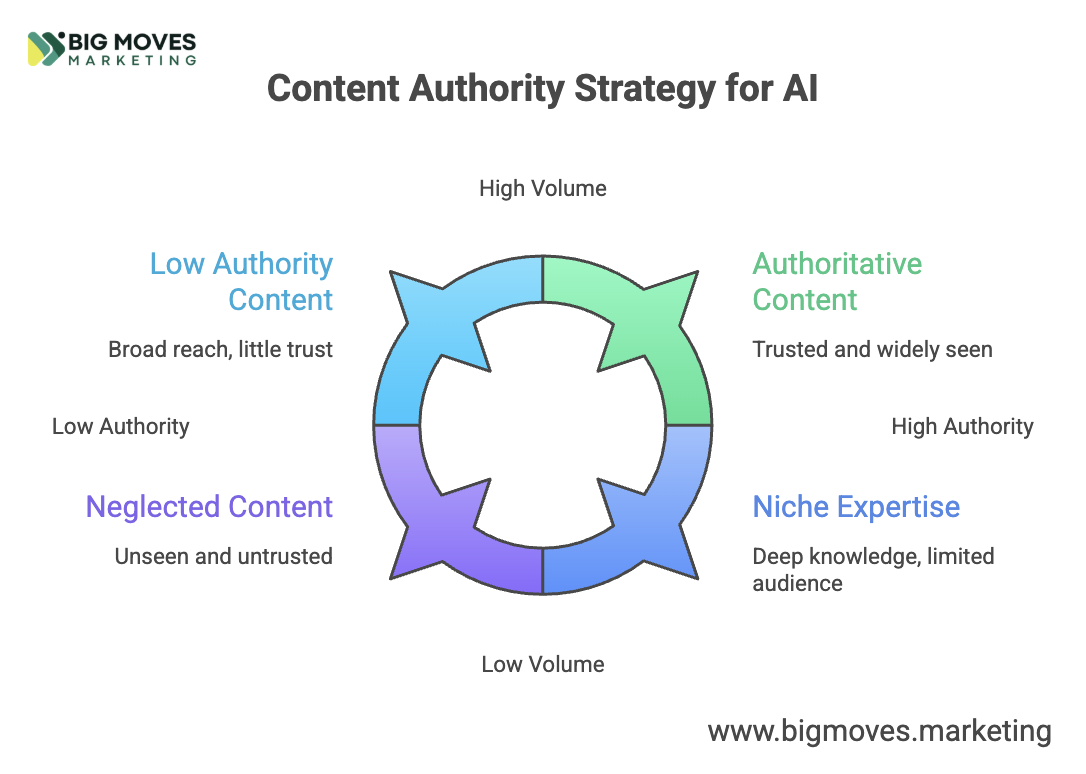
For teams looking to build a new or overhauled content programme, the research points to a clear strategic direction.
The first principle is topical depth over keyword breadth. Case studies are rated the most effective content type by 77% of B2B buyers, and long-form content (2,000+ words) generates three times more leads than shorter content. The AI citation data reinforces this: comprehensive, deeply researched content on a specific topic cluster consistently outperforms a broad library of thin posts. Choose two or three core topics where your team has genuine expertise and build a body of work around each.
The second principle is subject matter expert involvement. Search Engine Land's analysis of 8,000 AI citations found that Google's AI heavily favours content that demonstrates clear, verifiable expertise. For B2B brands, this means creating content in genuine partnership with your internal experts — product leaders, technical specialists, customer success managers, or experienced practitioners — rather than relying on generalist writers to research and produce content independently.
The third principle is ungating your top-of-funnel expertise. As discussed above, gated content is invisible to AI. Your strategy should be to make your most authoritative thought leadership publicly available, ensuring it is optimised for citation, and then use that visibility to draw qualified buyers into your conversion ecosystem.
The fourth principle is building third-party authority signals. The Search Engine Land citation analysis found that Google's AI draws heavily from third-party sources — industry publications, professional communities, peer review platforms, and authoritative blogs. For B2B brands, this means being active contributors to industry media, seeking coverage in respected trade publications, building a presence on professional communities, and gathering verified reviews on platforms like G2, Capterra, or TrustRadius.
The fifth principle is regular content maintenance. Content freshness is a verifiable citation signal. Google's AI checks facts in real time against authoritative databases, and content with outdated statistics or stale information loses citation probability over time. Build a quarterly review process into your content operations. Update statistics, refresh examples, add new research, and re-promote updated pages.
There is a dimension to this shift that goes beyond SEO metrics and traffic reports. Being cited in Google's AI Overviews is becoming a proxy for brand credibility in the minds of B2B buyers.
When a buyer sees your content named as a source in an AI Overview, they receive an implicit endorsement from the world's most trusted information system. It communicates that your organisation produces information reliable enough for Google's AI to stake its answer on. That is qualitatively different from simply ranking well on a list of blue links.
80% of B2B decision-makers find that articles and substantive content convey more useful information about companies than advertisements. 83% of B2B marketers who have invested in content marketing report achieving brand awareness goals, and 77% say content marketing has helped them build trust and credibility. Citation in AI Overviews accelerates both outcomes.
For B2B startup founders and product owners who are trying to establish credibility in competitive markets, this is particularly significant. You do not need the largest budget or the longest domain history to earn AI citations. You need genuine expertise, clear communication, and content that is structured to be both human and machine-readable.
The TrustRadius report also notes that AI Overviews frequently cite third-party technology sites — industry analysts, comparison platforms, and review aggregators — rather than vendor sites alone. This reinforces the case for building a distributed content presence, contributing to industry publications, and ensuring your brand is well-represented across the independent sources that AI systems trust.
As citation becomes a more meaningful measure of content performance, your reporting framework needs to evolve alongside your strategy. Traditional metrics — total organic traffic, average ranking position — still matter, but they tell an incomplete story.
Consider adding the following to your content performance dashboard: How often do your pages appear in AI Overviews for target queries? What is the click-through quality from AI-cited traffic, measured by engagement rate, time on page, and conversion rate? Which content types are generating the most citation appearances? How does your AI citation share compare to your key competitors?
Tools like Google Search Console, SEMrush, and emerging AI-visibility platforms are beginning to offer ways to track these signals. By November 2025, major analytics vendors were reporting 73% accuracy in AI Overview appearance detection — making consistent measurement increasingly feasible.
The 90% click-through rate among B2B buyers is not a frightening statistic. It is an invitation.
It tells us that AI Overviews are not replacing the relationship between buyers and trusted content sources. They are filtering it. The buyers who click through are doing so with purpose and intent. They are further along in their journey. They are more likely to engage, more likely to share your content internally, and more likely to convert.
The B2B brands that will thrive in this environment are those that invest now in content built on genuine expertise, structured for machine extraction, and grounded in the authentic insight that their industry actually needs. Content marketing already accounts for 26% of B2B marketing budgets — the largest single allocation. The question is whether that investment is being directed toward content that earns citation or content that simply exists.
The citation economy is already here. And for B2B marketers willing to build with intention, it represents one of the most level playing fields the industry has ever seen.
Published on bigmoves.marketing/blog — helping B2B brands make bold, strategic marketing moves.
Explore Big Moves Marketing services and resources:


%20-%20white.svg)