%20png%20copy.avif)
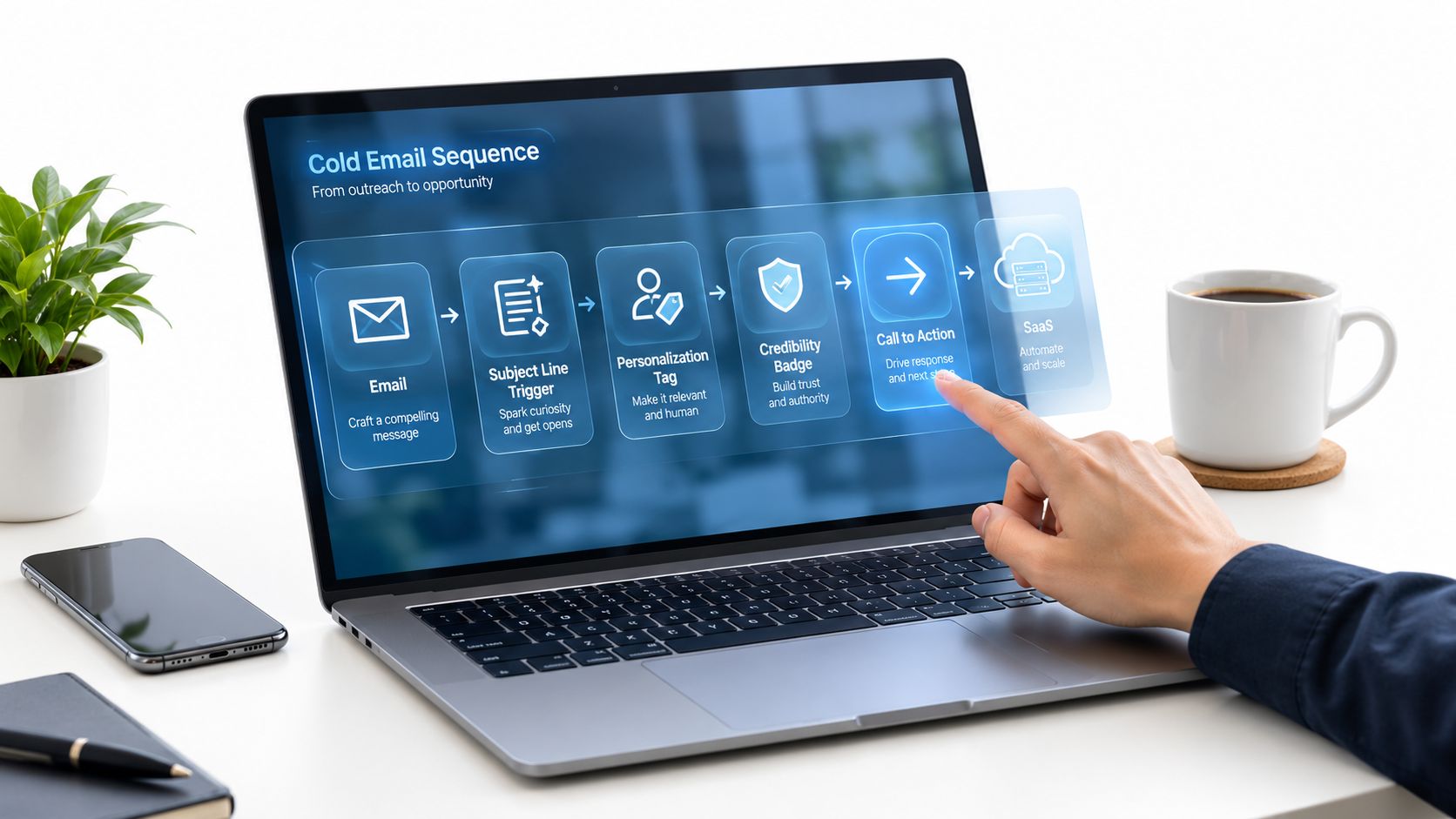
Signal-led personalization produces an 11.2% reply rate, compared with 2.1% for generic messages. The difference isn't better wording alone. It comes from sending a relevant message to a qualified account with a sending system that can reach the inbox.
That distinction matters because most B2B SaaS teams treat a cold email template as a copywriting asset. They workshop subject lines, debate sentence length, and add more personalization tokens while ignoring the list, the trigger, the domain, and the measurement model. Then they blame the template when the campaign fails.
A cold email is the visible output of a much larger system. If the ICP is wrong, relevance can't rescue the message. If the domain has poor authentication, strong copy never gets read. If the team measures opens instead of qualified conversations, it optimizes a weak proxy.
A cold email template cannot rescue a weak targeting or sending system.
In a 2026 analysis of 500 B2B cold emails, signal-led personalization produced an 11.2% reply rate, while generic messages produced 2.1%, a reported 5.3-times lift tied to relevant recipient or company context (GetGAngly's cold email reply rate study). The data points to recipient situation, not script craftsmanship, as the primary performance driver.
A founder entering a new segment has a different problem from a CMO rebuilding demand generation after a positioning change. Sending both people the same paragraph with their company name inserted creates a mail merge, not relevance.
Practical rule: Treat the template as the final expression of an account-selection decision, not as the campaign strategy.
Teams often respond to a weak campaign by adding more copy. They explain the product, list capabilities, include customer logos, add a calendar link, and end with several questions. Each addition makes the sender feel prepared. The recipient sees a crowded message with no clear reason to respond.
Backlinko's analysis of approximately 12 million outreach emails found that only 8.5% received a response (Backlinko's email outreach study). That benchmark frames cold outreach as an experimentation problem rather than a literary exercise. A campaign of 1,000 valid addresses would produce about 85 replies at that benchmark, before accounting for list quality, deliverability, offer strength, industry, or follow-up cadence.
Reply volume still says little about pipeline quality. A positive response from the wrong account is not an opportunity. An interested reply from someone without authority may not become a qualified conversation. Track delivered emails, replies, positive replies, meetings, and pipeline as separate stages.
Before writing, decide whether each account belongs in the campaign. Check ICP fit, role relevance, geography, company context, and a verifiable business trigger. Then confirm that the sender domain, authentication, mailbox health, and planned activity can support delivery.
The operating logic appears in a disciplined outbound lead generation process. The email comes after those decisions, not before them. Deliverability and ICP fit determine whether the message reaches a relevant person; copy is the final output of that pipeline.
The best template is modular. It gives the sender a stable structure while forcing every message to answer one question: why should this person care now?
A high-converting cold email is the final output of a pipeline, not a standalone piece of copy. First, the account must fit the ICP, the trigger must be real, and the sending infrastructure must support delivery. The template then turns that preparation into a clear reason to reply. Four parts keep the message focused.
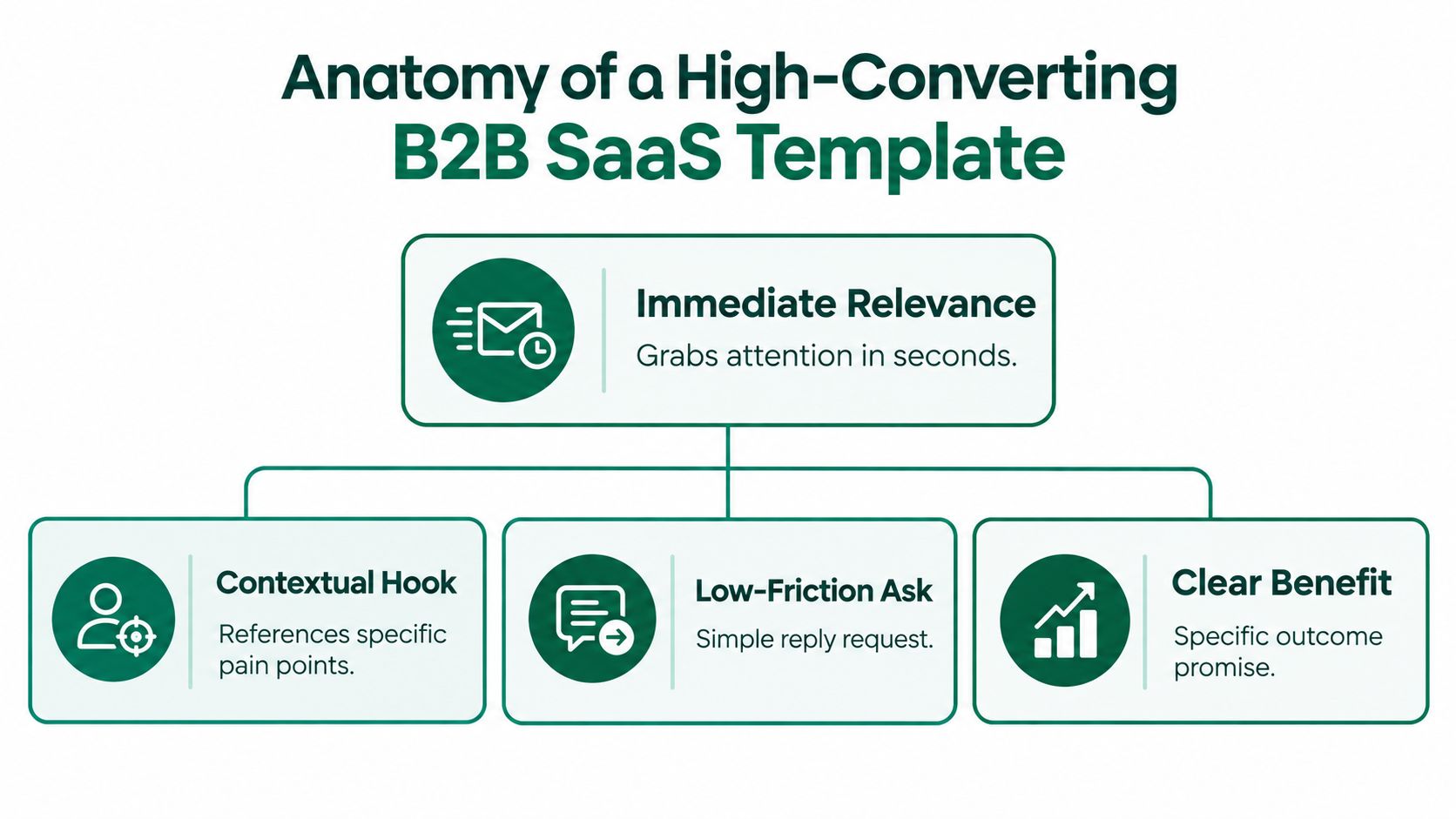
Open with something verifiable: a product launch, leadership change, hiring pattern, market expansion, pricing-page change, or shift in positioning. The trigger earns attention because it proves the email belongs to that account.
“I was impressed by your company” proves nothing and sounds automated. Write, “Your team is hiring for enterprise sales while expanding into regulated accounts.” Then connect that observation to a plausible constraint, such as inconsistent positioning across a new buying committee.
Address one acute problem. A B2B SaaS founder may care about pipeline visibility and a clear market position. A marketing leader may care about execution capacity after a launch or strategic change.
Do not list your service catalogue. State the outcome you believe matters, then make the hypothesis easy to challenge. The recipient should understand the proposed value without reading a product tour.
Credibility needs one relevant proof point, not a paragraph of logos. Reference the type of company, problem, or operating context you understand. If you lack verified evidence, do not manufacture it. Specific understanding carries more weight than inflated authority.
Ask whether the issue is relevant, whether the person owns it, or whether they would compare notes. A reply requires less commitment than a calendar booking, so the first email should make replying easy.
A practical example for a B2B SaaS marketing leader:
Subject line: Enterprise positioning during your expansion
Hi Maya,
I noticed your team is hiring enterprise marketers while expanding into regulated accounts.
That usually creates pressure to keep the product story consistent across new buyers, sales teams, and compliance stakeholders. We help SaaS teams turn that positioning into campaign and sales enablement material without adding another planning cycle.
I have worked through similar messaging problems during expansion. Is maintaining one clear narrative across those teams a priority this quarter?
Best,
Alex
The message uses one trigger, one business problem, one outcome, one credibility point, and one question. It does not force a meeting before the recipient confirms that the problem exists.
Use a stable structure across variants:
Keep the message concise. The earlier Economics of Cold Emailing analysis supports treating length as a practical constraint, not an invitation to include product history or several calls to action.
Test subject-line variables against the audience instead of treating any format as universal. The earlier Backlinko's email outreach study supports experimentation around subject-line wording and length, but a test is useful only when the ICP, sender reputation, and delivery conditions remain controlled.
For clarity and rendering choices, review HTML versus text email. Formatting cannot rescue an irrelevant trigger or a message sent from an unhealthy domain.
A first name inserted via mail merge is data automation, not personalization. Personalization changes why a specific recipient should care, while a generic email keeps the same offer, problem, and call to action for everyone. It adds a company name or a reference to a recent post, but the commercial relevance stays unchanged.
Copy is only the final output of an outreach system. The ICP, account selection, trigger data, sending infrastructure, and domain reputation determine whether a personalized message reaches the right buyer and earns attention. If the list is poorly matched or the domain has weak deliverability, better wording will not rescue the campaign.
Belkins analyzed 5.5 million B2B cold emails sent during 2024 and reported a 46% open rate for personalized subject lines compared with 35% for non-personalized subject lines. The same analysis reported a 7% reply rate for personalized subject lines versus 3% without personalization (Belkins benchmark data summarized by Prospeo). Opens show visibility. Replies show whether the message gave the recipient a reason to continue.
Suppose a SaaS company has started hiring implementation specialists. That signal may point to increased customer volume, greater product complexity, or pressure on onboarding capacity. A useful email selects one plausible constraint and connects it to a focused question.
“ I noticed you're growing your team and thought our platform could help” is decorative personalization. The same sentence could go to nearly any company. A signal-led version says, “The implementation hiring suggests onboarding volume is becoming a constraint. Are you reviewing how marketing, sales, and customer success describe the handoff before the next growth phase?” The recipient can confirm, reject, or correct the assumption.
A systematic review covering 12 randomized trials and 48,910 participants found that personalized approaches increased response odds by approximately 24%, with an odds ratio of 1.24 and a 95% confidence interval of 1.17 to 1.32 (the systematic review of personalized approaches). The practical lesson is to make the message account-specific, not to add more custom sentences.
Belkins also reported that the average reply rate across a separate dataset fell to 5.8% in 2024, down from 6.8% in 2023 (the Prospeo cold email benchmark). Buyers recognize personal details that carry no personal relevance. Inbox competition requires accurate targeting, credible signals, and healthy sending conditions.
Research should produce a testable business hypothesis. Compliments rarely create a useful reply.
Use signals such as:
Do not claim to have studied an account if you have not. Do not invent a customer result or cite research the recipient cannot verify. The strongest personalization gives the buyer a clear reason to correct you, add context, or ask a follow-up question.
For a broader method of tailoring relevance, one-to-one marketing principles offer a useful framework. Personalization should narrow the hypothesis while the infrastructure protects delivery and the ICP keeps the hypothesis relevant.
A single email is a message. A sequence is a decision system.
The sequence should reflect how a busy B2B SaaS buyer evaluates an unexpected message. The first email establishes relevance. A later touch adds a different piece of context or asks whether the issue belongs elsewhere. The final touch gives the recipient a clear way to decline or indicate that timing is wrong.

Segment by role, company context, and likely problem. Don't create ten copy variations for one undifferentiated list. A founder-led message about positioning and pipeline visibility should not share the same value hypothesis as a message to a Head of Growth responsible for campaign throughput.
Then hold the important variables steady. Keep the offer, sender identity, and audience quality constant while testing one message angle. If you change the audience, subject line, offer, and follow-up cadence at the same time, the results won't tell you what worked.
One experimental analysis reported response rates rising from 17% to 44% when emails were under 150 words and introduced the sender immediately (the Economics of Cold Emailing analysis). Treat that result as a testable observation, not a promise. Your market, list, offer, and sender reputation may behave differently.
Use a measurement model that favors commercial quality:
Open rates can provide directional information, but open tracking is increasingly unreliable. A reported open doesn't prove attention, and an absent open doesn't prove the message wasn't read. Positive replies and qualified conversations are harder to fake and more useful for decisions.
A sequence also needs a stop rule. Stop when the recipient declines, asks not to be contacted, leaves the role, or clearly doesn't fit. Follow up when you have a distinct reason, not because the automation platform says another touch is due.
If the team needs dedicated prospecting capacity, a dedicated SDR can own list qualification, research, sequence hygiene, and reply routing. That role shouldn't be measured only by activity volume. Its value comes from protecting relevance and moving qualified responses to the right owner.
Use the following video as a practical companion to the written framework, not as a substitute for segmentation and measurement.
Each stakeholder in an account requires a distinct commercial argument, even when the template structure remains stable. The sender should align the message with that person's risk, priority, authority, and evidence threshold. Copy is the final output of the pipeline. Deliverability, list quality, and ICP fit determine whether the right person receives a relevant argument in the first place.
A founder or CEO usually evaluates whether the market narrative and pipeline motion support the company's next stage. A marketing leader may accept the strategic problem while lacking the people, time, or operating process to address it. A revenue leader will examine handoffs, conversion quality, and whether outreach produces opportunities that sales can progress.
| Role | Primary Pain Point | Value Proposition Focus | Call to Action Type |
|---|---|---|---|
| Founder or CEO | Positioning confusion and weak pipeline visibility | Clarify the market narrative and identify the highest-value growth constraint | Ask whether the diagnosis matches current priorities |
| CMO or Head of Growth | Execution capacity and fragmented demand programs | Create a focused plan that connects messaging, channels, and measurement | Offer to compare the current growth plan with a focused alternative |
| Revenue leader | Poor-fit opportunities and inconsistent sales messaging | Improve the connection between ICP, outreach, and qualified pipeline | Ask where lead quality or conversion is breaking down |
| Product marketing leader | Strong product, unclear differentiation | Turn product capability into a buyer-relevant commercial story | Ask whether the current positioning survives competitive evaluation |
The founder version should sound like a strategic question rather than a service pitch. The marketing-leader version should acknowledge resource constraints and execution pressure. The revenue version should address opportunity quality instead of promising more activity. Product marketing outreach should connect product capability to the buyer's competitive decision.
Use a shared trigger and point of view across personas, adapting only the business consequence for each role. The same product launch can represent positioning risk for a founder, campaign pressure for a CMO, sales enablement work for a revenue leader, or differentiation risk for product marketing.
Keep the sender and offer consistent while changing the value hypothesis. That makes persona comparisons meaningful. A higher reply rate from founders says little if those replies are unqualified or lack buying authority. Judge each variant by positive, relevant responses and its ability to create a credible next conversation.
Teams extending prospecting capacity without building every capability internally may evaluate nearshore BDR hiring services. Make that staffing decision after defining segmentation, message logic, qualification, and reply ownership. Additional headcount cannot repair an unclear ICP or weak sending system.
Copy has no performance when the mailbox never receives it.
Technical infrastructure is the part of cold outreach that template articles routinely omit. A sender can spend days refining a message while authentication gaps, poor list hygiene, complaint rates, or sending behavior steadily damage inbox placement.
Recent benchmark data reported that verified senders using SPF, DKIM, and DMARC required about 108 contacts per reply, compared with 120 for unverified senders (Smartlead's state of cold email benchmark). The point isn't that authentication guarantees replies. It reduces an avoidable obstacle before the buyer evaluates the message.
Before launching a sequence, confirm the following:
Gmail treats senders delivering approximately 5,000 or more messages within 24 hours to personal Gmail accounts as bulk senders, and its requirements include authentication, low unwanted-message rates, and easy unsubscribing (Google's sender requirements). A B2B SaaS company scaling outbound should treat those requirements as operating prerequisites, not technical polish.
In the United States, CAN-SPAM applies to commercial email, including B2B messages. The sender must use accurate routing information, avoid deceptive subject lines, identify the message as an advertisement, include a valid physical postal address, and provide a functional opt-out method. The FTC says unsubscribe requests must be honored within 10 business days, and the opt-out mechanism must remain capable of processing requests for at least 30 days after the message is sent (the FTC's CAN-SPAM compliance guide).
That isn't legal decoration. It affects list governance, sequence logic, footer content, and who owns suppression. Market-specific legal review still matters, especially when a team contacts recipients across jurisdictions.
Teams should also understand the distinction between a permission-based nurture program and unsolicited outbound. Double opt-in guidance is relevant for consent-led programs, but it doesn't replace the compliance review required for the channel and market you're operating in.
The goal is a qualified conversation that converts to pipeline, not a reply rate metric.
A template that generates vague responses can perform worse than a quieter version that reaches the right account, role, and business problem. Reply volume is an input. Pipeline quality is the decision metric, and the email is only the final output of a system built around ICP fit, evidence, infrastructure, and measurement.
Personalization earns its place when it improves qualified outcomes. The systematic review cited earlier found an approximately 24% increase in response odds across 12 randomized trials involving 48,910 participants (the review of personalized approaches). Use that finding to improve account selection and relevance, not to justify longer emails for every prospect.
B2B marketing teams often respond to weak performance by broadening the list or adding more persuasive language. That usually makes the system worse. A larger list brings in borderline accounts, weakens relevance, and creates more opportunities for poor delivery or negative feedback.
A sharper operating model asks:
The template should preserve the answers. Include fields for the trigger, business constraint, outcome hypothesis, credibility, and low-friction question. Empty placeholders only make a generic paragraph look customized.
Use email marketing for lead generation within a broader pipeline model, not as an isolated volume channel. Connect campaign results to CRM stages, qualification decisions, meetings held, and opportunities created. Review performance by segment and persona so a blended average does not hide a weak list or a strong niche.
Infrastructure belongs in the same measurement loop. Track domain and mailbox health alongside positive replies, qualified conversations, and opportunity creation. A strong message cannot rescue poor targeting, weak sending controls, or missing suppression logic.
The most useful cold email template is a governance tool. It tells the team whom to contact, what evidence to use, what claim to make, how to request a response, and when to stop. Copy matters, but it comes after the system has selected the account and protected delivery.
Better personalization often means narrowing the audience, not writing a longer email. With a real trigger, a plausible problem, sound infrastructure, and pipeline-based measurement, the message becomes shorter because it has less to prove.
Big Moves Marketing helps B2B SaaS teams clarify positioning, build focused go-to-market programs, and connect outreach with measurable pipeline systems. If cold email performance is constrained by ICP confusion, weak messaging, or missing operational foundations, visit Big Moves Marketing to discuss a sharper growth plan.



%20-%20white.svg)