%20png%20copy.avif)
Most advice on double opt in starts with the wrong question: “Is it required for compliance?” For a B2B SaaS company, the better question is, what kind of contacts are you willing to let shape your sender reputation, nurture data, and pipeline forecasts?
Double opt in isn't a universal legal requirement. GDPR, CAN-SPAM, and CASL generally require consent and the ability to prove it, not necessarily a confirmation click. Yet the workflow remains one of the clearest ways to separate an email address submitted into a form from a person who has demonstrated control of that inbox.
That distinction matters when paid traffic, product-led signups, partner campaigns, and bots all feed the same CRM. A large list can create the appearance of demand while weakening deliverability and polluting attribution. A smaller confirmed list can give revenue leaders a more credible view of who actually wants continued communication.
Double opt in is not a blanket compliance checkbox. Applying the same confirmation flow to every market, funnel, and product motion can slow acquisition without addressing the legal question that matters: can your company prove valid consent for the contacts it chose to email?
GDPR doesn't require double opt in, but it does require organizations to prove consent. An affirmative confirmation click can strengthen that evidence. Pre-checked boxes and default consent do not qualify because consent must come from an affirmative action, as explained in this GDPR consent guidance from Kit. CAN-SPAM and CASL also do not make double opt in a universal requirement.
Jurisdiction determines the answer. Independent coverage identifies Austria, Germany, Greece, Luxembourg, Norway, and Switzerland as countries where double opt in is legally required. Major regimes such as GDPR, CAN-SPAM, and CASL generally stop short of mandating it according to Mailjet's jurisdiction-focused analysis. Set regional rules deliberately. Do not convert a local requirement or market norm into a global policy without measuring its effect on conversion and pipeline creation.
Double opt in predates modern privacy legislation. It emerged in the early email era and was used by LISTSERV by the 1980s, primarily to verify addresses and limit spam in this history of double opt in. By the turn of the century, practitioners commonly called the process “return address verification” or “confirmed opt-in.”
Adoption remained slow after the workflow was available. One historical benchmark cited in the same account found that 11 years after LISTSERV's first double opt-in implementation, only 5% of Fortune 500 companies were using it in the documented history of the practice. The history clarifies the method's original purpose. It was designed to establish whether an address could receive and act on a message, not to serve as a fashionable privacy setting.
For B2B SaaS leaders, that distinction is operationally valuable. Double opt in filters mistyped domains, disposable addresses, fake signups, and many bot-generated submissions before they enter active nurture. It also produces a stronger evidentiary trail than a form submission alone. A smaller confirmed list gives revenue leaders a more credible view of who wants continued communication.
Strategic rule: Use double opt in to control audience quality and preserve evidence of consent. Do not use it as a substitute for jurisdiction-specific legal judgment.
Email reporting requires the same discipline. Technical behavior and privacy controls can affect open data, so confirmation records should sit alongside broader engagement analysis, as discussed in Big Moves Marketing's article on tracking email opens. The commercial choice is direct: prioritize faster list growth, or accept slower activation to protect deliverability, evidence, and pipeline data quality.
The operational difference is simple, but its effect on pipeline data is substantial.
With single opt in, a prospect submits an email address and enters the mailing list immediately. The system can enroll that contact in a nurture sequence, trigger a product education email, or pass the record into a lead-scoring model as soon as the form event is recorded.
With double opt in, the form submission creates a pending contact. The platform sends a confirmation email containing a unique link, and the address becomes active only after the inbox owner clicks it. Microsoft describes the workflow as a two-step subscription process, a form submission followed by confirmation through a link in the email in its double opt-in documentation.
That extra step changes the meaning of “lead.” A single-opt-in contact has expressed interest at the form level. A double-opt-in contact has also completed an inbox-based action. Those are different signals and shouldn't be treated as equivalent in your CRM.
| Dimension | Single Opt In | Double Opt In |
|---|---|---|
| Activation | Immediate after form submission | After the confirmation link is clicked |
| Funnel velocity | Faster contact creation and nurture entry | Slower activation because confirmation is required |
| Address quality | More exposed to mistyped, invalid, disposable, and bot-generated addresses | Filters many addresses before activation |
| Consent evidence | Primarily based on the form event and captured consent data | Adds a recorded confirmation event |
| List size | Typically larger | Typically smaller, with a stronger intent signal |
| Best fit | High-velocity motions where immediate follow-up is central | High-value nurture, regulated markets, and quality-sensitive databases |
The workflow also affects automation design. A form submission shouldn't automatically equal marketing eligibility when the contact remains unconfirmed. Your lifecycle stages need a pending state, otherwise sales and marketing teams will interpret an unverified record as an active subscriber.
Many SaaS teams create avoidable confusion here. They add double opt in to the front end but leave the rest of the automation architecture unchanged. The result is a contact that exists in the CRM, triggers internal notifications, and appears in dashboards, while still being ineligible for marketing email. Your marketing automation for SaaS needs to distinguish submitted, pending confirmation, and confirmed states.
A larger database isn't automatically a larger audience. It may simply be a larger record of unverified intent.
Use single opt in when speed has a clear economic advantage and the acquisition source is controlled. Use double opt in when the cost of poor data, weak engagement, or disputed consent is higher than the cost of an extra click. That decision should sit with the revenue owner, not be buried inside a platform's default settings.
Double opt in is a sender-reputation control before it is a compliance feature. A confirmation step blocks mistyped, invalid, and many disposable addresses before they create bounces or complaints. It also gives growth teams a cleaner database for campaign analysis, as described in Mailgun's guidance on list-building hygiene.
Adoption remains uneven. A 2022 analysis of GetResponse customer campaigns reported that 9.19% used double opt in and 90.81% used single opt in, with publishing at 26.64% and retail at 3.06% in the reported email marketing benchmarks. The split shows that implementation reflects acquisition model and market expectations, not a universal standard.
EmailVendorSelection also reported figures from a Mailchimp study of 30,000 users. Double opt-in lists produced 72.2% more unique opens, 114% more clicks, and 48.3% fewer bounces than single opt-in lists. Because the available citation is second-hand, treat those results as directional evidence, not a guarantee for every SaaS program.
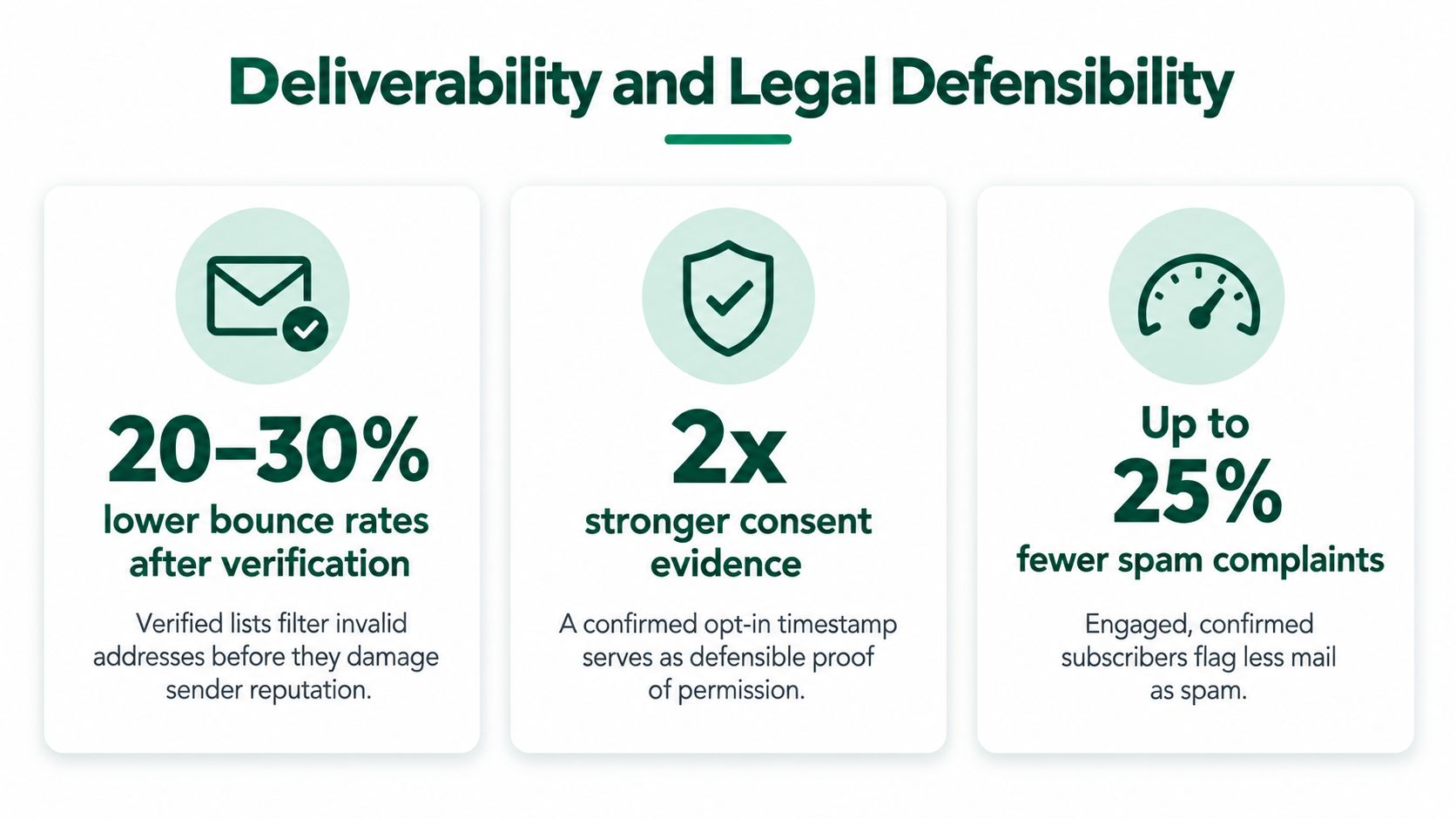
Legal defensibility depends on the sequence of events and the records behind it. Store the original form submission, the consent language shown, the confirmation message, its delivery status, and the time of the confirmation click. Activate marketing eligibility only after that unique link is used, as outlined in this implementation guidance for SaaS teams.
Jurisdiction matters. A 2026 German administrative court decision was reported to find that an email address with timestamp and IP logs was not sufficient proof on its own in coverage of the decision and the changing consent standard. The practical lesson is clear: an internal log proves what your system stored, while a confirmation event provides evidence that the address owner participated in the permission process. Do not present double opt in as a complete legal program. Consent wording, retention rules, source records, withdrawal handling, and the applicable national standard still require review.
Reputation and legal evidence also reinforce each other. Fake signups and invalid addresses can make inbox placement, engagement reporting, and complaint analysis less reliable even when they represent a small share of the database. For teams coordinating email with other channels, this number reputation management guide by SMS Activate provides relevant operational context.
Message format cannot correct weak acquisition controls. Choose between HTML and text email according to the job of the message. Use verification to establish whether the recipient belongs in the program at all. For global B2B SaaS, document the jurisdiction, acquisition source, confirmation event, and retention logic so your team can defend both delivery performance and consent handling.
Double opt in creates friction. The question isn't whether friction exists. The question is whether you're placing it before or after your company pays the cost of poor-quality demand.
A confirmed list can improve engagement density, reduce operational noise, and give sales teams cleaner signals. But confirmation also removes contacts that might have become useful later, including busy prospects who submitted a form during a workday and never returned to the message. In a high-velocity PLG motion, that lost activation can matter more than the hygiene benefit.
The right decision depends on deal value, buying cycle, market exposure, and acquisition quality. A founder selling an enterprise platform with a long buying process shouldn't evaluate signup quality the same way as a product team optimizing a self-serve trial.
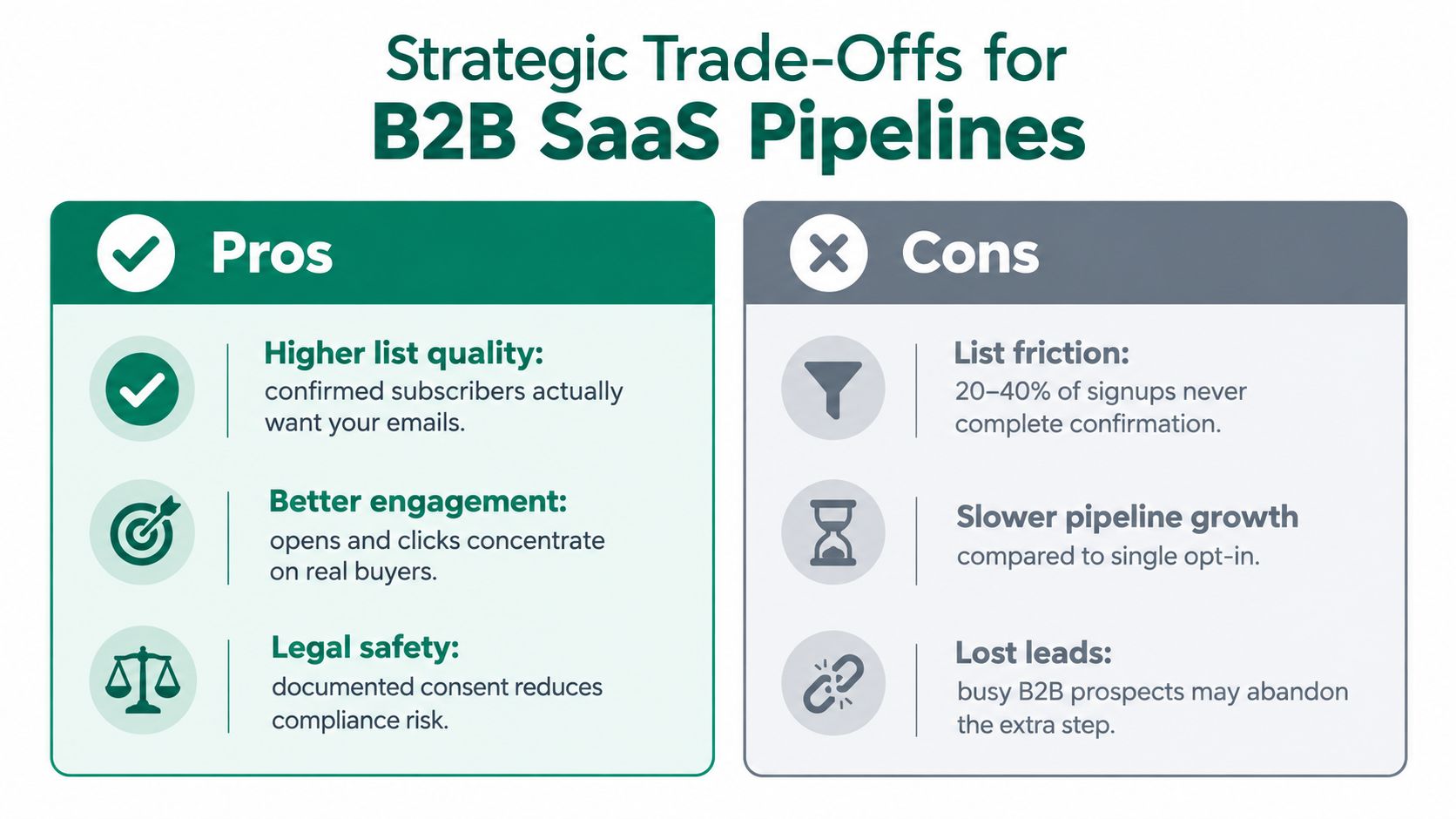
Use double opt in by default for high-value content and enterprise nurture when a contact may receive a sustained sequence over a long sales cycle. The cost of sending repeatedly to an unverified or mistyped address is higher when every interaction feeds account research, scoring, and sales prioritization.
It also makes sense when you're entering markets with stronger local expectations. Europe shows much higher adoption than North America, 89% versus 54%, which suggests regional operating norms can be mistaken for universal legal requirements in the Mailjet analysis of adoption and jurisdiction. If your company is expanding into several European markets, a consistent confirmation policy can reduce operational complexity, but your counsel should still validate the requirements market by market.
Single opt in may be appropriate for a tightly controlled product-led funnel where the immediate value of fast activation is clear. It can also suit an in-product account creation flow where the email is needed for product access rather than a broad marketing subscription, provided your consent and communication logic remain distinct.
Founder-level decision: Don't ask whether double opt in increases or decreases conversion in the abstract. Ask whether an unconfirmed contact can create enough future value to justify the data and deliverability risk.
Segmenting the policy is often better than choosing one global rule. Apply stronger verification to paid acquisition, public lead magnets, referral forms, and markets with stricter local expectations. Keep a faster path for authenticated product users when the product experience, transactional messages, and marketing consent are clearly separated.
The mistake is measuring only form completion. A smaller confirmed audience may produce better downstream visibility than a larger list filled with contacts who never wanted the sequence. Pipeline quality begins before lead scoring. It begins with deciding who is allowed into the marketing audience.
A confirmation flow should be easy for a legitimate prospect and difficult for an automated or accidental signup. That requires more than switching on a platform setting.
Start with the data model. Store the contact as pending, preserve the source and form context, and prevent marketing automation from treating the record as confirmed. Then send one clear confirmation email with one primary action. Don't bury the link under product messaging, multiple offers, or a long explanation of privacy policy language.
The email should answer three questions immediately:
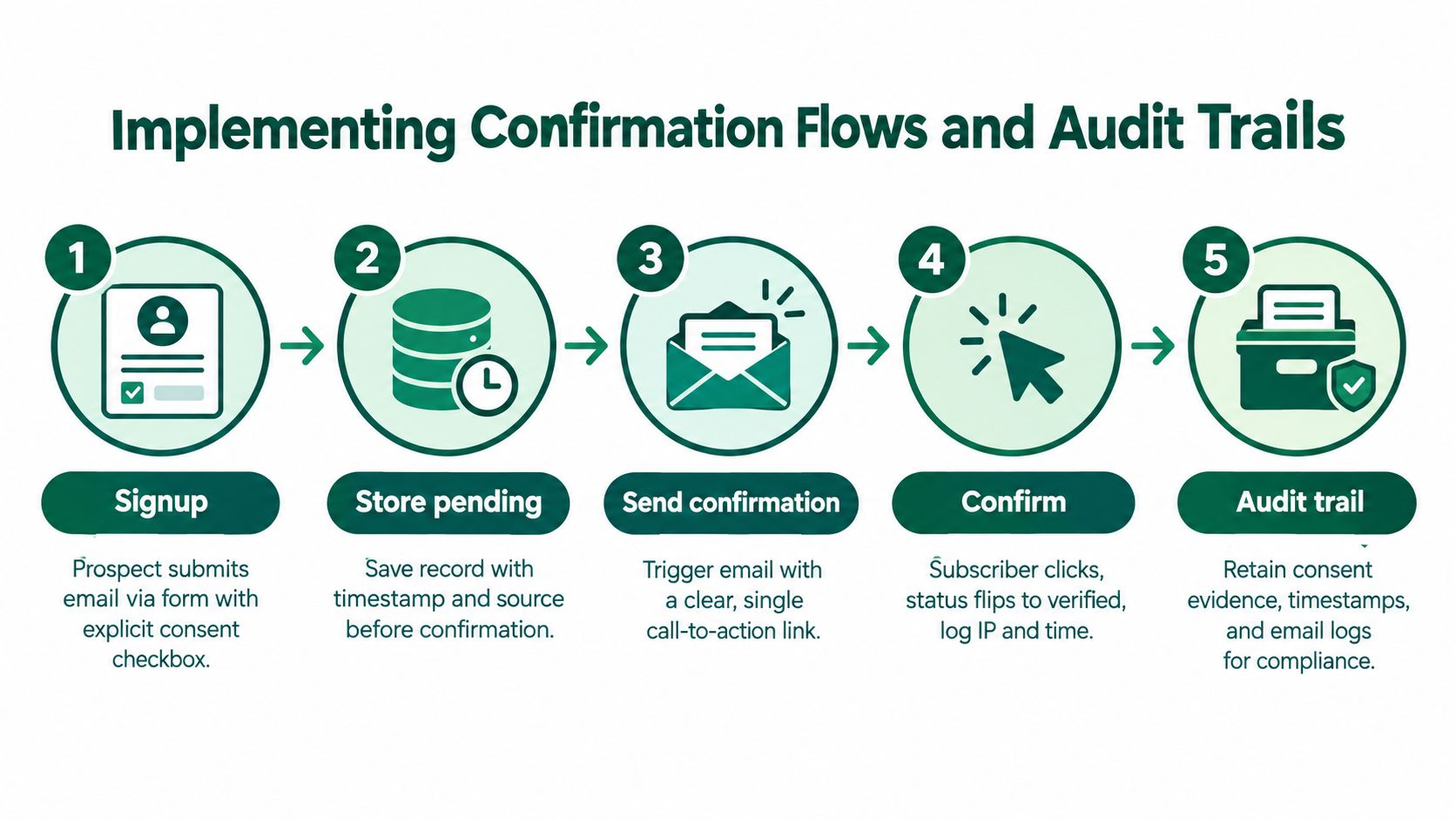
Your system should retain the form submission, consent language shown at the time, source page or campaign, confirmation email event, unique confirmation action, timestamp, and relevant request metadata. The purpose isn't to collect everything indiscriminately. It's to preserve enough context to reconstruct what happened.
The confirmation link should change the subscription status only after a successful click. At that point, record the verification event and pass the contact into the correct nurture or product communication path. Keep unconfirmed records out of marketing sends, while allowing your team to distinguish a pending contact from a withdrawn or invalid one.
Platforms can handle much of this without manual work. HubSpot, for example, can automatically send a follow-up confirmation email to contacts created through HubSpot forms, non-HubSpot forms, lead ad forms, or the Forms API when double opt in is enabled in its double opt-in settings documentation. Administrators can apply the setting across all forms and pages or select specific ones, which supports a segmented architecture.
Don't assume the platform's default configuration matches your consent model. Test every entry point, including embedded forms, imports, APIs, paid lead forms, and product signups. Confirm what happens when a contact changes their primary email address, submits another form, or enters an automation before verification.
The following video can help teams visualize the basic confirmation sequence before translating it into their own CRM and automation rules.
Your marketing automation workflow should make the state transition explicit. If the workflow can't tell the difference between pending and confirmed, the system isn't ready for double opt in.
The wrong dashboard makes double opt in look like a list-size problem. The right dashboard shows whether confirmation improves the quality and economics of the audience that remains.
Track the workflow as a sequence, not a single conversion event. Form submissions, confirmation emails delivered, confirmation clicks, confirmed subscribers, marketing engagement, sales acceptance, and qualified pipeline should each have a distinct state. That lets you identify whether friction occurs at the email delivery stage, the message stage, the click stage, or the handoff stage.
Confirmation rate tells you how many pending contacts become active. Don't treat it as a standalone success measure. A high rate from a low-value channel may matter less than a lower rate from a source that produces qualified accounts.
Time to confirmation reveals whether prospects act quickly or whether your workflow creates a long-lived pending backlog. Segment it by source, form, market, and offer. A confirmation email for a product trial shouldn't necessarily perform like one for a research report.
Unconfirmed decay shows what happens to pending records over time. Define a retention and suppression policy, then monitor how many remain unresolved. A growing backlog can indicate unclear copy, poor delivery, spam-folder placement, or low-intent acquisition.
Confirmed-to-qualified conversion connects verification to revenue. This is the metric that prevents teams from celebrating a clean list while ignoring pipeline impact. Compare confirmed contacts with the qualified opportunities they create, and compare that result with the equivalent single-opt-in path where appropriate.
Source-level quality exposes channel problems. If one paid campaign produces many form submissions but few confirmations, the issue may be targeting, incentive design, bot activity, or misleading copy. Don't automatically weaken verification to preserve a channel that attracts the wrong audience.
Use cohorts rather than blended averages. Compare signup source, company size, geography, offer type, and product motion. Then inspect the confirmation email itself, including sender identity, subject clarity, mobile rendering, link behavior, and the destination page.
Your reporting should connect these signals to business outcomes, not just email activity. Big Moves Marketing's overview of SaaS marketing metrics provides a useful reference point for building a broader measurement model around funnel and revenue performance.
If confirmation rates fall, don't immediately remove the step. First determine whether the audience is failing to confirm because the process is inconvenient or because the acquisition source is producing contacts who never intended to subscribe. Those are different problems with different fixes.
Most B2B SaaS teams don't have one signup flow. They have a collection of forms, product surfaces, integrations, imports, event lists, lead ads, and manual additions that evolved independently. A double opt-in policy applied to only one part of that system creates the appearance of control without delivering consistent evidence or list quality.
Audit the architecture from the contact's first action to the first marketing send. Identify every route that can create a contact, every place where consent is captured, and every automation that assumes a new record is immediately eligible for email.
The answer may be a global double opt-in policy, a segmented policy, or single opt in for a tightly controlled product flow with stronger monitoring. The answer should not be “whatever the platform default does.”
List quality is a leading indicator of revenue predictability because every downstream model depends on who entered the system and what they actually agreed to receive.
Founders should also review whether their team is optimizing for the wrong headline metric. Subscriber volume is easy to report. Verified engagement, qualified account creation, sales acceptance, and pipeline contribution are harder, but they tell you whether the audience can support a durable growth motion.
Big Moves Marketing's strategic work sits in that gap between positioning, acquisition, consent architecture, and measurable pipeline. If your signup flows, messaging, and reporting don't agree on what a qualified audience means, visit Big Moves Marketing to discuss a focused audit and growth plan. The goal is to help your team make faster decisions about where verification belongs, what to measure, and which growth motion deserves investment.




%20-%20white.svg)