%20png%20copy.avif)
Most founders use email as a blunt instrument. They blast generic content to bloated lists and wonder why their pipeline is empty.
This is a fundamental misunderstanding of the tool. In B2B SaaS, effective email marketing is not about volume. It’s about precision. It is a system for demonstrating—not just claiming—that you understand your customer’s world better than anyone else.
If you believe email is dead for B2B SaaS, you are operating from a broken model. I have seen this pattern across dozens of early-stage companies. The diagnosis is always the same: the strategy is misaligned with how sophisticated buyers make decisions.
You are applying a consumer playbook to a complex, considered B2B sale. The results are predictably poor.
The core problem is an obsession with list size over list quality. Founders chase vanity metrics like subscriber count, pouring resources into lead magnets that attract anyone with a pulse. These generic checklists and broad reports generate noise, not signal. They fill your CRM with students, consultants, and competitors—low-intent contacts who will never buy.
Your goal is not to "build a list." Your goal is to cultivate a small, high-intent audience that has the exact problem your product solves. Every email should act as a filter, simultaneously attracting the right people and repelling the wrong ones.
This is the mindset shift that separates high-growth companies from those spinning their wheels.
This misalignment manifests in predictable ways:
Your email list is not an audience for broadcast. It is a portfolio of future customer relationships to develop. Each interaction must add value and build credibility—or it actively destroys it.
This isn't just about wasted marketing spend. A broken email strategy creates downstream consequences that poison your entire go-to-market motion.
Sales teams burn out chasing ghosts. Product teams get skewed feedback from the wrong personas. Leadership makes strategic errors based on faulty pipeline data. It's a vicious cycle. To build a system that works, start with our guide to lead generation for SaaS.
Despite these common failures, email marketing remains a powerhouse for B2B. It consistently ranks as the most effective lead generation channel. For founders, the appeal is the asymmetric return. Data shows email can deliver $36 to $42 for every $1 spent, a return that dwarfs other channels.
The path forward is to stop executing the common playbook.
Move from tactical checklists to a strategic system designed for conversation. The only principle that matters is that your inbox is a direct line to your future best customers. Treat it with the respect it commands.
Most founders jump straight to tactics. They debate subject lines and CTA button colors before answering the two questions that actually determine success.
This is why most B2B SaaS email marketing fails before the first send.
Your entire lead generation engine rests on two pillars: a validated Ideal Customer Profile (ICP) and lead magnets that speak directly to that ICP’s most acute pains. Getting this wrong doesn't just produce low open rates; it creates a useless asset. You end up with a list of tire-kickers, a polluted CRM, and a sales team burning cycles on dead-end leads.
The typical playbook—slapping together broad personas and generic "ultimate guides"—is fundamentally broken. It’s a box-checking exercise that generates low-intent contacts who drain resources.
This is the common failure cycle that results from a weak strategic foundation.
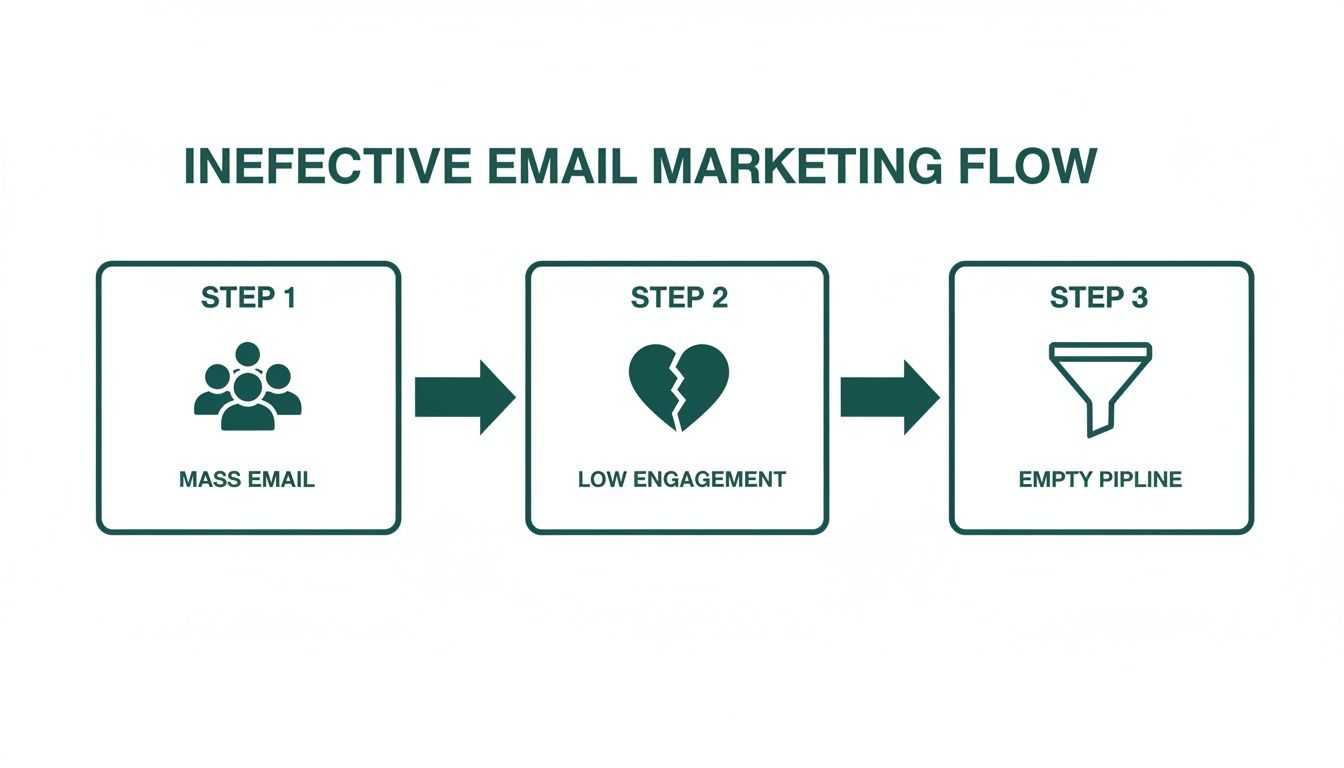
It’s a direct path from mass outreach to an empty pipeline, and it all starts with a lack of strategic clarity.
Your lead magnet has one job: to make a specific person, facing a specific problem, raise their hand. It must act as a qualification filter from the first click.
A high-signal lead magnet forces a prospect to self-identify their pain, role, and stage of awareness. It is designed to attract the right people and actively repel the wrong ones. This is the difference between an asset that generates qualified pipeline and one that just inflates subscriber numbers.
Imagine you're selling a SaaS tool that helps engineering teams manage technical debt. Consider two approaches:
The second option will get far fewer downloads. That’s the point. Every download is a strong signal of intent from someone with likely budget and authority.
You cannot design a high-signal lead magnet without a crystal-clear ICP. I don't mean a vague persona document collecting dust in Google Drive. I mean a validated profile built from direct conversations with your best customers.
If you have not done this work, stop here. Our firm has a practical ideal customer profile template to guide this process.
The quality of your lead magnet is a direct reflection of your customer understanding. A generic asset signals a generic understanding of the market. A sharp, specific asset proves you understand the buyer’s world better than your competitors.
To operationalize this, you need the right tools. For B2B SaaS companies, SaaS Marketing Automation Tools enable precise segmentation and delivery at scale. But the tool is an enabler, not the strategy itself.
The work is to stop treating email as a top-of-funnel list-building tactic. View it as the first step in your qualification process. This discipline is what separates companies with predictable pipelines from those struggling with lead quality. Build the right foundation, and you build a system that qualifies leads before they ever see an email.
The term "nurture sequence" is a misnomer. It implies a gentle, one-way flow of information. For B2B SaaS, that mental model is flawed. Top-performing teams don't "nurture"—they design structured conversations that systematically build trust and reveal a prospect's intent to buy.
A generic five-email "welcome series" is worse than useless; it's damaging. It signals to a savvy buyer that you see them as just another contact in your automation tool. It ignores the single most important piece of information you have: their entry point. That context is the entire basis for the conversation that must follow.
The standard playbook—sending a few blog posts, then asking for a demo—is a low-leverage activity. It fails because it does not distinguish between two crucial content types. To build a sequence that works, you must design it around this core distinction.
Your sequence needs two distinct functions. Nearly every failed automation campaign I have diagnosed misses this, which is why their emails are archived on sight.
A typical sequence from a Series A company is all authority, zero agitation. It is polite, informative, and toothless. It never forces the prospect to confront the cost of their status quo. To generate leads, your email marketing must do more than inform; it must compel action.
The goal isn't to get your emails opened. It's to make a qualified prospect think, "This is the first time someone has clearly articulated the exact problem I'm facing. I need to understand how they solve it."
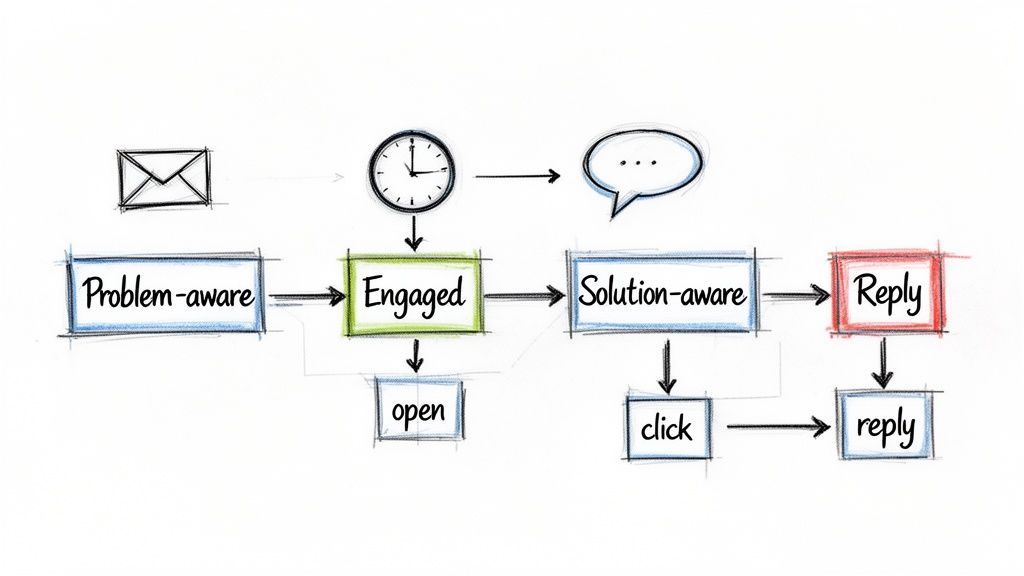
Your sequence should not be a straight line; it must be dynamic. Think of it less as a drip campaign and more as a logic tree, where a prospect’s actions—or inactions—determine the next step. This isn't personalization for its own sake. It’s about interpreting behavior as a signal of intent.
A practical structure includes:
This system moves a prospect from problem-aware to solution-aware, qualifying them for sales along the way. To manage this at scale, robust tools like marketing automation for agencies are necessary.
The power of this approach is documented. Nurtured leads produce a 47% higher average order value than non-nurtured leads. Structured follow-up achieves up to 10 times the response rate of standalone email blasts—a critical multiplier for any company with a long sales cycle.
Stop building "nurture sequences." Start designing intelligent, structured conversations that build authority, agitate the problem, and qualify prospects based on what they do. That is how you turn a list into a predictable pipeline.
Your perfectly crafted email is worthless if it lands in spam.
This is a hard, technical reality that most marketing leaders ignore until their domain reputation is destroyed. Deliverability is not a technical checkbox; it is the foundation of your email system. Skipping this work is like building a skyscraper on sand.
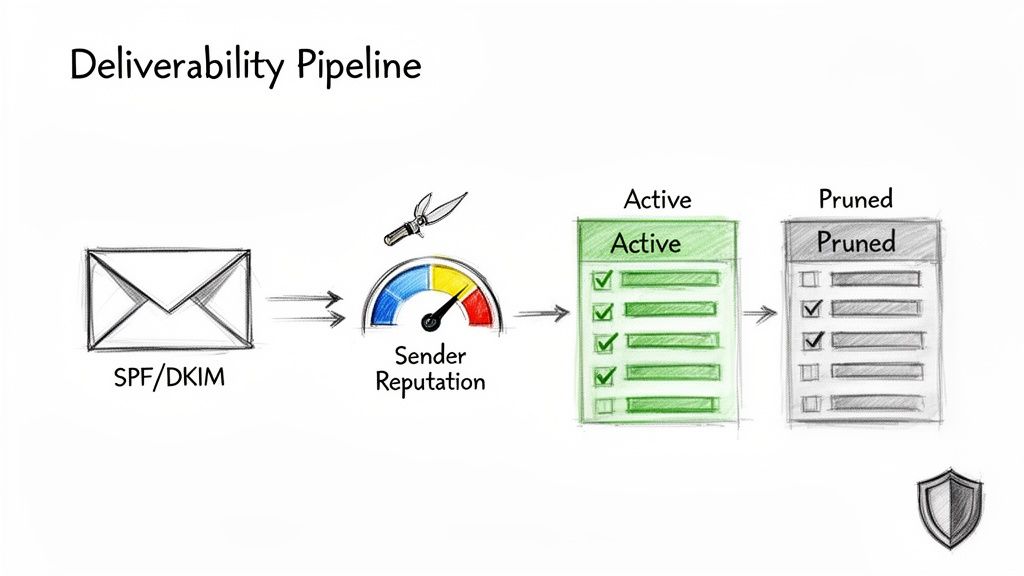
Most teams stop after setting up SPF and DKIM records. This is table stakes. True deliverability is about actively managing your sender reputation, which is a direct reflection of how people interact with your emails.
Mailbox providers like Google and Microsoft assign an invisible sender reputation score to your domain. A low score sends you directly to spam. High engagement—opens, clicks, replies—improves it. High bounces, spam complaints, and unsubscribes crater it.
This is especially critical for early-stage companies on a new domain. You must "warm up" your domain by sending small batches of highly personalized emails to engaged contacts, then gradually increasing volume. Jumping from zero to thousands of sends is a red flag that will get you flagged instantly.
This process is non-negotiable. It requires patience, but it protects your single most valuable marketing asset.
The single biggest mistake growth-stage companies make is clinging to a large, unengaged email list. They see a big number and mistake it for an asset. It is a liability.
A large list of dormant subscribers hurts your ability to reach those who do want to hear from you. Mailbox providers see low engagement rates and conclude your content is low-quality, throttling deliverability for everyone.
A smaller, hyper-engaged list of 1,000 true fans will always generate more pipeline than a bloated, dormant list of 50,000. Stop chasing vanity metrics and start optimizing for engagement.
Effective list hygiene is a continuous, ruthless process:
This discipline directly impacts revenue. Protecting your domain's health is the core operational requirement for turning email into a predictable revenue channel. For a deeper dive, you can learn more about building a high-quality B2B email database in our article.
Mastering deliverability is the unglamorous work that separates professional GTM teams from amateurs. It protects your brand, respects your audience, and ensures your messaging is read.
This is the point where most email marketing engines break down. It's not open rates that kill your ROI. It's the clumsy, broken handoff between marketing and sales—a moment of friction that poisons deals before they begin.
Most B2B SaaS teams treat this transition as a CRM notification. A lead hits a score, an alert fires, and a box is checked. This is a catastrophic misunderstanding. You are not transferring a contact; you are transferring intelligence.
Without that intelligence, sales reps are flying blind. They are forced to start conversations from square one, asking discovery questions that marketing should have already answered. The result is a disjointed buyer experience that erodes the trust you just built.
Ditch the simplistic MQL/SQL model that hinges on arbitrary point values. A lead who downloaded three random whitepapers is not necessarily more qualified than one who downloaded a single, high-intent pricing guide. Context is everything.
Define qualification criteria based on observable behaviors that signal buying intent. This requires a shared language—a true partnership—between marketing and sales.
Your sales team needs clear answers to these questions before they initiate contact:
This information cannot be buried in a raw activity log. It needs to be automatically populated into the CRM lead record in a concise, scannable format. An AE should not have to play detective to figure out why they are calling.
A successful handoff is not a notification; it's a briefing. It equips your sales team with the context to have a relevant, intelligent conversation from the very first sentence.
Once a lead is qualified based on these intelligence-driven criteria, the sales rep’s first touchpoint should never be a generic demo request. It must feel like a natural continuation of the conversation marketing started.
A powerful "warm-up" email from a sales rep directly references the prospect's journey.
Instead of this tired approach:
"Hi [Name], I saw you were on our website. Do you have 15 minutes for a demo?"
Try something that shows you've been paying attention:
"Hi [Name], my marketing team let me know you downloaded our framework on quantifying technical debt for the C-suite. Most VPs of Engineering I speak with find that communicating this is their biggest challenge. Is that something you're focused on right now?"
The difference is stark. The second email validates their interest, proves you understand their world, and frames the conversation around their specific problem. It signals you are not another name in an automated sales cadence.
This operational discipline is what connects your efforts to generate leads with email marketing directly to a predictable sales pipeline. For teams looking to tighten this critical connection, understanding the principles of aligning sales and marketing is a non-negotiable starting point. Building this bridge is an ongoing commitment to operational excellence that pays dividends in every deal cycle.
When I talk with founders and revenue leaders about email marketing, the same high-stakes questions always come up. Here are the direct, no-fluff answers I give them.
This is the wrong question. It puts tactics before strategy. The length is not the variable that matters—the objective is.
For a complex B2B SaaS product with a six-month sales cycle, your "sequence" might be a three-month structured conversation. For a simple PLG tool, you might need three to five emails over two weeks aimed at product activation.
The right question is: "What milestones of understanding must a prospect hit before they are ready for a sales conversation?"
Map your sequence to that journey. Start with the minimum number of emails required to deliver your value proposition and tackle the biggest objection. Then, let engagement data—not arbitrary "best practices"—dictate if you need more touchpoints.
Length is a function of your sales cycle's complexity, not a number from a blog post.
Forget vanity metrics. Open rates are notoriously unreliable and, at best, a weak directional signal. They tell you nothing about intent to buy.
The only numbers that matter are tied to pipeline and revenue. Your dashboard should focus on these:
Click-through rate (CTR) can be a useful diagnostic to see if messaging is resonating. But it’s not a success metric. A high CTR that generates zero sales conversations is a failure. Focus on metrics that signal buying intent.
No. For any B2B SaaS company building a credible brand, this is a fatal error.
Putting aside the massive deliverability risks—which can get your domain blacklisted—the bigger issue is that you obliterate trust before a conversation begins. Your first touchpoint becomes an unsolicited, irrelevant intrusion.
Buying a list is the digital equivalent of a cold caller barging into a board meeting. You might get a split second of attention, but you’ve permanently torched your reputation and guaranteed no one in that room will ever speak with you again.
The long-term damage to your brand massively outweighs any mirage of a short-term gain. The only sustainable path is to build a permission-based list of prospects who have explicitly raised their hands. It is slower. It requires more strategic thought. It is also the only way to build a predictable pipeline and a brand that commands respect.
Think of AI as a powerful accelerant, not a replacement for strategy. Its main job is to execute personalization and segmentation at a scale impossible for a human team.
This is no longer a novelty. AI's adoption in email marketing has hit a tipping point, with 63% of all AI adoption happening in this channel. The results are clear: AI-driven campaigns generate 41% higher revenue than traditional methods. For B2B SaaS leaders, this is a competitive edge to be seized. Marketers using AI for personalization have boosted email revenue by over 40%, with some seeing click-through rates as high as 13.44%. You can learn more about the impact of AI on email marketing performance.
But here’s the critical part: AI cannot fix a broken strategy.
If you have not validated your ICP, if your value proposition is weak, or if your lead magnets attract the wrong audience, AI will just help you send bad emails more efficiently. Get your strategy right first. Then, use AI to execute it with unparalleled precision.
At Big Moves Marketing, we help B2B SaaS founders build the strategic clarity and GTM systems required to drive predictable growth. If you are tired of generic playbooks and want a partner who can help you think better and decide faster, visit https://www.bigmoves.marketing.
Explore Big Moves Marketing services and resources:

%20-%20white.svg)