%20png%20copy.avif)

Most B2B SaaS teams think they’re doing personalization when they’re really doing decoration. A first-name token in HubSpot. A role field dropped into a cold email. A landing page swap based on industry. None of that fixes the problem, which is that your go-to-market motion still treats different buying situations like they’re the same.
That’s why your marketing feels generic even when the tooling looks advanced. One to one marketing isn’t a creative layer you add on top of the machine. It’s the operating logic of the machine. If your segmentation is lazy, your message is broad, and sales is freelancing the conversation, no tool is going to save you.
Most personalization is a waste of time.
It’s not just ineffective. It often makes you look less credible because the buyer can see the gap between surface-level tailoring and actual understanding. Using someone’s first name while sending the same abstract value proposition to every VP of Marketing in your CRM isn’t one to one marketing. It’s mail merge with better branding.
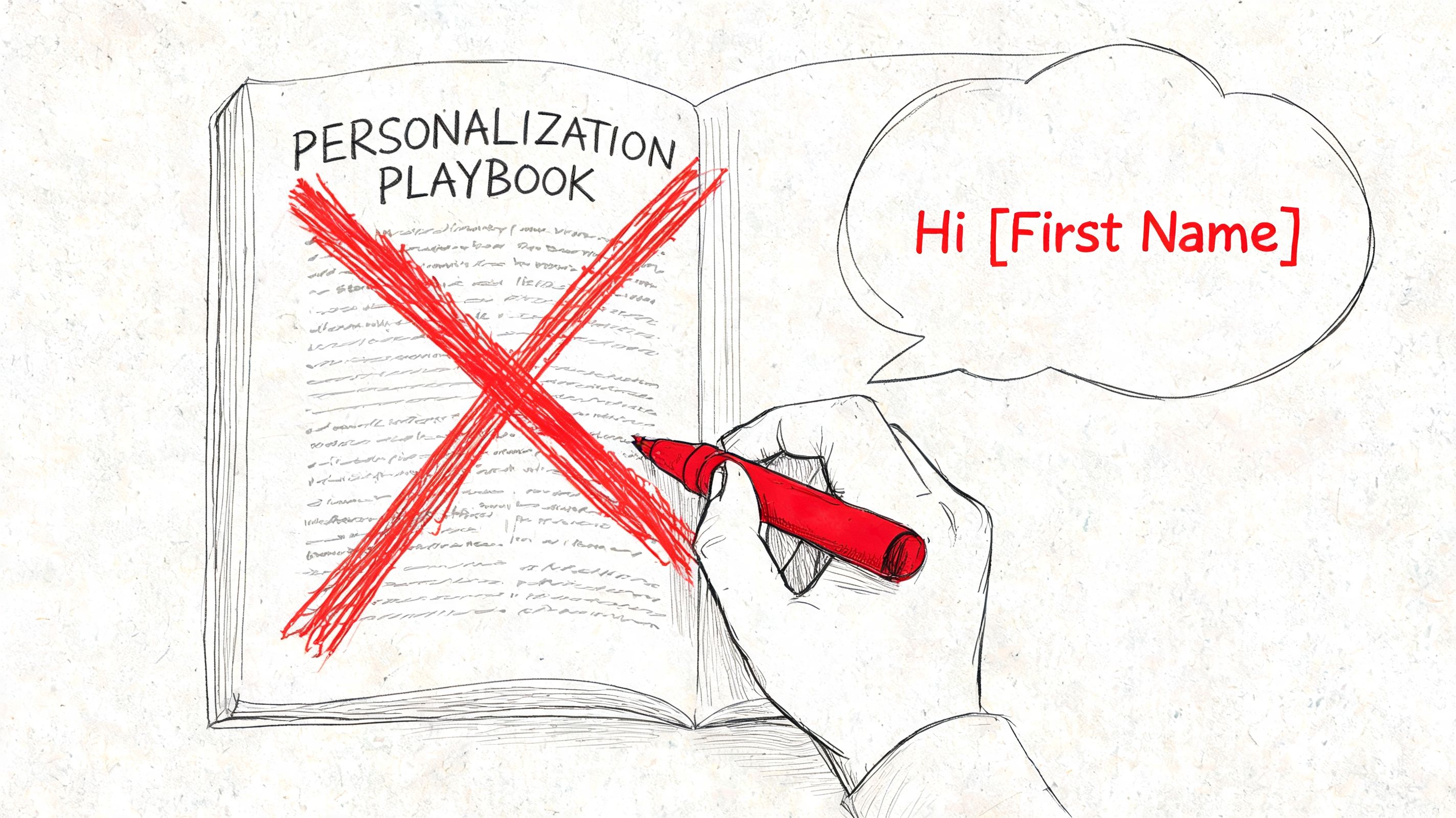
The underlying mistake is simple. Teams confuse personalization tokens with relevance. Buyers don’t care that you know their job title. They care that you understand the decision they’re trying to make, the risk they’re trying to reduce, and the internal friction they’re trying to overcome.
Founders often assume the issue is execution quality. Better prompts. Better automation. Better subject lines. That’s too shallow.
Your marketing feels generic because your company still talks in broad categories. “Finance leaders.” “Mid-market SaaS.” “Operations buyers.” Those buckets are too blunt to drive useful communication. If you haven’t done the harder work of defining buying context, problem severity, trigger event, and sales motion, your output will stay vague.
That’s also why a lot of teams jump straight into channel optimization and get nowhere. They tinker with subject lines, body copy, and meeting CTAs before fixing the strategic input. Tactical polish matters, and details like email subject line capitalization can improve clarity and consistency, but those refinements only help after the core message is relevant.
Generic messaging doesn’t become persuasive because you personalized the wrapper.
B2B buying isn’t one persona picking a tool on impulse. It’s a messy group process with technical, financial, and political constraints. Two companies can share the same headcount and vertical yet have completely different buying motives.
That’s why firmographic segmentation alone fails. It organizes your database, but it doesn’t tell you what to say. If your current model starts and ends with company size, industry, and role, it’s too thin to support one to one marketing. You need segmentation that reflects live buying conditions. If your team is still working through that challenge, this breakdown of B2B market segmentation is the right place to tighten the foundation.
Here’s the hard truth. One to one marketing isn’t about “personalizing more.” It’s about building a GTM system that produces relevance on purpose.
One to one marketing in B2B SaaS should be treated as an operating system, not a campaign tactic.
That means it governs how you collect signal, how you define segments, how you shape messaging, and how marketing and sales coordinate around actual buying conditions. When companies get this right, the commercial impact is material. McKinsey research cited by Braze says effective one-to-one marketing through personalization can reduce customer acquisition costs by up to 50%, lift revenues by 5-15%, and increase marketing ROI by 10-30%.
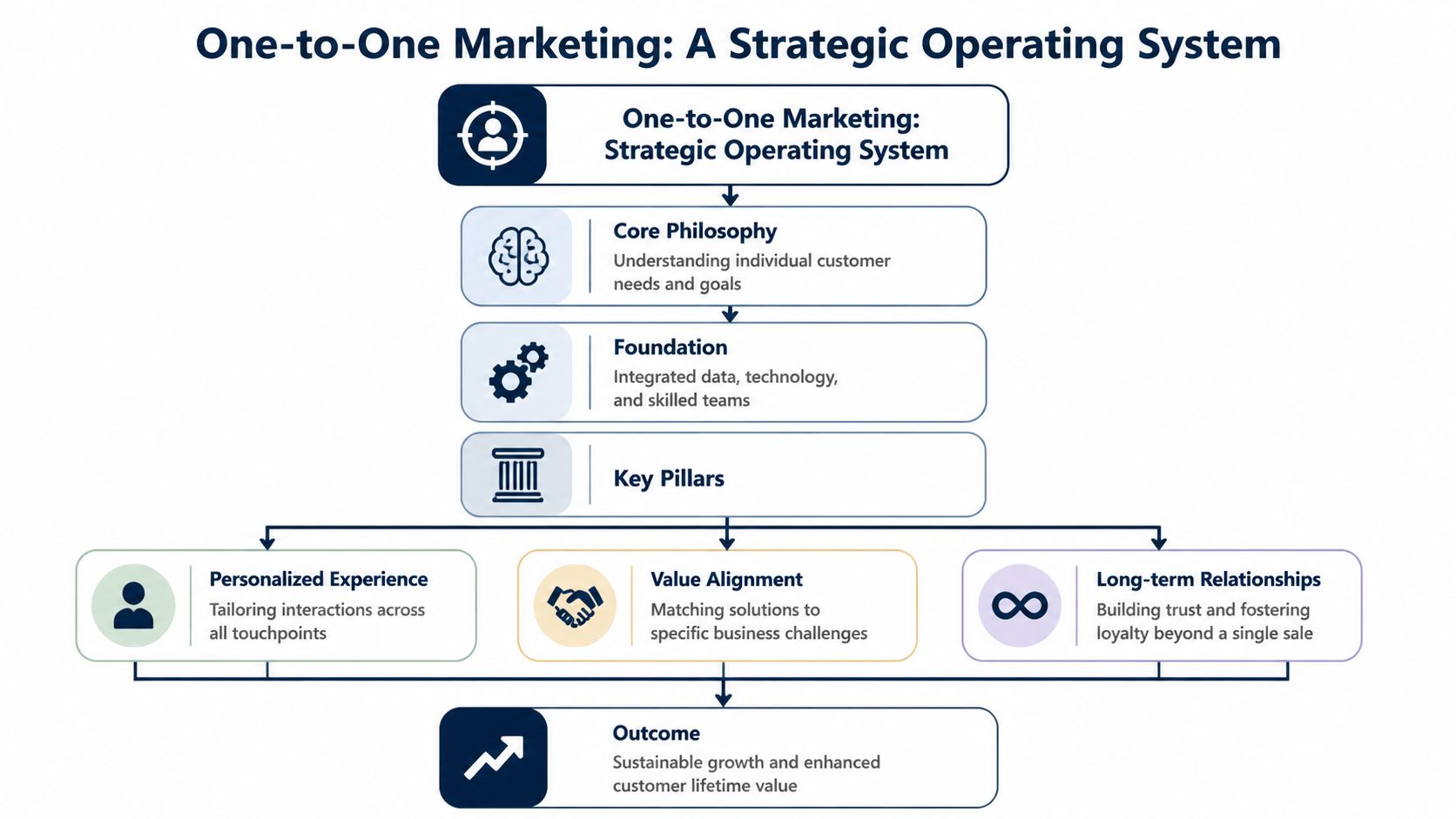
If you want one to one marketing to work in a growth-stage company, build it around three pillars.
This isn’t a prettier persona doc.
You need a working map of how different buyers experience the same category problem. That includes what triggers evaluation, what stakes make the problem urgent, what objections show up in the deal, and what internal language buyers already use to explain the issue. Good teams don’t just know who the buyer is. They know what changed in the account that made a purchase plausible now.
Useful inputs here are often plain and unglamorous:
Most B2B messaging is static when the buying context is dynamic.
A CFO evaluating a platform because procurement is pushing consolidation needs a different narrative than a VP who’s trying to fix a broken handoff between teams. Same category. Different buying logic. One to one marketing requires message architecture that can flex by problem, maturity, urgency, and stakeholder concern.
That’s where many teams benefit from a sharper account-based marketing approach. ABM is useful when it’s disciplined. It’s useless when it becomes expensive list building wrapped in generic creative.
A strong message system answers four things fast:
| Buying condition | Message requirement |
|---|---|
| Problem is obvious but urgency is low | Show cost of delay and operational drag |
| Problem is urgent but trust is low | Reduce perceived implementation risk |
| Team wants change but CFO is skeptical | Reframe value in financial and process terms |
| Champion is technical, committee is mixed | Equip the account with multi-stakeholder language |
Practical rule: If sales can’t explain why Segment A gets a different narrative than Segment B, you don’t have one to one marketing. You have copy variants.
A good message still fails when channels are disconnected.
The prospect sees one story in paid social, another on the website, and a third in SDR outreach. Marketing thinks it personalized. Sales thinks marketing generated weak leads. The buyer sees inconsistency and assumes the company doesn’t understand its own value.
Orchestrated delivery means every touchpoint advances the same account-specific argument. That includes:
That’s the operating system. Better signal. Better segmentation. Better narrative. Better coordination.
The biggest mistake growth-stage teams make is trying to build an enterprise personalization stack before they’ve earned the right to use one.
That’s backwards. You don’t start with a CDP project, a six-tool architecture, and a grand plan to personalize every touchpoint. You start by making a few high-value buying paths much more relevant. Then you expand.
Numerous teams find themselves stalled here. Gartner figures cited by Banuba show 63% of digital marketing leaders struggle with personalization implementation, and only 17% are using AI and machine learning across their marketing function. The bottleneck usually isn’t ambition. It’s operational discipline.
You probably have enough data to begin. You just haven’t organized it around decisions.
For an early or growth-stage B2B SaaS company, the first version of one to one marketing does not require a perfect customer data platform. It requires a usable signal layer. Start with three buckets:
Put those signals where both marketing and sales can use them. For many teams, that means cleaning up HubSpot, Salesforce, or both before buying anything else. If your automation is firing against bad fields and stale lists, fix that first. This guide to marketing automation best practices is useful if your workflows have become a mess of triggers without strategy.
Here’s the standard for phase one:
| Keep | Ignore for now |
|---|---|
| CRM stage data | Fancy identity resolution |
| Hand-raiser behavior | Full-channel predictive scoring |
| Closed-won and closed-lost notes | Massive taxonomy projects |
| Product usage for active accounts | Personalizing every asset at once |
One to one marketing becomes real at this point.
Teams often segment by attributes. Mature teams segment by buying conditions. That means your working segments should reflect what problem is active and why the account is in market.
Examples in B2B SaaS usually look like this:
These segments cut across industry and title. That’s the point. They produce sharper messaging because they’re tied to real decisions.
If your team needs a clean strategic reference point, actionable GTM frameworks can help structure this work. Use them as planning tools, not as a substitute for customer signal.
Most messaging projects die because they produce a brand document, not an execution tool.
You need a matrix that maps segment to message by stakeholder and by funnel stage. Keep it simple enough that SDRs, AEs, lifecycle marketers, and founders can all use it without interpretation.
A practical message matrix should include:
Segment definition
What buying condition puts this account here?
Primary pain
What operational problem is already visible?
Why now
What trigger event creates urgency?
Value angle
What outcome matters most in this context?
Proof type
What kind of evidence reduces doubt for this segment?
Likely objection
What blocks progress most often?
Channel adaptation
How should this show up in outbound, landing pages, and sales calls?
Don’t overcomplicate the copy. The goal isn’t brilliance. The goal is consistency with precision.
Your first one to one message matrix should feel slightly narrow. That’s a good sign. Broad message architecture is usually a symptom of weak choices.
Companies either create momentum or create noise.
A one to one marketing engine works when each channel carries the same strategic thread. The SDR email should sound like it came from the same company as the paid ad, the landing page, the case study, and the AE follow-up. Failure often occurs because each function writes its own version of the story.
A practical orchestration model for a lean team looks like this:
The founder’s role matters here. If you’re still founder-led in sales, don’t hide from this work. You are often the clearest source of market truth. Use your calls to refine segment language and sharpen the matrix. Then institutionalize it so the GTM system doesn’t depend on you forever.
If your dashboard for one to one marketing starts with opens, clicks, and MQL volume, you’re measuring the wrong thing.
Those signals can help diagnose execution, but they don’t tell a founder whether relevance is changing revenue outcomes. One to one marketing is only valuable if it changes the economics of pipeline.
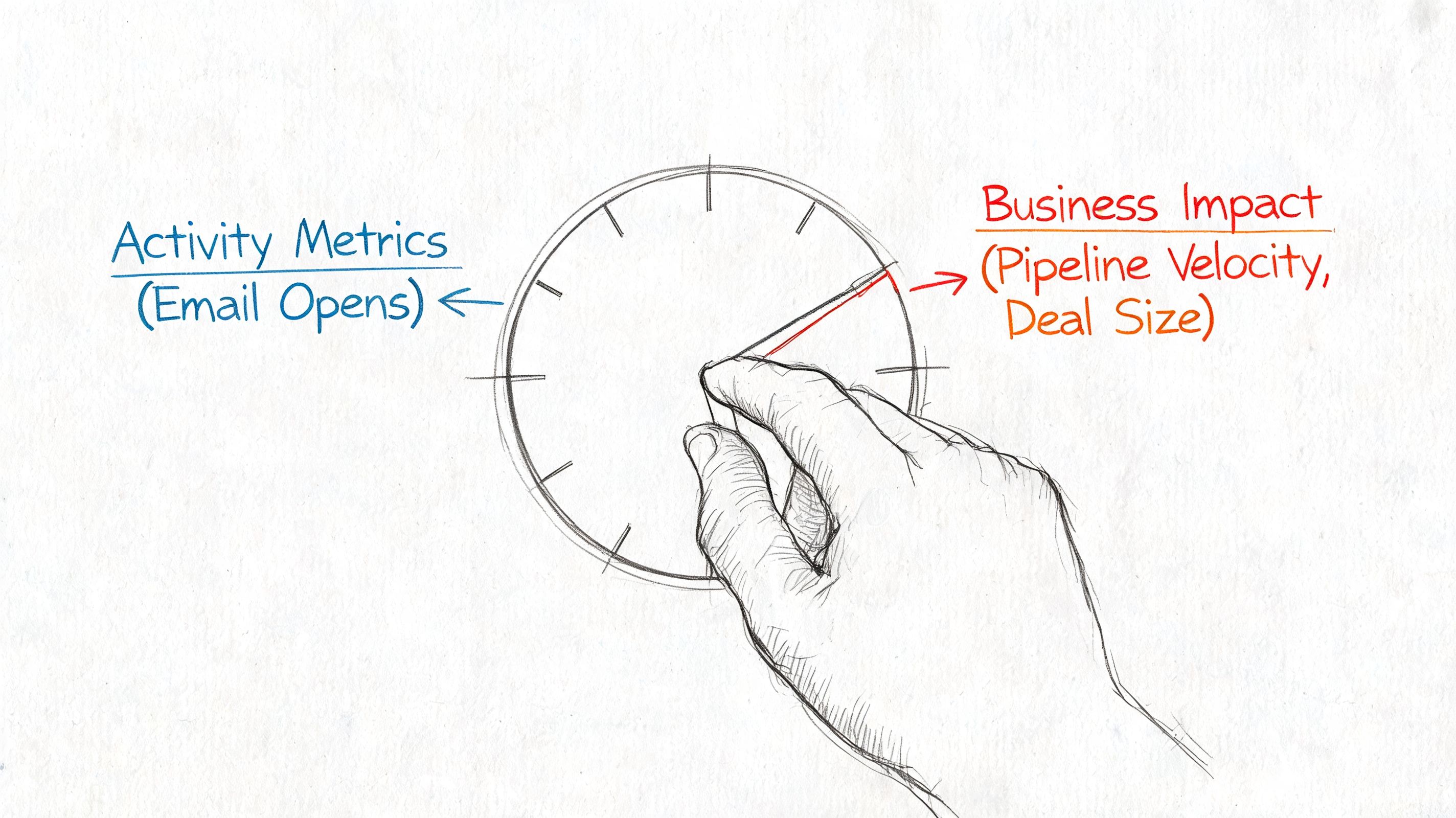
The case for relevance is strong. AB Tasty’s summary of personalization data notes that 80% of consumers are more likely to complete online purchases from brands offering personalized experiences, and one B2B brand saw a 24% reduction in CPA and a 59% rise in ROAS through micro-segmentation. Useful signal, but that still isn’t the scorecard a SaaS leadership team should stop at.
In B2B SaaS, the commercial test is simpler. Did relevance improve the quality and movement of target pipeline?
A strong CRM setup matters here because weak attribution creates fake confidence. If your fields, lifecycle definitions, and opportunity hygiene are sloppy, your reporting will tell comforting stories instead of accurate ones. This is why CRM discipline matters more than another reporting layer. If your foundation is uneven, tighten your B2B CRM model before you celebrate campaign metrics.
Use a scorecard that leadership cares about.
| Metric | What it tells you | Why one to one marketing affects it |
|---|---|---|
| Pipeline velocity | How quickly qualified deals move | Better relevance reduces confusion and shortens dead air between stages |
| Average deal size | Whether strategic segments are buying broader scope | Precise messaging helps sales anchor value to higher-stakes problems |
| Pipeline coverage in target accounts | Whether your best-fit accounts are progressing | Stronger segmentation improves focus and sequencing |
| Expansion and retention signal | Whether the promise matched reality | Good one to one marketing sets expectations with more precision |
One more rule. Compare these metrics by segment, not just in aggregate. Aggregate reporting hides whether your supposed personalization is helping the accounts you care about most.
A useful primer on aligning growth with revenue outcomes is below.
When messaging fits the buying condition, buyers ask better questions sooner. That’s usually the first commercial sign that the system is improving.
Most articles on one to one marketing skip the messy part. They tell you to personalize, then assume your team already knows how to identify the right account, frame the right problem, and coordinate the right follow-up.
That’s not how this plays out inside a real SaaS company. The work is usually narrower, slower, and much more operational.
The useful model here is simple. Teams identify a valuable buying pattern, differentiate how that pattern should be messaged, and interact with buyers in a way that reflects that context. That logic lines up with the RDI cycle discussed in the research on one-to-one marketing. The same research also notes that leading practitioners focus on the roughly 5% of website visitors who contribute disproportionately to key performance indicators.
This company sold into operations and IT teams. Marketing had decent top-of-funnel performance, but deals kept stalling after discovery. The issue wasn’t lead quality. It was message mismatch.
They were speaking to all target accounts as if they were buying for efficiency. Some were. Others were buying because a brittle process between teams had already failed internally. That second group needed a risk and coordination narrative, not a productivity narrative.
The fix was operational:
The result wasn’t magic. It was cleaner deal progression because the buyer felt understood earlier.
This team had strong product adoption at the user level but weak expansion into larger contracts. Their lifecycle marketing treated all active accounts similarly, even though usage patterns clearly showed different motives.
One cluster used the product tactically. Another was trying to formalize usage across teams. The messaging stayed broad, so account expansion relied too heavily on AE instinct.
They rebuilt one to one marketing around account maturity:
| Account pattern | Old message | Better message |
|---|---|---|
| Single-team usage | Product features | Team-level efficiency and control |
| Multi-team organic spread | Product updates | Standardization and governance |
| Admin activity increasing | Generic nurture | Rollout planning and stakeholder alignment |
This changed the commercial conversation. Customer marketing, product, and sales all used the same account logic. Expansion improved because the system recognized what kind of internal motion was already happening.
Good one to one marketing often feels obvious in hindsight. That’s because it finally matches how buyers were already behaving.
The founder knew the market extremely well and closed the best deals personally. Everyone else struggled.
That’s a familiar pattern. The company thought it had a pipeline problem. Instead, it had a transfer problem. The founder held the segmentation logic in their head and the rest of the team was working from generic persona language.
The intervention was not a big tech rollout. It was codification.
The team stopped trying to be relevant to everyone. That’s when the marketing started to feel specific, and sales stopped reinventing the pitch in every call.
These aren’t glamorous transformations. They’re disciplined ones. That’s what makes them work.
Most one to one marketing efforts fail long before launch.
Not because the idea is wrong. Because the organization treats it like a software purchase, a campaign layer, or a copywriting upgrade. The hard part is operational alignment. That’s also why so many polished guides are disappointing. They describe the destination and ignore the build.

A useful reality check comes from Adobe’s discussion of one-to-one marketing complexity. Mid-market B2B companies often lack the operational and technical infrastructure, including enterprise-grade CDPs, to execute personalization at scale. That gap gets ignored far too often.
Teams buy platforms before they’ve made strategic choices.
They assume software will produce relevance if enough data flows into the stack. It won’t. If you haven’t defined buying conditions, message differences, and handoff rules between marketing and sales, all you’ve done is digitize confusion.
A tool can distribute a good strategy. It can’t invent one.
The opposite mistake is waiting for perfect data.
You don’t need a pristine warehouse and a grand taxonomy project to start. You need enough signal to identify a few meaningful account patterns and enough discipline to act on them consistently. Teams stall because they mistake completeness for readiness.
This usually sounds responsible. It isn’t. It’s avoidance dressed up as rigor.
Marketing personalizes campaigns. Sales ignores them. Customer success hears different expectations after the deal closes.
That’s not one to one marketing. That’s departmental improvisation.
Here’s what siloed execution looks like in practice:
If your GTM functions can’t describe the same segment in the same language, the buyer experiences your company as fragmented.
This one gets underestimated.
A lot of marketing teams produce segment thinking that never reaches the frontline in usable form. Sales doesn’t need another positioning deck. Sales needs talk tracks, objection guidance, proof suggestions, and account cues that fit a live conversation.
Founders should ask a blunt question: can an AE explain why this account is in a given segment and what message should change because of it? If not, your one to one strategy is still trapped in planning.
More theory isn't what's typically required. A launch standard is.
Use the two templates below as working tools. Keep them short. Update them often. If they become bloated, they’ll stop being useful.
Use this before launching any segmented outbound, paid, lifecycle, or sales-assisted play.
If you want one to one marketing to survive contact with reality, give sales one page, not twenty.
For teams refining this discipline, a sharper definition of sales enablement is useful because enablement isn’t content volume. It’s decision support for live deals.
Use this template:
Segment name
What this account pattern is called internally
Who belongs here
The visible traits, triggers, or behaviors that place an account in this segment
What they care about
The operational problem and the stakes behind it
Why they might act now
The event, failure, mandate, or pressure creating timing
Primary message
The core narrative sales should lead with
Proof to use
The type of evidence that reduces risk for this buyer
Likely objections
Common pushback and the right response angle
Next best action
The call-to-action or conversation path that fits this segment
The value of one to one marketing isn’t that it sounds modern. The value is that it forces your GTM team to stop speaking in abstractions and start operating from actual buyer context. That takes work. It also creates the kind of precision generic SaaS marketing never will.
If your company’s message feels broad, your pipeline feels uneven, or sales keeps rewriting marketing in the field, Big Moves Marketing can help you rebuild the system behind it. The work usually starts with clearer segmentation, sharper messaging, and a GTM structure your team can effectively use.
Explore Big Moves Marketing services and resources:
June 26, 2026





%20-%20white.svg)