%20png%20copy.avif)
Most B2B SaaS founders are told that outbound lead generation is a volume play. This is fundamentally wrong. It's the core assumption that leads to burned lists, damaged brand equity, and sales cycles that drain morale and runway.
The typical outbound engine isn't failing for a lack of activity. It's failing because the system itself is broken.
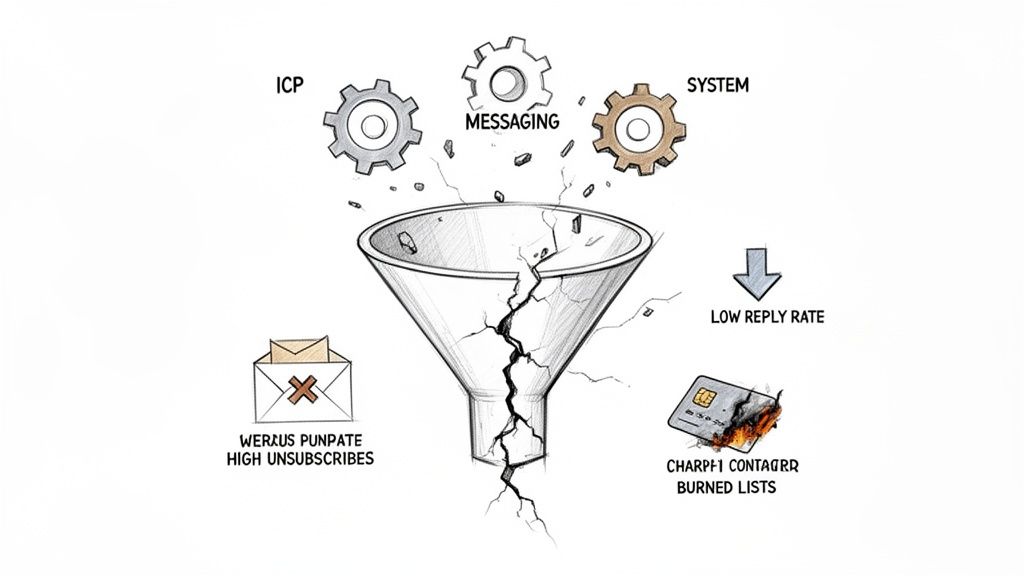
Teams mistake motion for progress, blasting generic campaigns at buyers who are conditioned to ignore them. The result is a sputtering engine characterized by abysmal reply rates and a high-velocity unsubscribe list.
The real problem isn't tactics. It's strategy.
When I'm brought in to diagnose a failing outbound program, the symptoms are always the same: rock-bottom reply rates, frustrated SDRs, and a pipeline that feels more like a mirage. These are not isolated tactical mistakes. They are systemic failures stemming from a deep disconnect between three critical components.
This flawed model forces sales reps into a brute-force motion, where they are compensated for activity, not for creating valuable conversations. The entire machine is optimized for noise, not signal. If your engine is sputtering, the first move is often to master one channel. For many, that's LinkedIn, and there's a proven guide on LinkedIn for B2B Lead Generation that covers everything from profile optimization to strategic campaigns.
The question isn't "How do we send more emails?" It is: "How do we systematically earn the attention of our highest-value accounts?"
Effective outbound is not about finding anyone who will take a meeting. It is about manufacturing conversations with the right people at the right accounts. This requires a fundamental shift in thinking.
Stop treating outbound as a tactical checklist and start treating it as a strategic asset for building predictable growth. This means recognizing the causal link between your ICP, messaging, and execution system. A breakdown in one guarantees failure across the board. Strong alignment between GTM functions is non-negotiable, a topic we cover in our guide to aligning sales and marketing for B2B SaaS success.
This guide is designed to pull you out of the "spray and pray" mindset for good. We will diagnose the symptoms of a broken outbound engine, trace them to their strategic roots, and provide a clear framework for building a system that generates a predictable, high-quality pipeline.
Top-tier outbound programs are won long before the first email is sent.
Success is not a function of clever subject lines or a new automation tool. It is forged in the foundational work most teams rush: defining a razor-sharp Ideal Customer Profile (ICP) and constructing messaging that reflects their world.
Your outbound engine is only as strong as its targeting. A fuzzy ICP guarantees wasted motion, burning capital and team morale chasing accounts that were never going to close.
To execute this correctly, you must move past the basics. Company size and industry are merely table stakes.
A strategic ICP is a working theory—a hypothesis about which specific segment of the market has the most urgent, expensive problem you are uniquely positioned to solve. This is not a static document to be filed away; it is a dynamic tool that focuses your entire GTM team.
To develop it, you need to analyze the context surrounding an account.
Achieving this clarity requires real work. It means interviewing your best customers, interrogating your sales team on recent wins and losses, and analyzing call recordings. The insights already exist within your business—you just have to extract them.
We developed a framework to help leaders do this; you can use our free guide and template for defining your Ideal Customer Profile to start.
To illustrate the gap between a typical ICP and one that drives results, consider this breakdown:
The difference is stark. One describes a generic pool of companies. The other paints a clear picture of an organization with a problem your solution is built for. That is the required level of focus.
Once you have a clear picture of who you're targeting and why it matters to them, you can build your messaging.
Your messaging should be a series of value hypotheses, not a list of features. Every email, call, and connection request becomes a micro-test of a core assumption about your customer's pain.
Most outbound messaging is a solution looking for a problem. Your job is to demonstrate you understand the prospect’s problem better than they do. Only then will they believe you have a credible solution.
This approach transforms outbound from a blunt instrument into a precision tool.
Consider the case of AirOps. They were stuck with stagnant growth from generic email blasts. They refocused on just 500 hyper-targeted leads identified using intent data and buyer signals. By crafting personalized outreach based on that data, they generated over 50 positive replies in the first week.
This is proof that a smaller, smarter list paired with resonant messaging will outperform a massive, generic one every time. To ensure your foundation is solid, see a complete guide to building your B2B Ideal Customer Profile.
The output of this foundational work is a clear playbook that aligns your entire GTM team. Sales, marketing, and product all operate from the same understanding of who the customer is, what they care about, and how to communicate value.
This is the bedrock of a scalable outbound system. Without it, you are guessing.
Here is a hard truth about outbound: a brilliant message sent to the wrong person is a waste. But even a great message sent to the right person on the wrong channel is just noise.
Effective outbound is not about sending one heroic email. It is about orchestrating a series of thoughtful "touches" across multiple channels, creating a logical, value-driven sequence that earns a conversation.
The real goal is to build familiarity and establish credibility before you ask for a meeting.
Most sales teams get this wrong. They build linear, single-channel sequences that hammer a prospect's inbox with slight variations of the same "got a minute?" request. This ignores how modern B2B buyers operate. Before replying, they are looking at your LinkedIn profile, checking your website, and assessing your credibility.
A strategic sequence anticipates this behavior and uses it as an advantage. It layers channels—email, LinkedIn, and sometimes a well-timed call—to create a surround-sound effect that feels less like a cold interruption and more like a relevant conversation starter.
It all starts with a rock-solid ICP and messaging that connects. Without those, your sequences will fall flat. Every time.
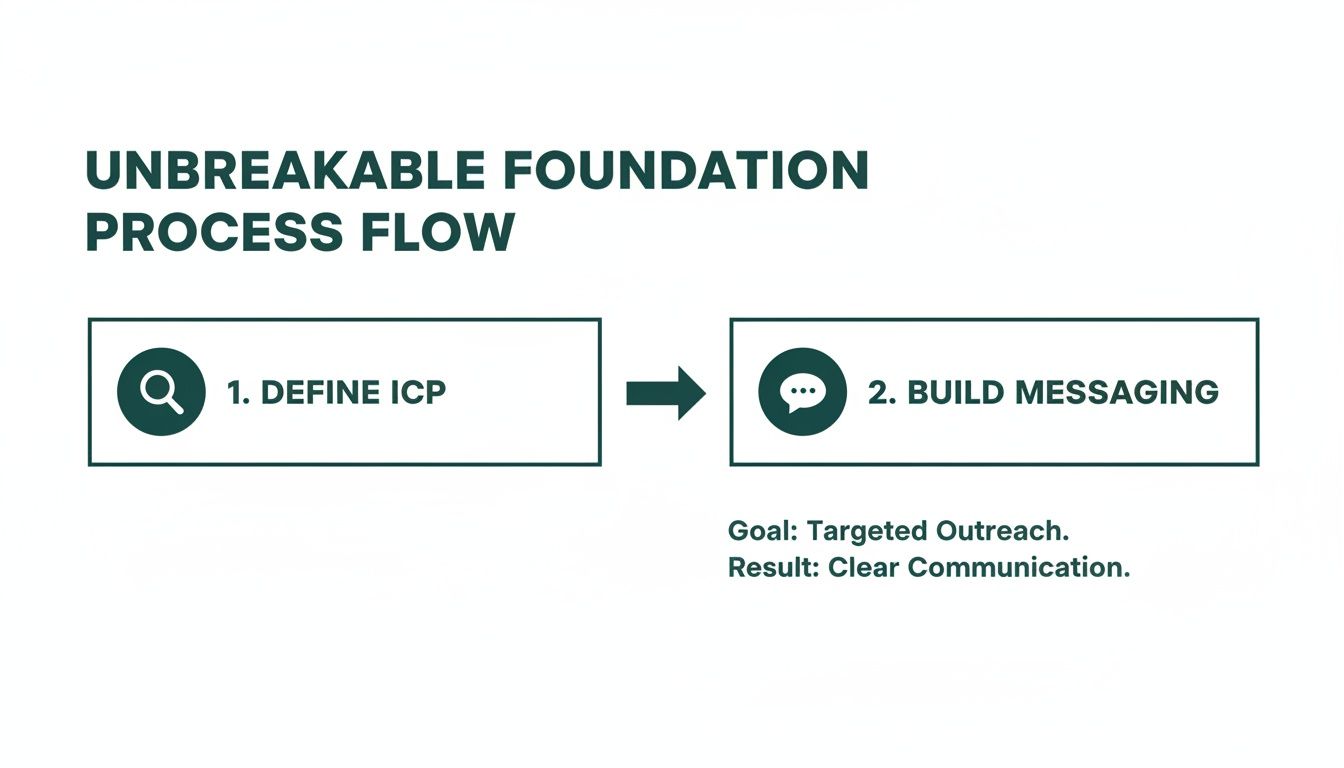
Think of sequence design as a direct output of that foundational work, not a standalone tactical exercise.
A winning sequence is a series of strategic "at-bats," each with a specific purpose. You are not just following up; you are building a narrative. Every touchpoint must deliver a new piece of value, offer a different insight, or frame the problem from a new angle.
Here is a simple structure we've seen work effectively over a 14-to-21-day period:
The point of a sequence is not to annoy someone into submission. It is to build a compelling case, piece by piece, that a conversation with you is worth their time.
Getting this right means integrating these channels intelligently. While LinkedIn is excellent for finding and vetting leads, cold email still delivers when personalized at scale—research shows 42% of businesses still rank it as their top channel for outreach.
The real leverage is in combining them. Sequences that blend LinkedIn touches, multiple emails, and targeted calls can triple your efficiency.
This orchestration requires a careful balance between automation and manual personalization. Use sales engagement tools to manage the cadence, but empower your reps to inject relevant details based on a prospect’s recent activity or company news. That is how scaled outreach can feel personal.
This multi-faceted approach is about crafting a cohesive story over time. For a deeper look at how this works in practice, explore our breakdown of successful multi-channel marketing campaign examples. The takeaway is clear: stop thinking in single channels and start designing integrated experiences that earn the right to a conversation.
A brilliant strategy is an intellectual exercise without execution. This is where most early-stage teams fail. They mistake activity for progress and drown in vanity metrics that mean nothing to the bottom line.
Building a scalable outbound system isn't about buying expensive software. It is about building a lean, effective infrastructure designed for one purpose: to run disciplined experiments, gather clean data, and generate a predictable flow of conversations.
The goal is a feedback loop where your inputs—ICP, messaging, and sequences—reliably produce the required outputs: meetings, pipeline, and revenue.
First, you must measure the right things. Too many teams obsess over open and click-through rates. These are weak directional signals at best. A decent open rate indicates your subject line was not terrible, not that your message resonated.
Your outbound dashboard should be a ruthless reflection of business impact, not a collection of vanity metrics. If a number doesn't trace back to a meeting or pipeline, it's noise.
Shift your focus to metrics that signal genuine buyer interest and sales momentum. These are the only numbers that provide a clear view of your outbound health.
Tracking these metrics is about diagnostics. It allows you to pinpoint where your system is breaking down. Low positive reply rates? A messaging problem. Low meeting booked rates? Your CTA is weak. Low SAO rate? A qualification or handoff issue. To learn more, see our guide on how to measure marketing effectiveness with the right KPIs.
Once you've defined your core metrics, build the infrastructure to support them. Resist the temptation to over-engineer your tech stack. You only need enough tooling to execute systematically and measure accurately.
For a team starting out, a lean stack has three core components.
1. Data Sourcing & Enrichment: You need a reliable source for contact and account data that aligns with your ICP. This is your fuel. Paired with an enrichment tool, it ensures your data is accurate and contains the contextual details needed for personalization.
2. Sales Engagement Platform (SEP): This is the engine of your outbound system. A solid SEP like Outreach or Salesloft automates your multi-channel sequences, enables A/B testing, and centralizes prospect communication. This is where your SDRs operate.
3. CRM: Your system of record. All activities, conversations, and outcomes must flow cleanly from your SEP into your CRM (like Salesforce or HubSpot) to track opportunities from creation to close. A messy CRM makes accurate ROI calculation impossible.
This lean setup provides everything needed to launch, manage, and measure your program effectively. It controls costs and focuses your team on execution, not managing a dozen different tools. It is the foundation for turning strategy into a revenue-generating asset.
Let's be direct. Booking a meeting is not the goal of outbound. Generating revenue is.
I have repeatedly seen growth-stage SaaS companies celebrate a spike in booked meetings, only to watch that pipeline evaporate after the first sales call. The hard work of your SDRs is wasted. The momentum dies.
This breakdown almost always occurs at the handoff. The sales team is not equipped with the right context, messaging, and assets to continue the conversation. Promising opportunities go cold because the Account Executive is forced to improvise, effectively starting from scratch.
This isn't about building a massive library of sales documents. It's about creating a focused, practical toolkit that gives your AEs precisely what they need to convert initial interest into a qualified opportunity.
Your outbound sequence makes a promise. It identifies a specific pain point and hints at a credible solution. When a prospect agrees to a meeting, they are accepting that specific premise.
But then the AE joins the call with a generic, "Tell me about your business..." and launches into a standard product demo. That is a broken promise. It creates a jarring experience that erodes trust.
The AE must pick up the conversational thread exactly where the SDR left off. This requires more than a glance at CRM notes five minutes before the call. It requires a standardized set of assets designed to ensure message consistency and equip the rep to lead with authority.
An outbound lead is a warm lead, but only if the handoff is seamless. The first sales call must feel like the next logical step in a conversation that has already started, not a cold reset.
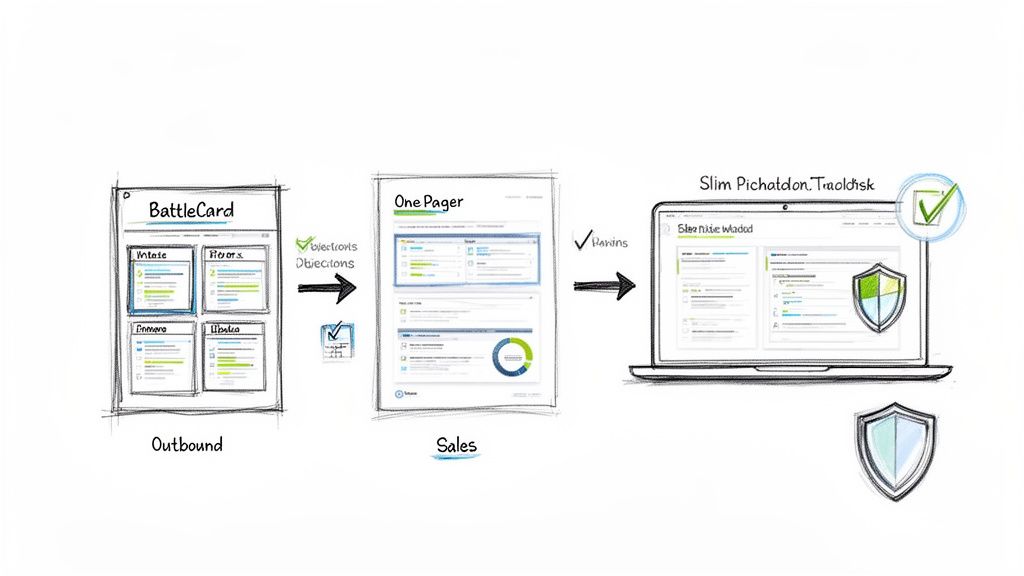
To maintain momentum, your sales team needs a core set of assets designed for these crucial early-stage conversations. These are non-negotiable.
Your team needs a small, potent set of tools to bridge the gap between that first "yes" and a real sales opportunity. Here are the core assets that make all the difference:
Building these assets ensures every AE arrives at the first call prepared, professional, and ready to continue the conversation your outbound team started. This alignment is where outbound efforts convert to revenue.
Creating these tools is not just a "sales problem"—it is a fundamental part of your go-to-market strategy. To get deeper into structuring these critical assets, see our guide on sales enablement best practices for B2B teams. Getting this handoff right is non-negotiable if you want to turn outbound interest into closed-won deals.
Even with a strong playbook, founders and sales leaders encounter the same practical hurdles when launching an outbound program. I have heard these questions from nearly every B2B SaaS team I have advised. Here are direct answers.
Founders require predictability. But outbound is not a light switch; it is an engine you must build, test, and tune. Budget a solid 60 to 90 days for initial setup, testing, and learning. This ramp-up period is not a failure; it is the cost of gathering real-world market data.
During the first two months, you are paying to learn what works. Every email sent is a micro-experiment testing your assumptions about your ICP and messaging. You may see the first qualified meetings appear after four to six weeks, but achieving a predictable flow of opportunities almost always takes a full business quarter.
The single biggest mistake is pulling the plug after 30 days of weak results. Outbound is a system that gets smarter with data and refinement. Patience is a strategic necessity.
Keep in mind that your timeline depends on your market. A six-figure enterprise deal will have a much longer feedback loop than a five-figure tool sold to mid-market tech companies. Your sales cycle, deal size, and market maturity are significant factors.
This decision depends on your company's stage and internal expertise. There is no magic answer, only trade-offs.
Early-Stage (Pre-Series A): Keep it in-house. Your primary goal is learning, not hitting a lead quota. The founder or first sales hire must run the initial outbound motion. You need that unfiltered, direct market feedback to understand how customers talk about their problems. Outsourcing too early creates a dangerous layer of abstraction between you and your market.
Growth-Stage (Series A and Beyond): This is where outsourcing or a hybrid model becomes viable. If you have achieved product-market fit but lack the internal expertise to build and scale a sales team quickly, a specialized partner can accelerate your progress. This allows your account executives to focus on closing deals.
A hybrid approach can also be effective. A partner handles list building and initial touches, and your in-house SDR qualifies interested prospects. The guiding question should always be: who is best positioned to gather market feedback and use it to sharpen our strategy?
Most outbound programs fail because of bad strategy, not bad tactics. I have seen the same three critical mistakes sink otherwise promising efforts repeatedly.
Another classic error is getting distracted by vanity metrics like open rates. Your dashboard must reflect what matters to the business—qualified meetings, pipeline generated, and closed-won revenue. Everything else is a distraction.
Calculating the true ROI of your outbound efforts requires discipline and a clean CRM. Counting meetings is insufficient; you must connect the investment to revenue.
The core formula is simple: (Revenue from Outbound - Total Program Cost) / Total Program Cost.
The difficulty lies in calculating "Total Program Cost." You must include everything:
To track this accurately, your CRM must be configured to follow a lead's journey from the first touchpoint to a closed-won deal. A key secondary metric is your Customer Acquisition Cost (CAC) for the outbound channel. A healthy outbound engine should deliver a strong Lifetime Value (LTV) to CAC ratio. For B2B SaaS, a 3:1 ratio is a common benchmark for sustainable growth.
Big Moves Marketing helps B2B SaaS founders build the clarity and leverage needed to avoid wasted growth motion. If you need to align your team and build a go-to-market strategy that actually works, let's talk. Learn more at https://www.bigmoves.marketing.
Explore Big Moves Marketing services and resources:

%20-%20white.svg)