%20png%20copy.avif)
Most advice about building an MVP is directionally right and commercially wrong.
It's right if your only question is whether users care about the problem. It's wrong if you're trying to win a serious B2B customer. Enterprise buyers don't buy experiments. They buy products they can defend internally, implement without embarrassment, and operate without creating downstream risk.
That's why so many B2B SaaS founders get stuck. They ship something functionally minimal, call it an MVP, start selling, and then act surprised when deals stall in security review, die in onboarding, or fade after a promising pilot. The problem usually isn't demand. The problem is that the product is learnable but not sellable.
If you're selling into teams, departments, or regulated environments, you need a different mental model. You need a Viable Minimum Product. Not the minimum thing that helps you learn. The minimum thing a real customer can buy, adopt, and champion.
The MVP playbook was built to reduce product risk. Founders keep misusing it in situations dominated by commercial risk.
That distinction matters. A classic MVP exists to validate demand before a company commits major development effort. It's designed around learning, not around procurement, stakeholder alignment, or operational trust. That model exists for a good reason. About 42% of startups fail because there's no market need, which is exactly why early testing matters, as the NNGroup definition of MVP explains.
But that same framing breaks once you move into B2B sales with meaningful contract value.
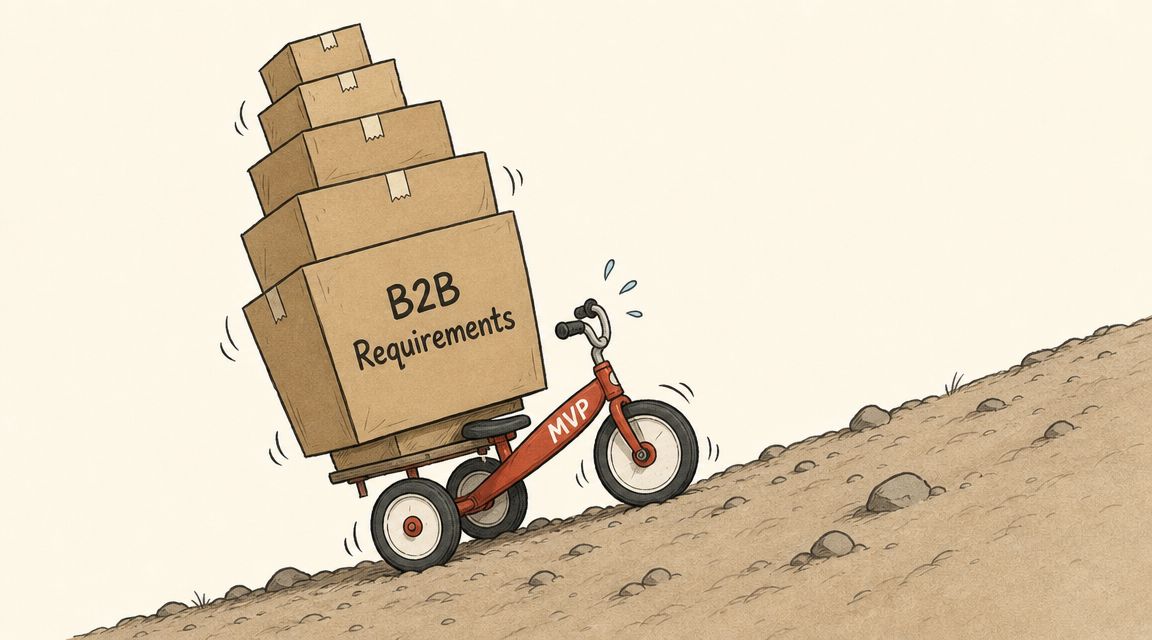
A founder hears “ship fast” and translates it into “strip the product to the core workflow.” That's fine if your target user is an individual early adopter. It's a bad move if your buyer is a VP, a finance leader, or an IT stakeholder who has to justify the purchase to colleagues.
In B2B SaaS, the first deal usually doesn't fail because your headline feature is weak. It fails because the product package feels incomplete. No admin controls. No clean onboarding flow. No confidence that the team can support deployment. No way for a buyer to say, “Yes, this is safe enough and mature enough to bring into our environment.”
Enterprise buyers rarely reject a product because it has too few features. They reject it because it creates too much organizational friction.
A lot of founders confuse product-market fit with deal readiness. They think a few strong user interviews and a working demo mean they're ready to sell. They aren't. If you're serious about finding product-market fit in B2B SaaS, you need to separate user enthusiasm from buyer confidence.
A consumer user can forgive rough edges. A B2B buyer can't. They're not buying a screen. They're buying implementation risk, support burden, internal optics, and expected reliability.
That changes the build brief.
The standard MVP mindset says, “What is the smallest thing we can release to learn?” In high-ACV B2B, the better question is harsher.
What is the smallest thing we can sell without creating avoidable objections?
A Viable Minimum Product is not another way of saying MVP. It's a different asset for a different job.
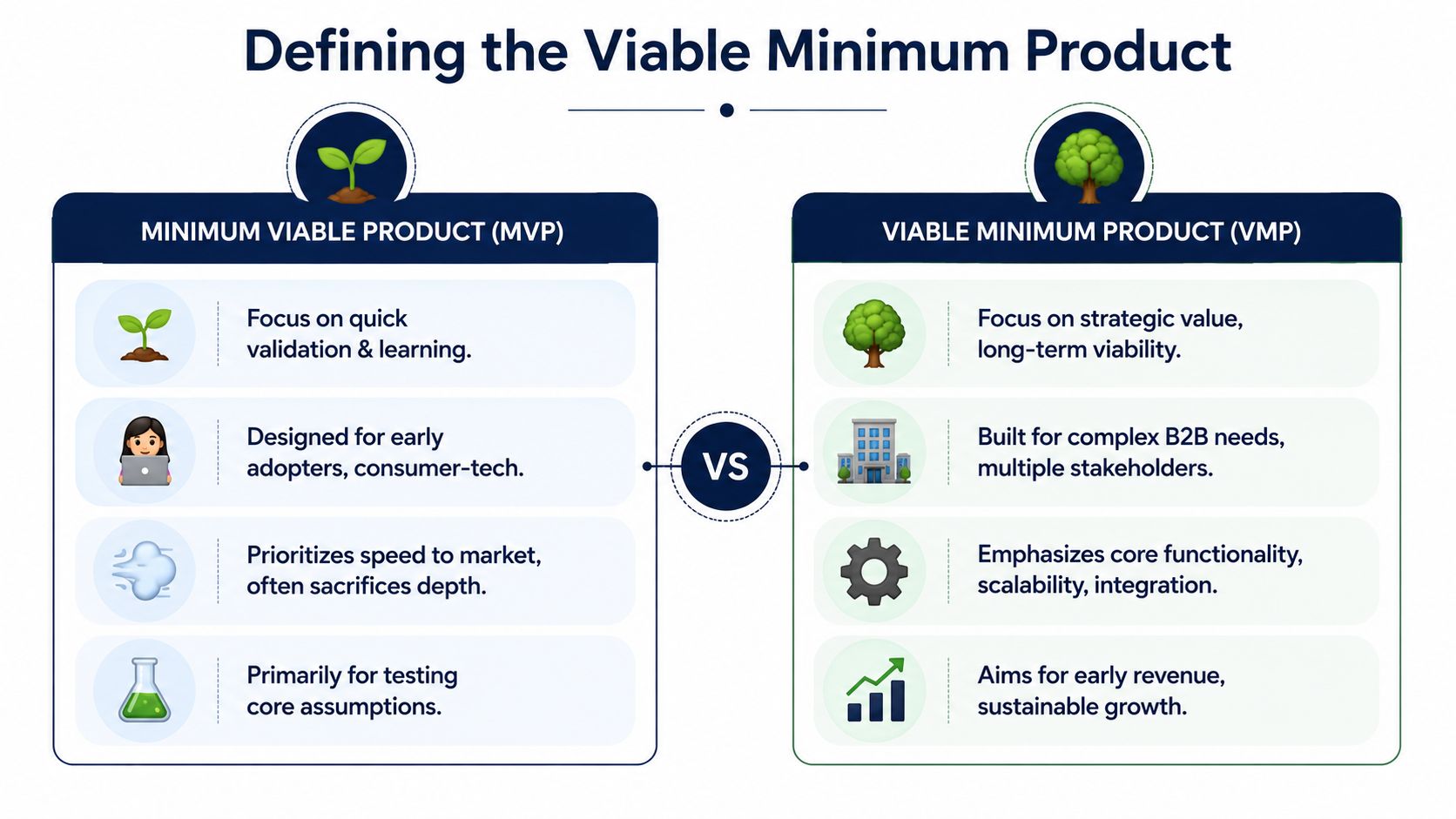
An MVP is the minimum product required to learn. A VMP is the minimum product required to close and successfully launch a deal with your target customer. That sounds subtle. It isn't. One is optimized for hypothesis testing. The other is optimized for commercial trust.
A lot of MVP advice collapses every early-stage validation method into one fuzzy bucket. Landing pages, clickable prototypes, concierge tests, and coded products get treated as interchangeable. They aren't. The right artifact depends on the risk you're trying to remove.
That's the most useful way to understand the VMP. It's the artifact you use when the key risk is no longer “Will anyone care?” It's “Will a serious customer buy this, implement it, and attach their reputation to it?”
The sharpest framing I've seen on this comes from a discussion on validation artifacts in B2B: the most valuable learning for a B2B company often comes from a signed contract, and a VMP is designed to answer whether a high-value customer will pay and risk their reputation to implement the product.
That's the difference. A VMP is built for commercial proof, not just product proof.
Founders usually hear “minimum product” and think “minimum features.” That's too narrow. A viable minimum product is the smallest bundle of capabilities and trust signals that allows a defined ICP to buy and adopt the product with reasonable confidence.
That bundle usually includes more than the core workflow:
Practical rule: If the customer can only use the product successfully when your founder manually fills every gap, you don't have a viable minimum product. You have a fragile service layer wrapped around incomplete software.
This is also where user research gets misread. Research helps you understand the problem, the workflow, and the buying context. It doesn't tell you what level of operational maturity a customer expects before they sign. That's why teams need both discovery and sharp interpretation of buying friction, not just more interviews. If you need a reset on that discipline, this breakdown of how to conduct user research is a useful companion to VMP thinking.
A VMP is a go-to-market asset. Treat it that way. It exists to support sales motion, buyer confidence, onboarding success, and referenceability. If your product can't do those things yet, calling it an MVP doesn't solve the problem. It just hides it.
A VMP succeeds or fails on three fronts. If one is weak, your first enterprise customer does not buy a product. They buy risk.
That is the difference between an MVP and a VMP. An MVP helps you learn whether demand exists. A VMP gives a serious buyer enough confidence to sign, implement, and stay.
DimensionMinimum Viable Product (MVP)Viable Minimum Product (VMP)Core questionDoes anyone want this?Will this customer buy and deploy this?Product scopeNarrow feature set for learningNarrow but complete solution for purchase and useReliability expectationGood enough for testingStable enough for business useAdmin and controlsOften deferredIncluded where needed for adoptionSecurity and supportUsually secondaryPart of buyer confidenceSuccess signalUsage and feedbackContract, onboarding, retention, expansion potential
Start here. If the product does not solve the full business job, nothing else matters.
Founders often confuse technical novelty with product readiness. Enterprise buyers do not care that your model flags a problem, surfaces an insight, or automates one step if their team still has to patch the rest together by hand. They care whether the product gets a valuable workflow from start to finish with acceptable effort, acceptable accuracy, and acceptable accountability.
That changes how you prioritize. You are not choosing features based on what looks differentiated in a demo. You are choosing the smallest set of capabilities that produces a usable business outcome. Teams that get this right usually have a sharper grasp of the difference between capabilities and buyer results, which is why it helps to clarify features and benefits in B2B messaging before you build the sales story around the wrong thing.
This pillar kills more early deals than missing functionality.
A buyer may like the product and still reject it because delivery looks chaotic. If onboarding depends on founder heroics, support lives in Slack threads, or account setup requires engineering every time, the product is not operationally viable. It is a fragile service disguised as software.
Operational viability means the product works consistently in the conditions a customer will face. It also means your team can implement, support, and troubleshoot without improvising every week.
Look for four signals:
This pillar is also where resourcing shows up fast. If every fix, integration, and interface change queues behind one overstretched engineer, your sales capacity is capped by delivery risk. Founders who need broader implementation coverage often hire full-stack developers to close that gap before pushing upmarket.
Enterprise buyers do not purchase software in a vacuum. They purchase an offer they can defend internally.
Commercial viability means the product feels safe to buy at your target ACV. The prospect understands scope, pricing logic, onboarding expectations, limitations, and what happens after signature. Their internal champion has enough clarity to explain the decision to procurement, IT, and leadership without guessing.
This is product work because the product shapes the buying experience. Packaging, documentation, support boundaries, implementation expectations, and visible product polish all affect whether the deal moves forward.
Commercial viability usually shows up in a few concrete areas:
When a prospect says the product looks interesting but feels early, they are usually reacting to this pillar. The issue is rarely a lack of innovation. The issue is that the offer still feels expensive to trust.
A VMP is the minimum complete offer that can survive scrutiny from both users and buyers. That is why it belongs in your go-to-market strategy, not just your product roadmap.
The fastest way to lose an enterprise deal is to dismiss the so-called boring parts of the product. Those details are usually what determine whether a buyer can move from interest to approval.
A professional MVP spec should define quantified constraints for performance, usability, and testing. A VMP goes further. It treats commercial readiness as a design constraint, which means explicit criteria for security, administration, and supportability, as described in Zartis's guidance on MVP product specifications.
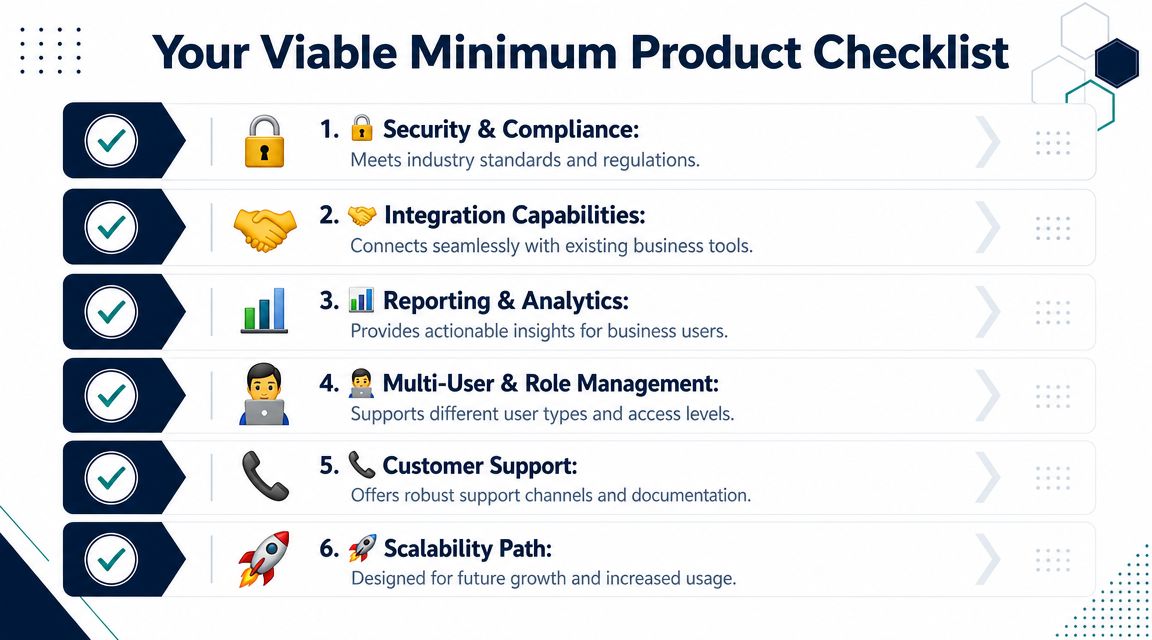
You don't need every enterprise feature on day one. You do need to remove the obvious objections that make a serious customer hesitate.
A VMP needs operating clarity, not just code.
Here's what I'd insist on before pushing hard into outbound or formal sales conversations:
For teams building against a tight timeline, this often requires stronger product and engineering coordination than the average startup has in-house. If you need extra execution capacity to cover application logic, admin controls, and integration work without creating a bloated team, it's reasonable to hire full-stack developers who can handle product-facing and infrastructure-adjacent requirements in one build stream.
The checklist is simple. If a reasonable buyer asks, “How would this work in our environment?” you should be able to answer without hand-waving.
One more point. Don't launch your VMP with a vague internal notion of readiness. Put the release through an explicit launch gate. A structured product launch checklist template is useful here because it forces alignment across product, sales, onboarding, and messaging before prospects start finding the holes for you.
A VMP earns the deal your MVP keeps delaying.
That distinction matters most in enterprise and mid-market B2B, where the first customer is not buying a prototype. They are buying an outcome they can approve internally, implement without chaos, and defend if the rollout gets scrutiny. That is why VMP is a go-to-market asset, not just a product milestone.
A CFO does not buy because the dashboard looks sharp in a demo. They buy when the product looks controllable.
Say you are selling workflow software into a mid-market finance team. The analytics are good. The reporting logic holds up. The product solves a real pain point. Then the buyer asks the questions that decide the deal. Can permissions be set by role? Is there an audit trail? Can the admin team control access without filing tickets with your engineers? What does onboarding look like for managers, analysts, and approvers?
If your team built an MVP, you probably have the core workflow and a persuasive demo. You probably do not have the minimum operating model the buyer needs to say yes. The deal slows because finance leaders are judged on implementation risk as much as feature value.
A VMP includes the workflow and the controls around it. It also gives sales a repeatable way to answer the same buyer objections every time. If your reps are still improvising those answers, build a B2B sales playbook for objection handling and deal progression before you push for larger accounts.
Legacy replacement exposes weak product strategy fast.
Founders love the wedge. Faster search, cleaner UX, better analytics, fewer clicks. Buyers care about continuity. They want to know what happens to old records, exception cases, approvals, and the daily workarounds their team depends on. A product can beat the incumbent on features and still lose because the switch creates too much operational risk.
At this point, MVP thinking breaks down. MVP asks, "Can we prove demand?" A VMP asks, "Can this customer switch without breaking the business?" Those are different standards.
The minimum viable sale in a replacement motion usually includes data import, migration support, workflow coverage for the common edge cases, and a rollout path the customer can explain internally. If you are still broad on who this product is for, tighten the target account first with Grou's ICP framework. Viability depends on the buyer context. A founder-led SMB can accept more gaps than an operations-heavy mid-market team replacing a system of record.
In replacement sales, the winner is the product that feels safer to adopt than the current system feels to keep.
Regulated markets punish incomplete products.
A vertical SaaS company selling into healthcare, legal, or another high-trust category can validate demand early and still fail commercially. The pain point is real. The workflow improvement is obvious. None of that closes the deal if traceability is weak, permissions are shallow, reliability is inconsistent, or the customer cannot explain your controls to compliance, legal, or IT.
In these markets, buyers are not separating product quality from company quality. They assume your onboarding process, admin model, support discipline, and operating maturity reflect the risk of choosing you. A functional MVP may prove the concept. It does not prove you are ready to carry the responsibility that comes with a production deployment.
That is the ultimate test across all three scenarios.
Your first serious B2B customer does not need the smallest version of the product. They need the smallest version that can be bought, implemented, and trusted.
If you're selling B2B SaaS with meaningful contract value, the MVP mindset can hold you back long after it has done its job.
Use MVP thinking when the primary risk is market need. After that, shift fast. The next risk is commercial failure. That's where a viable minimum product matters. It reduces the gap between “interested prospect” and “successful first customer.”
This also sharpens your ICP work. A VMP is never generic because commercial viability depends on who you're selling to. A team selling into founder-led SMBs needs one level of completeness. A team selling into multi-stakeholder mid-market accounts needs another. If your target account definition is still muddy, tighten it first. A practical starting point is Grou's ICP framework, because it forces you to define the customer context that determines what “viable” means.
Stop asking product teams to build the smallest possible thing.
Start asking these questions instead:
That's the shift. Product and GTM can't be separated at this stage. Your first real customers don't just validate the product. They validate the sale, the onboarding motion, the support model, and the implementation experience.
One useful forcing function is to build your sales process around VMP readiness rather than feature ambition. If your team doesn't yet have clear talk tracks, objection handling, deployment steps, and qualification discipline, fix that in parallel. A practical resource is this sales playbook template, especially for founder-led teams trying to turn early wins into a repeatable motion.
Founders who stay trapped in endless validation loops usually aren't being disciplined. They're avoiding the harder problem. Selling something a real business can trust.
A viable minimum product is how you solve that problem. It's the minimum product that can carry the weight of an actual deal.
If your team is stuck between “the product kind of works” and “buyers still won't move,” Big Moves Marketing helps B2B SaaS companies tighten positioning, sharpen ICP and messaging, and align product readiness with a sales motion that can support real pipeline, not just early interest.


%20-%20white.svg)