%20png%20copy.avif)
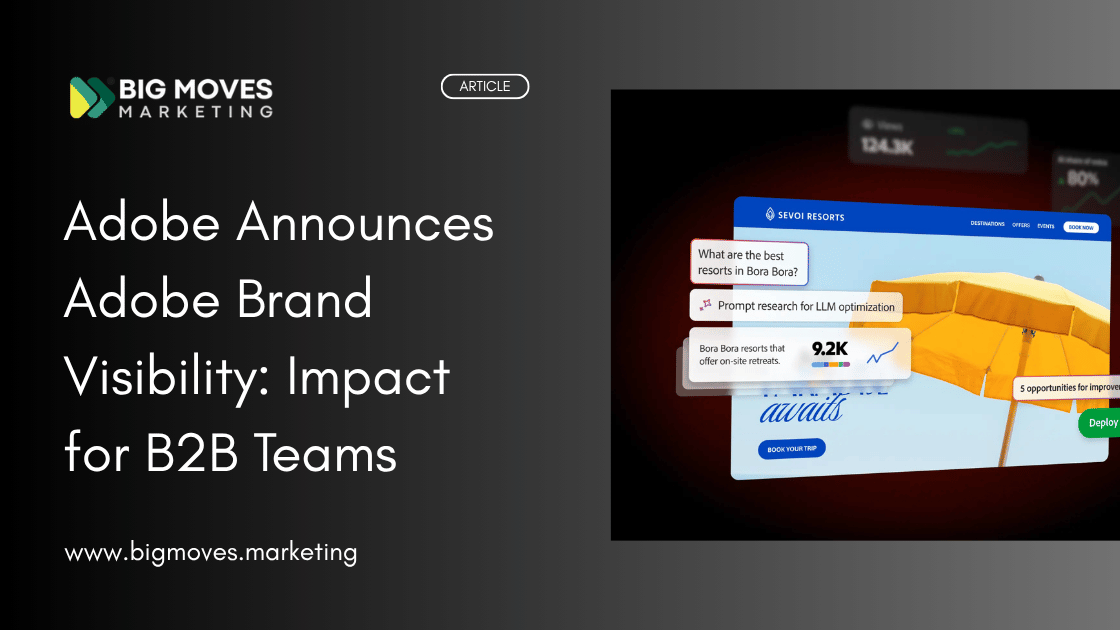
Adobe launched Adobe Brand Visibility this week — a platform that combines its LLM Optimizer with Semrush's AI Optimization data to let brands monitor and influence how they appear across ChatGPT, Google AI Mode, Microsoft Copilot, and Perplexity. The headline feature: access to nearly 300 million real-world AI search prompts to benchmark citation frequency, audience reach, and competitive share-of-voice across AI surfaces.
It is a significant product announcement. But the more important signal isn't what Adobe built — it's what the announcement confirms about where B2B buyer discovery now happens, and how much ground most marketing teams have already ceded.
Before getting to tactics, sit with a few figures.
94% of B2B buyers used generative AI tools during their purchase process in 2025, according to 6sense. 90% of B2B buyers now use generative AI at some point during their buying journey, per Walker Sands. Adobe's own data shows AI-driven traffic to U.S. retail sites surged 1,324% between October 2024 and May 2026.
Those are adoption numbers. The conversion numbers are more instructive. AI-referred visitors convert at 14.2% on average, versus 2.8% for Google organic — a 5x gap. Bain & Company found that 95% of B2B purchases go to a vendor already on the buyer's shortlist before any salesperson is involved. And that shortlist is increasingly formed in AI conversations, not on page one of Google.
The implication: buyers arriving from AI recommendations are closer to decision than almost any inbound source you currently track. They've already done the research. They've already narrowed the field. If your brand isn't in the AI answer, you're not ranked third — you don't exist in that conversation at all.
This is what Adobe Brand Visibility is commercialising. It's worth taking seriously.
Adobe Brand Visibility does three things. First, it surfaces citation data — how often your brand appears in AI-generated responses, which prompts trigger mentions, and how that compares to competitors. This is the Semrush layer: a database of prompt-level data built on real user queries. Second, it generates prioritised recommendations for improving that citation rate and lets teams deploy content changes rapidly. Third, it connects those optimisations back to measurable business outcomes via Adobe Analytics integrations.
What it isn't: a shortcut. Adobe's own president acknowledged that "early customer demand has exceeded expectations" — which likely reflects the anxiety B2B marketing teams feel about this category, not necessarily the maturity of the tooling. Google's own published guidance for AI search optimization is explicit that tactics like creating LLMS.txt files, chunking content for AI, or manufacturing inauthentic mentions simply don't work. Adobe Brand Visibility sits on top of a content and authority foundation that a platform cannot create for you.
The tool is only as good as the underlying brand presence it has to work with.
Most B2B SaaS companies have an SEO programme. Very few have a GEO programme. Those are not the same thing, and the gap is widening.
Traditional SEO optimises for crawl and rank. GEO — Generative Engine Optimization — structures content and digital presence so that AI platforms cite, recommend, or mention your brand when buyers ask category questions. Research from Princeton and Georgia Tech published in 2023 and cited consistently since shows that AI search exhibits a systematic bias toward earned media and authoritative third-party sources, not brand-owned content alone.
That finding matters for B2B teams in a specific way. If your content strategy is primarily publishing on your own domain — blog posts, landing pages, gated guides — and you have limited presence on Reddit, G2, Capterra, industry publications, and third-party review platforms, AI systems have insufficient corroboration to cite you with confidence. Only 38% of AI citations come from top-10 organic results. Authority signals from outside your domain carry disproportionate weight.
There's also a platform concentration problem. ChatGPT's share of measurable B2B AI referrals dropped from 89% in August 2025 to 63% by early 2026, as Claude, Gemini, and Perplexity each took share. A single-engine optimisation strategy is already fragile. Each platform has different retrieval logic, different citation behaviour, and different user intent profiles. Optimising for one and ignoring the others is the GEO equivalent of publishing only for one keyword cluster.
Adobe Brand Visibility is a useful monitoring and optimisation layer — eventually. But before you invest in the tooling, the foundation needs to exist. Here's the order of operations that makes sense.
1. Audit your AI visibility before you buy a platform to fix it.
Search your brand across ChatGPT, Perplexity, Google AI Mode, and Claude. Ask the questions your buyers are actually asking: "Who are the best [your category] platforms for [your use case]?" and "How does [your brand] compare to [competitor]?" What you find is more diagnostic than any platform dashboard. If you're not being cited at all, the problem is foundational. If you're being cited inaccurately, that's a different problem — one that requires correcting authoritative third-party sources, not updating your homepage.
2. Prioritise earned presence over owned content.
Your G2 profile, your Capterra listing, your presence in analyst coverage, your mentions in industry publications — these are the sources AI engines draw on most heavily. AI engines frequently cite Reddit, YouTube, and category-specific forums rather than vendor websites. For B2B, that means making sure your brand appears accurately and favourably in the communities where your buyers actually talk. That's a different investment than content production.
3. Restructure content for answer-first extraction.
Google's AI Mode now serves over a billion monthly users, with queries averaging triple the length of traditional search. Buyers are asking full questions, not entering keywords. Your content needs to answer those questions directly — in the first paragraph, before any preamble. The buyers asking AI about your category aren't looking for a 3,000-word guide. They want a clear, defensible answer that the AI can cite. Structure your key pages with that extraction in mind.
4. Build topic authority across multiple AI surfaces simultaneously.
Sites present on four or more platforms are 2.8x more likely to appear in ChatGPT recommendations. That's not a distribution preference — it's a corroboration requirement. AI engines triangulate authority across sources. A brand that appears in analyst coverage, independent reviews, peer forums, earned media, and its own well-structured content is harder to ignore than one that has 200 blog posts and nothing else. Between 40% and 60% of cited sources change month-to-month across Google AI Mode and ChatGPT — visibility here is inherently less stable than organic rankings, which makes breadth of presence more important than optimising any single source.
5. Treat GEO as a pipeline metric, not a traffic metric.
AI-referred sessions convert at 3.76% versus 1.19% for standard organic search, according to Amsive. The measurement case for GEO investment is more straightforward than it was for most content marketing initiatives over the last decade. But you have to be tracking AI referral traffic separately in GA4 (ChatGPT, Perplexity, Claude, and Gemini each have distinct referral signatures) to make the pipeline connection visible. Most teams aren't doing this yet. Fix the attribution before you spend on optimisation.
Adobe Brand Visibility is genuinely interesting as a category bet. The Semrush acquisition gives them a proprietary data layer — nearly 300 million real-world prompts with user consent — that no other platform currently matches at scale. Combining that with Adobe Experience Manager's content deployment infrastructure is a logical closed loop: measure citations, identify gaps, update content, measure again.
For enterprise B2B companies already running Adobe's stack, the integration case is strong. For growth-stage SaaS teams in the $5M–$50M range, the more immediate question isn't which platform to buy — it's whether the underlying content and authority foundation is strong enough to optimise. A GEO visibility tool deployed on a thin earned-media presence will surface gaps faster than it can close them.
The more important thing Adobe's launch confirms is that AI visibility has moved from an experimental concern to a commercial infrastructure decision. That transition happened faster than most B2B marketing roadmaps anticipated.
GEO isn't a campaign. It isn't a quarterly project. It's a structural question about whether your brand appears in the spaces where buyers are now forming their initial vendor lists — before your sales team is ever involved, before your paid ads have a chance to reach them, and often before they visit your website at all.
Adobe building a dedicated platform for this is a signal, not a solution. The signal is that the window for treating AI visibility as someone else's problem has closed.
Big Moves Marketing helps growth-stage B2B SaaS companies build the content infrastructure and distribution strategy that makes AIO possible — not as a standalone tactic, but as part of a pipeline-connected marketing system. Get in touch.

%20-%20white.svg)