%20png%20copy.avif)
Here’s the problem with the endless debate over features and benefits. A feature is what your product does. A benefit is the immediate good thing that happens because of it. Neither is enough to get a CFO to sign a six-figure contract.
Most B2B SaaS teams are having the wrong conversation.
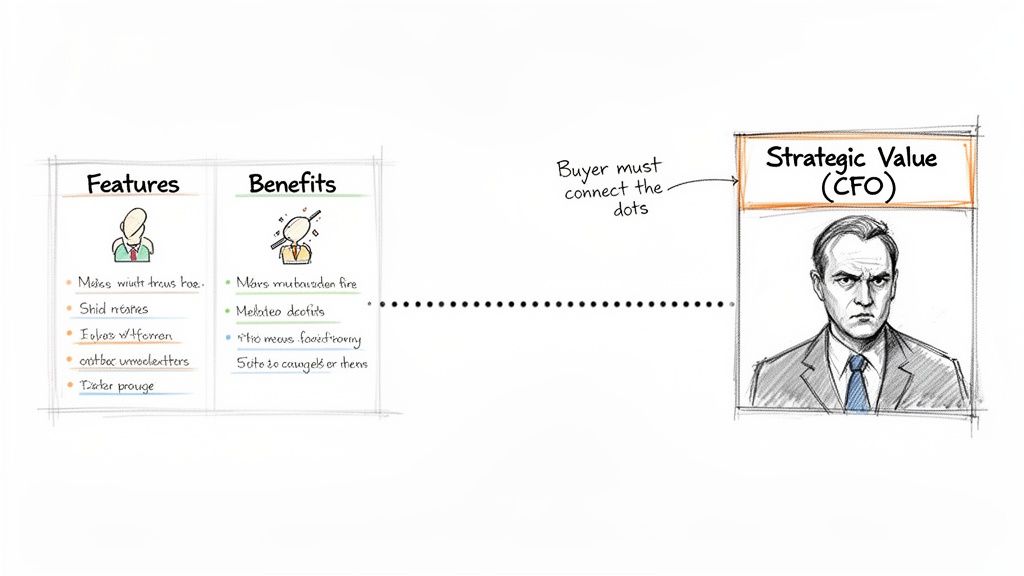
The most common messaging failure I see in B2B SaaS isn't just confusing features and benefits. It's the belief that articulating a benefit is the end of the job. This signals a fundamental misunderstanding of how senior executives make purchase decisions.
Product-obsessed teams list features, assuming buyers will connect the dots to business value. More mature teams translate features into direct benefits, but they still leave the final—and most critical—translation to the customer.
In a competitive market, that’s a fatal flaw.
When your messaging stops at benefits, you place the entire burden of strategic justification on your internal champion. You force them to build the business case from scratch for their CFO.
That’s a risk they are less willing to take.
Your messaging's job isn't to explain what your product does. Its job is to give your internal champion the precise logic they need to defend a six-figure purchase in a budget meeting.
This is where most messaging falls flat. It talks about your product's effects instead of the customer's business outcomes. A benefit like "save time on data entry" is a nice-to-have. An outcome like "reallocate 20 developer hours per week from manual reporting to core product innovation" is a strategic imperative.
This distinction is not semantics. It's the difference between being seen as a "tool" and being valued as a "strategic investment."
While understanding feature-benefit selling is a necessary starting point, it's not the final destination. To win high-value deals, you must graduate from explaining benefits to articulating tangible business outcomes.
Senior decision-makers don't buy efficiency. They buy competitive advantage, revenue acceleration, and risk mitigation. Every significant purchase is a career risk, scrutinized under the harsh light of budget constraints and internal politics.
They aren't asking, "How will this make my team's life easier?" They're asking, "How will this protect my budget, accelerate a KPI I personally own, or give me a defensible story to tell the board?" A benefit like ‘faster reporting’ might get a nod, but it will never justify a new line item in a locked-down budget.
An outcome, on the other hand, is a self-contained business case. It’s a quantifiable impact on a core business driver. This is where the distinction between features, benefits, and outcomes becomes mission-critical for selling enterprise software.
An outcome is the ammunition your internal champion needs to convince their CFO. It transforms a software "cost" into a strategic "investment" with a clear, defensible return.
Consider the difference in impact:
The second statement doesn’t just describe an effect; it quantifies a specific, high-stakes business result. It speaks directly to revenue protection and strategic agility—the native language of the executive suite.
Your messaging must connect your product’s capabilities to the buyer's P&L. Every major B2B purchase decision boils down to one of four drivers. Your product must help the business:
If your messaging doesn’t map your features and benefits to one of these four outcomes, you are not having a strategic conversation. You are talking about software. In a downturn, software gets cut. Strategic investments do not.
I've seen countless B2B SaaS teams get lost in messaging debates. It almost always comes down to one thing: they lack a rigorous process to get from engineering reality to a commercial narrative. You need a system for translating what your product does into what your customer achieves.
This requires a direct, unflinching interrogation of your value proposition. The goal is to strip away technical jargon and surface-level benefits to expose the quantifiable business impact that gets a contract signed.
The "So What?" Test is a three-step exercise to force clarity. This isn't a brainstorming session; it's a cross-examination. For every major feature, your team must be able to answer these questions instantly.
This sequence moves the conversation from your product's world to your customer's business reality. It elevates the discussion from usability to profitability. That final question is where the real value lives.
This is how buyers think. They mentally progress from a simple benefit to the final, decisive outcome.
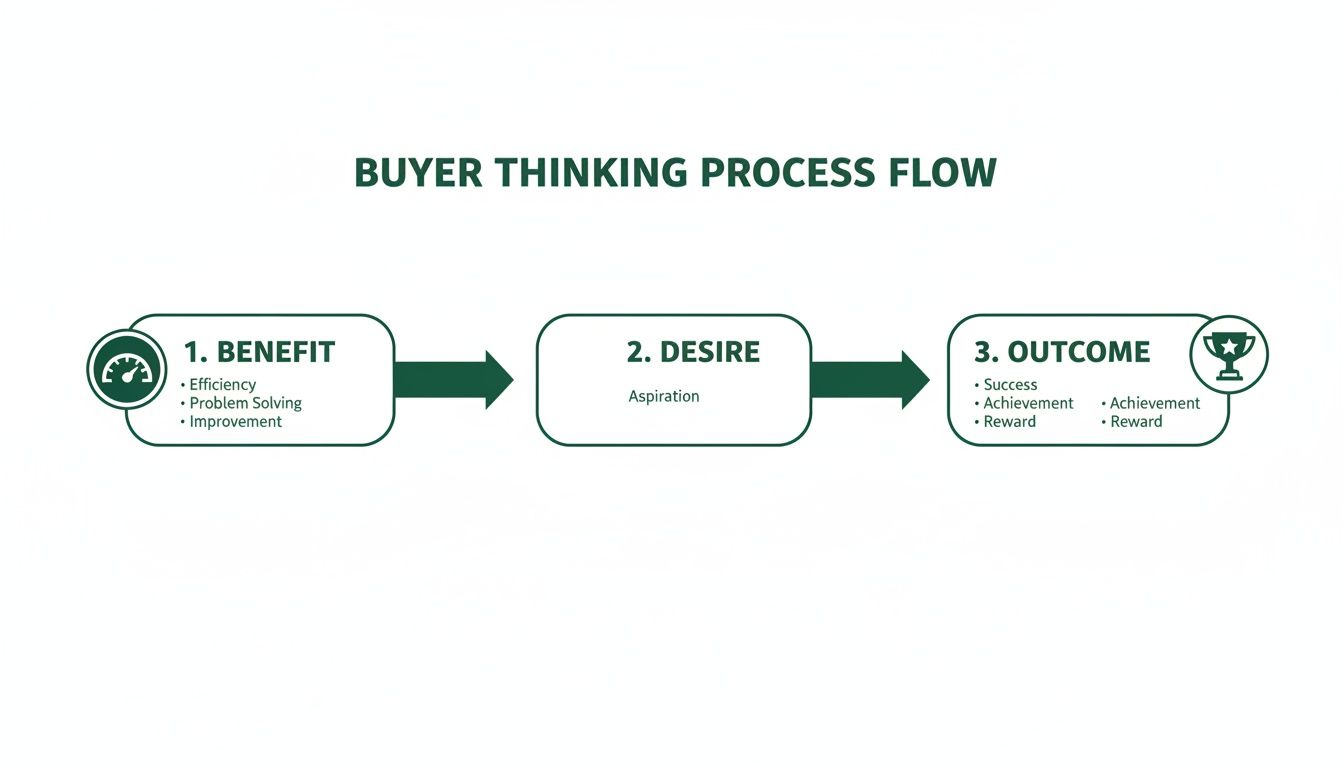
A benefit sparks interest. The clear, tangible outcome secures the investment.
Let’s run a common B2B SaaS feature through this process.
Feature: "Automated data synchronization between CRM and marketing automation platforms."
"So What?" → Benefit: "Sales and marketing teams always have real-time, accurate customer data without manual updates."
"What Does That Let Us Do or Prevent?" → Outcome: "It prevents your sales team from calling a high-value prospect who just submitted a critical support ticket. You're not just syncing data; you're mitigating a seven-figure pipeline risk and protecting your brand's reputation for being customer-aware."
The feature is technical. The benefit is operational. The outcome is strategic and financial. It contains risk, consequence, and a clear business impact an executive can take to their CFO. This is how you arm your internal champion to win their budget battles.
For a deeper look at structuring this narrative, you can learn more about how to build a B2B messaging framework that works.
This isn't a marketing exercise. It’s a commercial weapon. By forcing this clarity, you transform dry specs into a compelling argument for why your solution is an essential investment. This is the core of moving from selling features to selling outcomes.
A product launch is the ultimate test of your messaging. Get it wrong, and you don’t just have a quiet quarter—you burn capital, generate confusing market signals, and leave your sales team trying to explain a product nobody understands.
The outcome framework shifts from a strategic exercise to a tactical necessity for high-stakes B2B SaaS and AI launches. Your launch assets—the landing page, the first sales email—must relentlessly focus on answering one question from the prospect's perspective: "How does this make my business more resilient or profitable?" Everything else is noise.
This is how you build a real pipeline, not a temporary spike in website traffic.
With AI products, the challenge is steeper. The market is drowning in "AI-powered" claims that are meaningless to an executive buyer. They don't care about your algorithm. An "AI-powered" feature is an implementation detail, not a business solution.
An outcome, however, gets their attention.
Bad: "Our new AI-powered support module."
Good: "Our new module reduces manual ticket categorization by 90%, freeing up two support reps to focus exclusively on high-value customer engagement."
The first statement describes technology. The second describes a measurable impact on operational costs and customer value—a clear business outcome a Head of Support can take to their CFO.
The measure of a successful launch isn't just signups; it’s sustained adoption. This is where outcome-led messaging pays dividends. In B2B SaaS, strong feature adoption is the hallmark of a great launch. While average signup-to-paid conversion rates can hover as low as 3.1%, top-performing launches see this climb to 15% or higher when adoption is prioritized from day one.
Products with effective launches have a 23% higher retention rate in the first 90 days. When you launch based on outcomes, you’re not just releasing a feature; you are delivering on a concrete promise of business impact.
Your first users are primed to look for that specific value, which dramatically shortens their time-to-value and solidifies adoption. This approach is fundamental to a well-executed GTM strategy, turning a launch event into a sustained revenue driver. You can explore our complete guide for more insights on building a successful product launch plan template.
This focus ensures your launch doesn't become a "fire and forget" exercise. By rooting every communication in a clear outcome, you build a foundation for both immediate pipeline and long-term customer success.
Your messaging is irrelevant if your sales team defaults to a feature demo on a call. This is where most GTM strategies break down—in the chasm between the boardroom narrative and the reality of a sales call.
To close this gap, your sales enablement must mandate an outcome-first conversation.
This isn’t about prettier slides. It's about re-engineering the tools your reps use to communicate value. Every asset must serve as a guardrail, guiding the conversation away from product functionality and toward business impact. The goal is to make it harder for your sales team to talk about features and benefits than it is to talk about outcomes.
Your pitch deck should map directly to customer pain and quantifiable resolution. Your one-pagers must be written as a concise business case an executive can forward to their CFO.
Nowhere is this shift more critical than in your competitive battlecards. Most are just a grid of features—a defensive document that traps reps in a tit-for-tat comparison. It is a losing game.
An outcome-driven battlecard reframes the entire competitive dynamic. It doesn’t ask, "What features do they have that we don't?"
It asks, "What business outcome do we deliver that they fundamentally cannot?"
Before: Feature-Led Battlecard
- Competitor X Feature: Manual Reporting Suite
- Our Feature: Automated, Real-Time Dashboard
- Talking Point: "Our dashboard is automated, saving your team time."
This is weak. It forces your rep to compete on a minor convenience.
After: Outcome-Led Battlecard
- Competitor X's Business Problem: Their architecture creates data latency, forcing customers into stale, rearview-mirror decisions.
- Our Strategic Outcome: We provide a single source of truth with zero latency, enabling leaders to make in-quarter adjustments that protect revenue and outmaneuver the competition.
- Killer Question for the Rep: "How much at-risk revenue could you save if your leadership team could react to market changes in hours, not days?"
This shift transforms the conversation. You’re no longer arguing about dashboards. You’re contrasting a competitor’s inherent business limitation with your unique ability to deliver a strategic outcome. For more guidance, explore our key B2B sales enablement best practices.
This is how you arm your team to have C-level conversations. You empower them to move beyond a demo and facilitate a strategic discussion about risk, opportunity, and growth.
That is how you stop competing on price and start closing on value.
Your pricing page is where your strategic narrative faces its final, unfiltered test. It’s the moment of truth.
Yet, most B2B SaaS companies treat their pricing page like a feature checklist, commoditizing their own product.
A standard feature-grid pricing model is a strategic error. It prompts prospects to ask the worst question: "Which plan gives me the most stuff for the least money?" This frames the buying decision around your costs, not their gains, and forces you into a race to the bottom.
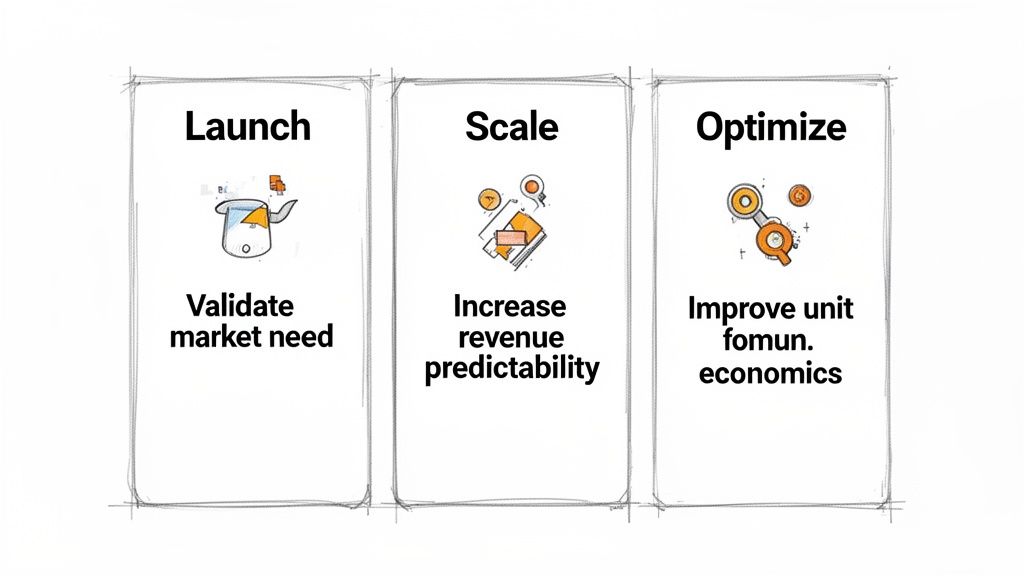
The most powerful move is to anchor your pricing tiers to customer outcomes. This aligns your pricing directly with the business results your ideal customers want at different stages of their growth.
This is the final step in aligning your entire commercial engine around what actually matters: your customer's success.
Your pricing page shouldn't be a menu of features. It should be a map of your customer's journey, showing them how you accelerate their progress from one strategic milestone to the next.
For example, ditch the "Basic, Pro, Enterprise" model. Instead, structure your tiers around outcomes:
This structure immediately forces a value-based conversation. For a great real-world example of connecting offerings to customer goals, look at Stamina's pricing page. It reframes the buying decision from "What do I get?" to "What can I achieve?"
This is how you stop competing on individual features and benefits and start commanding a premium based on your true value. To go deeper on this model, read our guide on how to define value-based pricing for your SaaS.
Stop framing this as a "marketing exercise." Connect their work directly to business outcomes—and by extension, to revenue.
Run a joint workshop using the "So What?" framework. When a developer sees how their "API latency improvement" feature directly prevents a 5% customer churn risk, they're no longer just coding; they're a partner in the go-to-market strategy.
Show them how their work secures the budget for the next project. That’s how you get buy-in.
Even the most technical buyer still has a boss and a budget to justify. A Head of Engineering cares about "Kubernetes integration" (the feature) because it cuts down on deployment failures (the benefit), which helps their team ship revenue-generating products faster (the strategic outcome).
They operate within a business context. Lead with the outcome, but have the deep-dive technical documentation ready for their evaluation. Never mistake their need for technical validation as a preference for feature-first selling.
Technical buyers need to justify their decisions to non-technical business leaders. When you give them the outcome-led business case, you make them look smart and help them get the budget approved.
You don't guess. You extract them from your earliest design partners and beta customers. Stop asking, "What features and benefits do you like?"
Ask these questions instead:
Their answers are your first draft of outcome-led messaging. The real value of your product isn't what it does; it's the tangible business change it creates.
Tired of seeing your product's value get lost in translation? Big Moves Marketing helps B2B SaaS founders align their product, messaging, and sales strategy around the business outcomes that drive revenue. Let's build a GTM strategy that wins deals. Find out more at https://www.bigmoves.marketing.
Explore Big Moves Marketing services and resources:

%20-%20white.svg)