%20png%20copy.avif)

Are your sales results all over the map? If inconsistent revenue is holding your startup back, a sales playbook is the operational blueprint you need to build a predictable revenue engine. This isn't just another document gathering dust on a shared drive; it’s a living, breathing guide that gets your entire team aligned, sharpens your messaging, and gives reps the exact plays to run in any B2B scenario.
I’ve seen it time and time again: founders build incredible, game-changing products but then completely struggle to create a repeatable sales motion. The answer isn’t just to work harder or hire more reps—it's about working smarter with a documented process. For any modern B2B startup, a solid sales playbook is the single source of truth for the entire revenue team.
This guide goes way beyond theory. It comes with a downloadable, customizable sales playbook template built specifically for the unique challenges of B2B SaaS and AI startups. We’ll walk through everything you need to build a system that actually drives results.
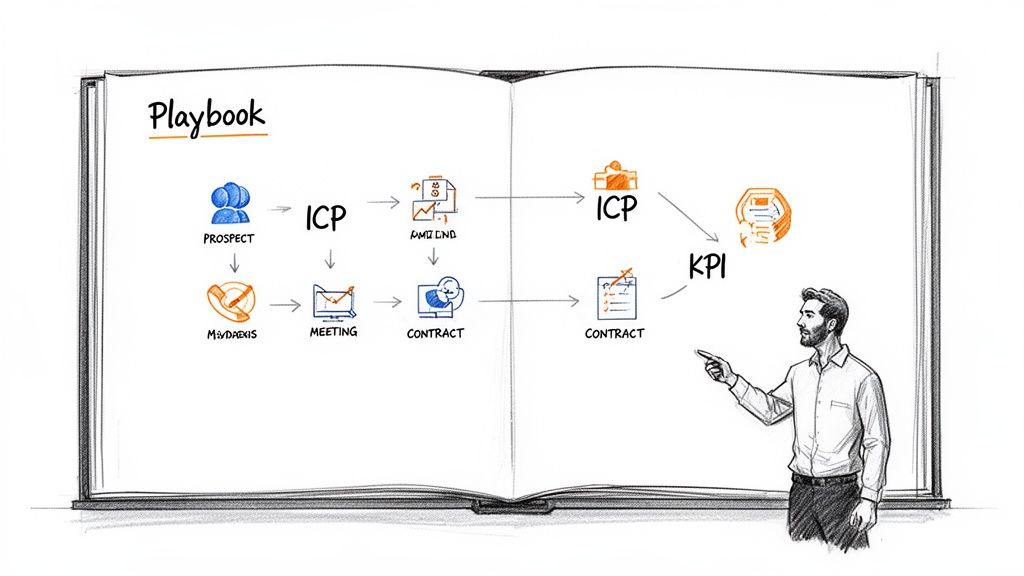
Trying to run a sales team without a playbook is like asking your reps to navigate a complex city without a map. It's chaotic, inefficient, and you'll probably get lost.
Yet, a staggering 40% of B2B sales teams operate exactly this way. It's no surprise that teams who formalize their sales process with a playbook see dramatic improvements across the board, from higher quota attainment to better lead conversion rates.
In fact, Gartner found that sales teams using structured playbooks saw 25-30% improvements in win rates on complex B2B deals. That data paints a pretty clear picture: there's a huge gap between teams that document their strategy and those winging it. You can discover more insights about these sales playbook findings and see the impact for yourself.
Ultimately, this blueprint provides the structure you need to scale predictably. It ensures every new hire gets onboarded with the same proven methods your top performers are already using.
A great sales playbook isn’t a rigid script; it’s a framework for excellence. It empowers reps with the confidence and tools to adapt to any B2B conversation while ensuring the core message remains consistent and powerful.
Before we dive in, let's look at the core components you'll be building. A winning sales playbook isn't just a collection of scripts; it's a comprehensive system. The table below breaks down the essential sections that turn a simple document into a revenue-driving machine.
With these components in place, your playbook becomes the central nervous system of your sales organization, guiding every action toward a common goal.
Throughout this guide, we're going to deconstruct the essential elements of a winning B2B sales playbook. You’ll learn exactly how to build out each critical component, turning our blank template into your company's most powerful asset.
Here are the key sections we'll build together:
By the end, you won't just have a template. You'll have a complete sales playbook filled with your company's unique strategies, ready to be implemented immediately to boost your team's confidence and, more importantly, their performance.
Before a single sales call is made, two things need to be absolutely dialed in: who you’re talking to and what you’re going to say. A sales playbook is just a collection of empty pages without this. Selling without a crystal-clear Ideal Customer Profile (ICP) is like shouting into the void—you’ll make a lot of noise, but no one who matters will hear you.
Everything that follows in your sales motion, from the prospecting lists you build to the language you use to close deals, is built on this foundation. This is where so many B2B startups get it wrong. They’ll describe their target as "mid-market tech companies" or "VPs of Operations," but that’s nowhere near specific enough to build a predictable revenue machine.
Your ICP isn’t just a demographic sketch. It's a living, breathing portrait of the exact company that gets the most value from your solution and, just as importantly, is the most profitable for you to serve. We need to go way beyond basic firmographics and get into the messy reality of their business.
Start by looking at your best customers—the ones who love you, are getting massive value, and you wish you could clone. What do they have in common?
By documenting these traits, you create a powerful filter. It helps your team instantly spot a great-fit account and, crucially, ignore the time-wasters. To really get this right, you have to master the art of customer profiling. For a deeper dive, check out this guide on Customer Profiling Mastery to really get inside your audience's head.
An effective ICP is a tool for strategic ignorance. It tells your sales team who to pursue with relentless focus, and just as importantly, who to walk away from. This discipline separates the high-performers from the rest.
If you want a more structured way to build this out, grab our detailed ideal customer profile template. It breaks down every single component you need to consider.
Once you know exactly who you're talking to, you can finally craft a message that speaks their language. This is where you stop talking about your product's features and start talking about the outcomes that matter to them. Your core message has to be sharp, consistent, and laser-focused on the customer’s world, not yours.
A powerful messaging framework should answer three simple questions from the prospect's point of view:
Let’s run a quick example. Imagine a B2B AI startup that automates financial reporting. Their messaging could look something like this:
See the difference? That's the kind of direct, outcome-focused language that gets a CFO to lean in. It’s not about "proprietary AI algorithms"; it's about closing the books faster with fewer mistakes. Getting this core message documented in your sales playbook ensures every single rep communicates your value with deadly precision.
A high-performing sales motion isn't a series of random events; it's a structured sequence of actions. It’s the difference between hoping for deals and engineering them. Now we move from the who (your ICP) and the what (your message) to the how—mapping out a complete B2B sales process from the first touch to a closed deal. This is where your playbook truly comes to life.
Having a documented sales process brings clarity and consistency. It gives every rep a clear roadmap for advancing opportunities, ensuring no deal slips through the cracks because of ambiguity. For a deeper dive, check out our guide on building a rock-solid B2B sales process.
A quick but powerful way to visualize this is through a simple flow: Profile → Value → Message.
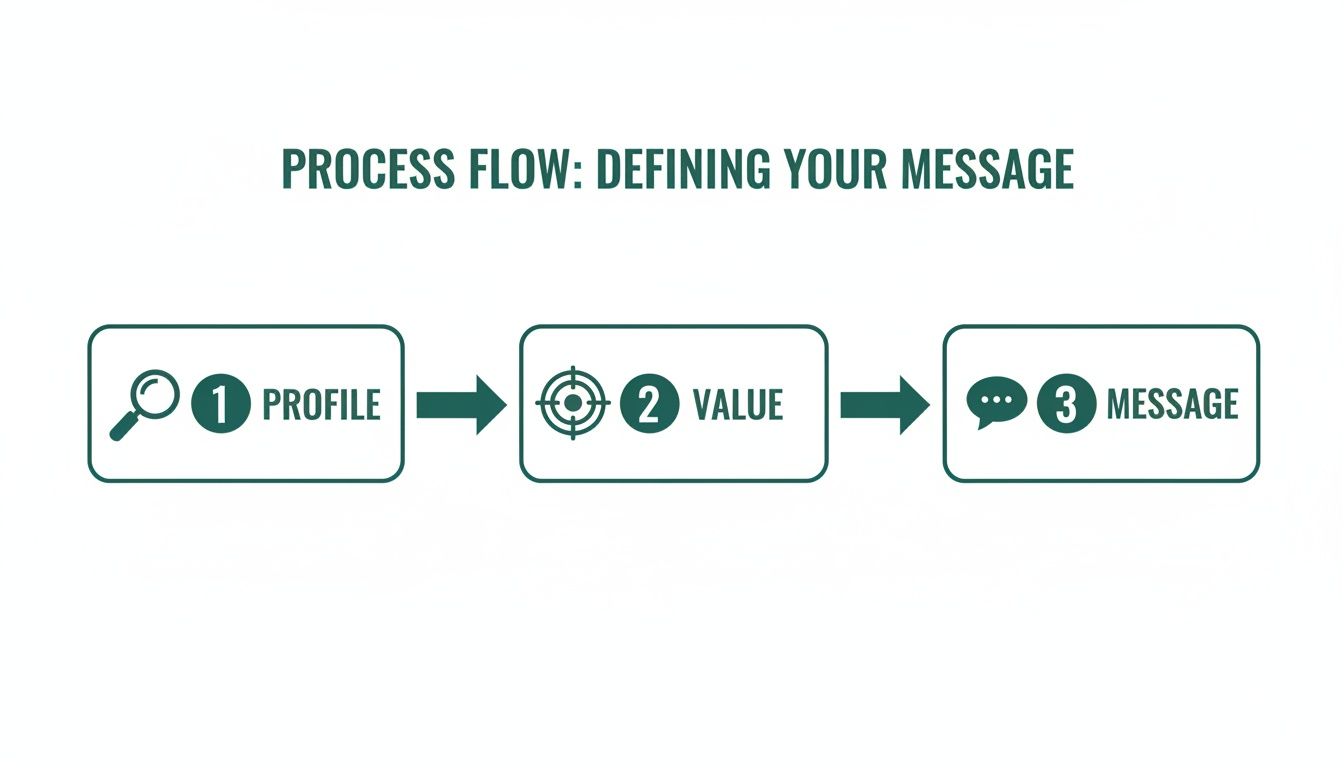
This visual underscores a simple but powerful truth: you can't craft a compelling message without first deeply understanding your ideal customer and the specific value you deliver.
Your sales process should be broken down into distinct stages, each with its own set of rules. Think of it like a board game; you can't move to the next square until you've completed a specific action.
For a B2B SaaS startup, a typical sales process might look something like this:
For each stage, you need to define clear entry and exit criteria. What absolutely must happen for a deal to move from Discovery to Demo? For example, the exit criteria for Discovery might be: "Confirmed budget, identified decision-maker, and received verbal agreement on the primary business challenge." This rigor removes guesswork and makes your forecasting way more accurate.
With your stages defined, it's time to build the 'plays'—the specific, repeatable motions your team will run for different B2B scenarios. A play isn't just a script; it's a mini-strategy for a common situation.
A sales play gives your reps the "what to do" and "what to say" for any given moment in the sales cycle. It transforms your playbook from a reference document into an actionable tool that actively moves deals forward.
Let's build out a few examples of plays you’ll want to have ready to go.
This play is all about speed and qualification when a prospect fills out a demo request form.
This play focuses on breaking into a target account that fits your ICP but has shown no prior interest.
These plays provide a repeatable framework, giving your team the confidence to execute consistently. The impact of this structured approach is huge. For instance, when Salesforce overhauled its B2B sales playbook, it led to more accurate forecasting and a 27% faster pipeline movement. Data shows that teams with comprehensive playbooks achieve 92% quota attainment versus just 63% for teams without them, demonstrating a clear link between process and performance. Mapping your process is the first step toward achieving that level of success.
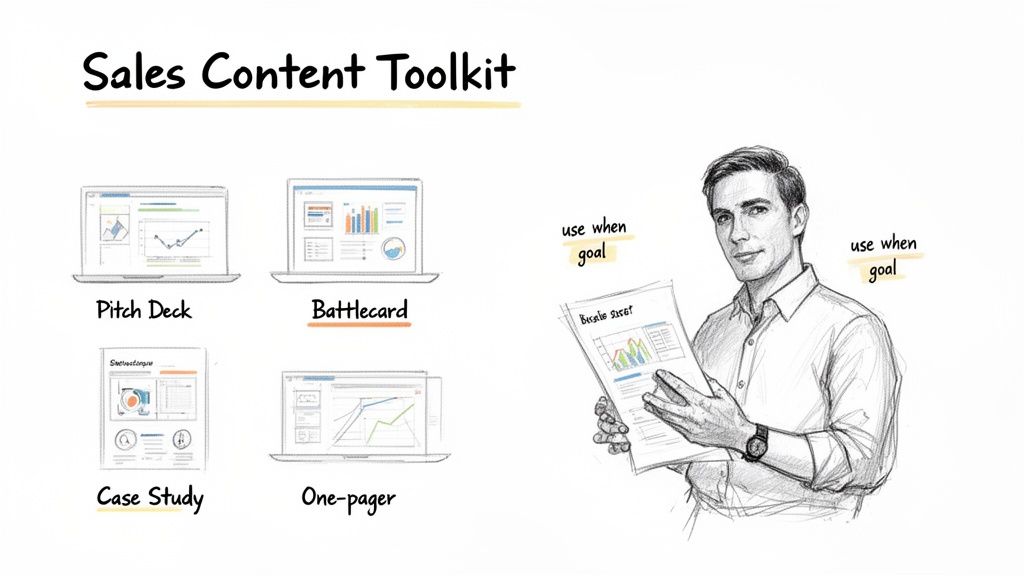
Your playbook outlines the grand strategy, but it’s your sales content that brings it to life on the front lines. This is the tangible arsenal your B2B sales team carries into every single interaction. Without compelling, high-quality content, even the most brilliant plays will fall flat.
Think of each piece of collateral as a specific tool for a specific job, designed to guide a prospect from one stage of their buying journey to the next. The goal is to arm your reps with the right asset for the right moment, ensuring they can tell a consistent and powerful story every time.
Your pitch deck is often the centerpiece of your sales toolkit. Its job isn't just to list every feature you've ever built; its true purpose is to tell a story that makes the prospect the hero. A great deck validates the pain you uncovered during discovery and presents your solution as the only logical conclusion.
A truly effective B2B pitch deck follows a clear narrative arc:
Your pitch deck is a conversation starter, not a monologue. Its design and flow should invite questions and facilitate discussion, turning a one-way presentation into a collaborative working session.
In B2B sales, it’s a guarantee your reps will be asked, "So, how are you different from [Vendor Y]?" A well-crafted battlecard ensures they have a sharp, confident answer every single time. This is an internal-only cheat sheet for navigating those tough questions about alternatives.
Your battlecards have to be direct and scannable—something a rep can glance at during a live call. They are not the place for dense essays.
This kind of preparation gives your team the confidence to control the narrative instead of being put on the defensive. It also signals to prospects that you have a deep, nuanced understanding of their options. As you build out your content, it's also worth understanding sales presentation psychology to make sure your visuals land with impact.
Beyond the deck and battlecards, your team needs a library of supporting assets they can pull from at different points in the sales cycle. These pieces of content help reinforce your message, build credibility, and address the specific concerns of different stakeholders.
Key assets to include in your sales playbook template are:
Having a robust set of materials ensures your team can tailor their follow-up and provide real value at every touchpoint. For more inspiration on what to create, check out these excellent B2B content examples for successful sales enablement that can help elevate your team's conversations.
Let's be honest: a brilliant sales playbook that just sits in a folder is a total waste. All that work, all that strategy, collecting digital dust. The real goal is to embed your playbook so deeply into your team's daily rhythm that it becomes second nature—a living, breathing guide that helps them win deals, not some static document they forget exists.
This is where the rubber meets the road. Turning your playbook from a document into a performance driver comes down to two things: the right tech and the right metrics. You have to make your plays accessible and actionable inside the tools your reps already live in, and you absolutely must track the numbers that prove it's working.
The number one reason playbooks fail is friction. If a rep has to stop what they’re doing, hunt down a file, and search for the right script in the middle of a live call, they just won't do it. The solution is simple: bring the playbook to them, right where the action is.
Your Customer Relationship Management (CRM) platform should be the central nervous system for your entire sales motion. A well-configured CRM is so much more than a digital rolodex; it can become the active, dynamic version of your playbook.
Think about it. You can configure your CRM to automatically push the right resources to your reps based on exactly where they are in a deal:
This is where things get really interesting. Modern AI tools are completely changing how sales teams execute their plays. Instead of just giving reps a static PDF, these tools offer real-time coaching and automation that puts your playbook on steroids. Your playbook goes from being a guide to being a true co-pilot.
The impact here isn't marginal; it's massive. Organizations using AI to enhance their sales playbooks are reporting up to 50% improvements in lead conversion rates. B2B SaaS firms using AI-driven playbooks have seen 33% higher close rates on new pipeline, and teams are getting 28% more efficient at moving deals forward. These tools can even slash new rep ramp-up time from 90 days down to just 45, which helps boost overall quota attainment by an incredible 41%. You can dig deeper into how AI is supercharging sales playbooks and see the data behind these numbers.
An AI-enhanced playbook doesn't just tell a rep what to do; it actively helps them do it better. It listens to calls, suggests better phrasing in real-time, and automates tedious data entry so reps can focus on what they do best: selling.
You can't improve what you don't measure. Tracking the right KPIs is the only way you'll know if your playbook is actually working and where it needs to be tweaked. Forget vague metrics—you need to zero in on the numbers that draw a straight line from your playbook's strategies to your bottom-line results.
Track these essential KPIs to understand the real-world impact of your sales playbook on revenue and efficiency.
By keeping a close eye on these KPIs, you create a powerful feedback loop. You'll see which plays are landing and which ones are falling flat. This data-driven approach ensures your playbook is a living document that constantly evolves and improves, ultimately becoming your startup's most valuable asset for building a predictable revenue engine.
Alright, let's tackle some of the most common questions that pop up when founders and sales leaders start getting serious about building a sales playbook. You’re not just creating a document; you're building a system for predictable growth, and it’s natural to have questions.
Think of this as your final pre-flight check. These insights come from years of seeing what works—and what definitely doesn't—so you can sidestep the common pitfalls and make sure your playbook becomes a revenue-driving machine from day one.
Your sales playbook needs to be a living, breathing document, not a PDF that gathers dust in a forgotten folder. For an early-stage B2B startup, everything is in flux—your market, your product, your customer feedback. Things change fast.
I’m a big believer in a formal review and update every quarter. A quarterly check-in is the perfect rhythm to bake in new learnings from the field, sharpen your battlecards with fresh intel, and fine-tune your messaging based on what’s actually landing on calls.
But don’t wait for the calendar. Certain events should trigger an immediate update. If you roll out a major product feature, pivot your ICP, or dive into a new market, the playbook has to reflect that new reality right away. The best sales teams treat their playbooks like a dynamic resource that always shows the most effective, current way to sell.
Easy. The single biggest mistake I see startups make is creating their sales playbook in a vacuum.
It usually plays out like this: a founder or the new VP of Sales locks themselves in a room for a week, writes the whole thing based on their own brilliant ideas, and then unveils it to the team like it's the Ten Commandments.
This top-down approach is almost always a recipe for disaster. You end up with a playbook that’s theoretically perfect but practically useless on the front lines. Your reps will quietly ignore any tool that doesn't match the reality of their daily conversations or help them handle the objections they actually face.
The best sales playbooks aren't handed down from on high; they're co-authored with the sales team. When your reps contribute their own insights, their biggest challenges, and the phrases that win deals, they feel a sense of ownership. That ownership is everything.
So, how do you avoid this? Build it from the ground up, collaboratively.
When your sales reps see their own expertise staring back at them from the page, they're infinitely more likely to use it, trust it, and help you make it even better over time.
Adoption is the name of the game. A brilliant playbook that nobody uses is just a waste of time and energy. Getting your team to weave it into their daily workflow isn't about sending a memo; it's a strategic effort.
First, put the playbook where your team already works. Don't make them hunt for a separate Google Doc or PDF. Embed your plays, scripts, and battlecards directly into your CRM. A great setup uses automation to surface the right information at the right time in a deal. Make it frictionless.
Second, make it a core part of your sales culture. Talk the talk. Weave the playbook's language into your team meetings, 1-on-1s, and deal reviews. Ask reps which 'play' they ran on that big call or how they handled an objection using the playbook's framework. When it becomes the team's shared language, using it becomes second nature.
Third, and most importantly, show them the data. Track the performance of reps who consistently use the playbook against those who don't. When they see a clear, undeniable link between following the plays and hitting their quota, adoption will take care of itself. Success is the ultimate motivator.
Absolutely, and this is a critical point that trips up a lot of leaders. A playbook should be a framework for success, not a rigid script that turns your talented salespeople into robots. The goal is to provide guardrails and ensure message consistency, not to stifle the creativity and rapport-building skills you hired them for.
A great playbook empowers reps; it doesn't constrain them. It gives them the core value prop, the must-ask discovery questions, and proven ways to handle tough conversations. In fact, our guide on how to handle sales objections is all about giving your team frameworks that build confidence without scripting every single word.
The best playbooks offer options and encourage reps to think on their feet. For instance:
It's all about arming your team with the right tools and strategies so they can be more creative and effective in their conversations, not less.
Building a sales playbook is one of the most high-impact things you can do for your startup's future. It’s the blueprint for turning chaotic, heroic sales efforts into a predictable revenue machine. If you're ready to build the sales engine your product deserves but want expert guidance to get it right the first time, Big Moves Marketing is here to help.
Explore Big Moves Marketing services and resources:




%20-%20white.svg)