%20png%20copy.avif)

Most B2B SaaS founders are chasing the wrong thing. Product-market fit isn't a milestone you achieve or a checkbox on a roadmap. It’s not an internal feeling of accomplishment. This framing is a dangerous illusion that encourages founders to mistake their own hard work—their push—for genuine market demand.
The only metric that matters is pull.
PMF is an external force. It feels less like you found a customer segment and more like an entire market segment found you. It’s a chaotic, often overwhelming force that rips the product out of your hands. The rest is vanity.
The path to finding product market fit is littered with false positives. Founders, driven by optimism, are conditioned to see progress in early revenue, a few happy pilot customers, or positive feedback from friendly prospects.
These are not reliable signals of PMF. They are often signals of a founder doing effective sales.
This "checklist mentality" is the core of the problem. It incorrectly frames PMF as an internal achievement based on actions the company has taken:
This thinking is fundamentally broken. It tricks you into pushing a product into the market, mistaking your own effort for genuine demand. You end up optimizing for vanity metrics that feel like progress but signify nothing about building a scalable business.
The critical mental model shift is from pushing your product onto the market to being pulled by it. The difference is night and day.
Pushing feels like a constant, uphill battle. Every lead is a grind. Every sales cycle drags. Every renewal requires a heroic effort from customer success. In this scenario, your team is the only source of energy in the system.
Being pulled is the opposite. It’s an overwhelming, sometimes uncontrollable force.

Market pull is when you can't keep up. Inbound leads from your exact ICP appear without paid spend. Sales cycles shorten because prospects already know who you are. Customers get angry when your product is down—not because they're difficult, but because their operations now depend on it.
This is not a subtle feeling; it's a phase change for the business. The energy no longer comes from you pushing outward; it comes from the market pulling inward.
This pull is the only signal that matters. It tells you that you've stopped selling a "nice-to-have" and started providing something so essential that a specific market segment cannot imagine working without it.
Stop chasing milestones. Start hunting for pull.
Every founder’s pitch deck tells the same story: a clean, 12-month sprint from MVP to a scalable growth engine. This story is a fantasy.
Founder optimism is necessary, but when applied to the product-market fit timeline, it becomes a fatal flaw. For B2B companies, the reality isn’t a sprint; it’s a grueling, multi-year marathon through immense market friction. You aren't just selling software; you're rewiring established business processes. That kind of change creates massive organizational drag.
Prematurely scaling sales and marketing into that friction is the single biggest killer of promising, well-funded B2B startups. You hire expensive AEs and pump cash into demand gen, assuming the market is ready. It isn’t. You’re just pushing an unproven solution harder against a wall of institutional inertia.
Data from hundreds of successful B2B startups shows a median time of roughly two years from idea to PMF. For complex enterprise solutions, that timeline often stretches to three years—far longer than most founders budget for, in both capital and psychological endurance.
When 42% of failed startups cite ‘no market need’ as the cause of death, it’s clear that rushing this discovery phase is a direct path to the startup graveyard.
Your timeline isn't set by your burn rate or your board’s impatience. It’s dictated by your customer’s reality:
Ignoring these structural realities is a strategic failure.
The moment you accept a 24-36 month journey to PMF, your strategy changes. Discipline replaces delusion. Your focus shifts from frantic execution to methodical learning.
The goal in the pre-PMF stage is not to hit a revenue target. It is to survive long enough to find a repeatable GTM motion. Your entire operational structure—team, capital, and roadmap—must be aligned with this singular objective.
A realistic timeline forces you to build the company differently. Instead of a bloated sales team, you need a lean discovery unit—led by the founder.
Aggressive marketing spend is reallocated to extending runway, buying more time for disciplined experimentation. Our guide on building a realistic product launch timeline template details how this marathon mindset changes your entire GTM plan.
You cannot force the market to adopt your product on your schedule. You must structure your company to withstand the market’s timeline, methodically iterating until you find the undeniable pull that signals true product-market fit. Mistaking a marathon for a sprint ensures you collapse long before the finish line.
Most B2B SaaS dashboards are a firehose of noise. Website traffic, MQLs outside your ICP, and social media mentions are vanity metrics. They feel good but reveal nothing about whether you’ve built something a specific market needs.
True signals of product-market fit are a small, potent set of indicators that show genuine market pull. Focusing on them is the difference between disciplined signal-hunting and frantic noise-chasing. You must be ruthless in cutting through the clutter to find data that proves you're solving a high-value problem for a specific, repeatable customer profile.
Founders expect a clean, rocket-ship trajectory. The reality is almost always a long, winding road of iteration.
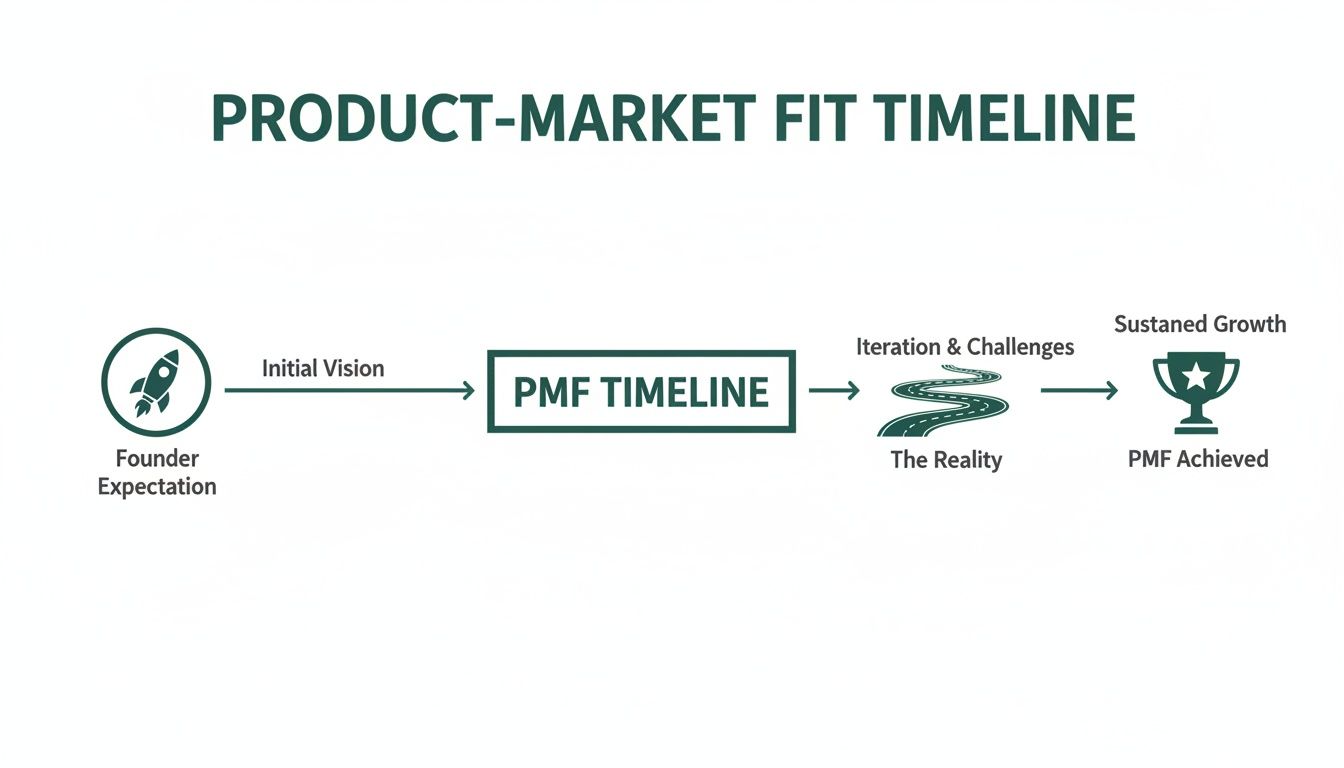
The journey to PMF is rarely the straight line drawn on whiteboards. It’s a messy, iterative process of finding the right combination of problem, solution, and market.
Before drowning in cohort analyses, start with the most human signal. The Sean Ellis test is often misunderstood as a simple survey. It's a diagnostic tool for finding the specific segment of users who would genuinely suffer if your product vanished.
The benchmark, pulled from analyzing nearly 100 startups, is clear: you're likely on to something when 40% or more of your users say they would be ‘very disappointed’ if they could no longer use your product. This qualitative pulse is your first real signal. When paired with hard data, it cuts through the fog.
An NPS of 60 is meaningless if your champions have no budget authority. A 2% monthly churn rate is a lie if it's from early-adopter customers you can't replicate. The "who" behind the data matters more than the number itself.
This gut check is your starting point. From there, you must triangulate it with metrics that show what people do, not just what they say.
Once you’ve found that core group that desperately needs your solution, you must find proof in your quantitative data. We're looking for a combination of leading and lagging indicators that confirm the story your qualitative feedback is telling.
This framework separates past proof from future predictors. It’s about looking at the full picture—what happened, what’s likely to happen, and how users are behaving right now.
| Signal Category | Metric/Indicator | What It Tells You | Threshold for Strong Signal |
|---|---|---|---|
| Lagging Indicators | Retention Curves That Flatten | You've found a core group that gets continuous value, not just a series of one-time users. | After an initial drop-off, cohort retention stabilizes above 25% for a B2B SaaS product. |
| Lagging Indicators | Non-Paid Organic Acquisition | The market is pulling your product into existence through word-of-mouth and genuine need. | 20%+ of new, qualified leads find you on their own, not through paid channels. |
| Leading Indicators | Shrinking Sales Cycles | Your value proposition is hitting the mark, and ideal customers "get it" faster. | The average sales cycle for new ICP customers decreases by 15-20% over 6 months. |
| Leading Indicators | High Trial-to-Paid Conversion | The value is so clear that users are willing to commit after experiencing it. | >25% conversion for self-serve; >15% for sales-assisted trials. |
| Behavioral Signals | "High-Expectation" Customer | Users are not just using your product; they are demanding more from it. | A noticeable increase in sophisticated feature requests and bug reports from power users. |
| Behavioral Signals | Users Hacking the Product | Customers are finding so much value they are pushing the product beyond its intended use. | Seeing customers use your product in creative, unintended ways to solve adjacent problems. |
This triangulation is critical. A single metric can lie, but when lagging, leading, and behavioral signals all point in the same direction, you can be confident you’re on the right track.
Your most important job in this phase is to filter signals from the noise. Every demo request is not a signal. Every new user is not a signal.
Mastering how to qualify leads effectively is non-negotiable. This ensures your team only pays attention to interactions that truly matter.
A qualified lead from your exact ICP who signs up after a referral from a current power user? That’s a potent signal. A lead from a different industry who downloaded an ebook? Noise. Learning the difference is critical and is underpinned by the KPIs in our complete guide to customer success metrics.
The hunt for product-market fit isn't about collecting positive data points. It's about finding a coherent story told through both qualitative desperation and quantitative validation—all from a highly specific, replicable customer segment. Everything else is a distraction.
The most dangerous place for a B2B startup isn’t zero revenue. It’s the deceptively comfortable plateau of 'almost-PMF'.
You have just enough happy customers for a few case studies. You have just enough linear revenue growth to justify your existence to the board. But you’re missing the one critical ingredient: escape velocity.
This is the startup equivalent of purgatory. Growth is a constant, brute-force effort. You are pushing, not being pulled. It's a quiet killer because it doesn't feel like a crisis; it feels like you're "almost there."
The hard truth is that linear growth signals a fundamental mismatch between your product and the market. You're servicing a handful of customers who found a use for your tool, but you haven't discovered a repeatable, scalable engine for market penetration.
Persistence won't fix this. You need to confront some unforgiving growth benchmarks, because the numbers don’t lie. For an early-stage B2B SaaS startup, hitting $20k MRR feels like a victory, but if growth is crawling at 6% month-over-month, you are on the edge of finding product market fit, not in the center of it.
True PMF is defined by double-digit monthly growth, especially in the crucial $10k to $50k MRR range. This is where market pull becomes undeniable. As SaaStr's analysis highlights, once you truly solve a high-value problem for 10-50 customers, finding the next 50 should become an order of magnitude easier. If your growth is below 10% after this point, you have a core problem. You can learn more from SaaStr's deep dive into early-stage SaaS indicators.
The "Almost-PMF" plateau is a strategic trap. The revenue feels real enough to discourage a pivot, but the growth is too slow to build a venture-scale business. It’s where capital and morale go to die a slow death. Decisive action, not more of the same, is the only way out.
To break free, you have to stop pushing and start diagnosing. Your problem isn't a lack of effort; it's a lack of clarity. The constraint is almost always one of these four issues, or a combination of them:
Getting off this plateau requires a deliberate return to first principles. This isn’t about scrapping your product; it’s about re-engaging with the market to refine your aim. It means pausing the frantic push for new logos and reallocating that energy toward strategic learning.
Your immediate priority is to re-validate your core assumptions. This involves returning to raw, unfiltered customer conversations with a different objective: not to sell, but to listen. It's about conducting rigorous research to understand the real-world context of their pain. Our guide on how to conduct user research explains how to run this process to drive strategic clarity.
This diagnostic process is about seeking the truth, no matter how uncomfortable. Is your ICP wrong? Is your messaging weak? You must have the discipline to follow the evidence and make decisive changes to your go-to-market strategy. Anything less just keeps you running in place on a plateau that leads nowhere.
Finding product-market fit isn't a passive search. It’s an active, systematic assault on market ambiguity. Too many founders treat it like waiting for a signal. You have to generate the signal yourself through a series of deliberate go-to-market experiments.
At this pre-PMF stage, your product is not the variable you should be tweaking endlessly. Your positioning and messaging are your primary experimental levers. They are faster, cheaper, and far more informative to iterate on than your codebase.
Your mission is to build a machine for learning, not a machine for selling. At this stage, revenue is a byproduct of learning correctly, not the primary objective.
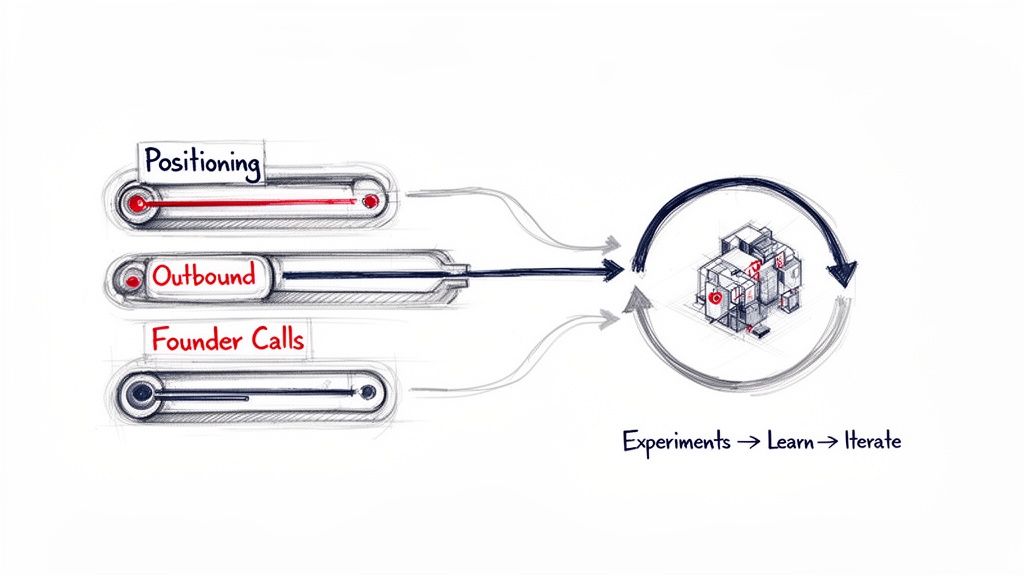
The posture of your commercial efforts has to shift. Founder-led sales isn't just a "best practice" at this stage; it is a non-negotiable requirement. No commissioned AE has the patience or context to extract the insights you need from early conversations.
Every interaction is a test. You are not trying to close a deal; you are trying to validate or invalidate a hypothesis.
This mental shift changes your entire approach:
Your most powerful weapon in this fight is a spartan one-page value proposition canvas or a three-slide deck. It should be focused and easily changed between calls. One version might frame your product as a cost-saving tool for CFOs. The next might frame it as a productivity multiplier for engineering leads.
These are not sales calls. They are intelligence-gathering missions.
You can’t improve what you don’t measure, and the most valuable data right now is qualitative. You need a system for capturing, analyzing, and acting on market feedback with extreme prejudice. Forget complex CRM setups; a well-organized spreadsheet is your command center.
This system is built to track patterns in language, not just wins and losses.
The most valuable feedback pre-PMF is rarely a feature request. It's when a prospect uses their own words to describe their pain, and those words are a better, sharper version of your own messaging. When you hear your value proposition repeated back to you, you are getting close.
Your feedback loop should be a weekly, unforgiving ritual. The founder and key team members review the raw, unfiltered data from the week’s conversations. What objections came up repeatedly? Which pain points resonated most strongly? Did a specific phrase cause a prospect’s eyes to light up?
This qualitative analysis feeds directly into your GTM roadmap. This disciplined process is central to developing an effective go-to-market strategy for B2B companies.
To run this process systematically, you need a clear framework. This isn't about throwing things at the wall; it’s about structured experimentation where each variable is isolated and tested. A simple matrix can bring immense clarity to your efforts.
Here's how to structure these experiments to hunt for early signals of fit.
| Experiment Type | Hypothesis Being Tested | Key Asset Required | Success Metric (Signal of Fit) |
|---|---|---|---|
| ICP Segment Test | "We believe VPs of Operations at mid-market logistics firms feel this pain most acutely." | Hyper-targeted outbound sequence with pain-centric messaging. | Meeting book rate > 5% with the target persona. |
| Value Prop Test | "Framing our solution as a compliance risk reduction tool is more compelling than framing it as a workflow automation tool." | A/B tested three-slide pitch deck versions. | Prospect asks unprompted questions about implementation details, not just pricing. |
| Pain Point Test | "The pain of manual reporting is a top-three priority for our target buyer, not just a minor annoyance." | A single-page PDF outlining the cost of inaction. | Prospect volunteers specific, quantifiable metrics related to their pain. |
| Channel Test | "Our ICP is more responsive to direct, personalized LinkedIn outreach than to cold email." | Mirrored outbound campaigns across both channels. | Higher-quality conversations (not just replies) originating from one channel. |
This process is a grind. It is methodical, often frustrating work. But it is the only way to systematically de-risk your business and move from assumption to hard evidence.
Finding product-market fit isn't an accident. It's the result of weaponizing your go-to-market engine as a tool for discovery, running dozens of small, deliberate experiments until the market’s response shifts from apathy to undeniable demand.
The theory of product-market fit is clean. The reality is a messy, frustrating, and confusing process. Founders and GTM leaders constantly battle the same critical questions where one wrong turn costs months of runway.
These are the direct answers to the most common points of confusion I see from teams in the trenches.
The core idea is the same, but the signals are worlds apart. B2C chases individual adoption, even virality. B2B hunts for organizational pull.
This isn't about one person loving your app; it's about an entire company starting to rely on it. You see this when accounts expand their spend, when sales cycles shorten because your category authority is growing, and when a steady stream of inbound leads perfectly matches your ICP.
The feedback loop is much slower in B2B. This means you must lean heavily on the qualitative insights from your first pilot customers. You're solving a complex business problem with a clear ROI, not a personal preference.
Absolutely. It happens more often than you think. PMF isn't a trophy you put on a shelf; it's a dynamic state you must constantly maintain.
You lose it when the market shifts, a disruptive competitor changes the game, or you bloat your own product so much its core value is buried. Complacency is the silent killer of great companies.
This is why continuous customer discovery and a paranoid focus on leading indicators are non-negotiable, even for market leaders.
The moment you stop treating PMF as something to be defended is the moment you start losing it. The same disciplined feedback loops that got you here are the ones that will keep you here.
Before you have product-market fit, the primary job of the sales team is not to generate revenue. It is to generate intelligence. Every conversation is a data-gathering experiment.
This is why founder-led sales is so critical in the early days. You are not trying to close deals at all costs; you are trying to get unfiltered market feedback to test your ICP, your value proposition, and your messaging.
Your early sales function must act as the company's ears. Meticulously log every objection, feature request, and the exact words customers use to describe their pain. That intelligence is infinitely more valuable than early ARR. It's the raw material you'll use to sharpen your Ideal Customer Profile template and build a real GTM motion.
Pivoting the entire product should be the absolute last resort. Before considering that, execute a go-to-market pivot.
More often than not, the problem isn't your product—it's who you're selling it to and how you're positioning it. Are you talking to the right ICP? Is your messaging connecting their pain to your solution? Changing your target customer or your messaging is a far cheaper and faster experiment than rebuilding your tech. As you work through this, make sure you're asking the 8 critical product market fit questions that can reveal if the issue is the product or the GTM.
Dig into your data. If you have a tiny cohort of users who absolutely love your product, the answer might be to pivot the business to focus exclusively on them, not to scrap the product they already value.
At Big Moves Marketing, we partner with B2B SaaS founders to cut through the noise, find market pull, and build go-to-market strategies that create undeniable momentum. If you need a strategic partner to navigate this journey, let's connect at https://www.bigmoves.marketing.
Explore Big Moves Marketing services and resources:




%20-%20white.svg)