%20png%20copy.avif)
When you’re building a B2B company, "user research" isn't an academic exercise. It’s the raw, unfiltered process of getting out of your own head and directly engaging with the people who might actually write you a check. It’s how you validate every single assumption you have about your business.
This means using structured conversations and real-world observation to build a product that companies desperately need, not just one you think they need. It’s the secret to making sure your go-to-market strategy actually lands with decision-makers grappling with urgent, expensive problems.
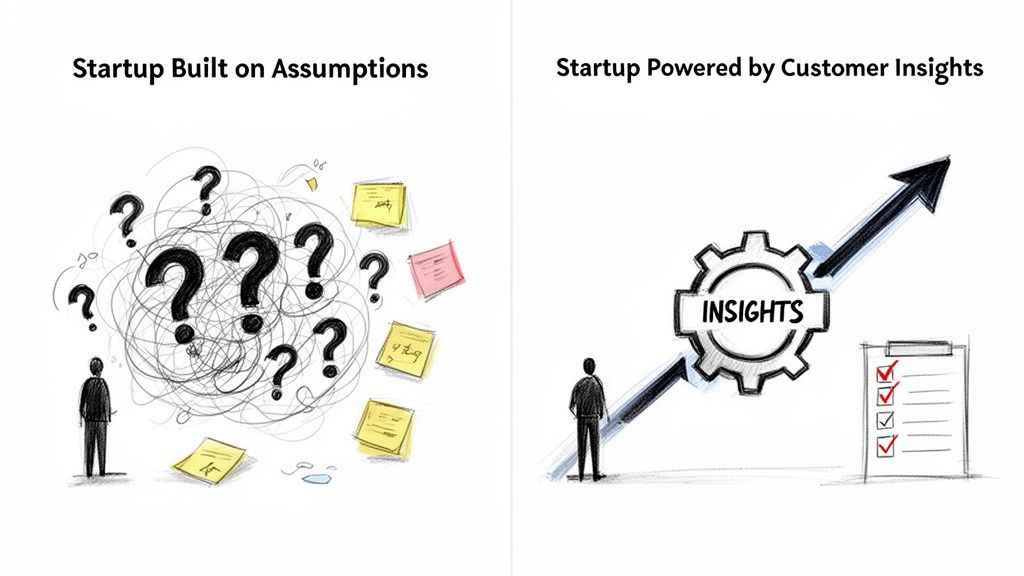
Let’s play out a tale of two startups.
Startup number one is running on pure assumption. They’ve got a brilliant idea, and the founders are convinced they know exactly what the market needs. They spend months heads-down, building features, polishing the UI, and crafting the perfect pitch deck. Launch day arrives… and all they hear are crickets. The message doesn't connect. Sales calls go nowhere. They built a beautiful solution to a problem nobody was trying to solve.
Now, picture startup number two. Before a single line of code is written, they get on the phone with ten potential customers. They’re not pitching; they’re listening. Intently. These conversations completely reshape their product roadmap and tear up their initial go-to-market plan.
This isn’t just a hypothetical. I once watched a single 45-minute user interview save a company from making a six-figure development mistake. The feedback made it painfully clear that our core value proposition, while clever, solved a problem that was, at best, a low-priority headache for our target business users.
This is the real power of user research in a B2B context. It’s not a "nice-to-have" task you hand off to the product team. It’s your most direct path to real, tangible business results.
The core function of user research isn't just to build a better product; it's to build a successful business. Every conversation is a step toward de-risking your venture and accelerating your path to product-market fit.
The data backs this up. Organizations that embed user insights into their core strategy see 2.7x better overall outcomes. That breaks down into 5x enhanced brand perception and 3.6x more active users compared to teams that fly blind.
These aren't just minor bumps; they represent a fundamental difference in a startup's entire trajectory. If you’re interested, you can dig into more of these stats in the full research about user insights.
This guide is your roadmap to making customer insight your most reliable, repeatable, and strategic advantage. Let's get started.
Before you even think about asking your first question, you need a plan. The most impactful B2B user research doesn't just happen; it's meticulously designed. Without a blueprint, you risk ending up with a pile of interesting but ultimately useless information.
A solid plan is what makes every minute you spend with a potential customer a genuine step forward for your business. This isn't about getting bogged down in rigid processes—it’s about being intentional.
Your first move? Define razor-sharp research goals that are tied directly to a real business problem. Generic goals like "understand our users" are a recipe for aimless conversations. You need to connect your research to something specific and urgent.
These kinds of goals give you focus. They transform casual chats into strategic intelligence-gathering missions and make it obvious when your research is actually done.
With a clear goal, you can now figure out exactly who holds the answers. In B2B, this is so much more than a company profile. You’re looking for the specific person whose problems keep them up at night.
You have to get beyond basic firmographics and dig into an individual’s specific role, their day-to-day responsibilities, and what truly frustrates them. This is where creating a detailed Ideal Customer Profile (ICP) just for research purposes becomes non-negotiable.
To make sure your research actually translates into smart decisions, it's crucial to understand how to conduct market research that drives decisions. Adopting that mindset from the start is what separates data collection from true insight. And to help you get started, we've put together a comprehensive ideal customer profile template that will give you the structure you need.
Okay, now for the tricky part: finding these incredibly busy people without blowing a massive budget.
Forget about mass email blasts—they’re a waste of time. Your outreach has to be personal, respectful, and centered on providing value. A personalized LinkedIn message that proves you’ve actually done your homework is ten times more effective than a generic email template ever will be.
Your request for a B2B professional's time is a value exchange. You're not just asking for a favor; you're offering them a chance to influence a tool built for their industry and to voice their expert opinion.
Start with the people you know. Ask for warm introductions from advisors, investors, and even your current happy customers.
And be prepared to offer a fair incentive for their time. A gift card is standard, but sometimes offering early access to a new feature or a summary of anonymized industry insights can be far more compelling. The key is to show you respect their expertise and won't waste their time.
With a clear goal, a precise participant profile, and a thoughtful outreach strategy, you're ready to start gathering the kind of insights that will genuinely shape your startup's future.
In the B2B world, picking a research method isn't about what's trendy—it's about what gets you the unvarnished truth. You're dealing with busy professionals, complex workflows, and business decisions that have real financial consequences. The wrong method doesn't just waste your time; it burns through the limited goodwill of your target users.
The trick is to work backward from what you need to know. Don't start by asking, "Should we do a survey?" That’s putting the cart before the horse. Instead, ask yourself, "What is the single most important question we need to answer right now?"
For instance, if you're trying to understand a company's labyrinthine, multi-step procurement process, a generic survey will only scratch the surface. That kind of question demands a deep dive. This is where one-on-one, in-depth interviews shine, letting you probe, ask "why" five times, and truly map out the business user’s reality.
But if your goal is much simpler—say, getting a quick gut check on the messaging for a new sales deck—you don't need to book a series of hour-long interviews. A quick, unmoderated usability test where a few target users react to your slides can give you incredibly valuable feedback in a fraction of the time.
The most common mistake I see B2B companies make is using a tool that doesn’t match the job. They'll use a survey to try and uncover unknown problems, which is like using a metal detector to find a wooden treasure chest. A survey is great for quantifying issues you already know exist, but it's terrible for discovery.
When you're trying to figure out which approach to take, it’s helpful to understand the essential user experience testing methods and what each one is built for. Knowing the tools at your disposal stops you from using a hammer when you really need a scalpel.
Think of it like a simple decision tree:
This blueprint gives you a high-level view of the process, from defining what you need to learn to finding the right people to talk to.
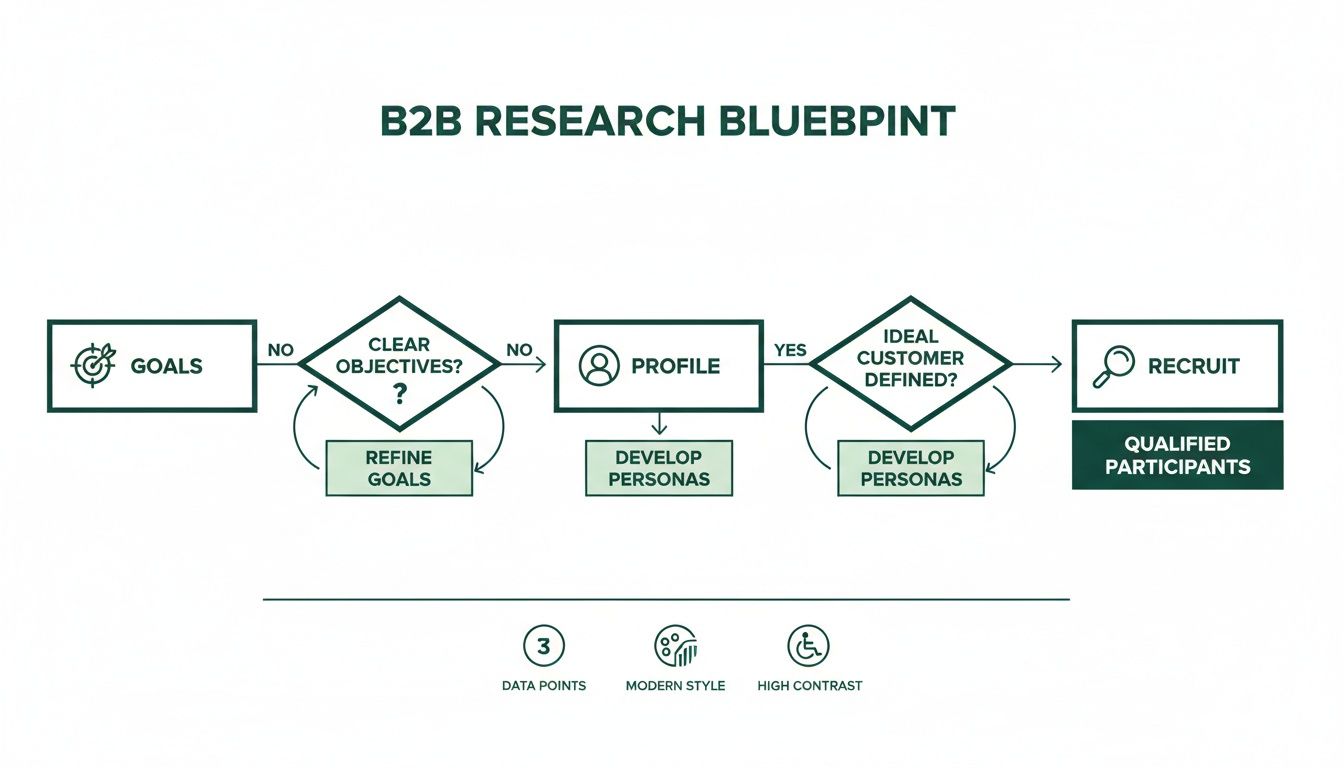
As you can see, you can't even begin to select a method until your goals are crystal clear and you know exactly who you need to talk to.
Choosing the right method can feel overwhelming. This table is a quick-reference guide I use to match common B2B business goals with the research method that's most likely to deliver the goods.
Think of this as your cheat sheet. When a new business question comes up, a quick look here can point you in the right direction and save you from spinning your wheels with the wrong approach.
Let's make this real. Imagine your company has a project management tool for construction firms. You just rolled out a slick new "Subcontractor Invoicing" feature, but analytics show that almost nobody is using it.
Your goal is simple: figure out why.
Here’s how a team might get it wrong versus getting it right:
The goal of B2B user research isn't just to gather opinions; it's to observe behavior within a specific business context. Choosing the right method is about creating the right environment to witness that behavior firsthand.
And remember, your B2B audience isn't a monolith. A procurement officer uses your software completely differently than a project manager on the ground. To make sure you're targeting the right people with the right questions, you have to get your segmentation straight. For a deeper look at that, check out our guide on how to approach customer segmentation for B2B companies. It’ll help you tailor your research so your insights are not just interesting, but directly applicable to the people you actually need to sell to.
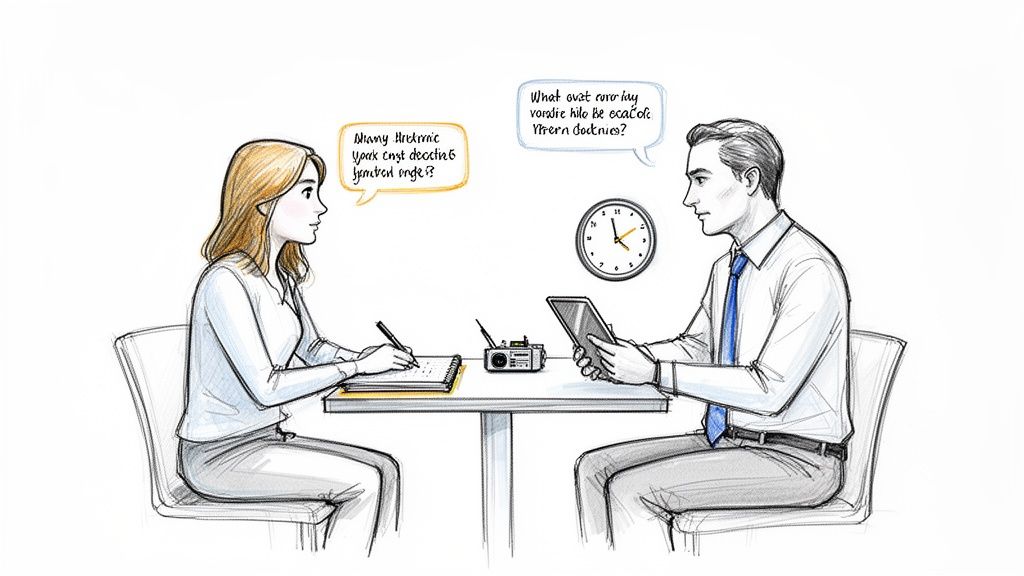
A conversation with a B2B professional is a goldmine. But you have to know how to dig. The goal isn't an interrogation; it's a guided conversation that uncovers the unfiltered, meaningful feedback you need to build a product that companies will actually pay for.
The secret to a great interview is having a guide that feels more like a list of genuine curiosities than a rigid script. It should be there to spark a natural discussion, not force a robotic Q&A. Your real job is to listen way more than you talk, creating a space where the participant feels comfortable sharing their actual, day-to-day reality.
The most powerful tool in your kit is the open-ended question. These are the questions that simply can't be answered with a "yes" or "no." They practically force the participant to tell a story, and it's inside those stories that you find the hidden gems—the real pain points and motivations.
For example, instead of asking, "Is invoicing a problem for you?" try this:
"Could you walk me through the last time you had to process a subcontractor invoice? What did that look like from start to finish?"
See the difference? That small change shifts the entire dynamic. The first question is a dead end. The second one opens the door to a detailed narrative about their workflow, the tools they juggle, and the frustrations they run into along the way. Your personas are only as good as the stories that build them; our guide on using buyer personas to accelerate B2B marketing can help you connect these interview insights directly to your sales process.
Once someone starts sharing, your next job is to dig deeper without putting words in their mouth. It’s incredibly easy for your own biases to creep in and influence their answers. You need a few neutral phrases in your back pocket that encourage them to keep talking.
Here are a few I use constantly:
These simple prompts keep the focus squarely on their experience and stop you from accidentally leading them toward the answer you want to hear.
When a participant says something that surprises you, resist the urge to correct them or explain how your product should work. Get curious instead. That unexpected feedback is often where the most valuable product opportunities are hiding.
This kind of discipline is becoming non-negotiable. Today, a staggering 77% of companies are weaving UX research directly into their marketing decisions, which is fundamentally changing how B2B teams position their products. For startups, this means you simply can't afford to launch without testing your messaging on real decision-makers first.
The return on this effort is undeniable. Every $1 invested in UX can yield up to $100. You can discover more insights about the state of UX and see just how critical this has become.
When you finally land an interview with a busy executive, respecting their time is everything. Start the call by confirming the end time, and then stick to it. No exceptions. Have your questions prioritized so that if you start running short, you know you’ve already covered the most critical topics.
Their perspective is often more strategic, so tailor your questions accordingly. Focus on business impact, team-level challenges, and how they measure success. By leading a conversation that reveals the 'why' behind their team's behavior, you build the confidence to create a solution they'll actually champion.
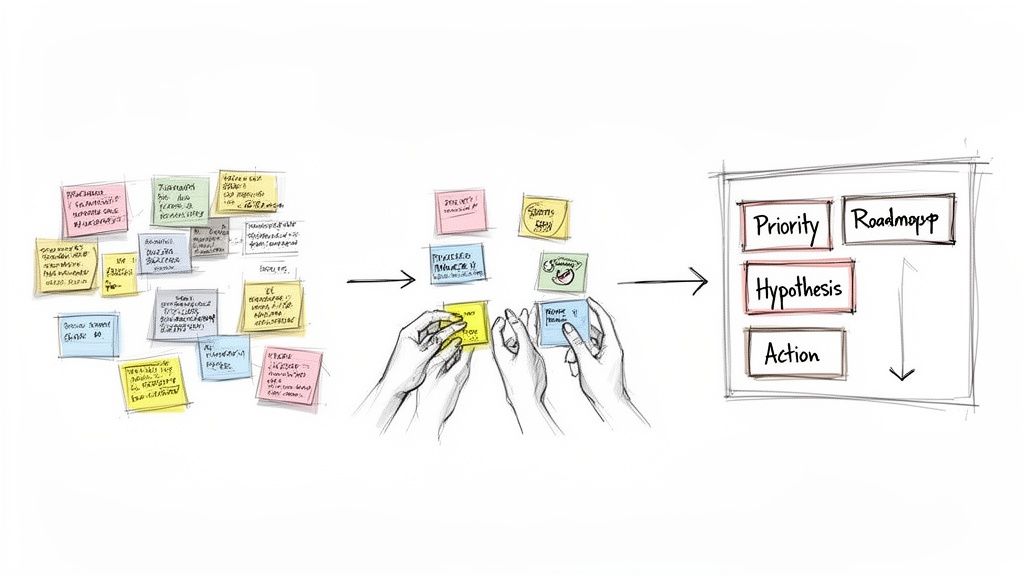
Let’s be clear: collecting data is a milestone, not the finish line. The real magic happens when you take those messy interview notes, scattered survey results, and random observations and turn them into a story that moves your business forward. This is where you graduate from just gathering information to generating real strategic intelligence.
Your goal isn’t just to report what people said. It's to find the patterns—the recurring themes that point directly to your users' deepest needs and frustrations. You don't need fancy software to get started. One of the most powerful and surprisingly simple techniques is affinity mapping. It's all about grouping individual data points to see the bigger picture emerge.
Here’s how it works in practice. Write down every single observation, quote, and pain point from your research on individual sticky notes. Seriously, every single one. Then, start clustering them together on a wall or a digital whiteboard.
You’ll quickly see themes start to form. Maybe a handful of users mentioned how clunky your reporting feature is. Or perhaps you notice a pattern of comments all pointing to a need for better team collaboration tools. These clusters aren't just anecdotes anymore; they're signposts telling you what truly matters to your audience. This is the first crucial step in turning conversations into a concrete product roadmap.
The most potent insights often live in the contradictions and surprises. When a user describes a workflow that completely defies your assumptions, that's not a data point to discard—it's a massive opportunity waiting to be explored.
AI is also becoming a key player in speeding up this synthesis. The User Interviews State of User Research Report 2025 found that AI usage among researchers has jumped to 80%. What's more, 73% of them are highly confident using AI to accelerate this exact process of finding patterns and pulling out insights, showing just how valuable these tools are becoming.
Once you've identified your key themes, the final job is to weave them into a narrative that gets your entire team on the same page. Your product managers, engineers, and sales leaders don't have time to wade through hours of interview transcripts. They need a concise, powerful story that makes the user's problem impossible to ignore.
Frame your findings around the user's journey. What are they trying to accomplish? What’s getting in their way? And, most importantly, how can your product become the hero that solves their problem?
This storytelling approach is the backbone of a truly data-driven marketing strategy. It ensures the hard-won insights from your research don't just get buried in a report. Instead, they get embedded into every feature you build and every sales pitch you deliver, leading to a product that actually resonates with the people you’re trying to serve.
Look, even the most visionary B2B founders get snagged on the practical details of user research. It's completely normal to feel a bit stuck when you're just starting out. I get these questions all the time, so let's clear up some of the most common hurdles I see founders face.
Think of this as a set of guardrails, not a rigid rulebook. The most important thing you can do is just start talking to people.
This one surprises a lot of people. For the kind of deep, qualitative B2B research we're talking about, the magic number is way smaller than you'd think. Your goal isn't statistical significance; it's pattern recognition.
Honestly, you'll start seeing those "aha!" moments and recurring themes after just 5 to 8 solid interviews with people from the same user segment. Go much beyond that, and you'll probably just hear the same things over and over. Five rich, hour-long conversations with your absolute ideal customer are worth infinitely more than twenty surface-level chats with a lukewarm audience.
Time is a B2B professional’s most guarded asset, so you have to respect it. Gift cards are the standard for a reason—they work. A range of $75-$200 per hour of their time is pretty typical and shows you're serious.
But don't just throw money at the problem. You'd be surprised how powerful non-monetary incentives can be when framed correctly. Pitch the interview as a chance for them to:
One of my favorite incentives is offering a summary of the anonymized research findings. This turns the exchange into a win-win. You get the insights you need, and they get valuable market intelligence they can actually use.
When you ask for an expert's time, you're not just asking for feedback; you're offering them a seat at the table to shape the future of their own work. This intrinsic motivation is often more compelling than cash.
A zero-dollar budget isn't a dead end. It's a prompt to get creative and resourceful. Your most valuable feedback is sitting right inside your existing network.
Start with your current customers. They already have a vested interest in seeing you build something great. Next, hit up your professional connections on platforms like LinkedIn and ask for warm introductions. You can also join industry-specific Slack communities or online forums where your ideal users hang out. The key is to add value first—participate in conversations, share your own knowledge, and build some rapport before you ask if someone would be willing to chat for 15-20 minutes.
This bootstrapped approach often uncovers the most passionate and insightful users who are critical to making sure you're building the right thing. This whole process is an essential part of our product-market fit checklist, which is designed to help you navigate these early-stage validation efforts.
At Big Moves Marketing, I specialize in helping B2B SaaS startups translate these kinds of customer insights into powerful positioning and launch strategies that drive real revenue. If you're ready to turn your research into results, let's connect at https://www.bigmoves.marketing.
Explore Big Moves Marketing services and resources:


%20-%20white.svg)