%20png%20copy.avif)

A two pager template is a structured, two-page business document designed to communicate key information clearly and drive a specific reader action. In B2B sales and marketing, two pagers sit between a one-line pitch and a full proposal. They give decision-makers enough detail to say yes to a meeting, a demo, or a next step. Well-structured short-form documents increase meeting rates by 200–300% compared to cold emails, and they outperform 15-slide decks in initial conversion. That number tells you something important: brevity wins, but only when the structure is right.
Every effective two pager template follows a predictable structure. Readers scan, not read. Your job is to make the right information land in the right order, fast.
Effective short-form documents contain seven core sections: a headline, audience definition, problem, solution, proof, pricing or next steps, and a clear call to action. A two page document template gives you room to expand each section slightly, but the logic stays the same.
Here is what each section does:
Pro Tip: Write your headline last. Once you have filled every other section, the single most important claim becomes obvious.
The two-page format gives you a second page for proof, case study excerpts, or a visual. Use that space deliberately. Every line on page two should support the claim you made on page one.
Preparation separates a two pager that gets read from one that gets filed. Three inputs matter most: audience clarity, data quality, and tool selection.

Know your audience before you write a word. Tailored versions of short documents built for specific audiences outperform generic ones. An investor version focuses on market size and traction. A sales version focuses on client outcomes and ROI. If you send the same document to both, you will underperform with both.
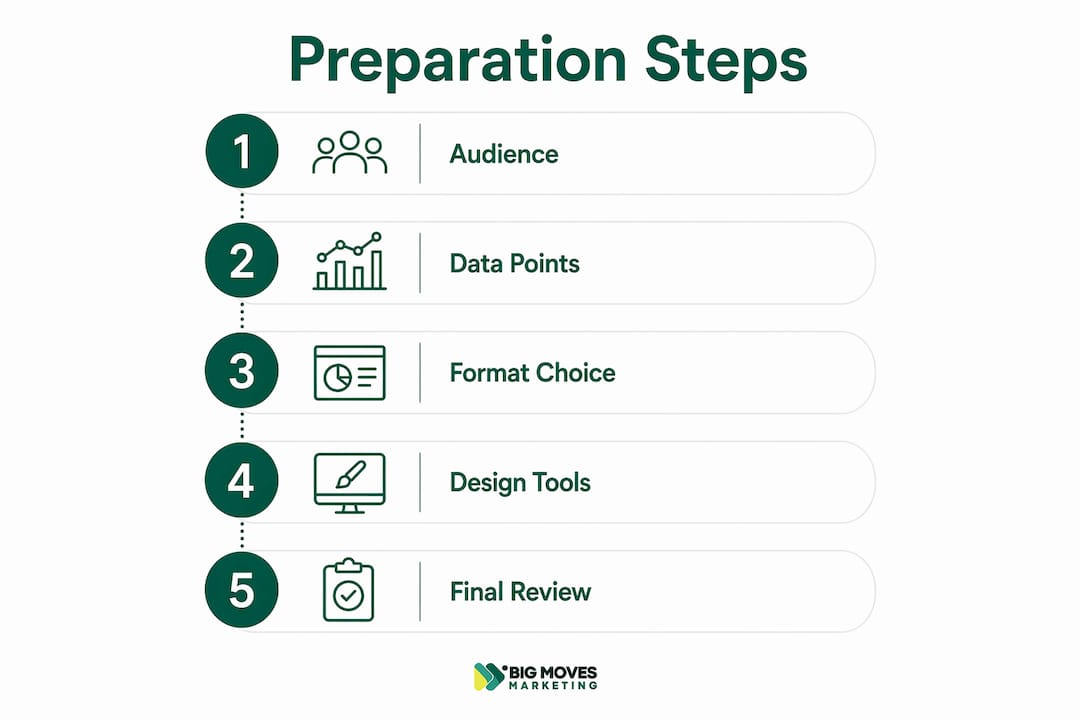
Gather specific, verifiable data points. Vague claims lose credibility with professional audiences. The difference between “we improve response times” and “we cut customer support response time by 96% for Acme Health” is the difference between ignored and forwarded. Collect your best three to five metrics before you open any template.
Choose the right format for your use case. Static PDFs work for one-time submissions. For active sales cycles, live digital links let you update data automatically without resending documents. High-growth B2B teams now prefer live links over PDFs for exactly this reason.
| Format | Best for | Key advantage |
|---|---|---|
| Static PDF | One-time submissions, RFPs | Universal compatibility |
| Live digital link | Active sales cycles | Auto-updates, no resend needed |
| Editable slide deck | Internal presentations | Easy to customize per meeting |
| Printed document | In-person events | No device dependency |
Pro Tip: Build your two pager in a tool that supports both PDF export and a shareable live link. That gives you flexibility for every situation.
Structure your process before you open a blank page. Teams that write first and structure later produce documents that ramble. Follow this sequence.
Write your headline first as a hypothesis. State your single biggest claim in one sentence. You will refine it later, but having it written keeps every other section focused.
Draft the problem statement in your reader’s words. Pull language from customer interviews, sales call notes, or support tickets. If your reader recognizes their own frustration in your words, they keep reading.
Describe your solution in plain language. Avoid product feature lists. Describe the outcome the reader gets. “Your team closes tickets 40% faster” beats “AI-powered ticket routing engine.”
Add your three strongest proof points. Each proof point needs a number, a named outcome, and ideally a recognizable client name. Specificity in claims is the single biggest differentiator between documents that get responses and those that do not.
Write your call to action last, and make it one thing. A single, clear CTA outperforms multiple asks every time. “Book a 20-minute call at [link]” is better than “reach out however works for you.” For guidance on building effective CTAs that convert in B2B contexts, the principles apply directly to two pager closers.
Apply visual hierarchy. Use one font family. Set body text at 11pt for readability, with headlines at 18–22pt. Add white space between sections. Readers scan in 60–90 seconds. Visual hierarchy tells them where to look.
Edit for length. Read every sentence and ask: does this earn its place? Cut anything that does not directly support your main claim. Two pages is a constraint, not a target. If you can say it in less, do.
Get one external review. Send the draft to someone who does not know your product. Ask them to tell you the main point after 60 seconds. If they cannot, rewrite.
Pro Tip: Print your two pager before you send it. Problems with spacing, font size, and visual balance are far easier to spot on paper than on screen.
For more on how B2B SaaS teams structure their go-to-market materials in 2026, the principles of concise positioning apply directly to two pager design.
Most two pagers fail for the same reasons. Knowing the patterns helps you avoid them before the document goes out.
“The single-page restriction acts as a forcing function for clarity. Two-page documents risk diluting reader focus. The solution is not more pages. It is more discipline in what you include.”
Run a final checklist before sending: one main message, three specific proof points, one CTA, and no sentence that could apply to any other company in your category.
For a deeper look at how to structure a B2B presentation so it drives decisions rather than just informs, the same logic applies to two pager design.
A two pager template works when it forces one clear message, three specific proof points, and a single call to action onto two disciplined pages.
| Point | Details |
|---|---|
| Structure drives results | Seven defined sections give readers the information they need in the order they need it. |
| Specificity beats vague claims | Named metrics and client outcomes build credibility and get responses. |
| Tailor for each audience | Investor and sales versions need different emphasis to convert effectively. |
| Live links beat static PDFs | Auto-updating documents keep data current throughout long sales cycles. |
| One CTA, one ask | A single, specific call to action outperforms multiple or open-ended requests. |
After 17 years working with B2B SaaS teams at Bigmoves, I have reviewed hundreds of two pagers. Most of them are one-pagers that ran out of discipline. The second page exists because someone could not decide what to cut, not because the content required it.
The teams that get the most meetings from their two pagers treat the format like a constraint, not a canvas. They write the one-page version first. Then they decide what genuinely earns a second page. Usually it is proof: a case study excerpt, a before-and-after metric table, or a visual that would be too small on a single page.
The shift I have seen in 2026 is the move from static PDFs to live links. This is not a minor formatting preference. It changes how sales teams operate. A live document means you can update a metric or swap a case study without chasing down every prospect who already has the old version. That is a real operational advantage in a long sales cycle.
My practical advice: write your two pager as if it will be read in 60 seconds, because it will be. Every section should work as a standalone sentence. If your problem statement only makes sense after reading the headline, rewrite it. Clarity at the section level is what separates documents that get forwarded from documents that get filed.
— Veb
B2B SaaS teams that invest in clear positioning documents also need a website that carries the same message forward. A two pager gets you the meeting. Your website closes the gap between interest and commitment.
Bigmoves builds B2B SaaS websites designed specifically for go-to-market execution. The same discipline that makes a two pager work, one clear message, specific proof, a direct next step, applies to every page of a high-performance website. If your current site does not match the quality of your sales collateral, that gap costs you deals. Bigmoves closes it.
A 2 pager is a structured, two-page business document that communicates a company’s value proposition, problem, solution, and proof points to a specific audience. It is used in B2B sales and marketing to secure meetings or advance deals.
A one-pager fits all key information on a single page, which forces maximum clarity. A two pager adds a second page for additional proof, case study details, or visuals, but risks diluting focus if not structured carefully.
Every two pager template needs a headline, audience definition, problem statement, solution description, proof points with specific metrics, and a single call to action. These seven elements give readers everything they need to take the next step.
Live digital links are the better choice for active sales cycles because they update automatically when data changes. Static PDFs work for one-time submissions where version control is not a concern.
A well-designed two pager takes 60–90 seconds to scan. That scan time is the standard professional audiences apply, so every section must deliver its key point in the first sentence.



%20-%20white.svg)