%20png%20copy.avif)
A solid competitive battlecard template is more than a simple fact sheet. It’s a strategic playbook that turns raw market intel into the exact, deal-winning talking points your B2B sales team needs to close. It’s what helps them disarm objections, navigate tough conversations with rivals, and clearly hammer home your unique value.
The moment a prospect mentions a rival is where deals are truly won or lost. It's the ultimate test of your sales team's preparation and conviction. All too often, I’ve seen reps fall back on generic data sheets, reciting features and specs that completely miss the mark on the buyer's actual problems. This reactive approach just leaves money on the table.
This is about turning hesitation into confidence. It's about arming your team with the precise insights they need to turn a challenging conversation into a defining moment. A great battlecard doesn't just list a competitor's weaknesses; it provides the exact language to expose those gaps in a way that truly resonates with your prospect.
Think of a battlecard as the bridge connecting your product's capabilities to the buyer's desired outcomes. It translates complex information into clear, persuasive dialogue. When you get this right, your team can:
To really move beyond data sheets and see consistent wins, it's also critical to have a proven path to build a sales pipeline that consistently brings in qualified leads. This foundational work ensures that when your reps pull out their battlecards, they're talking to people who are actually ready to listen.
The real magic of a battlecard template lies in its ability to distill a mountain of information into action. According to industry reports, a staggering 58% of professionals struggle to keep their materials updated, which completely erodes trust with sales teams. A well-structured template creates a system for turning a constant flow of market intel into easily digestible talking points.
A battlecard's purpose isn't just to inform—it's to empower. It should give a salesperson the clarity and conviction to walk into any call, know precisely how to position their solution, and articulate exactly why they win.
This whole process starts with a strong foundation. You can't effectively counter your rivals if you haven't nailed your own place in the market first. To get that piece right, check out our guide on what is product positioning to make sure your core message is rock solid. With that clarity, you can build a tool that doesn't just stack up facts, but tells a compelling story of why your solution is the only real choice.
So, what’s the real difference between a battlecard that wins deals and one that just collects digital dust? It’s not about stuffing every last piece of rival intel onto a page. A truly high-impact competitive battlecard template is a masterclass in curation. It's a blueprint designed for speed, clarity, and persuasive power.
The goal is to give your reps exactly what they need, right when they need it, turning those high-stakes calls into decisive wins. The best ones feel less like a dense dossier and more like a tactical cheat sheet. For B2B SaaS, that means going way beyond a simple feature list and digging into strategic positioning, landmines, and objection handling.
This infographic nails why having the right intel is so crucial for reps in the trenches.
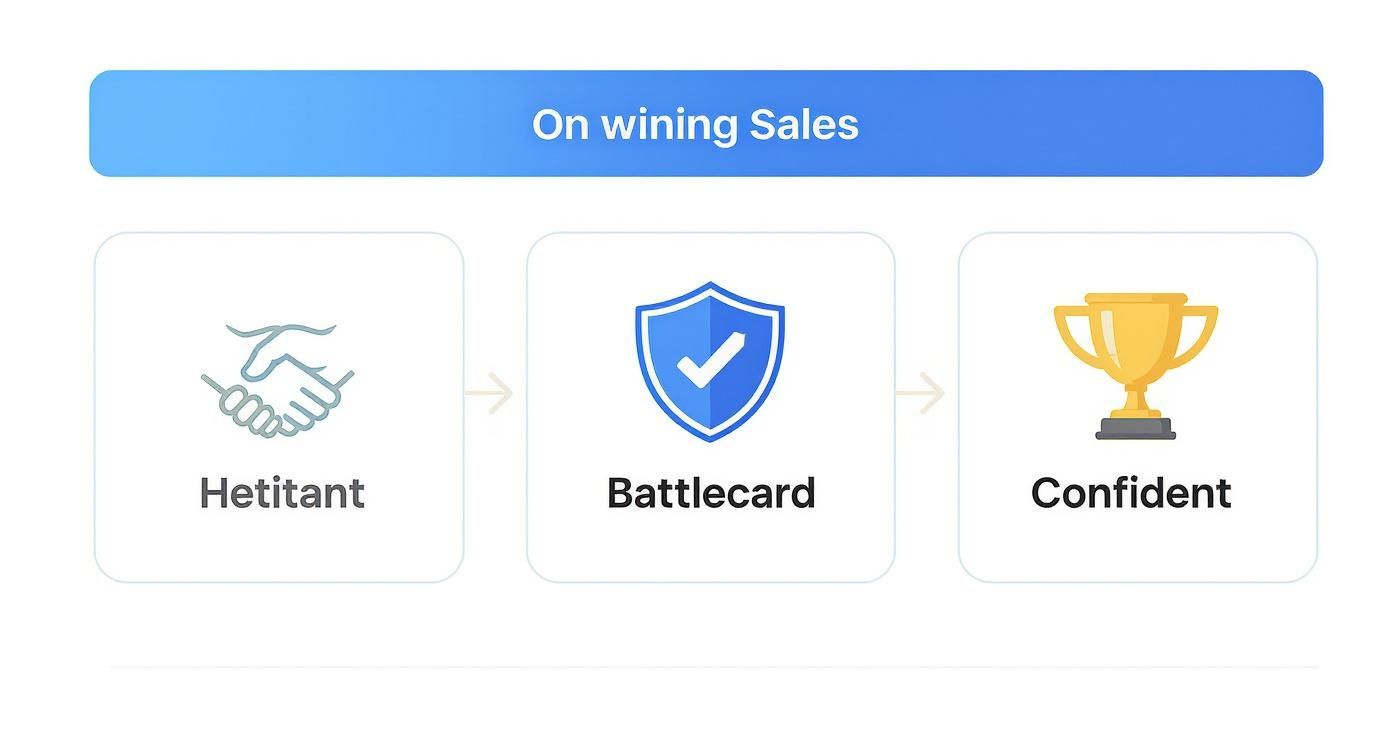
As you can see, a great battlecard acts like a shield. It moves a rep from a place of hesitation to one of confidence and authority, which is what it takes to close the deal.
To build a template that actually delivers, you need to break it down into a few core, battle-tested components. Each one has a specific job to do, designed to be found and absorbed in seconds.
Let’s take a look at the essential sections every effective battlecard needs. The table below outlines the core components and why each one is critical for arming your sales team.
By structuring your template around these key pillars, you create a tool that’s not just informative but genuinely empowering for your sales reps on every call.
Forget the long-winded company history. Your reps need a sharp, scannable summary that gets straight to the point. This section should feel more like an executive briefing than a research paper.
Nail down these essentials:
This quick overview sets the stage. It gives a rep immediate context before they dive into the more granular details needed for a specific conversation.
This is the absolute heart of your battlecard. "Why We Win" statements aren't just a list of your strengths; they are concise, evidence-backed arguments tailored to dismantle a specific opponent. Every statement needs to be a knockout punch.
For example, don't just say, "We have better customer support." That’s weak. A powerful 'Why We Win' statement sounds like this: "When they bring up [Rival]'s slow support, pivot to our 2-hour average response time and dedicated onboarding specialists. We get you fully operational in days, not weeks."
Your goal is to arm reps with definitive, memorable statements that connect a rival's weakness directly to a prospect's pain and then resolve it with your unique strength.
These statements transform a defensive conversation into an offensive one, putting your team back in control of the narrative. They're also a critical part of creating killer B2B content examples for successful sales enablement, ensuring your messaging stays sharp and consistent across the board.
A classic mistake is building a massive grid that compares every single feature. It's overwhelming, hard to read, and totally useless in a live call. Ditch that approach.
Instead, focus only on the features that lead to fundamentally different business outcomes for the customer. Structure your comparison around their goals.
This reframes the conversation away from a check-box comparison and toward a much more compelling discussion about tangible business value.
Landmines are your secret weapon. They're carefully crafted questions designed to expose a rival's weakness without you having to attack them directly. The idea is to guide the prospect to discover the opponent's shortcomings on their own.
Think of questions that lead the prospect right where you want them to go:
These questions position your sales rep as a knowledgeable consultant, not just a seller. You're building trust by helping the buyer ask smarter questions and see the hidden risks.
This section is your team’s safety net. It needs to be formatted for instant recall, providing short, punchy responses to the most common objections and FUD your team hears about a specific rival. Think of it as pre-scripted comebacks that sound natural and confident.
A sales team armed with a well-structured battlecard template can navigate these tough conversations with ease. By deconstructing the battlecard into these core components, you create a tool that doesn’t just inform—it empowers.
A battlecard template, no matter how well-designed, is just an empty shell. What brings it to life—and what makes it a genuine weapon for your sales team—is potent, real-world intelligence. The info you gather fuels every talking point, every landmine, and every "why we win" statement.
But here’s where many teams go wrong: they rely solely on a rival's marketing website, which only gives them the polished, best-case-scenario version of the truth. Real insights—the kind that actually close deals—come from digging much deeper. The goal isn't just to find information; it's to uncover an opponent's genuine weaknesses from the people who experience them firsthand.

This means you need a repeatable process for sourcing intelligence that is both current and brutally honest. Your battlecard becomes truly powerful when it reflects what’s actually happening in the market, not just what a rival claims on their homepage.
The most valuable intel almost always comes directly from people who have evaluated—and either chosen or rejected—a rival's solution. These sources provide the unvarnished truth about product gaps, onboarding nightmares, and unmet promises.
Here's where to look:
Capturing these direct quotes and recurring complaints gives your sales team authentic, evidence-based ammunition they can use with confidence on their calls.
The real power of a battlecard comes from turning a rival's customer complaints into your sales team's strategic advantages. When a prospect hears an objection that they've already seen in a third-party review, your credibility skyrockets.
A critical piece of this puzzle is having a solid system for conversation intelligence. These tools can automatically scan sales calls and customer interviews, flagging mentions of rivals and recurring pain points without anyone having to do it manually.
Your sales and customer success teams are on the front lines every single day. They hear the latest rumors, objections, and FUD (Fear, Uncertainty, and Doubt) directly from prospects and customers. Too often, this invaluable intel lives and dies in a single conversation or a private Slack message.
Building a simple, frictionless feedback loop is essential. This isn't about adding another administrative task to your reps' plates. It's about making it incredibly easy for them to share what they're hearing.
Set up a dedicated Slack or Teams channel—call it something like #intel-drop or #rival-chatter. Encourage reps to post quick, raw notes immediately after a call. It could be as simple as: "Prospect just said [Rival] is now quoting 90-day implementation times for new clients."
That single data point can become a powerful 'Why We Win' statement. The key is to make sharing intel a celebrated, low-effort activity. For a deeper look at this process, check out our guide to conducting a thorough SaaS competitive analysis.
All the rival intel in the world is useless if your reps can’t translate it into a compelling conversation. This is where we move from data dumps to deal-closing dialogue. A killer competitive battlecard template is all about shaping raw facts into persuasive, natural-sounding language your B2B team can use on the fly.
The point isn't to arm your reps with robotic scripts that make them sound like they’re reading off a screen. It's about giving them the building blocks for authentic, agile responses that sound authoritative, even when they’re under pressure. You'd be surprised how small shifts in wording can make a massive difference in how a prospect sees your solution.
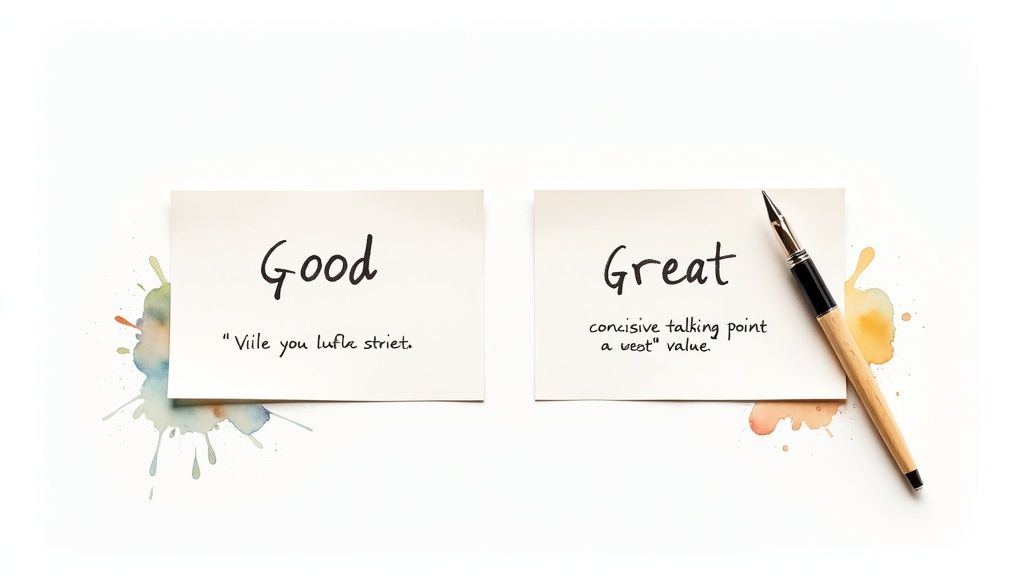
Let's break down how a few subtle tweaks can completely reframe the conversation. This is the real magic of a great battlecard—it doesn't just state facts; it tells a story that positions you as the obvious choice.
Here’s a classic example:
Good Talking Point: "Our software has more integrations than Competitor X."
Great Talking Point: "That's a great question. While Competitor X often requires third-party tools that add cost and complexity, our platform comes with native, one-click integrations for Salesforce and Marketo. It means your team can be up and running in an afternoon, not next quarter."
See the difference? The second version connects a feature directly to a business outcome (speed to value) while subtly planting a seed of doubt about the opposition (hidden costs and headaches). This is the kind of detail that builds trust and makes your reps sound like seasoned consultants, not just salespeople.
One of the most powerful moves a rep can make is to get ahead of the conversation. Instead of waiting for a prospect to bring up an opponent, they can proactively frame your solution in a way that neutralizes the threat before it even comes up.
This is where simple, adaptable scripts in your battlecard become invaluable.
Scenario: You know your biggest rival is a favorite among huge enterprise clients but often struggles to serve mid-market companies well.
This little bit of conversational jujitsu validates the prospect’s research while immediately drawing a clear line in the sand. It tells them, "We understand the market, and here’s exactly where we shine for you." Developing these clear positioning statements is a core part of building effective messaging framework examples that your entire go-to-market team can rally behind.
So, what happens when a prospect hits you with, "Competitor Y is 20% cheaper"? This is where most reps get defensive. A solid battlecard gives them the exact language to pivot from price to value.
Scenario: Your solution costs more, but it includes dedicated support and a more robust feature set that saves customers money on other tools.
This response is a masterclass in objection handling. It does three things perfectly:
By equipping your team with these kinds of persuasive talking points, your battlecard template transforms from a static document into a living, breathing tool that actively helps reps navigate tough conversations and steer deals toward a close.
Building out a killer competitive battlecard template is a huge win, but let's be honest—that's only half the battle. The best insights in the world are useless if they’re collecting dust in a forgotten folder. The real magic happens when your battlecards become a living, breathing part of your sales motion, something your reps instinctively reach for in the heat of a tough conversation.
The rollout of a new or updated battlecard needs to be an event, not just another email attachment. This is your chance to get the team fired up and fluent. You want these tools to feel like an extension of their own expertise, not a crutch. A good launch makes sure your team doesn't just know what's on the card, but how to use that intel to close deals.
This is all about turning a static document into a dynamic weapon in their arsenal.
Your initial rollout is the single best opportunity you have to embed these battlecards into your team’s daily workflow. Whatever you do, don't just send a link and cross your fingers. Instead, make the launch an interactive training session that builds real-world confidence and muscle memory.
Structured role-playing is, hands down, the best way to do this.
These exercises are what transform theoretical knowledge into practical skill. They quickly highlight where the gaps are and help reps internalize the messaging, so it sounds natural when a real deal is on the line.
In the fast-moving world of B2B SaaS, a battlecard that's three months old might as well be from the stone age. It’s a huge problem—a staggering 58% of intelligence professionals say they struggle just to keep their content updated. This is where most battlecard programs fall apart. Outdated intel kills trust, and once your sales team stops trusting the cards, they’ll stop using them. Period.
To keep this from happening, you need a simple, repeatable process for keeping everything fresh. A quarterly review cycle is a great place to start.
A battlecard should never be considered "finished." Think of it as a living document that evolves with every new product release, pricing change, and shift in market positioning from your opponents.
Your quarterly review doesn’t need to be some massive, week-long project. Just create a simple checklist to run through for each key rival. Getting this right is all about creating a sustainable feedback loop, and for a deeper look at that, check out these 5 steps to align B2B marketing and sales.
Your best, most potent updates will come directly from the front lines. Your sales team is a firehose of fresh intel, and your win/loss data tells the unfiltered story of what’s actually working with buyers. Tapping into this is how you create battlecards that aren't just accurate, but razor-sharp.
Use ongoing analysis to constantly refine your content:
When you make maintenance a continuous, team-wide effort, your battlecards transform from static files into a dynamic intelligence hub. They become a reflection of your team’s collective wisdom—always current, always trusted, and always ready to help win the next deal.
Even the best blueprint hits a few speed bumps when you start putting it into practice. This is where the real-world questions pop up. Let's dig into the common hurdles I see B2B teams face when they start building out an intelligence program.
It's tempting to try and build a battlecard for every single player you've ever heard of in your market. Don't. That's a fast track to burnout and a folder full of digital dust bunnies.
The smart move is to start small and focus on impact.
Who are the top three to five rivals that come up over and over again on sales calls? Those are your targets. Prioritize the names your team actually fights against day-to-day, not just the big industry giants who might not be in your deals as often.
It's far better to have three exceptional, always-current battlecards your team trusts than fifteen mediocre ones they ignore.
Once you’ve nailed that core group and your update process is running smoothly, then you can start expanding. Focus delivers results.
Ownership is everything. A battlecard without a clear owner is a battlecard that's already out of date. While your whole GTM team should be feeding you intel, one person or function needs to be in charge of curating, updating, and distributing the final product.
In most B2B SaaS companies I've worked with, that responsibility lands with:
Whoever it is, this can't be a side-of-the-desk project. It needs to be a core, official part of their role with real accountability.
You have to know if all this work is actually moving the needle. Tracking usage and impact is how you prove the value of your CI program and get buy-in for more resources down the line.
Here are a few metrics I always keep an eye on:
When you can walk into a leadership meeting with data showing that battlecard adoption correlates with higher win rates, you've won. You'll have no trouble making the case for continued investment in your intelligence efforts.
Ready to stop losing deals and start equipping your sales team with the intel they need to win? At Big Moves Marketing, I specialize in building custom sales enablement assets—from positioning frameworks to the very battlecards we've discussed—that give B2B SaaS teams a decisive edge. Let's build your winning playbook together. https://www.bigmoves.marketing
Explore Big Moves Marketing services and resources:
Related reading:



%20-%20white.svg)