%20png%20copy.avif)

December 2025
B2B SaaS growth in 2026 is being driven by a clear split in the market: software demand is still expanding, but easy growth is not. Budgets are flowing toward products that automate painful work, prove ROI faster, and fit tightly into the systems customers already use. In our review of the 2026 data, the most credible pattern was not "AI wins by default"; it was that startups are winning when they combine AI, workflow depth, retention discipline, and sharper pricing into one operating model. Private-company benchmarks underline that shift: median SaaS growth was 22% in one 2026 benchmark set, down from 25% in 2024, while another benchmark showed average growth at 18% and a much wider spread between winners and laggards, with many companies still shrinking year over year SaaS Capital benchmark data.
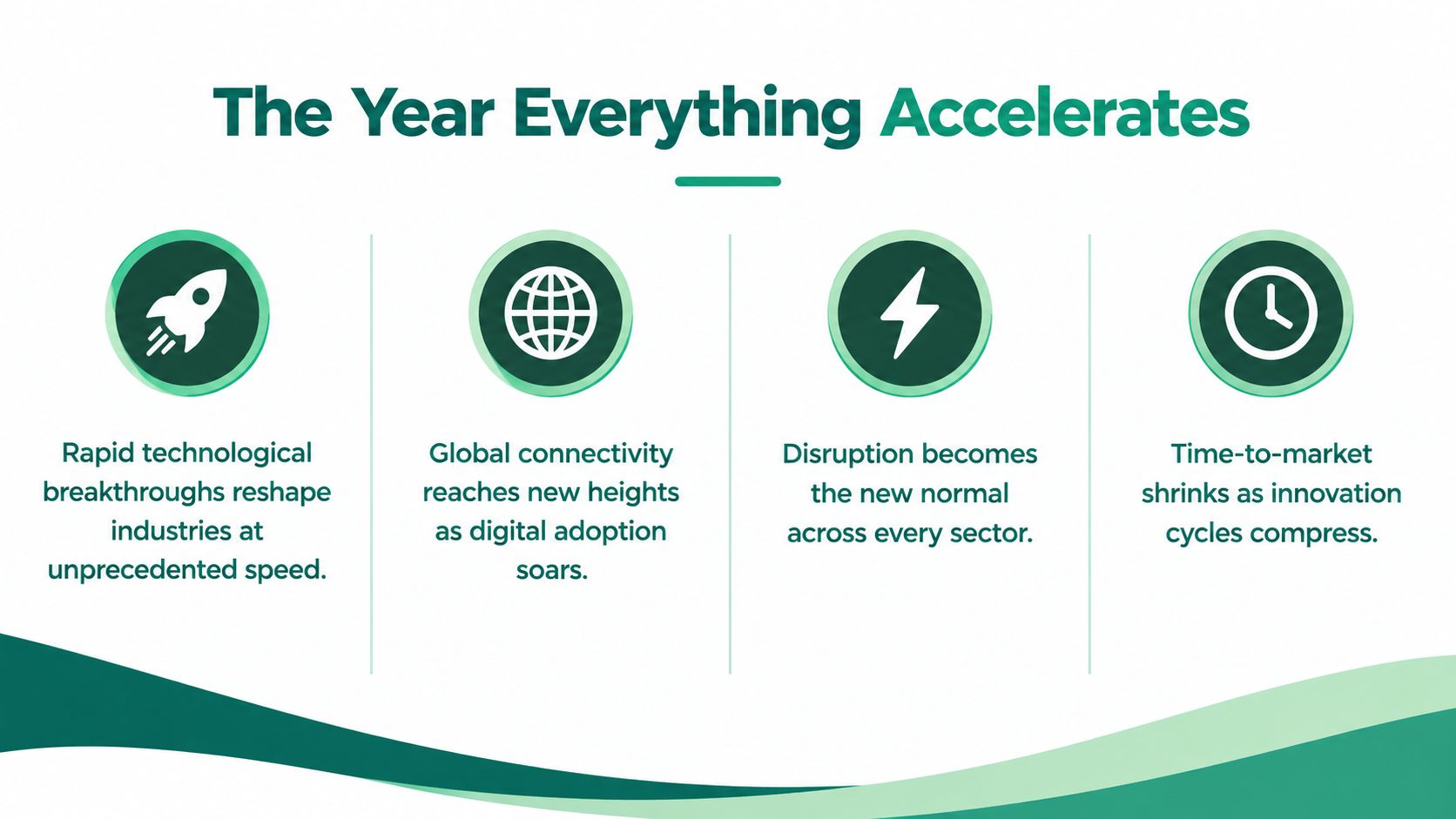
The market itself is still enormous. One major forecast puts global SaaS at $375.57 billion in 2026 and $1.48 trillion by 2034, implying 18.7% annualized growth; another estimate sized the market at $408.21 billion in 2025 and $465.03 billion in 2026, while noting SaaS spending outpaced broader IT spending growth Fortune Business Insights. I find the range more useful than pretending one number settles the debate: the exact market total varies by methodology, but the implication for startups is the same. There is still room to build meaningful companies, yet broad market expansion should not be confused with startup-level growth. Category size helps, but execution now decides who captures it.
These five lessons were selected because they show up repeatedly across benchmark reports, operator commentary, customer-behavior signals, and public-company pattern shifts. They are not predictions built on novelty alone. They are recurring moves we can already see separating durable B2B SaaS businesses from products that get attention without earning lasting spend.
We chose these lessons by prioritizing recent evidence over broad trend-post claims. The inputs included private SaaS benchmark data, analyst research from firms already cited in this article, public examples of companies changing pricing or product direction, and customer-side behavior such as consolidation pressure, ROI scrutiny, and adoption of workflow automation.
A trend only made this list if it met four tests:
What got excluded? Generic claims that "AI changes everything," broad statements about SaaS efficiency with no revenue implication, and trends that were real for large incumbents but not usable for an early-stage or scaling startup. What I trust most in this market are patterns that show up in retention, pricing, and workflow adoption because those are harder to fake than launch headlines.
For the past few years, the B2B SaaS world has been dominated by a single conversation: generative AI. But in 2025 and going into 2026, that conversation has matured. Buyers are no longer impressed by AI features that autocomplete text or generate content. They're demanding AI that can perform end-to-end tasks with minimal supervision.
Think of agents that read context, act across apps, and report back on outcomes. As Microsoft CEO Satya Nadella has stated: "We are moving from autopilot to co-pilot... to having this co-pilot that is a true agent that has deep knowledge of you."
The data backs up this shift. McKinsey's global survey shows how quickly adoption has grown: individual use of generative AI inside companies climbed from about one-third in 2023 to more than two-thirds in 2024, and executive-level use is now mainstream. IDC expects AI spending growth near one-third annually through the second half of the decade, specifically calling out agentic systems as a driver of budget expansion.
Multiple analyses in 2025 reported a striking number: roughly 95% of enterprise generative AI pilots are not reaching measurable P&L impact. That doesn't mean AI is failing—it means the way teams adopt it is off target.
The winners are narrowing their scope to painful jobs-to-be-done and integrating with existing systems. According to BCG's research on agentic AI, effective AI agents can accelerate business processes by 30% to 50%, with early adopters seeing 20-30% faster workflow cycles and significant reductions in back-office costs. For teams that need a plain-English primer on how these systems work in a growth context, see the overview from MakeAutomation.
Consider these real-world results:
Bain's Technology Report 2025 offers a critical framework for understanding where AI will help vs. hurt existing SaaS businesses. They identify four strategic scenarios based on two factors: the potential for AI to automate user tasks and the potential for AI to penetrate SaaS workflows.
For incumbents, the key insight is this: workflows with high user automation potential and low AI penetration risk are your "growth gold mines." Here, companies hold exclusive data and rules, giving them a head start on full automation. Leaders should build solutions with end-to-end agents, shift pricing from seat-based to outcome-based, and train sales teams to sell business results, not just features.
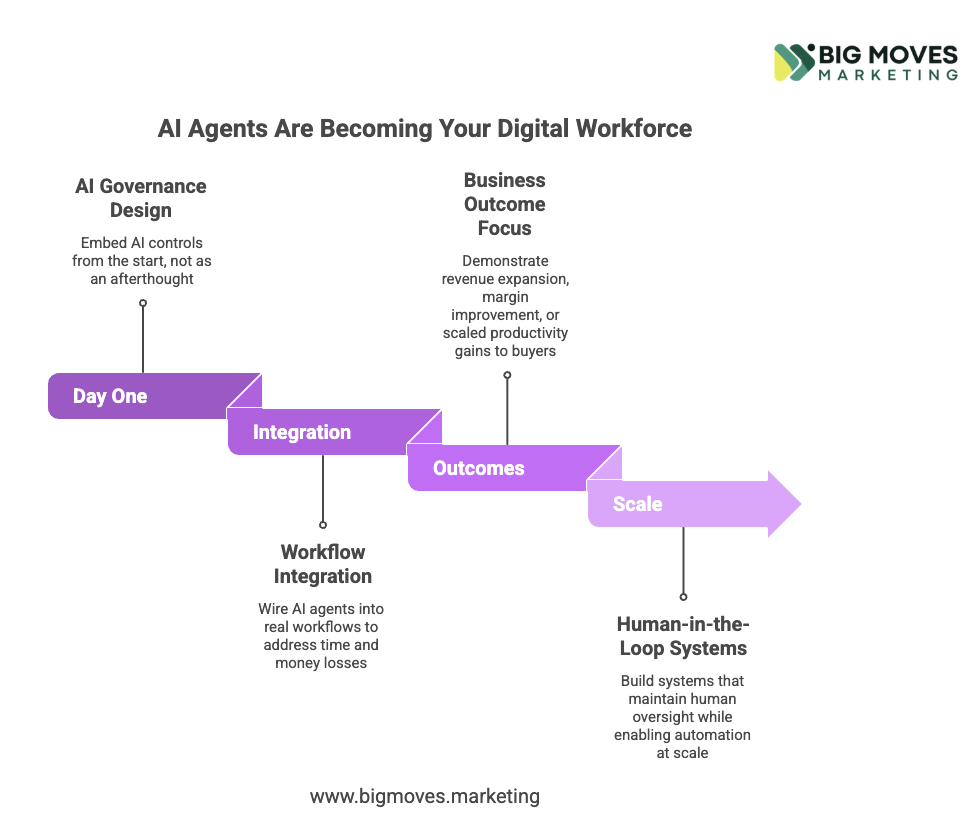
AI Agents integrated for B2B SaaS Operational Effectiveness
For SaaS executives navigating this shift, several approaches are proving effective:
Perhaps the most fascinating development emerging in 2026 is the very real possibility of the "one-person unicorn"—a billion-dollar company built and run by a single founder leveraging AI. This isn't science fiction anymore; it's the natural evolution of trends that have been building for years.
OpenAI CEO Sam Altman and his tech executive peers have established a betting pool predicting when the first one-person billion-dollar company will emerge. According to Fast Company, some experts suggest the company could be founded in 2026—if it hasn't been already—due to rapid advancements in agentic AI.
"The ability of a person to scale themselves, to automate their lives, has just become amazing," says Kyle Jensen, director of entrepreneurship programs at Yale School of Management. "What is the probability that you'll see a solo-entrepreneur who's like, some engineer from Google, who decided she doesn't want to do that anymore—and she's going to do her AI startup from home, and become the first unicorn? I think it's a pretty decent probability."
Infrastructure making The Rise of the Micro Unicorn possible
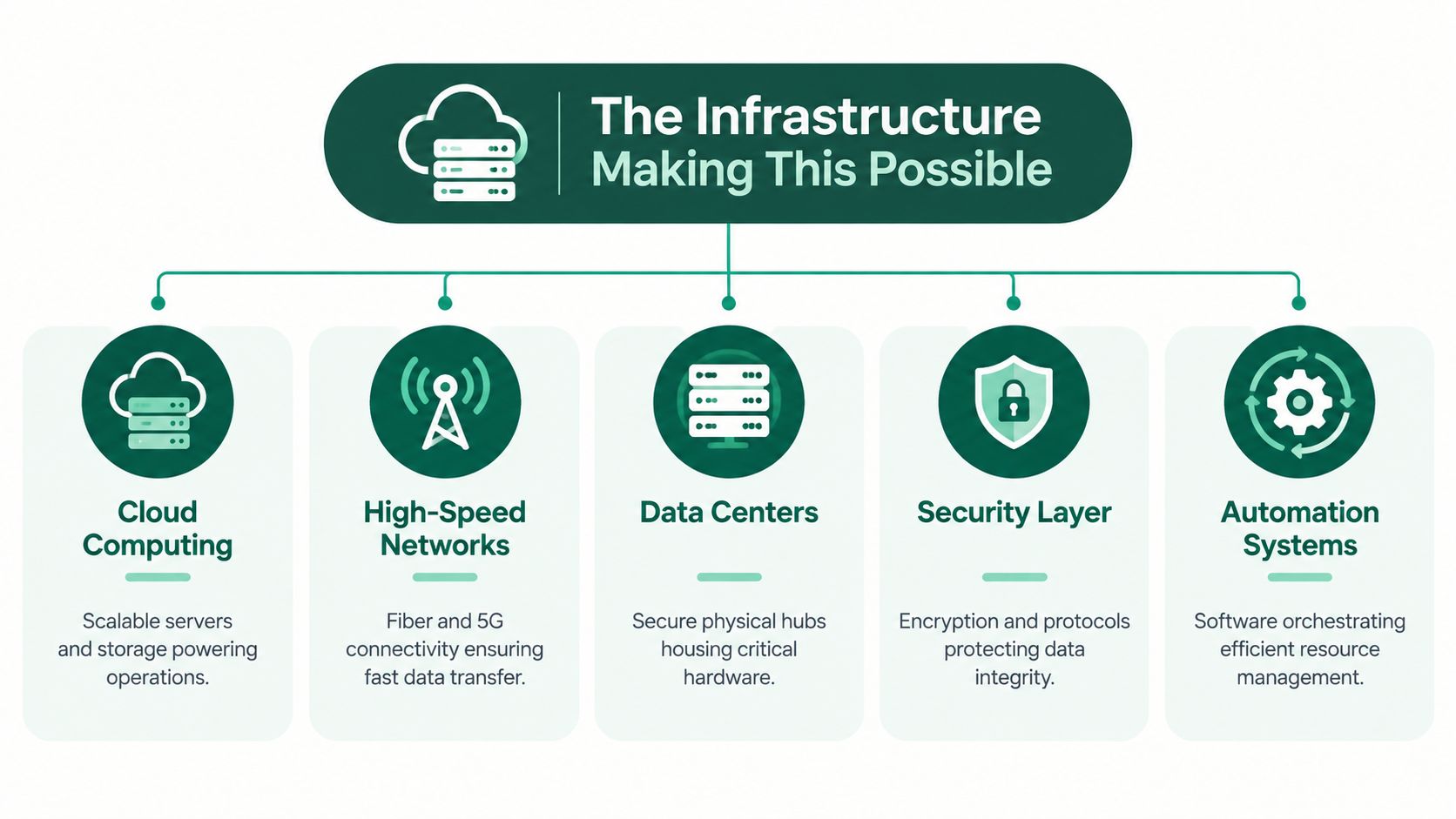
Several converging forces are making the micro unicorn increasingly feasible:
As Mike Krieger, Instagram co-founder and now Chief Product Officer at Anthropic, explains: "When I think back to Instagram's early days, our famously small team had to make painful decisions... With AI agents, startups can now run experiments in parallel and build products faster than ever before."
The foundation for solopreneur unicorns already exists. Pat Walls's Starter Story recently featured over 50 solopreneurs generating more than a million in annual revenues. AI startups received 64% of all venture capital dollars in the U.S. during the first half of 2025, according to PitchBook data.
Recent history shows the trend accelerating:
The rate at which AI startups are hitting ARR milestones is raising important questions for both founders and investors. As Right Side Capital notes, when scaling costs drop dramatically, traditional markers like headcount and office expansion become unreliable indicators of progress. "If a startup can reach $10 million ARR with a fraction of the burn compared to 2018, does it still justify the same valuation multiple?"
For B2B SaaS founders, this has profound implications:
Horizontal tools will not vanish, but a significant share of budget growth is flowing into vertical stacks that solve industry-specific workflows with data and models tuned to a domain. The reason is practical: when you speak the customer's language and plug into their systems of record, onboarding is faster and outcomes are easier to measure.
Gartner predicts that more than 70% of businesses will utilize Industry Cloud Platforms (ICPs) to speed up business efforts by 2027, up from less than 15% in 2023. This represents a fundamental shift from cloud as infrastructure to cloud as industrial outcomes.
On top of industry clouds, providers are deploying pre-modeled data schemas and domain-specific agents for functions like claims processing, underwriting, clinical intake, and policy servicing. Salesforce's growth to more than 15 industry clouds exemplifies this momentum—bundling sector-specific data models, processes, and partner solutions.
Vertical SaaS is outperforming because software buyers have become less interested in generic flexibility and more interested in operational fit. In 2026, the strongest products are not merely industry-branded wrappers around horizontal tools; they embed into core workflows, reflect domain rules, and make adoption easier for teams that cannot tolerate mistakes. I think many startup decks still miss the plot: they describe a market by TAM category, while the winning products describe a workflow that is expensive, frequent, regulated, and hard to switch away from.
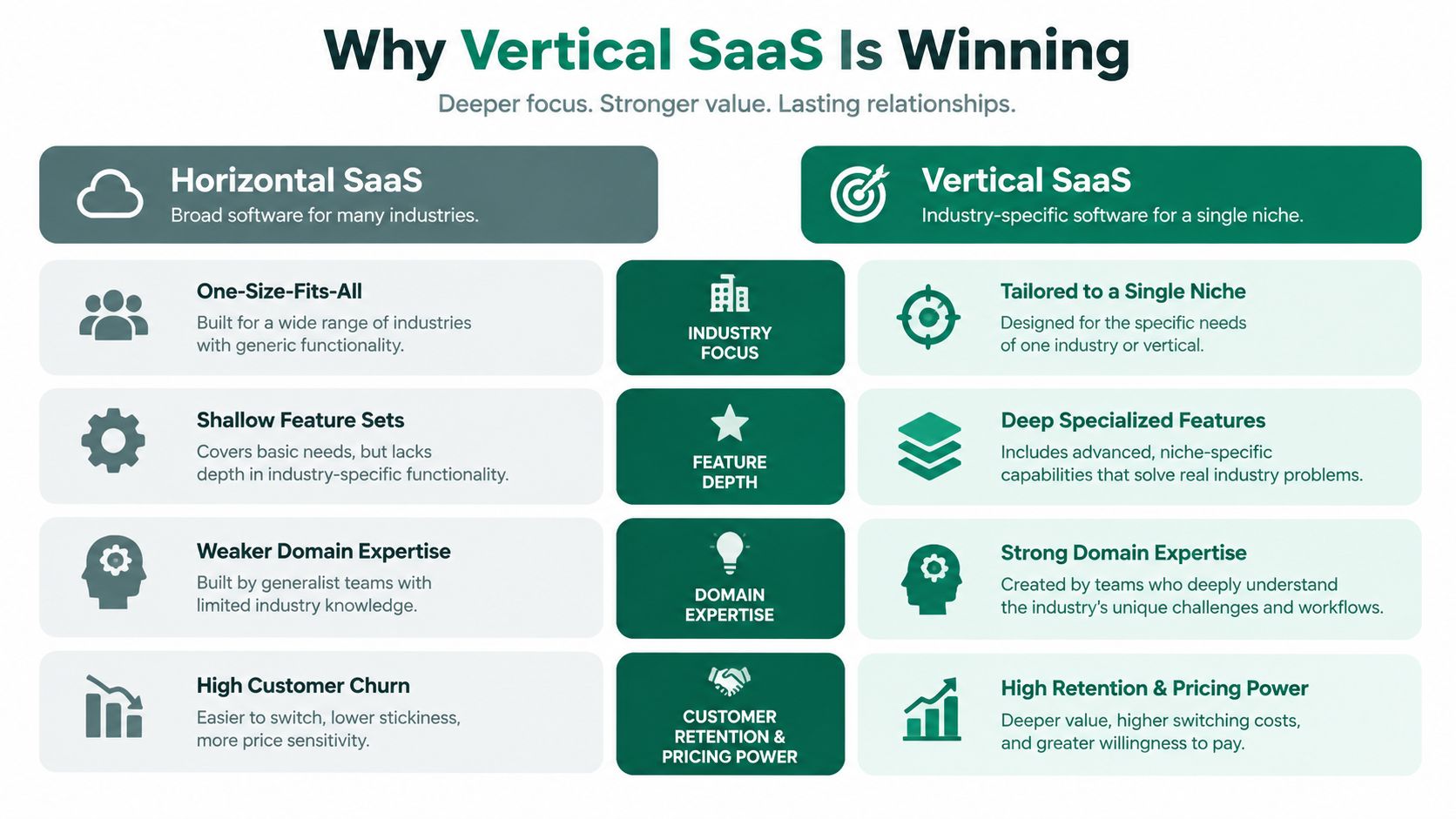
Why Vertical SaaS Is Winning
Several factors are driving this shift:
Y Combinator has even started "rebranding" B2B SaaS to vertical AI agents, recognizing the magnitude of this shift. Companies like Writer, Agentic, and Sierra have raised billions of dollars offering solutions that let businesses create their own vertical AI agents.
Consider these vertical SaaS success stories:
These examples matter for one reason: each captured spend by getting closer to core operations. They did not win by being slightly better generic software. They won by reducing operational complexity inside a specific environment.
Despite the momentum, vertical SaaS is not finished maturing. The most attractive gaps are still hiding where workflows remain fragmented, compliance is painful, or AI needs proprietary context to be useful. Founders should look closely at categories where teams still swivel between a system of record, email, spreadsheets, and manual approval chains; where audits or reporting obligations create recurring urgency; where an incumbent owns data but not the full workflow; and where AI assistance is only valuable if it understands domain-specific documents, terminology, and downstream actions.
That creates a practical map for new opportunities:
Interestingly, while vertical SaaS grows, enterprises are simultaneously consolidating their overall SaaS portfolios. The average company now manages approximately 275 SaaS applications, with spending reaching $49 million yearly (about $4,830 per employee). CFOs are pushing to retire duplicative apps, standardize suites, and control renewals.
This creates a dual opportunity for vertical SaaS providers:
Before chasing a niche, test it against four questions:
If the answer is yes across all four, you may have more than a niche. You may have the foundation for a category leader.
For most of the last decade, SaaS success was defined by one thing: new logo growth. But heading into 2026, that equation has flipped. The companies winning now are those expanding revenue from customers they already have—not just chasing new ones.
Net Revenue Retention (NRR) is now the single most accurate indicator of SaaS health. Unlike Annual Recurring Revenue or Customer Acquisition Cost, NRR captures what happens after the deal closes, the part of the customer lifecycle that defines long-term success.
The data is compelling. According to KeyBanc's 2025 SaaS Benchmark Report, best-in-class public SaaS companies average 120-125% NRR. McKinsey's analysis of more than 100 B2B SaaS companies found that top-quartile-valued companies achieve NRR rates of 113%—meaning they grow 13% without adding any new business—while bottom-quartile peers only reached 98%.
More importantly, High Alpha's research shows that SaaS companies with high NRR grow 2.5x faster than their low-NRR counterparts. This makes sense when you consider the compounding nature of retention and expansion revenue: retaining and growing your existing customer base requires less capital and effort than acquiring new customers.
In 2026, Customer Success (CS) will complete its evolution from a support function to a core revenue driver. According to Benchmarkit data, approximately 40% of SaaS revenue now stems from renewals and expansion. As Gainsight's Chief Revenue Officer Marilee Bear points out, "CS is absolutely in the best position to identify and influence those opportunities."
Unlike sales teams that traditionally focus on upselling and cross-selling, Customer Success teams maintain intimate, ongoing relationships with customers. This positions them to uncover expansion opportunities naturally as they work alongside clients to meet business goals.
ChurnZero's 2025 Customer Revenue Leadership Study found that the presence of enablement, CSMs, support, and account management correlates directly with higher NRR. As CEO You Mon Tsang notes, "2026 will be all about customer go-to-market teams going on the offense. Leaders who build customer-data-centric systems, hire for critical customer roles, and move AI from productivity to revenue impact will distinguish themselves from the pack."
Markets are increasingly demanding margin expansion and efficient, sustainable, recurring growth. McKinsey's analysis found that efficient growth is most correlated with value creation: companies in the top quartile of valuation multiples—with a median enterprise-value-to-revenue multiple of 24x compared to 5x for bottom-quartile peers—show better performance on core metrics of efficient growth, particularly NRR.
Top-quartile NRR companies also outperform on key operational metrics, including higher growth efficiency and shorter payback periods. They sustain higher valuations than peers through both bull and bear markets.
Strategies for Improving NRR
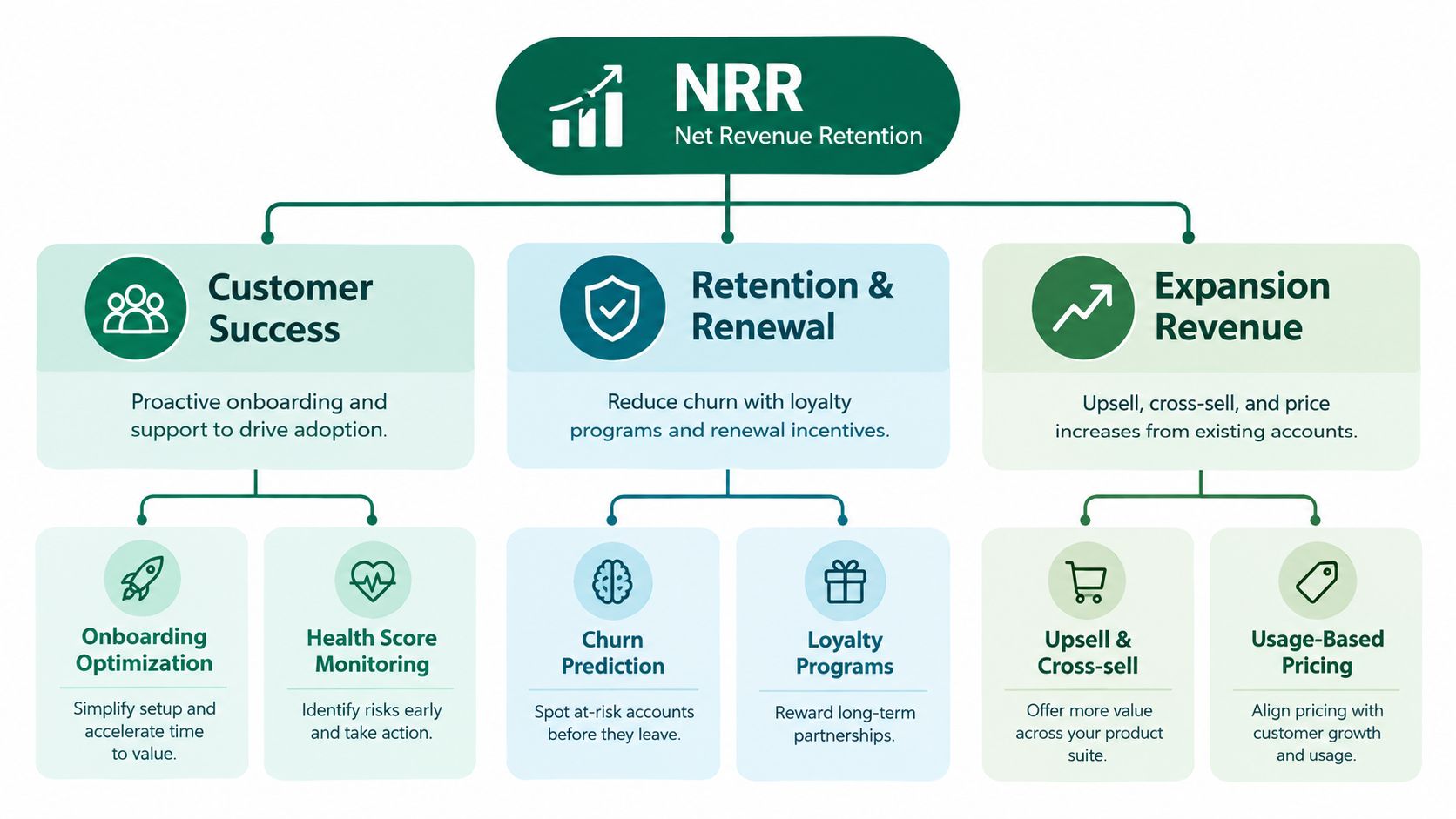
For SaaS executives focused on improving retention and expansion:
In our 2025 analysis, we identified the correlation between company size and optimal pricing models—fixed-rate for early stage, usage-based as you scale. In 2026, that evolution continues with a dramatic new development: the emergence of true outcome-based pricing.
According to the 2025 SaaS Pricing Benchmark Study, one notable trend is outcome-based pricing, where vendors share risk and reward with customers based on measurable business outcomes. While only 9% of companies have fully implemented such models, 47% are actively exploring or piloting these approaches.
As David Thompson, CFO of Chargebee, notes: "The future of SaaS is removing the divide between vendor success and customer success. When we directly tie our revenue to customer outcomes, we create perfect alignment."
Several forces are converging to make outcome-based pricing viable:
McKinsey's latest B2B Pulse research shows that eight in ten B2B decision-makers will actively look for a new vendor if performance guarantees aren't offered. The transition from subscription to consumption-based and outcome-based pricing models is accelerating.
Companies pioneering outcome-based models include:
OpenView's research shows a clear split: only a minority of companies are pure usage-based, but a large share now runs hybrid plans that blend a predictable base with metered value. The common thread is alignment with how customers realize value rather than just how many people log in.
As pricing expert Kyle Poyar observes, "Hybrid is where most of the smart money is going." The future likely combines subscription, usage, and outcome elements.
For 2026, two moves to expect:
For companies considering outcome-based pricing:
Strategic Implications For Your B2B SaaS Startup in 2026
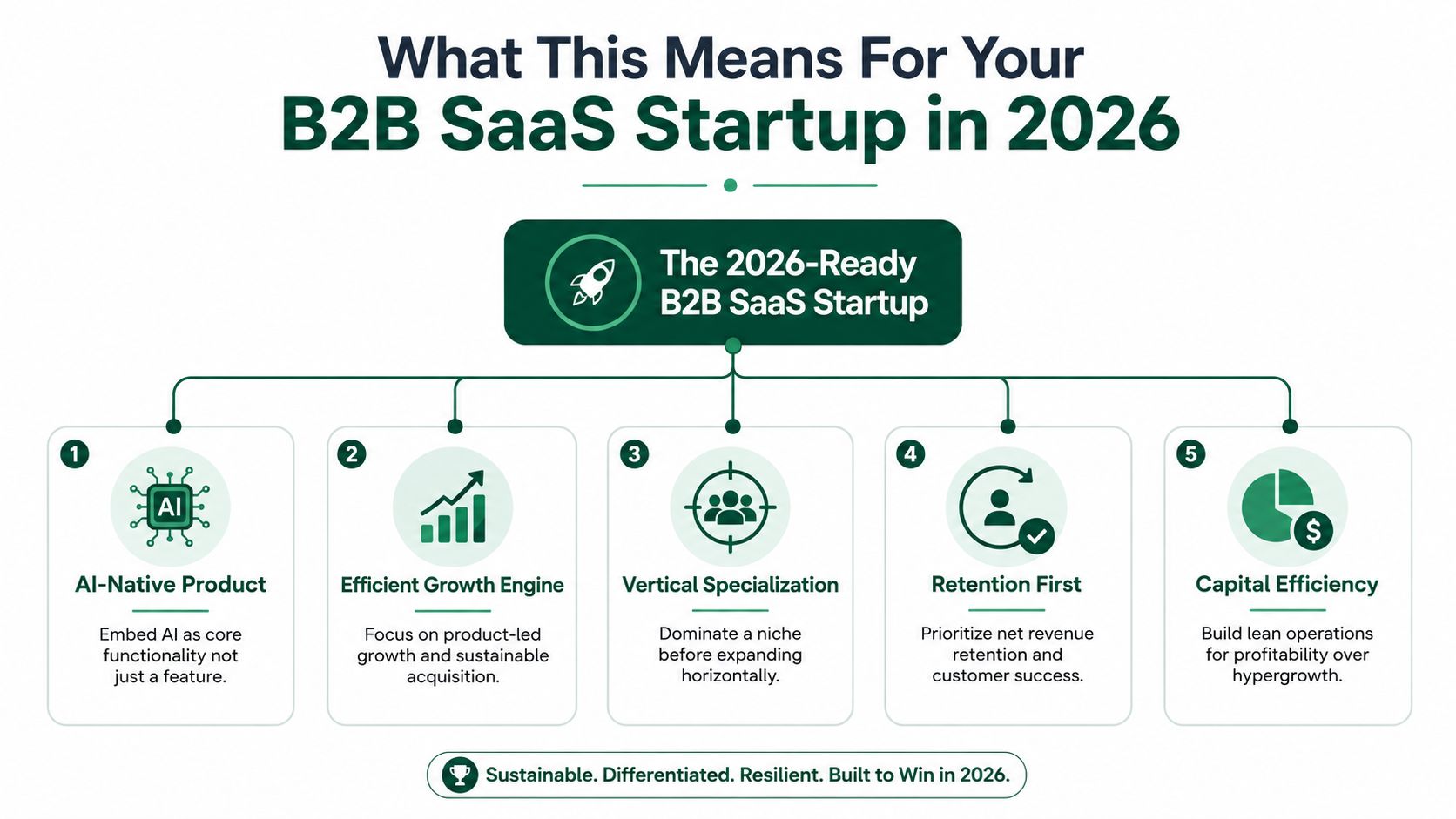
The clearest takeaway from 2026 is that B2B SaaS growth still exists at meaningful scale, but it now favors companies with tighter operating discipline. A market measured in the hundreds of billions is still expanding fast Fortune Business Insights, yet benchmark data shows outcomes are spreading further apart between strong operators and everyone else SaaS Capital benchmark data. That is why the right response is not "grow at all costs" or "wait for the market to settle." It is to adopt a clearer growth framework.
Here is the operating model these five lessons point to:
If you want a compact checklist, use this sequence: solve one urgent workflow, embed into the system of record, prove recurring value, expand accounts through measurable wins, and only then widen product scope. What I find most credible about this framework is that it works whether you are pre-seed or scaling. The specifics change, but the logic does not.
If You're Early Stage (Pre-$1M ARR):
If You're Scaling ($1M-$10M ARR):
If You're at Growth Stage ($10M+ ARR):
The founders most likely to win in 2026 will not be the ones chasing every trend at once. They will be the ones translating market conditions into a few repeatable decisions: tighter positioning, deeper workflow ownership, stronger retention, and pricing that matches outcomes. That is how startups turn broad SaaS market growth into company-level momentum.
B2B SaaS means software sold by one business to another on a subscription or recurring-revenue basis. Instead of selling to consumers, these companies help teams manage workflows such as CRM, finance, support, operations, compliance, analytics, or industry-specific processes.
The rule of 40 is a common SaaS benchmark that adds growth rate and profit margin. If the total is 40 or more, the company is often viewed as balancing growth and efficiency reasonably well. It is useful as a high-level scorecard, but it should not replace deeper metrics like retention, payback period, or gross margin quality.
The 3 3 2 2 2 rule is a startup growth heuristic often used in venture circles. It typically refers to tripling ARR for two years, then doubling for three more years, starting from an early revenue base. It is a shorthand for strong compounding, not a law of company building, and many healthy SaaS businesses grow differently depending on category, pricing model, and market maturity.
Some categories are crowded, especially broad horizontal products with weak differentiation. But B2B SaaS is not uniformly oversaturated because new gaps keep opening inside vertical workflows, compliance-heavy industries, and AI-enabled operational use cases. In practice, the harder problem is not market crowding alone; it is whether a startup can solve a painful enough problem to displace existing tools.
Large research firms size the global SaaS market differently, but both point to continued expansion. One estimate places it at $375.57 billion in 2026 with a path to more than $1.48 trillion by 2034, while another put the market at $465.03 billion in 2026 after strong year-over-year growth Fortune Business Insights. The range matters less than the direction: software spend is still growing, even as buyers become stricter about ROI.
Early on, founders often focus on ARR because it is simple, but retention quality usually tells the stronger story. If customers activate quickly, keep renewing, and expand over time, growth becomes more durable and less dependent on constant acquisition. That is why many of the best operators treat net revenue retention and time-to-value as leading indicators, not secondary metrics.
For those looking to dive deeper into these topics, consider exploring:
Get more insights on how to grow your B2B SaaS Enterprise startup in 2026 and beyond. Work with me www.bigmoves.marketing
Explore Big Moves Marketing services and resources:





%20-%20white.svg)