%20png%20copy.avif)

The best presentation in B2B SaaS isn't a performance. It's a precisely engineered tool designed to force a decision. Most founders get this wrong. They focus on delivery, polish, and information transfer, believing a compelling performance will win the deal. It won't.
Your presentation is a product. Its only job is to move a specific audience—investors, enterprise buyers, channel partners—from their current state of uncertainty to your desired outcome. The goal isn't applause. It's a term sheet, a signed pilot, or a partnership agreement.
This shift in mindset, from performer to product manager, is the only one that matters.

Founders treat high-stakes presentations like a stage performance. They rehearse talking points and focus on a flawless information dump. This approach fails because it's self-centered. It’s about what they want to say.
A presentation isn't a speech to be delivered; it’s an asset engineered for a specific business outcome. A performer worries about sounding impressive. A product strategist obsesses over the audience's problem and the single action they must take to solve it.
When you treat your presentation as a product, you stop asking, “What do I want to say?” and start asking, “What does this audience need to believe to take the one action I require?”
Every audience "hires" your presentation to do a specific job. Building a deck without defining this job is like building software without user research. It’s malpractice.
The jobs are fundamentally different:
A generic deck fails all three audiences because it’s not designed for any specific job. The core content might be 70% the same, but the final 30%—the framing, the proof points, the call to action—determines the outcome.
Your deck isn’t a monologue. It is a user interface for your argument, designed to guide a specific user (your audience) to a specific outcome (your desired action). If it fails, the fault is in the design, not the audience.
When you approach your presentation like a product, every slide and every data point is ruthlessly optimized for a single, desired action.
For an investor, the action is securing the next partner meeting. For a prospect, it’s agreeing to a paid proof-of-concept. This demands a level of strategic precision that most "how to give the best presentation" advice misses entirely. This approach is rooted in our philosophy on product thinking for B2B marketers.
Stop performing. Start building.
Your presentation isn't an event; it's a critical component of your growth engine. Engineer it with the same rigor you apply to your software.
Senior executives don't buy features. They don't buy data dumps. They buy into a narrative that makes a compelling, logical case for change. I see founders constantly make this mistake: they treat their deck as a collection of facts instead of a structured argument. The result is a confused, bored, and unconvinced audience.
Your narrative is the engine of persuasion. It must create tension, establish the stakes, and position your solution as the only inevitable next step. This isn't storytelling; it's engineering a strategic case that withstands executive scrutiny.
The single biggest error in B2B presentations is starting with the solution. Founders, proud of their product, jump into features and assume the audience understands the context. This is backward. Your first job is to make the audience feel the full weight of a problem they may not have fully articulated.
A winning narrative follows a specific arc:
This structure isn't theoretical. An internal analysis of B2B sales decks showed that presentations following a clear Problem-Agitate-Solution arc were 22% more effective at securing a next step than those that were feature-led.
Each point in your narrative must build on the last, creating an unbreakable chain of logic. You are guiding the executive's thinking from A to B to C, leaving no room for doubt. Each slide must anticipate and answer the next question forming in their mind.
After you frame the problem, they're thinking, "I see the problem, but why is the old way of solving it broken?"
After you discredit the old way, they're thinking, "Fine, but why is your approach the right one?"
Your presentation should feel less like a pitch and more like a well-reasoned consulting engagement. You are the expert guiding them to the only logical conclusion.
For founders, securing funding or a key deal hinges on this narrative discipline. This practical guide on how to pitch to investors offers complementary insights.
This entire framework rests on a clear strategic position. A weak position creates a weak narrative. We detail this in how to write a positioning statement in our article.
Your narrative is your strategy made manifest. It translates market insight and product vision into an argument so clear and logical that the decision to move forward feels like their idea.
Your slides are the user interface for your argument. Most founders treat them like a teleprompter, packed with dense text that forces the audience to read. This is a fatal flaw.
When your audience is reading your slides, they are not listening to you. You’ve created a distraction, not an asset.
Effective slide design isn't about artistry; it's about engineering for clarity. The goal is a visual aid that supports your narrative and makes complex ideas land instantly. Anything else is noise.
The most common failure in B2B decks is cognitive overload. Founders cram multiple concepts, walls of text, and raw data onto a single slide, assuming more information equals more value.
The opposite is true.
The non-negotiable rule is one core idea per slide.
Each slide must have a single job. Is it to introduce the market shift? Is it to reveal a key metric? Define its purpose and build the slide around that alone. This discipline forces a logical argument and ensures the audience follows without getting lost.
A simple visual flow is the most effective way to illustrate your narrative arc.
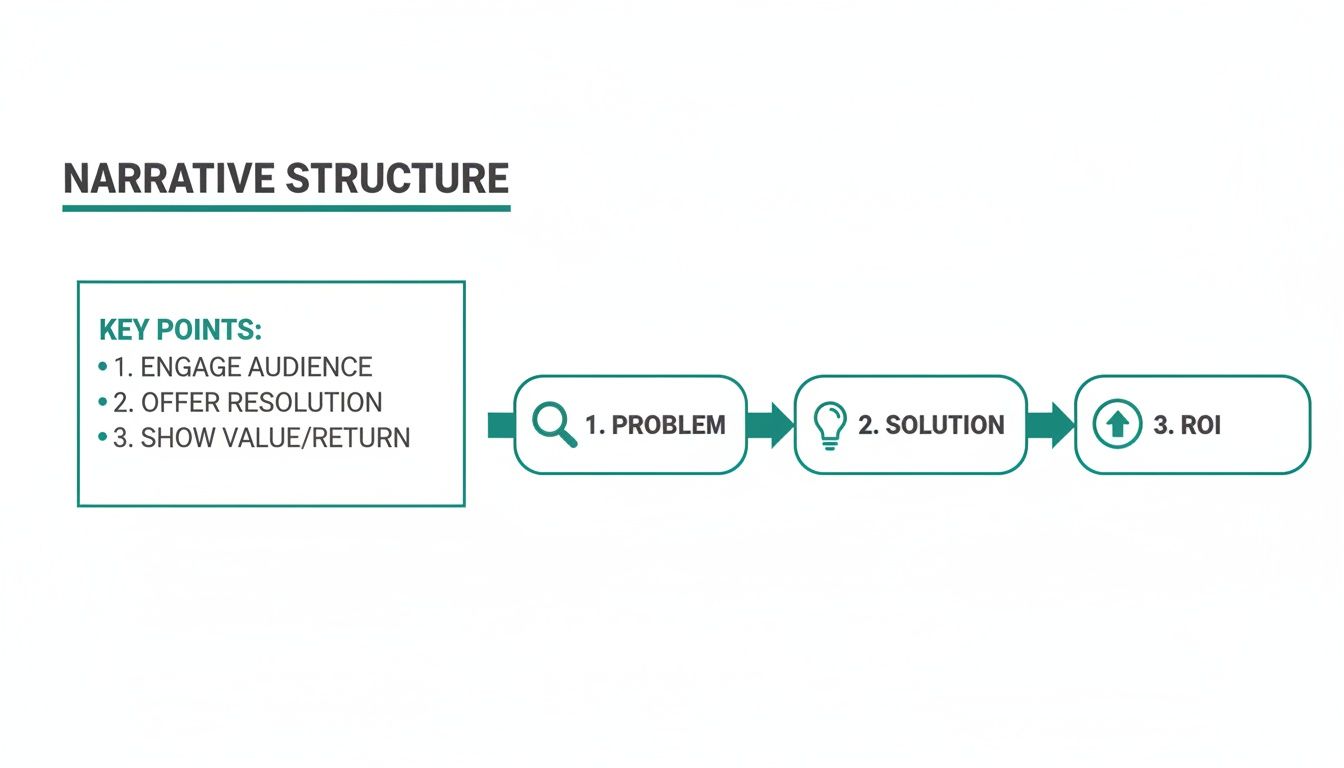
This structure reinforces the natural flow of a persuasive argument: identify a painful problem, present your elegant solution, and prove the tangible return.
Slides are a visual medium, yet most are just documents in disguise. Your audience can read a document on their own time. Your role is to provide context, emphasis, and authority that a document cannot.
This requires prioritizing visuals over text.
The difference is significant. Presentations with strong visual support can increase audience retention by up to 65%. In a sales context, visually-driven pitches close up to 20% more deals, proving the commercial value of clear design. For more data points, see these B2B SaaS benchmarks from adamfard.com.
Stop writing slides. Start designing them. Treat each one like a billboard—it must land its message in three seconds. If a slide requires you to explain it, it has failed.
Shifting from a text-heavy to a visually-driven approach is a tactical change in how you build a deck. It’s moving from default habits to strategic design.
This table breaks down common mistakes and their corrections.
The best presentations use slides to create a clean, professional backdrop that supports the speaker. The deck should feel almost invisible, focusing all attention on the power of your argument.
For a structured starting point, our guide on building a winning sales deck template provides actionable frameworks.
A cluttered deck signals cluttered thinking. A clean, focused deck demonstrates command of your subject.
A brilliant narrative and a clean deck are worthless if the delivery fails. This is the moment most founders and GTM leaders undermine their own authority and lose the room.
Confidence in B2B SaaS isn't about being a slick performer. It's about earned authority. It's owning your narrative so completely that you demonstrate controlled, deliberate expertise.
Your presence—physical or vocal—is the final layer of your argument. A rushed, hesitant delivery signals a lack of conviction in your own solution.
The most powerful and underused tool in a presentation is the strategic pause. Most presenters are terrified of silence and rush to fill every second with words, overwhelming the audience with a firehose of information.
This is a tactical error.
A well-placed pause after a key claim achieves two critical things:
This has a measurable impact. A study of business pitches found that speakers using deliberate 4-6 second pauses after key points closed 30% more deals. The pauses boosted audience comprehension by 40%.
Your goal is to be understood, not just heard. Slow down. Punctuate your argument with silence.
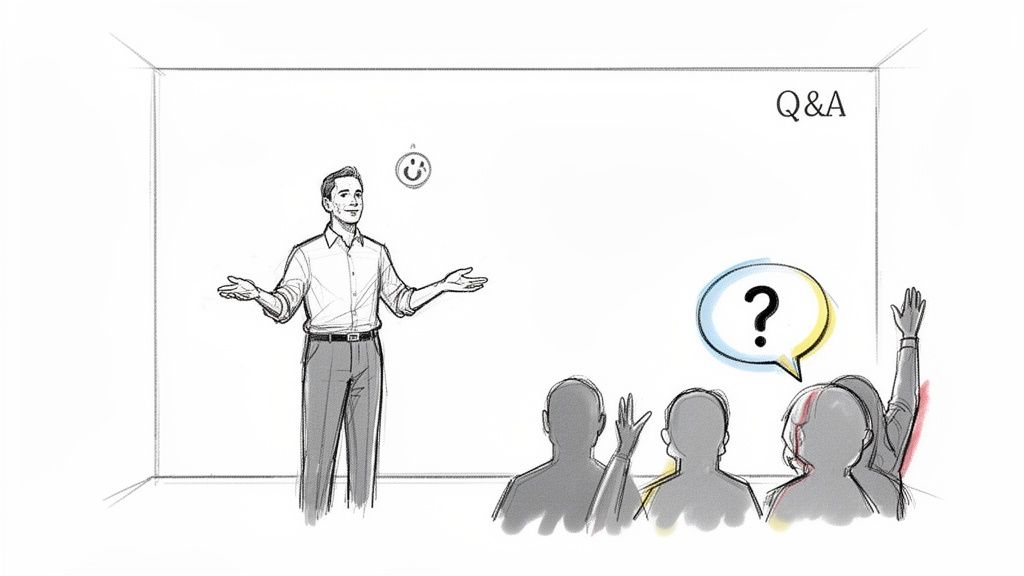
The Q&A session is where most presentations fall apart. Founders adopt a defensive crouch, treating every question as an attack to be parried. This is a strategic blunder.
Q&A is not an epilogue to your presentation; it is the final, most crucial act. It is your opportunity to prove you’ve thought more deeply about the problem than anyone else in the room.
Treat every question not as a challenge, but as a prompt to reinforce your core narrative. Use the A-R-C framework: Acknowledge, Reframe, Control.
This structure prevents you from getting dragged into tactical weeds. It allows you to use their skepticism as a springboard to restate your strategic advantage.
When a prospect asks about integration, it's an opportunity to talk about your open API philosophy. When an investor questions your TAM, it's a prompt to reiterate your focused GTM strategy.
Mastering Q&A is central to knowing how to give the best presentation. For format-specific guidance, see our guide on webinar marketing for B2B tech companies.
Don't just answer questions. Use them to dismantle objections and guide the conversation back to your solution as the inevitable choice.
The founder who "wings it" in a high-stakes meeting is committing strategic malpractice. The polish seen in world-class delivery is never natural talent. It's the result of a rigorous, systematic rehearsal process designed to forge an unbreakable presentation.
This isn’t about memorizing a script. It’s about pressure-testing your narrative until it cannot fail.
The most valuable practice comes from presenting to your sharpest, most cynical internal critics. The head of product who nitpicks every claim, the senior engineer who questions your technical framing, the finance lead who scrutinizes every ROI calculation—these people are your secret weapon.
Empower them to be ruthless. Don't ask for generic feedback. Give them a specific mandate to break your argument.
Ask them to focus on three areas:
This isn’t an ego exercise. It’s about finding all the cracks in your logic before your audience does. Harsh internal feedback is a gift.
Reading slides aloud in your office isn't practice. Real rehearsal means simulating the actual event.
If you're presenting over Zoom, run the entire thing on a video call. If it's an in-person pitch, stand up and deliver it as you would in the boardroom.
The point is to eliminate variables. Test your equipment. Time each section. This discipline builds muscle memory, freeing up your mental bandwidth during the actual presentation to read the room and guide the conversation.
Rehearsal isn't about achieving perfection. It's about achieving control. It’s about anticipating every question and having a crisp, confident answer locked and loaded, turning the unpredictable Q&A into a guided tour of your strongest points.
Feedback from these dry runs is your roadmap for iteration. This is where you refine not just what you say, but how you say it.
Did a key data point fail to land? The slide may need a stronger visual anchor. Did you stumble while explaining pricing? That section must be simplified and rehearsed until it feels effortless.
This is a core tenet of effective sales enablement. Teams that adopt this systematic rehearsal see a measurable lift in their ability to control the sales cycle. We discuss this further in our insights on sales enablement best practices.
The system is simple:
Repeat this cycle at least twice for any high-stakes presentation. By the time you walk into the critical meeting, you won’t be performing; you’ll be executing a well-honed plan.
Even with the best framework, founders and GTM leaders run into the same handful of questions when building a high-stakes presentation. Here are the most common ones I encounter.
Forget a magic number. The only rule is ruthless efficiency. The classic mistake is dumping your entire company's knowledge into one deck, thinking more data equals more persuasion. It doesn't.
For an initial sales pitch, aim for 10-15 slides. Design it for a 20-minute delivery that leaves ample room for discussion. For an investor pitch, you might extend to 15-20 slides, but the principle remains the same.
The goal of these early presentations isn't to close the deal on the spot. It's to earn the next meeting.
Your presentation is an asset engineered to create forward momentum. It must be long enough to build a compelling case for change and short enough to leave them wanting more. Anything else is a strategic failure.
Stick to the absolute essentials: the problem, your unique solution, traction, and the team. Save the deep-dive financials and technical schematics for the data room.
Leading with the product. It’s the most damaging and common error. Founders are proud of what they’ve built, but they assume the audience cares how it works before they’ve bought into why it matters.
Your audience isn't listening for a feature list. They are tuned into one station: WIIFM (What's In It For Me?). They are thinking about their own problems, KPIs, and internal politics.
Your first job is to enter that conversation. Articulate their problem with such painful clarity that they feel you've been in their meetings. Once you've established that deep level of understanding, then you can introduce your product as the only logical solution.
Starting with a demo or a feature list is arrogant and irrelevant. You haven't earned their attention.
The core narrative should not change. The delivery mechanics must adapt.
For virtual presentations:
For in-person meetings:
The medium changes, but the principles of building a clear, persuasive argument do not. Mastering the presentation means knowing how to apply these principles in any environment.
At Big Moves Marketing, we help B2B SaaS leaders build the strategic clarity and GTM assets required to win high-stakes meetings. If your presentation isn't creating the momentum you need, we should talk about re-engineering it for impact. Learn more at https://www.bigmoves.marketing.
Explore Big Moves Marketing services and resources:




%20-%20white.svg)