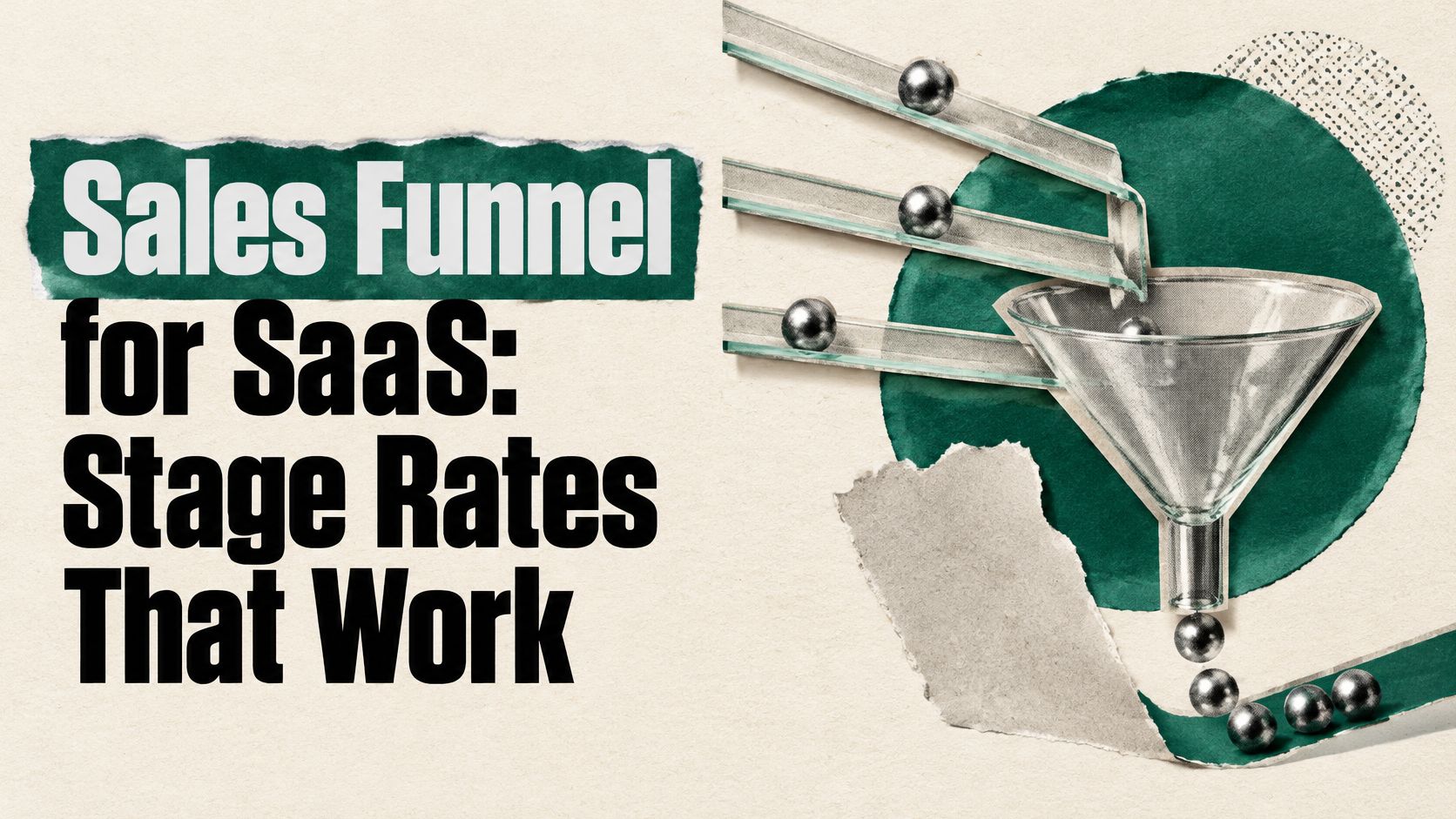
The most popular advice about building a sales funnel for SaaS starts with attracting more visitors. That's the wrong starting point. Before you buy attention, define what counts as buyer progress, who owns each transition, and when a seller should enter.
A funnel isn't a collection of campaigns. It's a set of cohort stage transitions, each with an accountable owner and a measurable rate, supported by an account-level rule for human intervention.
The awareness-to-close diagram is useful for a presentation. It's inadequate for running a revenue team.
A founder sees rising sessions. Marketing celebrates form fills. Sales asks for more demos. None of those events proves that an account has moved closer to a purchase, especially when a user, technical evaluator, security reviewer, finance lead, and executive need different answers.
McKinsey's analysis of B2B sales reported that buyers used approximately five distinct marketing and sales touchpoints during a buying experience five years before its newer analysis, compared with as many as ten more recently. Across more than 100 B2B sales organizations, it also described potential gains from coordinated commercial activity of up to 20% more customer leads, 10% growth in first-time customers, and as much as a 20% reduction in time from qualification to close.
Those findings don't justify adding channels indiscriminately. They justify coordinating the buyer's experience across them.
Say a technical champion starts a trial after finding a comparison page. They like the product, but their security team needs documentation and finance needs a credible business case. Another demonstration of the same features won't resolve either objection.
The broken assumption is that the next marketing or sales activity automatically produces the next buying decision.
The distinction becomes clearer when the buyer's actual path replaces the straight-line diagram.
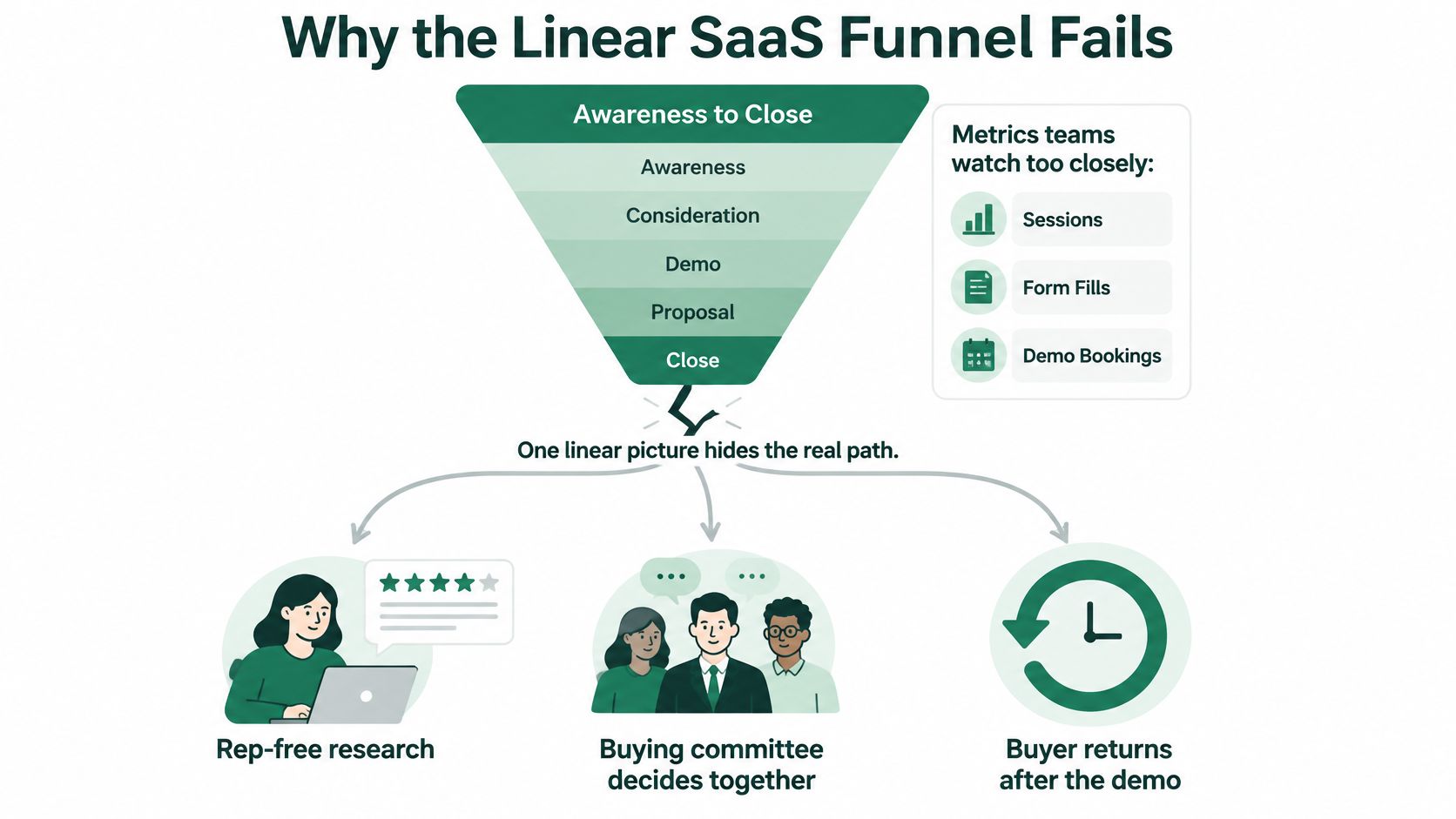
Traffic, a lead, and an opportunity are different events. A channel report can count them separately without revealing whether the handoffs work.
Connect search, your website, email, webinars, paid media, outreach, and customer proof through a shared account and contact history. That history should contain:
Keep product adoption visible after the contract, too. A signed agreement and a rollout-ready customer aren't the same outcome.
Retire the classic funnel as an operating system. Keep it as a sketch.
The practical replacement isn't a more elaborate drawing. It's a report that shows which buyers advanced, what evidence justified the move, and where the next decision stalled.
Start with the buying motion, not your preferred channel. A signup-driven product and a procurement-heavy enterprise sale require different evidence of progress, even when they share a codebase.
Use this sequence to establish the operating model before expanding acquisition.
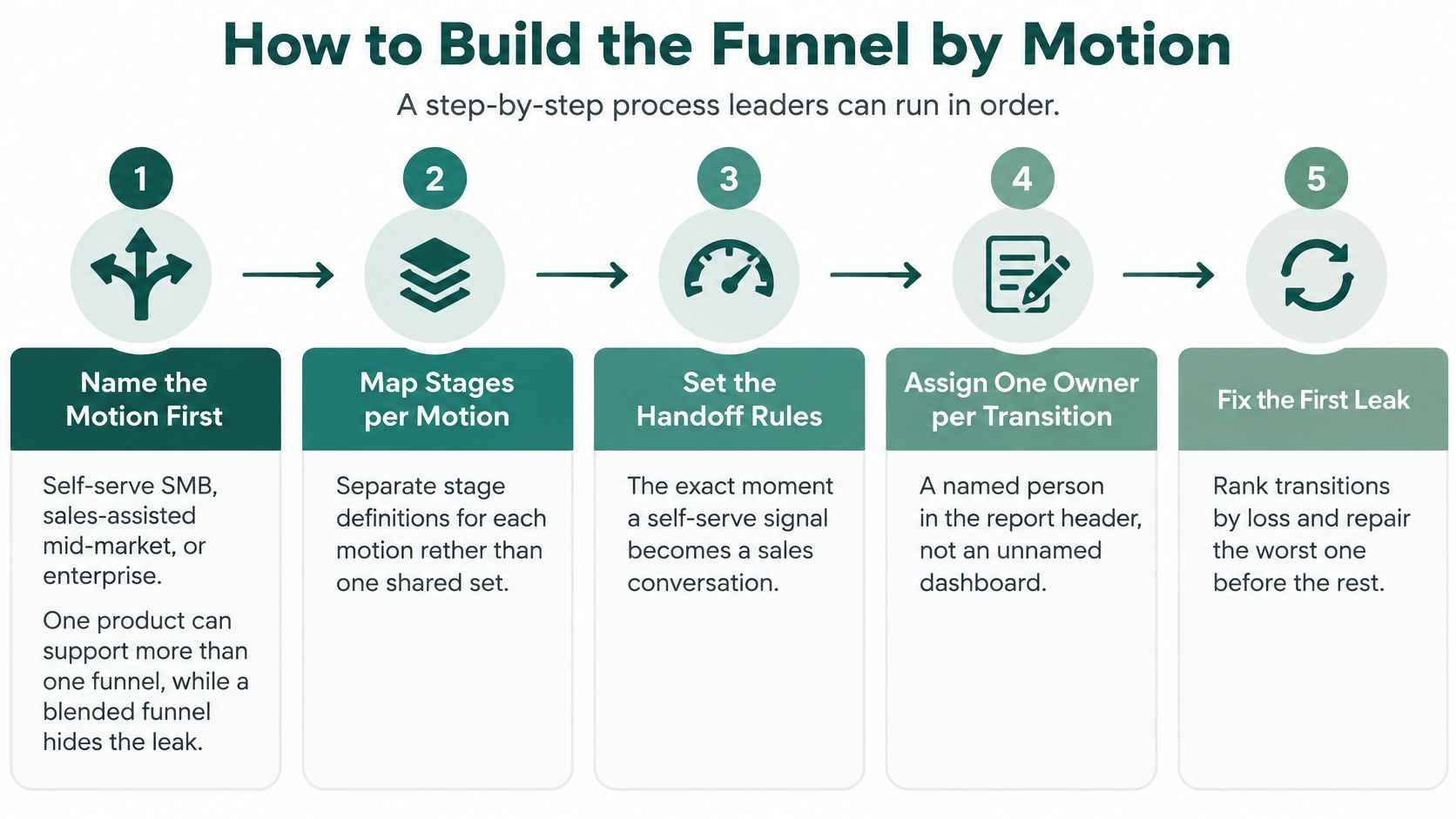
Name the motion first. Choose self-serve SMB, sales-assisted mid-market, or enterprise for the funnel you're designing. A product can support multiple motions, but blending them makes a healthy self-serve path capable of hiding a failing enterprise process.
Write the buyer's job at each stage. Use language such as problem recognized, shortlisted, technically credible, business case accepted, procured, and ready to roll out. CRM labels describe your records. Buyer jobs explain what must change for someone to commit.
Attach a message and proof asset to each job. Technical evaluators need architecture and implementation detail. Security needs risk evidence, finance needs defensible payback assumptions, and executives need a strategic outcome. Name the blocking role before commissioning another case study.
Define a conversion point and an observable exit rule. A new hire should be able to apply the rule without asking what the account executive meant. “Interested” fails that test. “Technical evaluator accepted the integration approach” is evidence someone can inspect.
Choose acquisition after defining progression. Content and search can address problem and category demand. Restrict paid search to relevant queries with matching pages, use LinkedIn against a defined account list, and offer a product-led route where buyers can experience value without substantial assistance. Don't choose channels because the team already knows how to run them.
Write the sales handoff checkpoint. Document the evidence that authorizes seller involvement and the receiving role. Don't leave routing to an automation default or an informal agreement between department heads.
Build the cohort report before scaling spend. Confirm that records retain their source, stage history, and outcome. Otherwise, an acquisition pilot can generate activity without teaching you which transition deserves investment.
These are go-to-market decisions, not CRM administration. Your B2B SaaS go-to-market strategy should explain why the chosen customer, buying motion, message, and route to market belong together.
Use the following video as a discussion prompt when aligning the team on funnel design.
Finish with a one-page operating sheet containing the ICP, stage dictionary, message-to-stage map, source IDs, and priority transition.
Keep the complexity proportional to the sale. A founder validating demand shouldn't inherit an enterprise approval taxonomy. An enterprise team shouldn't treat a product signup as sufficient evidence that a buying group is ready.
Stage conversion equals records that advance from a stage divided by records that entered that stage in the same cohort, measured through a stated observation window. It doesn't equal this month's opportunities divided by this month's leads.
That distinction prevents you from crediting new acquisition for opportunities generated by older cohorts. It also prevents an immature cohort from looking like a failed one because buyers haven't had time to progress.
The following cohort stage priors for a B2B SaaS funnel come from Strategnik's B2B GTM benchmark, including its enterprise ranges for a $100K-plus ACV motion and its reported about 2–3% lead-to-close reference.
| Transition | Typical B2B prior | Enterprise motion | What a weak rate usually means |
|---|---|---|---|
| Visitor to lead | 1.5–2.5% | 0.8–1.5% | Traffic quality or offer mismatch |
| Lead to MQL | 25–35% | Set from motion-specific qualified cohorts | Stage definition too loose or too tight |
| MQL to SQL | 15–21% | 10–18% | Scoring, fit, or slow follow-up |
| SQL to opportunity | 40–60% | Set from motion-specific discovery cohorts | Discovery quality or missing stakeholders |
| Opportunity to close | 15–25% | 15–22% | Business case, procurement, or fit |
| Lead to close | About 2–3% | Lower than the typical motion | Blended figure; don't manage to it |
These are priors, not targets or a mathematically consistent benchmark cohort. The listed sequential ranges don't reconcile with the separate lead-to-close reference. Don't multiply independent benchmark ranges and present the result as a validated forecast.
Use your own linked cohort rates for that purpose. Treat the lead-to-close reference as a prompt to inspect definitions, not a number the team must achieve.
Require these CRM controls before trusting a rate:
Segment by sales motion, ACV, channel, and geography before comparing teams. Review mature cohorts monthly and use a trailing four-quarter view to distinguish persistent problems from short-term movement.
The forecast is:
Traffic × visitor-to-lead × lead-to-MQL × MQL-to-SQL × SQL-to-opportunity × opportunity-to-close × average contract value.
For a sensitivity case, replace only the weakest transition with a defensible improvement assumption from your own cohort history. Hold the remaining inputs constant. The difference in forecast revenue shows the potential value of that repair without pretending every stage improves simultaneously.
Outbound Consulting's business development KPIs for pipeline provides a useful companion reference when specifying the operating metrics around this model. Keep those definitions consistent with your pipeline coverage ratio, so pipeline quantity doesn't obscure opportunity quality.
Prioritize revenue-weighted leakage, not the lowest percentage. A weak transition matters because of the revenue you can realistically recover, not because it looks alarming in red.
Judge a channel by opportunities, wins, sales-cycle length, and customer acquisition cost. Cost per lead is a purchasing metric, not a growth strategy.
A cheap contact who never qualifies consumes budget and sales capacity. An expensive contact can still be commercially attractive when the account fits, progresses, and closes.
The B2B SaaS channel conversion past the lead comparison below uses the reported channel benchmarks in SERPsculpt's B2B sales conversion analysis.
| Channel | Visitor to lead | MQL to SQL | Use it when |
|---|---|---|---|
| SEO | 2.1% | 51% | Buyers already name the problem or category |
| 2.2% | 30% | The account list is finite and search won't reach the buyer | |
| 1.3% | 46% | The person has already raised a hand | |
| Webinars | 0.9% | 39% | You need depth with a known audience, not net-new volume |
| Paid search | 0.7% | 26% | A short list of high-intent queries has a matching page |
The paid-search trap is straightforward. A campaign can look productive on form fills while supplying weak sales-ready demand. Increasing bids doesn't fix a query that attracts the wrong buyer or an offer that invites low-commitment responses.
These benchmarks aren't a universal channel ranking. They're a reason to inspect what happens after capture rather than treating all leads as equivalent inventory.
SEO and comparison pages should help buyers evaluate a problem they can already describe. Don't confuse broad informational reach with category demand. A page that attracts practitioners outside your ICP may earn visits without creating a plausible purchase.
Paid search requires a tight relationship between query, promise, landing page, and next action. LinkedIn serves a different purpose: reaching the right people within named accounts when waiting for search demand would leave those accounts untouched.
Email should continue an expressed interest rather than restart a generic pitch. Webinars should resolve a substantive evaluation question for a known audience. A product-led signup belongs where buyers can test value directly and a compulsory demo would obstruct that evaluation.
Don't ask which channel produces the most leads. Ask which audience-offer combination produces buyers who advance.
If lead volumes are comparable, favor the stronger sales-qualification path until the weaker path has a specific repair hypothesis. Then verify the decision against contract value, wins, and acquisition cost. A qualification advantage alone doesn't settle the economics.
For referral-channel planning, directoryeasy.com's resource to compare top referral payouts for 2026 can inform incentive research. Don't select a referral model on payout attractiveness alone; define the eligible customer, qualification event, and acquisition-cost ceiling first.
Your B2B demand generation strategy should distinguish demand capture from account development. Before declaring a test winner, hold audience, channel conditions, attribution rules, and observation period consistent. Otherwise, you're comparing different buying situations and calling the difference marketing performance.
Keep general education self-serve. Bring a seller in when the buyer needs contextual judgment, coordination, or commercial help.
Gartner's buyer research found that 61% of B2B buyers prefer a rep-free buying experience, while buyers prefer seller input for contextual tasks such as determining whether a product fits their company. The distinction matters more than an argument about whether product-led or sales-led growth is superior.
Category education, comparison pages, pricing clarity, technical documentation, and trial or sandbox access shouldn't require a conversation merely because sales wants another meeting.
Security documentation should also remain accessible where disclosure requirements permit. Reading a security page signals a question, not automatic permission for persistent outreach.
Use the buyer's task to decide whether assistance will remove friction or introduce it.
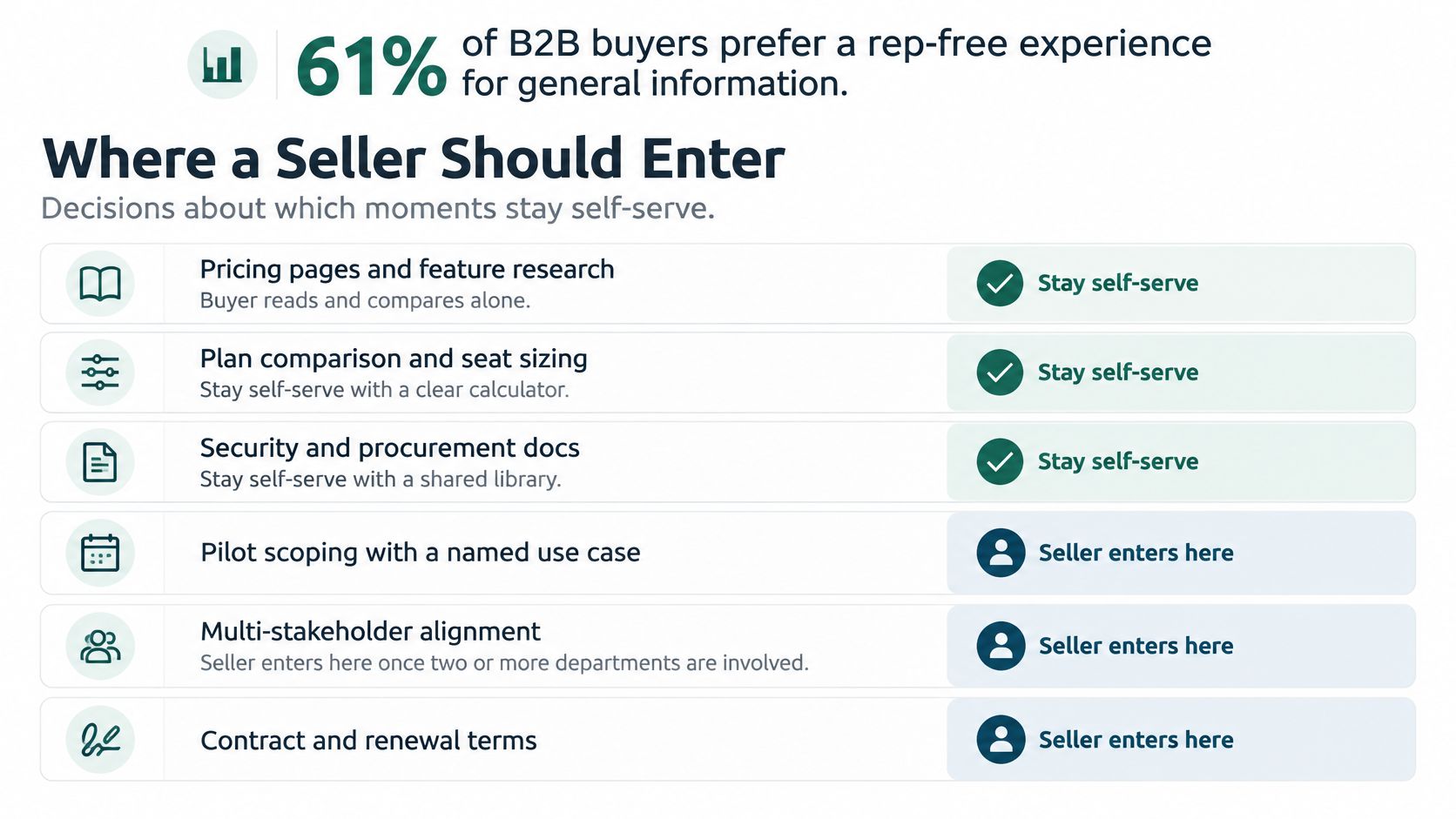
Build the handoff around a combination of fit, contextual intent, and unresolved complexity. Useful signals include repeated product use, teammate invitations, relevant feature adoption, pricing-page returns, and engagement across different roles in the account.
Apply the rule differently by motion:
A single content download doesn't satisfy that rule. Nor does an isolated architecture-page visit. The seller needs enough context to explain why a conversation would help this account now.
Say an engineering lead repeatedly uses the product and invites colleagues. A security stakeholder then examines deployment documentation while a department head returns to pricing. The useful outreach offers to resolve deployment and approval questions, not to deliver the introductory feature tour everyone has already outgrown.
Treat the original lead as a contact inside an account. Don't assume that person controls budget or can secure every internal approval.
Record the economic buyer, technical evaluator, security reviewer, and procurement contact when relevant. Missing coverage of a blocking role is a more actionable signal than another anonymous content interaction.
Your B2B lead qualification approach should preserve that distinction. Sales is an escalation layer for complexity, risk, procurement, integration, and expansion, not the mandatory next step after curiosity.
Apply these operating rules before authorizing another acquisition increase:
| Symptom | First diagnosis | Accountable owner | Wrong response |
|---|---|---|---|
| Heavy traffic, flat leads | Page promise or ICP mismatch | Marketing lead | Buy more reach |
| Healthy leads, weak MQL-to-SQL | Scoring or follow-up failure | Named sales owner, supported by revenue operations | Lower qualification standards |
| Strong SQLs, few opportunities | Discovery gaps or missing stakeholders | Sales leader | Push premature opportunities |
| Late-stage stalls | Business case or procurement proof | Account executive, supported by marketing | Repeat the feature demo |
Collaboration doesn't require shared accountability. Revenue operations can investigate routing and marketing can supply proof, while a named person remains responsible for the transition.
Use the funnel view to locate the repair, then inspect the underlying records.
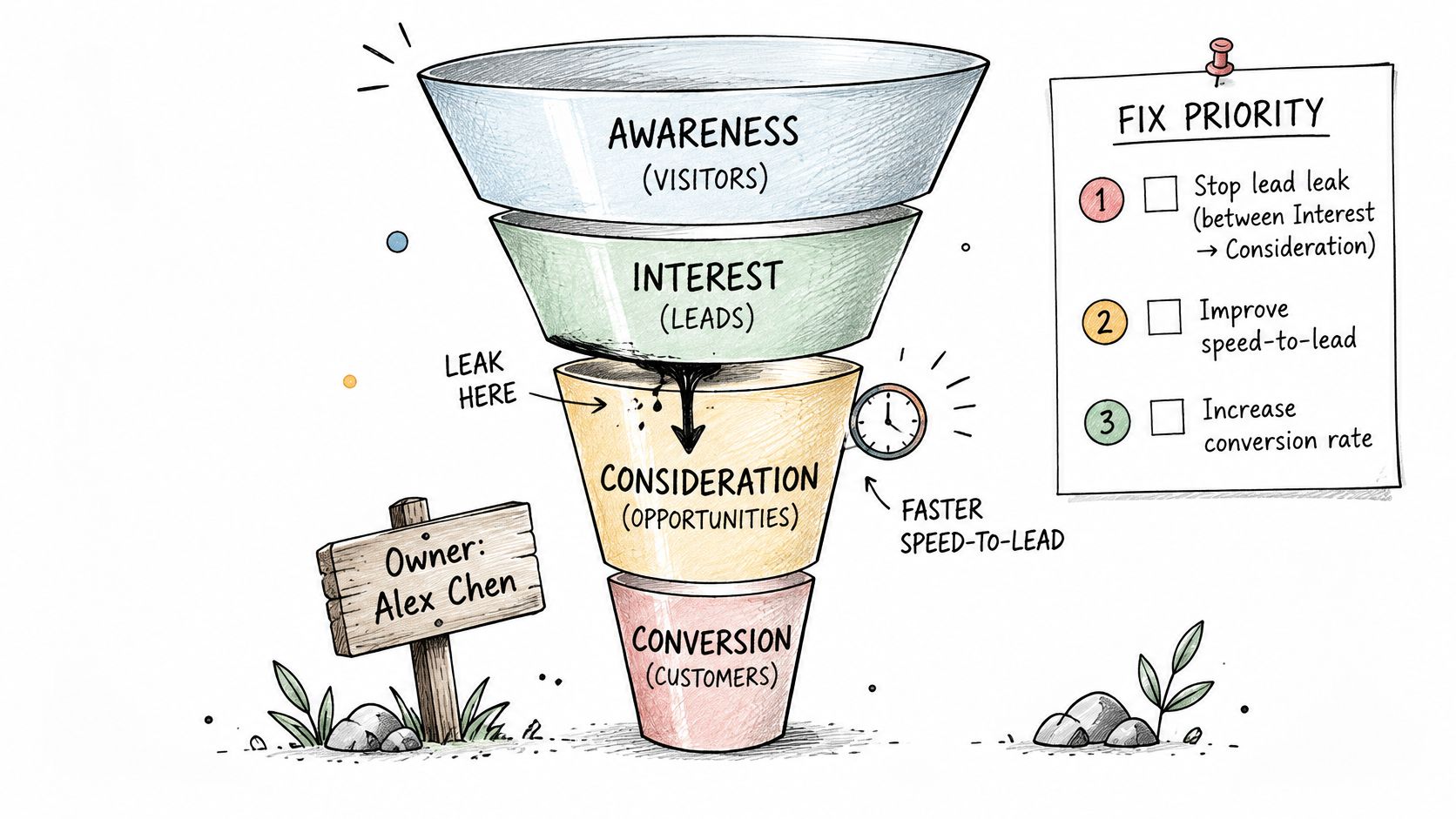
A handoff SLA can be changed within a week. A revised stage definition needs a full cohort observation window before you trust the comparison. Don't declare success because a stricter definition makes the next-stage percentage look better.
Use sales conversion improvement as a diagnostic discipline: inspect lost records, test the proposed cause, and specify the downstream evidence that would confirm a repair.
At Big Moves Marketing, our founder brings 17 years of experience in product marketing, demand generation, and sales operations for 75+ B2B startups and enterprises. Our process starts with a free consultation call to understand the client's growth stage and aspirations; demand generation pilots can then test lead generation and customer acquisition as part of go-to-market execution.
That sequence matters. A low percentage in a small stage can deserve less attention than a modest conversion miss among high-value accounts.
Don't buy more reach before you have a stage dictionary, trustworthy cohort math, and a written handoff rule. Repair the transition with the greatest recoverable revenue, and reject incremental spend that doesn't support that priority this quarter.
Leave the planning meeting with CRM-ready definitions, not another funnel slide. Use this checklist to make the model operational.
Use these as transition records. The entry and exit columns describe the work being measured, not interchangeable definitions of a stage label.
| Stage | Entry rule | Exit rule | Owner | Required CRM field |
|---|---|---|---|---|
| Visitor to lead | Form, signup or trial start with source ID | Contact captured and tagged to campaign | Marketing | Source and campaign ID |
| Lead to MQL | Fit score plus an intent signal | Scoring threshold met | Marketing | Score version and timestamp |
| MQL to SQL | Sales accepts within the SLA | Discovery call logged with qualification notes | Sales development | Disqualification reason code |
| SQL to opportunity | Pain confirmed and budget owner named | Opportunity created with stakeholder map | Account executive | Opportunity created timestamp |
| Opportunity to close | Business case accepted | Closed-won or closed-lost | Account executive | Close reason code |
Add entry timestamps to every transition and retain the history when records move backward or reopen. Distinguish pending records from disqualified ones so unfinished evaluations don't become artificial losses.
The finished model should let a leader answer a practical question without interpretation: Which transition will we repair, who owns it, and what evidence will justify further investment?
Big Moves Marketing helps B2B SaaS founders connect positioning, go-to-market choices, and demand generation to measurable pipeline progression. Visit Big Moves Marketing to arrange a free consultation, bring your current stage report, and identify the transition that deserves attention before you increase acquisition spend.