%20png%20copy.avif)
Your sales conversion rate is falling. The default response is to scrutinize the sales team: more training, new scripts, a different CRM configuration. This is almost always a waste of time and capital.
I've observed this pattern across dozens of SaaS companies. Founders and revenue leaders treat the symptom—lost deals—while the disease runs rampant. They hire more AEs and push for more demos, only to see conversion rates stagnate. It's a fast path to burning cash and morale.
The hard truth is this: a low sales conversion rate is rarely a tactical failure. It's a strategic one. It’s a flashing red light signaling a fundamental disconnect between your product, your ideal customer, and your entire go-to-market motion.
Before a deal reaches the proposal stage, it's often sabotaged by decisions made months earlier in the strategy room. A lagging conversion rate is a direct reflection of your company's alignment—or lack thereof—across product, messaging, and market fit.
To fix it, you must stop blaming sales execution and start diagnosing the root causes of friction in your go-to-market. This requires a rigorous, unfiltered look at your strategy and a recognition that even the best conversion rate optimization best practices cannot fix a broken foundation.
Working with early and growth-stage SaaS companies, I’ve seen the same strategic flaws torpedo revenue potential time and again. The issues are rarely about a lack of sales effort. They're about a lack of strategic clarity.
Three silent killers are responsible for the vast majority of these revenue leaks:
The most common failure mode for B2B SaaS isn't building the wrong product. It's building the right product for a market you don't truly understand. Your conversion rate is the ultimate measure of that understanding.
Improving sales conversion isn't about finding a new closing script. It's a diagnostic process—tracing revenue leaks back to their source. Founders and leaders must stop asking, "How can we sell more?" and start asking the harder question: "Why aren't they buying?"
Answering that question honestly forces an examination of your core B2B SaaS go-to-market strategy. It reframes the problem, demanding strategic clarity first—the only sustainable path to higher conversion.
To improve your sales conversion rate, you must get brutally honest about your entire go-to-market motion. This isn't about A/B testing button colors. It is a first-principles look at where prospects lose momentum and, more importantly, why.
Most founders are flying blind, obsessed with lagging indicators in their CRM while the real damage happens in the qualitative gaps between funnel stages. To understand what’s happening, you must move past simple metrics and uncover the story behind customer confusion, indifference, or a fundamental misalignment with your solution.
Before tearing your funnel apart, establish a realistic baseline. Chasing an arbitrary conversion rate you saw on Twitter is a surefire way to make strategic errors. B2B SaaS operates on a different rhythm than B2C.
The gap is massive. B2B SaaS companies consistently outperform B2C counterparts at nearly every stage. The most dramatic difference is MQL-to-SQL conversion, where B2B hits an impressive 63.33% compared to a meager 1-10% for B2C.
For an established B2B SaaS, a healthy median conversion rate is around 7%. For an early-stage startup, the target should be at least 5%. The trial-to-paid stage tells a similar story: B2B converts 30-60% of trial users, while B2C is lucky to get 1%.
These numbers are a reality check. They provide context to set achievable goals. A "low" rate might not be a failure in a market with long sales cycles and massive deal values. The goal is steady progress against a sane benchmark, not chasing a vanity metric.
Your most valuable data isn't in a dashboard. It's hiding in the conversations your sales team has every day. You need a system to capture and interpret these qualitative signals.
Most conversion problems are symptoms of a wobbly strategic foundation.
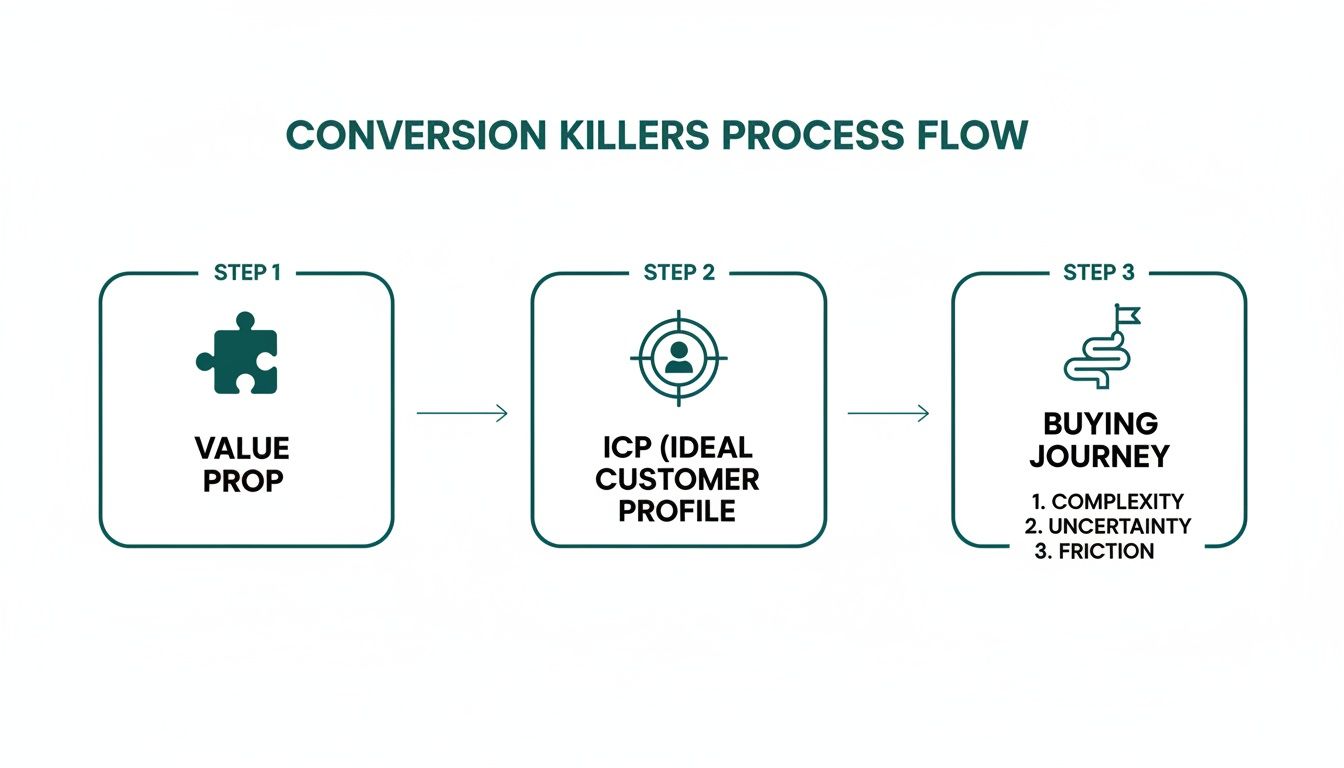
This process reveals that conversion issues are rarely tactical missteps. They are downstream effects of a broken value proposition, a fuzzy ICP, or a buying journey filled with friction. To uncover these root causes, founders must act as detectives.
This checklist is designed to pinpoint the real friction points across your funnel. It moves beyond the quantitative "what" to uncover the qualitative "why."
This checklist isn't about finding blame; it's about identifying systemic cracks in your GTM strategy. Use these questions to guide conversations with your marketing, sales, and product teams to get a full picture of the customer journey.
Let's examine the three most common friction zones.
A healthy funnel isn't just about the percentage of deals that close. It's about the velocity and confidence with which deals move between stages. Friction is the enemy of momentum.
This framework forces an uncomfortable but essential shift in focus. It moves the conversation away from individual sales performance and puts the spotlight squarely on the integrity of your GTM strategy. Fixing your conversion rate starts by admitting the problem is almost always upstream—in your positioning, messaging, and ICP definition. Fix those, and the funnel will begin to fix itself.
No sales tactic or last-minute discount can save you from weak positioning. It’s the silent killer of sales funnels.
If your ideal customer looks at your solution and doesn't immediately understand why it’s the answer to their expensive, high-priority problem, the deal is dead before it begins. This isn't just a marketing issue; it's a fundamental business problem that will tank your conversion rates.
Most B2B SaaS founders are justifiably proud of their product's features. The mistake is assuming buyers care about those features. They don’t. Buyers care about outcomes. Your positioning is the bridge between what your product does and the tangible business results a buyer can take to their CFO.
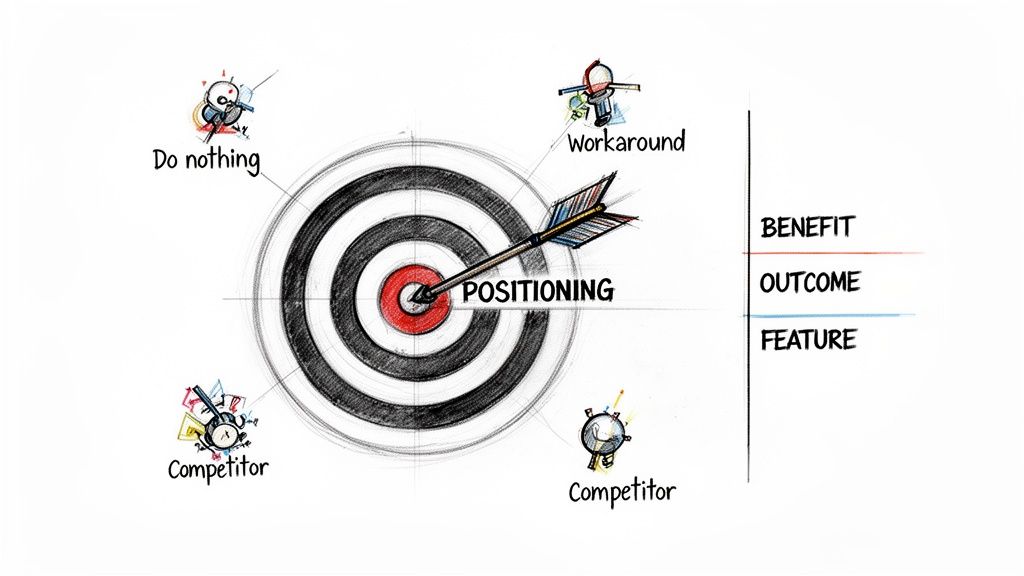
To win more deals, you must win the argument happening inside the buyer's head. That argument is rarely against the competitor listed in your CRM. Your real competition is far more dangerous because it's invisible.
Every buyer is weighing your proposal against three powerful alternatives:
A chronically low conversion rate is a screaming signal that you are consistently losing to "doing nothing." Your value proposition has failed to create urgency, branding your solution as a 'nice-to-have' that can always be pushed to the next quarter.
This forces a critical shift in how you approach messaging. You aren't just selling your product; you're selling a change in behavior. Our guide on how to write a positioning statement can help you build messaging that connects with this core need.
Economic buyers—the people signing checks—do not buy features. They buy financial outcomes. Deals are lost when your sales team gets stuck explaining what the software does instead of articulating the business impact it delivers.
To fix this, you need a clear messaging hierarchy that translates dense product capabilities into sharp, outcome-focused language that resonates with leadership.
The Feature-to-Outcome Translation Framework
This isn't a copywriting exercise; it's a strategic discipline. Every feature must be translated up this ladder. When your sales team leads with the outcome, they immediately elevate the conversation from a technical discussion to a strategic one.
Your sales team needs more than a slide deck. They need intellectual ammunition. They should be the smartest people in the room about the problem they solve, not just the product they sell. This is where tools like competitive battlecards and messaging frameworks become mission-critical.
A useful battlecard does more than list competitor features. It arms your reps to reframe the entire conversation in your favor.
Sharpening your positioning is the single highest-leverage activity you can undertake to fix your sales conversion rate. It aligns your product, marketing, and sales teams around a single, compelling story. When your ideal customer sees your solution as the only credible way to solve their most pressing problem, conversion becomes the natural conclusion.
Your sales deck is not a product manual. It's an instrument of persuasion. Yet, I see the same mistake repeatedly: feature-packed documents that talk at the buyer, not with them.
Most decks are built from an internal perspective. They catalogue features and completely fail to guide a prospect through a decision. This is a massive, often invisible, driver of stalled deals.
When an AE sends a deck and the prospect goes dark, the problem isn't the follow-up cadence. The problem is that the asset failed its one job: to make a compelling, coherent argument for change. Improving your sales conversion rate means you must stop creating product tours and start architecting persuasive narratives.
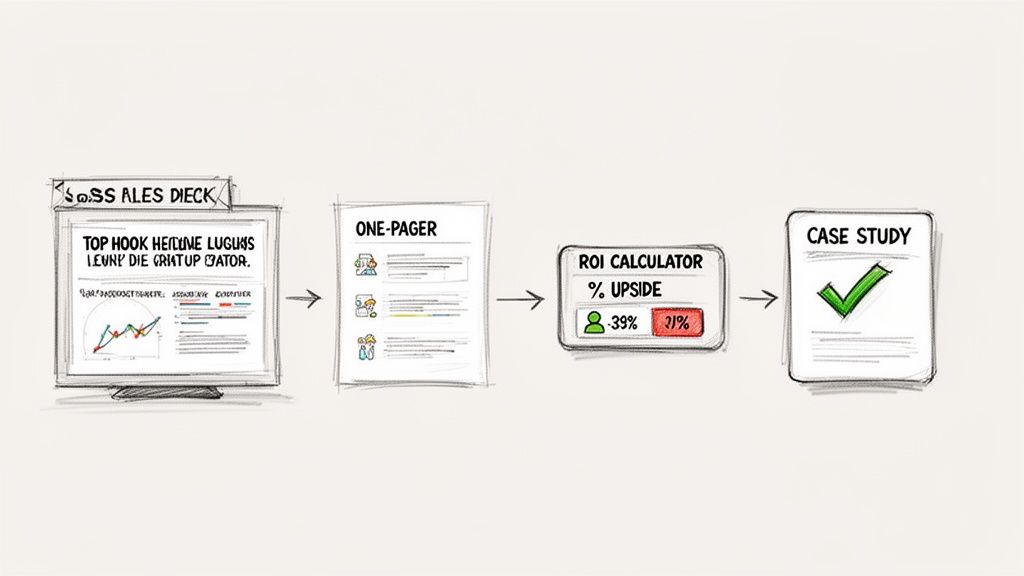
A high-conversion sales narrative doesn't sell features; it sells a new way of thinking. It reframes the prospect's problem, introduces a better path forward, and then—only then—positions your solution as the only credible vehicle to get them there.
The standard, low-impact structure—About Us, The Problem, Our Solution, Features, Pricing—is a recipe for a slow "no." It forces the buyer to connect the dots between your features and their business outcomes. That’s work they are unwilling to do.
A conversation-focused deck does the heavy lifting for them. It puts their journey ahead of your product's functions, building relevance and credibility with every slide.
To build assets your sales team will actually use—because they work—you must deconstruct your current pitch and rebuild it around buyer psychology.
Most sales decks are designed to inform. High-conversion decks are designed to persuade. The difference is whether you force the buyer to find the value or you deliver the value proposition to them, fully formed.
This structure transforms your sales assets from passive documents into active selling tools. It allows your sales team to guide the conversation, preempt objections, and build a logical, defensible case for choosing you.
These principles apply to every piece of sales collateral you create.
A one-pager isn't a condensed feature list; it's a concise argument for your unique value. An ROI calculator isn't just a spreadsheet; it’s a tool that helps your champion build their internal business case for you.
To make this clear, compare the standard, product-focused approach with a high-conversion, buyer-centric narrative. The difference is stark.
The takeaway is simple: rethink your sales assets as structured arguments, not information packets. When your materials do the heavy lifting of persuasion, your sales team can focus on what they do best: building relationships and closing deals. This is a non-negotiable step to sustainably improve your sales conversion rate.
You can nail your positioning, run a flawless sales process, and have the best product, only to watch the deal fall apart at pricing. Treating pricing as a simple financial calculation is a strategic blunder.
Pricing isn't just a number on a proposal. It is the commercial expression of your value proposition. If it’s confusing, complicated, or out of sync with the value your customer perceives, you’re creating massive friction that will kill your conversion rate.
The most common pricing mistake is offering too many options. Founders, fearing they'll leave money on the table, create complex menus of tiers, add-ons, and usage models. This doesn't empower the buyer—it paralyzes them.
Decision fatigue is real. When a buyer is confused, they don't try harder to understand; they walk away. Your pricing page should never be a puzzle. It needs to be a clear on-ramp that guides your ideal customer to the right solution.
Pricing should make the buying decision easier, not harder. If a prospect needs a 30-minute call just to understand which plan they need, your packaging has failed.
Present three, maybe four, clearly defined tiers that tell a story. Each tier should map to a specific stage of customer maturity, making the choice feel obvious. The upgrade path between them should feel logical and aspirational, not punitive.
The second fatal flaw is anchoring your price to a metric that has nothing to do with the value your customer receives. Charging per seat for a tool that delivers its main value through automation for a small team is a perfect example of misalignment. The customer sees costs rising without a corresponding increase in perceived value.
A strong value metric scales alongside your customer’s success. As they use your product more and get more value, their business grows, and they are happy to pay you more. It’s a partnership.
Examples in action:
This alignment changes the conversation from negotiation to partnership. When you win, they win. That’s a powerful foundation for closing deals and retaining customers. To dive deeper, check our complete guide on how to price software products.
For larger, more strategic accounts, sticker price isn't the only obstacle. The perceived risk of messy implementation, change management, and unproven ROI can be even bigger deal-killers. A standard 14-day trial is rarely enough to overcome that level of organizational inertia.
This is where a structured, paid pilot or proof-of-concept (POC) becomes your most powerful conversion tool. This isn't a free trial; it’s a limited, focused engagement designed to prove a specific business outcome.
A successful pilot has a few key ingredients:
A correctly structured pilot completely de-risks the purchase for the customer and qualifies their intent for you. The conversion rate from a successful paid pilot to a full annual contract is incredibly high because you’ve already proven your value in their environment.
Theory is useful, but growth happens when you address the specific, difficult questions that arise daily. The founders and GTM leaders I work with understand the concepts. They get stuck on the real-world trade-offs needed to move the needle.
Here are the most common conversion questions I get, with the direct answers learned from years in the trenches.
Obsessing over benchmarks is a dangerous distraction. If you need a number, a realistic lead-to-customer conversion rate for an early-stage B2B SaaS company is in the 1-3% range. If you're consistently above 5%, you are performing exceptionally well.
However, the absolute number is far less important than your trend line and the conversion rates between stages.
For example, a sky-high MQL-to-SQL rate that falls off a cliff from SQL-to-Close points to a problem with your value proposition or sales process, not your lead quality. Don't chase an arbitrary external benchmark. Find your biggest leak and fix it first.
Do not react to weekly blips. Tearing up your sales process because of one bad week creates chaos and destroys team morale. You need to see a pattern, not random noise.
So, how much data is enough? You must observe at least one full sales cycle for a meaningful cohort of leads.
If your average sales cycle is 60 days, review performance quarterly, not weekly. The time to intervene is when you spot a consistent, repeatable drop-off at the same stage, quarter after quarter. That signals a systemic problem that requires a strategic fix, not a panicked, tactical tweak.
This is a non-negotiable principle for efficient growth: always start at the bottom of the funnel and work your way up.
Think about it: improving your demo-to-close rate from 20% to 25% has a much bigger and more immediate impact on revenue than doubling lead volume. It’s pure math.
Fixing leaks closest to revenue proves that your core value proposition and sales motion are sound. Once you have healthy, predictable close rates, you can pour fuel on the top of the funnel with confidence, knowing you’ve built a machine that can turn that demand into revenue. Pouring leads into a leaky funnel is the fastest way to burn cash.
When a prospect says 'it's too expensive,' they are really saying 'I don't believe the value of this solution is greater than its cost.' Price is almost never the real issue. It’s a value problem disguised as a budget problem.
Resist this impulse. "Losing on price" is almost always a symptom of a failed value conversation, not a true pricing problem. It’s the easiest excuse that masks a deeper issue in your positioning, messaging, or sales process.
Before you touch your pricing, dissect your GTM motion.
Are your reps consistently selling to the economic buyer who controls the budget? Is your ROI case crystal clear, specific, and believable? Are your salespeople equipped to defend your value against the alternative of doing nothing? Lowering your price is a short-term move that erodes long-term value and signals a lack of confidence. Fix the value conversation first.
At Big Moves Marketing, we help B2B SaaS founders build the strategic clarity needed to drive sustainable growth. If you’re ready to move beyond tactical fixes and solve your conversion problem at its source, we should talk. Learn more about our approach.
Explore Big Moves Marketing services and resources:
June 26, 2026



%20-%20white.svg)