%20png%20copy.avif)

Welcome, founders. You’ve poured countless hours into building a B2B SaaS product that actually solves a real problem. Now comes the hard part: turning that brilliant piece of software into a thriving business. This is where your go-to-market strategy isn't just a document—it's the bridge between your product and your very first paying business customers.
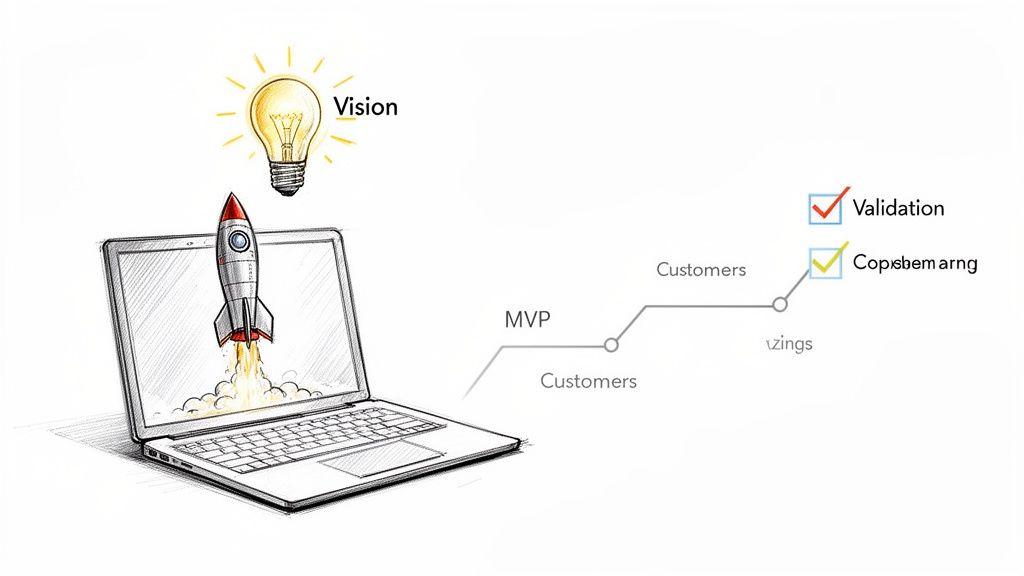
After steering over 70 SaaS startups through the chaos of launching, I’ve seen one thing play out time and again: a brilliant product with a weak GTM plan will stall, while a solid product with a killer GTM strategy can absolutely dominate.
A great plan does more than just list out marketing tactics; it gets your entire company marching in the same direction, focused on a single, clear objective.
This guide is my personal playbook, forged in the trenches of those launches. We're skipping the abstract theories and diving straight into the actionable steps that build momentum, lock in those crucial early wins, and set you up for real, sustainable growth.
Let's be blunt. In the B2B SaaS world, having a slightly better product is no longer a guarantee of success. Your business buyers are smarter and have more options than ever before. A deliberate GTM strategy is what helps you:
Your GTM strategy is the operational translation of your company’s core purpose. It connects your product’s potential to the market’s reality, ensuring your vision doesn’t just stay on a whiteboard but makes a real impact.
Think of this playbook as your roadmap for the journey from MVP to market leader. It all starts by grounding your efforts in a clear purpose, vision, and mission—the growth accelerants for B2B startups—so that every move you make is intentional and effective. This is your first step toward building not just a product, but a business that lasts.
Before you even think about spending a dollar on marketing, you need rock-solid clarity on two things: who you're selling to and why on earth they should care. This isn't just some preliminary box-checking exercise; it's the unshakeable foundation of your entire go to market strategy for B2B SaaS. Get this wrong, and every single thing you do next will be a struggle.
Your first mission is to go way beyond generic market segments and build a hyper-specific Ideal Customer Profile (ICP). I'm not talking about vague descriptions like "mid-market tech companies." We need to get granular and paint a vivid picture of the real-world context for the businesses—and the people inside them—you’re built to serve.
A strong ICP isn't just a list of company stats. It's a living, breathing portrait of the organization where your product won't just get used, but will become absolutely indispensable. It’s the difference between shouting into a crowded stadium and having a meaningful, one-on-one conversation with the person who holds the purse strings.
Start with the firmographics, but don't you dare stop there.
Once you have a clear picture of the company, you need to understand the people inside it. This is about more than just a job title; it's about digging into their daily pains, their career goals, and how they make buying decisions. For a deeper dive, there are some great resources on how to identify a target audience.
To really bring your ICP to life, you have to map out the key buyer personas. Think about the Economic Buyer who signs the check, the Champion who will fight for your solution internally, and the End User whose daily work you're about to change. A perfect company profile is useless if you don't understand the people who bring it to life.
With a crystal-clear image of your customer, it's time to craft your value proposition. This is where so many founders trip up. They're so in love with their product's features that they completely forget to talk about the customer's actual problems.
A value proposition isn’t a list of what your product does. It’s the specific, measurable transformation your product delivers to your ideal customer. It answers their silent question: "Why should I choose you over every other option, including just sticking with what I'm doing now?"
To build a value prop that actually hits home, use this simple framework:
Let's look at an example.
See the difference? The second one is powerful because it's specific, it speaks directly to a defined audience, and it promises a real, quantifiable result. This is the kind of messaging that gives your sales team a compelling story to tell and makes your marketing actually connect with someone.
To make sure this foundational work is solid, we've put together a guide with an Ideal Customer Profile template to help structure this process. Don't skip this step.
So, you've nailed down who you're selling to and why they desperately need your solution. That’s a huge milestone. Now, we get to the really fun part: figuring out how you’re actually going to get your product into their hands and get paid for it.
This is where you decide on your growth engine and pricing model. Don't gloss over this. These two decisions are foundational and will dictate everything from your product roadmap to the kind of team you need to hire. It's a major fork in the road.
Are you building a product that sells itself, or one that needs expert salespeople to guide customers through a complex purchase? The answer has to line up with your product's complexity and, just as importantly, how your ideal customers already like to buy things.
You can think of it like this: your core value proposition should naturally lead you to the right model.
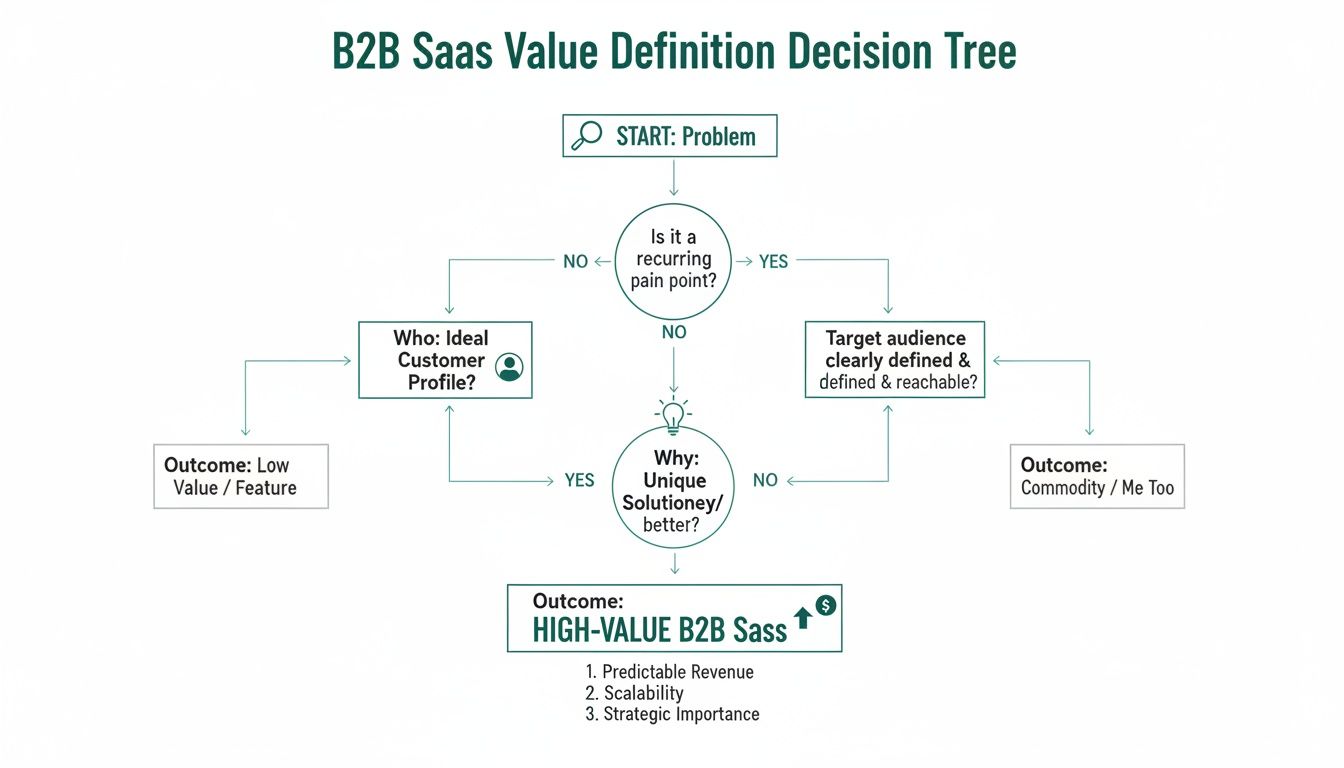
As you can see, every successful strategy starts from a deep understanding of the customer's problem and the unique value you're bringing to the table.
Your sales motion is essentially your playbook for getting customers. For most B2B SaaS startups, it boils down to one of three approaches. Each has its own rhythm and is built for different products and markets.
The shift toward PLG isn't just hype. In the B2B SaaS space, a significant number of companies are now running a product-led motion. The results are notable: PLG companies can achieve higher free-to-paid conversion rates and can be significantly more profitable than their sales-led peers.
The right sales motion is the engine of your go-to-market strategy. To help you weigh the pros and cons, here's a quick comparison of the three primary models.
Growth MotionBest ForPrimary DriverKey MetricsProduct-Led (PLG)High-volume, low-complexity products; individual users or small teams; fast time-to-value.The product itselfActivation Rate, Free-to-Paid Conversion, Net Revenue Retention (NRR)Sales-Led (SLG)High-ACV, complex products; enterprise buyers; long sales cycles.Sales teamQualified Leads, Pipeline Velocity, Quota Attainment, Customer Acquisition Cost (CAC)HybridProducts that serve both SMBs and enterprise; land-and-expand models.Product for acquisition, sales for expansionProduct Qualified Leads (PQLs), Expansion MRR, Average Contract Value (ACV)
Ultimately, your choice should reflect your product's nature and your customer's buying behavior. A PLG motion for a complex cybersecurity platform is a recipe for failure, just as an expensive sales team for a simple utility tool is overkill. Choose the engine that fits the vehicle you've built.
Let's be honest, pricing can feel like one of the scariest things a founder has to do. It’s part science, part art, and a whole lot of educated guessing at the start. But a smart pricing structure does so much more than bring in revenue—it’s a powerful tool for communicating your value and guiding customers to the right plan.
Think of it this way: your pricing is the bridge between your value proposition and your bank account. It's the moment of truth where a prospect looks at the transformation you're promising and decides if it’s worth the price tag.
Your pricing strategy shouldn't be based on your costs or what others are charging. It should be a direct reflection of the value your product creates for your customer. If you save them $10,000 a month, charging $50 is leaving a monumental amount of value on the table.
Here are a few proven frameworks that B2B SaaS companies lean on:
1. Value-Based Pricing
This is the gold standard, period. You're not pricing based on your features or your costs; you're pricing based on the value your customer gets. To do this, you have to know your ICP's pain points inside and out and be able to show a tangible ROI. For instance, if your AI tool helps a sales team close just one extra deal per month worth $5,000, pricing your tool at $500/month becomes a no-brainer for them.
2. Tiered Packaging
This is probably the most common model you'll see out there. You create different packages (e.g., Basic, Pro, Enterprise) for different types of customers. The trick is to make each tier a logical next step, so it’s easy for customers to upgrade as their business grows. Your tiers should be built around value metrics—the things your customers get more value from as their usage increases, like the number of users, contacts, or projects.
3. Usage-Based Pricing
With this model, customers simply pay for what they use. It’s popular with infrastructure products like AWS or API companies like Twilio. This approach feels incredibly fair and perfectly aligns your success with your customers' success. The downside? It can make your revenue a bit harder to predict.
Getting your pricing right is an ongoing process. For a much deeper dive into the mechanics, take a look at our complete guide on how to price software products.
And remember, the price you launch with is almost certainly not the price you'll have in a year. Be ready to test, listen to the market, and make adjustments as you learn more.
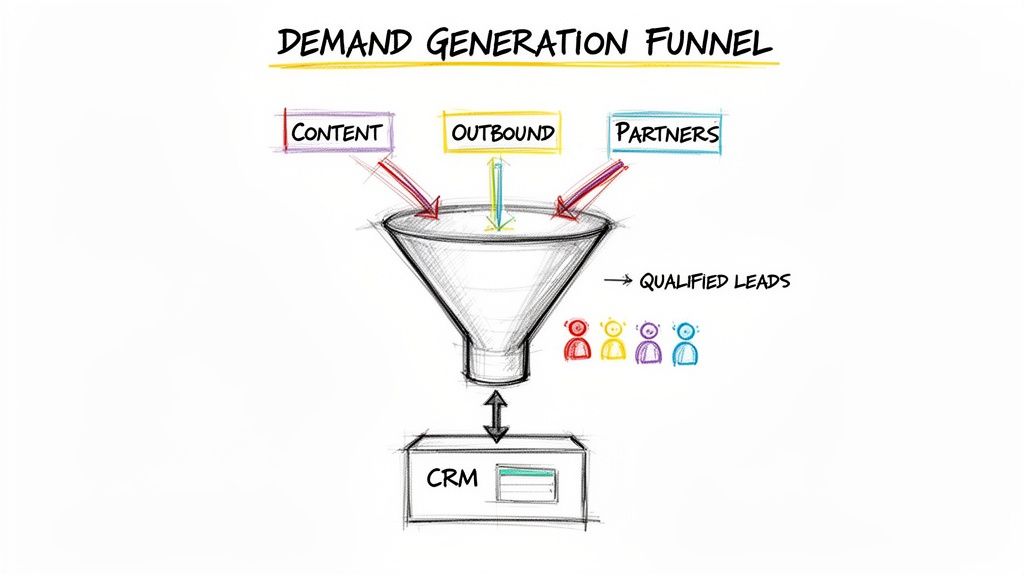
Let's be blunt. A world-class product and a brilliant go to market strategy for b2b saas are completely useless if your ideal customers don't know you exist. This is where demand generation comes in. It’s the engine you build to create awareness, spark interest, and consistently fill your pipeline with qualified leads.
We’re going to skip the generic advice to "be on social media" and get straight to the high-impact channels that actually move the needle for early-stage B2B SaaS. The goal isn’t to be everywhere; it's to be in the right places, making the right impression.
This means building a multi-channel system where each part works together to attract, engage, and ultimately capture the attention of your ICP.
Once leads are flowing, keeping that pipeline clean and reportable is its own discipline — a RevOps partner like Revenue Wizards handles the CRM, tooling, and pipeline reporting so your GTM data stays trustworthy.
In the B2B world, trust is your most valuable currency. The fastest way to build it? Generously share your expertise. This is where pillar content becomes your cornerstone—a substantial piece of content that thoroughly explores a core topic your ICP is struggling with.
Think of a comprehensive guide, an original research report, or a massive "how-to" article that solves a real, painful problem for your audience. This isn't just another blog post. It's an asset that establishes your authority and becomes a long-term source of organic traffic.
This approach works because it pulls in customers who are actively searching for solutions, meaning they arrive with high intent. It's the foundation of any solid demand generation strategy because it fuels all your other marketing efforts.
Outbound gets a bad rap, and honestly, it’s usually deserved. Spammy, generic emails are a complete waste of everyone's time. But a thoughtful, targeted outbound strategy can be a game-changer for B2B SaaS, especially when you're just starting out.
The key is to make it about helping, not selling. Instead of a generic pitch, your outreach needs to offer genuine value upfront.
This simple shift reframes the conversation from "buy my stuff" to "I have something that can help you." It respects your prospect's time and positions you as a helpful expert, not just another vendor.
Your goal with outbound isn't just to book a meeting; it's to start a meaningful conversation. By leading with value, you earn the right to ask for their time later.
Why spend months building an audience from scratch when you can collaborate with others who have already earned the trust of your ICP? Partner marketing lets you connect with potential customers through channels they already know and respect.
This doesn't have to be some complex, formal partnership. Early on, it can be as simple as this:
To effectively build and scale your demand generation pipeline, it's crucial to understand how to connect with customers across various platforms; a valuable resource is this modern guide to multi-channel marketing automation.
These partnerships give you instant credibility and access to a pre-built, relevant audience. It’s one of the most efficient ways to build brand awareness and generate high-quality leads in the early days. In my experience, a single successful webinar can often fill your pipeline for an entire month.

So, your demand gen engine is starting to hum, and those precious first leads are trickling in. Fantastic. Now the game shifts. It's time to arm your sales team—which, let's be honest, is probably just you and a co-founder at this stage—with the tools they need to turn those conversations into closed deals.
This isn't just about throwing a few PDFs together. Sales enablement is about building a cohesive set of assets that tell a consistent, powerful story. Think of these as strategic instruments designed to build confidence, handle tough questions, and ultimately, shorten that all-important sales cycle.
Your master pitch deck is the absolute backbone of every sales conversation. It's far more than just a presentation; it's the central vault for your messaging, value prop, and customer stories. Every sales call, every demo, every follow-up—it all stems from this core narrative.
But this isn't a laundry list of features. It's a story. And a good story has a clear arc that connects with your ICP on a gut level.
Your pitch deck is your story, codified. It ensures that whether it's you, your co-founder, or your first sales hire on the call, the message is always on point, compelling, and consistent.
Remember to treat this as a "master" version. You'll absolutely create shorter, tailored versions for specific situations. But this complete deck is your single source of truth, the internal-facing tool that fuels all your external communication.
It’s going to happen. "So, how are you different from Competitor X?" If you fumble this question, you instantly lose credibility. This is exactly where battlecards become your team's secret weapon.
A battlecard is a quick, one-page cheat sheet that gives your team everything they need to confidently field questions about alternatives. And I mean all alternatives—direct rivals, adjacent tools, and even the dreaded status quo of "we'll just keep using spreadsheets."
A killer battlecard boils down to a few key points:
Building these out turns a defensive moment into an opportunity to hammer home your unique value.
The pitch deck tells the story and the battlecards handle objections. But one-pagers and case studies deliver the hard evidence that buyers need to justify their decision to their boss. These are the assets that keep selling for you long after the Zoom call ends.
A one-pager is a visually sharp, digestible summary of your product. It’s the perfect thing to send after an initial discovery call or for your champion to forward to their team. It needs to crisply communicate the problem, your solution, and the key outcomes. No fluff.
Case studies are your heavy hitters. Even if you only have a couple of early design partners, their stories are pure gold. A great case study isn't just a glowing quote; it's a mini-narrative that walks the prospect through a relatable journey:
These materials are absolutely fundamental. To dive deeper into building a robust program around them, check out our guide on sales enablement best practices. Building out this toolkit is how you empower your team to stop just pitching and start selling with undeniable conviction.
Everything you’ve done so far—defining your ICP, nailing the messaging, and picking your channels—all leads to this moment: the launch. But let's get one thing straight. A successful B2B launch isn’t a single, explosive event.
It’s more like rolling thunder than a lightning strike. The goal is to build anticipation, create impact on day one, and then sustain that energy to generate vital early traction. Your launch plan is the timeline that keeps the entire orchestra in sync. This is where your go-to-market strategy for B2B SaaS jumps off the page and into the real world.
A chaotic launch kills momentum before it even starts. The key is to break it down into distinct phases. This lets your team focus their energy where it’ll have the most impact at each stage, making sure your entry into the market is both smooth and powerful.
The second you go live, your focus has to shift from pure execution to measurement. It's incredibly easy to get sucked into a vortex of data, but you have to resist the allure of vanity metrics. Things like raw website traffic or a spike in social media likes feel good, but they tell you almost nothing about the actual health of your business.
Instead, you need to zero in on the Key Performance Indicators (KPIs) that directly tell you if your GTM strategy is working. These are the numbers that signal whether you're on the right path or if you need to make a sharp turn—fast.
Your first set of KPIs aren't about proving you were right. They're about learning where you were wrong, as fast as humanly possible. This data-driven feedback loop is your greatest asset for iteration and growth.
For an early-stage B2B SaaS company, these are the metrics that truly count:
Crafting this plan is your first big move—a declaration of intent that turns your vision into a measurable, market-ready force. Here are a few common questions I hear from founders diving into this process.
Look, for an early-stage B2B startup, you can hammer out a solid initial go-to-market strategy in about four to six weeks of focused work. That timeline gives you enough room for deep customer research, nailing your messaging, making pricing decisions, and picking your first few channels.
But here's the thing: this isn't a "set it and forget it" document. Your GTM strategy is a living guide. You should be revisiting and tweaking it quarterly as you get real feedback from the market. Each iteration sharpens your approach and makes it that much more effective.
The most powerful strategies are not written in stone; they are molded by customer interaction and data. View your initial GTM as your best hypothesis, ready to be tested and improved upon.
The most common—and most expensive—mistake is building the product in a vacuum and only starting to think about market entry a few weeks before launch. This almost always leads to a painful, sinking feeling when you realize there's a disconnect between what you've built and what the market actually needs.
A successful GTM strategy has to develop in parallel with the product itself. This is non-negotiable. When you do this, customer insights shape both the software and its story from day one, ensuring you're building something people will genuinely open their wallets for.
You absolutely must define the strategy first. Your go-to-market plan dictates everything about your sales hires: who you need, what skills they must have, the sales motion they'll run, and the core message they will deliver.
Hiring a sales team without that clarity is like hiring a construction crew without a blueprint. You'll end up with a team of motivated people with no clear direction, which is a fast track to wasted time, squandered capital, and a whole lot of frustration.
Crafting a powerful go-to-market plan can feel daunting, but it's the single most critical step in transforming your product into a real business. If you need a partner to help build the positioning, sales tools, and launch strategies that drive revenue, Big Moves Marketing is here to help. Find out how we can help your B2B SaaS succeed.
Explore Big Moves Marketing services and resources:

%20-%20white.svg)