%20png%20copy.avif)
Most B2B SaaS teams don't have a lead generation problem. They have a lead qualification problem.
The conventional wisdom—chase every form fill, respond in minutes, and push for a demo—is a playbook for burning out your sales team on low-probability deals. It mistakes activity for progress. The real bottleneck isn't the top of your funnel; it’s the lack of a ruthless, systematic filter to protect your team’s most valuable asset: their time.
Qualification isn't about processing leads. It’s a diagnostic process to identify true revenue potential. It’s about ensuring your best people spend their time on opportunities that can and will close.
The real issue in your pipeline isn't a lack of leads; it’s a flawed diagnostic model. Most B2B SaaS companies are handed simplistic frameworks and told to qualify based on static firmographics, with response speed being the only metric that seems to matter.
This is a massive miscalculation.
Chasing every marketing qualified lead (MQL) doesn't just burn your sales team's calendar. It drains your most precious and finite resource: the focus of your senior GTM team. The core mistake is treating all inbound interest as equal. It never is.
The mantra to "respond fast" is everywhere. But speed without an intelligent filter is just a fast track to nowhere. With an estimated 61% of initial leads lacking budget or authority, reacting instantly to every form fill is profoundly inefficient.
Teams that pair rapid response with smart filtering see their MQL-to-SQL rates jump from the dismal 13% average to over 30%. You can review the B2B sales benchmarks yourself.
This obsession with speed forces teams into a reactive posture. A demo request arrives, and the old playbook demands an immediate call. This approach ignores the crucial context. Who is this person? Why now? What problem are they actually trying to solve?
The goal of qualification isn't to convert every lead. It's to ruthlessly protect your sales team's time for the opportunities that can and will close. Effective qualification is a strategic diagnostic process, not a checklist.
Your current process likely rewards activity—more calls, more demos, more MQLs passed to sales. But this volume-based thinking clogs your pipeline with low-intent prospects who drain resources and tank morale. They show up for a demo, ask for a proposal, and ghost.
It's time to move away from metrics that feel productive but waste everyone's time.
Chasing vanity metrics like MQL volume is a recipe for a bloated, inefficient pipeline. The real goal is to build a systematic filter that separates high-intent prospects from everyone else. This means moving beyond outdated frameworks like BANT, which often fail in modern SaaS buying cycles. A prospect may not have a defined "budget," but they might have a massive, costly problem demanding a solution. BANT disqualifies them; a smarter system flags them as high-priority.
This guide isn't about a new acronym. It's about building a systematic filter tied to your go-to-market strategy. We’re going to reframe how to qualify B2B leads by focusing on what truly matters: correlating signals of intent with actual revenue potential.
All qualification frameworks—BANT, CHAMP, MEDDIC—are useless without a rock-solid Ideal Customer Profile (ICP). Relying on them without an ICP is like performing surgery in the dark. You’ll make cuts, but you won't hit your target.
The first step in building a lead qualification machine is defining, with painstaking detail, who you sell to and, just as critically, who you don’t. This isn't about casting a wider net; it's about building a hyper-efficient filter that protects your sales team's time.
Most early-stage companies get this wrong. They describe their ICP with a vague statement like, "mid-market tech companies." That’s not an ICP; that's a market segment. It lacks the sharp edges needed to quickly disqualify leads that will waste cycles and never close.
A powerful ICP goes beyond surface-level data. Firmographics like company size and industry are just table stakes. The real leverage comes from layering on dynamic signals that indicate a company isn't just a fit, but is ready to buy.
Your ICP must incorporate these richer dimensions:
Technographics: What’s their current tech stack? Are they using a competitor you’re built to displace? Do they use complementary tools (like a marketing automation platform) that signal sophistication? A company already paying for a tool in your category has pre-qualified themselves as problem-aware.
Situational Triggers: What's happening inside their business right now? A recent funding round (Series A or B funding often precedes new tooling budgets), a key executive hire (a new VP of Sales will re-evaluate the entire sales stack), or significant headcount growth are all flashing green lights. These are the events that create budget and urgency.
Pain Signals: Where are they publicly signaling pain? This could be a trail of negative G2 reviews for a competitor, specific phrasing in job descriptions ("seeking a manager to fix our broken reporting process"), or employees asking for solutions in industry forums. These are active, explicit signs of a pain you solve.
Your goal is to define your Tier 1 ICP—the absolute bullseye. These are the companies that see massive value in your product, have short sales cycles, and become your best advocates. If you're building this from scratch, there are resources that can help you create an Ideal Customer Profile that reflects your best customers.
Your Tier 1 ICP is a hypothesis about where your product's unique value intersects with acute market pain. It’s a dynamic document, not a one-time exercise. Review it quarterly with your sales and product teams.
Start by analyzing your happiest customers. Who signed fastest? Who uses the product most? Who sent referrals? Find the common threads across these accounts. Dig deeper than company size—what specific problems were they trying to solve right before they found you?
Once you have this level of detail, your qualification process transforms. A lead is no longer a "VP of Marketing." They become a "VP of Marketing at a 200-person Series B fintech company that just hired a Head of Demand Gen and is running on HubSpot."
One is a contact. The other is a high-probability opportunity.
This detailed ICP is the foundation for everything else: your lead scoring, discovery questions, and handoff rules. Without it, you're operating blind.
Lead scoring is where most SaaS teams get stuck. Founders either skip it entirely, relying on gut feel, or they over-engineer a complex system that creates more confusion than clarity. Both paths lead to a frustrated sales team and wasted effort.
The goal isn't a flawless algorithm on day one. It's a simple, functional system that gives your sales team a clear signal on where to focus. This is about building a priority list, not a black box.
A solid model needs only two core components: explicit fit and implicit intent.
This answers one question: How closely does this lead match our Tier 1 ICP? We're looking at hard data—firmographics, technographics, and demographics. You’re assigning value to the attributes that define a high-potential account.
Start with a baseline of 100 points. Assign high scores for non-negotiables.
You're quantifying how much a lead looks like your best customers before they’ve taken a single action.
Next is intent. This is where you measure interest based on behavior. The question is: How actively is this lead signaling they have a problem we can solve? These are the dynamic actions that show engagement and urgency.
This two-part model prevents your team from chasing high-fit, low-intent leads (the VP at a perfect-fit company who only subscribed to your newsletter) and low-fit, high-intent leads (an intern requesting a demo for a school project).
This decision tree visualizes a simplified version of this flow, helping teams sort leads by checking their firmographics and technographics against your ICP.
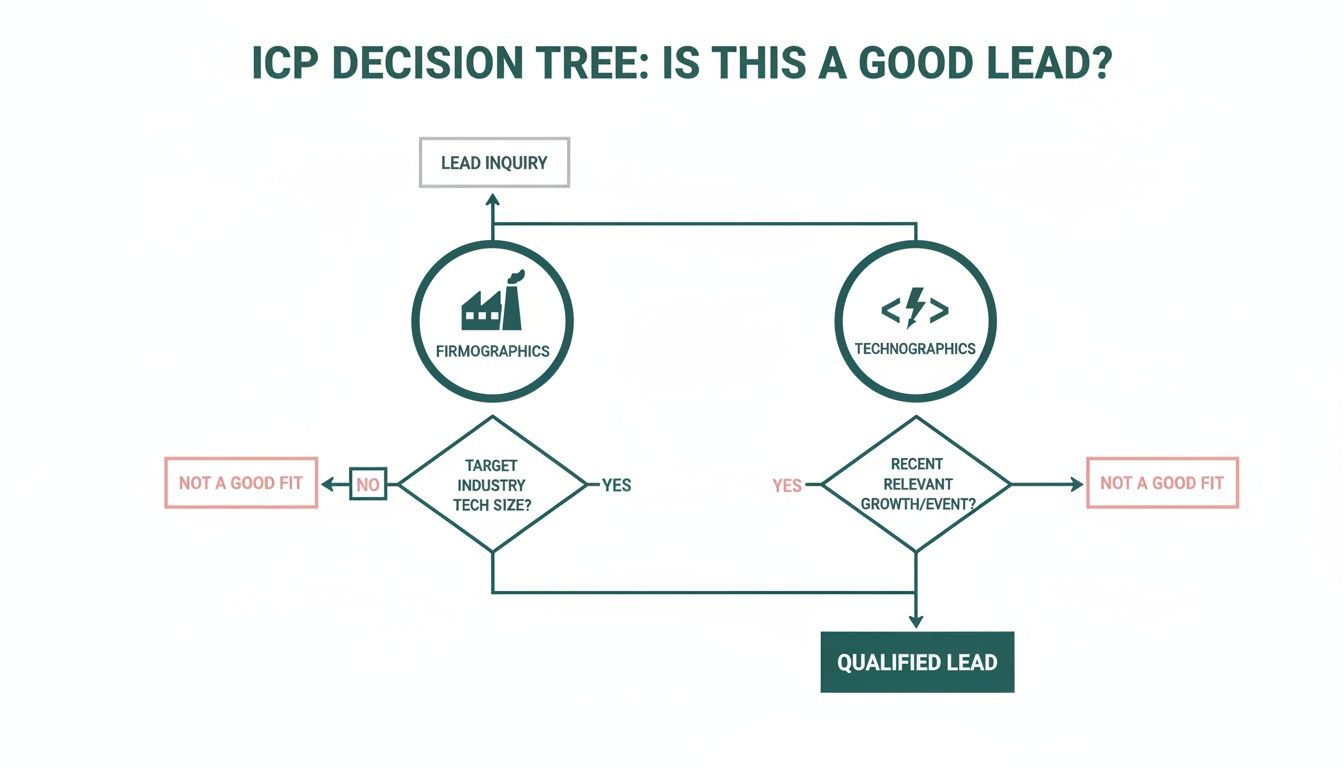
Good qualification is a sequence of filters, not a single judgment call. It ensures resources are focused on leads that meet the most important criteria first.
Turn raw scores into simple, actionable tiers. Don't just hand sales a number; give them a clear directive.
A tiered system brings immediate clarity and ends the debate about "what makes a good lead." And the impact is real. AI-driven lead scoring is delivering a 40% boost in accuracy over manual methods, with 67% of B2B companies now using AI to analyze behavior. This isn't about chasing trends; it's about fixing a real problem, especially when only 40% of organizations consistently apply any qualification criteria at all. You can explore more data in these B2B lead generation statistics on reachmarketing.com.
Start simple. Your first model will be wrong. The goal is a functional system that gathers feedback from sales for iteration. A "good enough" model in use is infinitely better than a "perfect" one in a spreadsheet.
This model isn't static. As your product evolves, revisit and adjust point values. For the operational side, our guide on marketing automation best practices shows how these systems fit together. This iterative process turns a basic scoring system into an engine for predictable pipeline.
A great discovery call has one primary objective: to disqualify.
Your team's time is their most valuable asset. Every minute spent on a low-fit prospect is a minute stolen from a high-potential deal. Yet most sales teams treat discovery like a feature pitch disguised with a few limp questions.
This approach is fundamentally broken. It assumes the prospect has perfect self-awareness of their problem. The reality is that most inbound leads are problem-aware but solution-unaware. Your job is not to show them your product; it's to diagnose the severity of their problem and determine if their organization has the ability to solve it.
This means moving beyond lazy questions like, "What keeps you up at night?" You need questions that are more like a surgeon's scalpel—sharp, precise, and designed to reveal the truth about a prospect's pain, priorities, and internal politics.
Before you mention your solution, you need to understand their problem with absolute clarity. The goal is to quantify the pain and confirm it's a big enough fire to be worth putting out. If the pain is a minor annoyance, the deal will stall. Guaranteed.
These questions get to the heart of the matter:
Once you've established a real, painful problem, figure out how they envision a solution. This is not your cue to pitch features. It's about seeing if their mental model of a "fix" aligns with what your product actually does.
Don't sell the product; sell the outcome. A prospect's ability to articulate the desired future state is a strong indicator of their readiness to buy. If they can't describe what 'good' looks like, they aren't ready to invest in getting there.
To gauge alignment, try these questions:
Reframe your inquiries to be diagnostic tools that either qualify prospects in or, more importantly, qualify them out.
By asking sharper questions, you force specificity and move the conversation from a casual chat to a strategic diagnosis. This is how you separate serious buyers from time-wasters.
Finally, map the path to a decision. Countless deals die in the swamp of internal bureaucracy. Your job is to uncover the real process, identify the key players, and stress-test whether your champion has any actual influence.
Ask direct, unflinching questions:
These questions are diagnostic tools. Strong discovery skills are one of the three pillars of B2B marketing and are critical for success. Qualify hard, disqualify ruthlessly, and your pipeline will thank you for it.
Even the best ICP and lead scoring model will fail if the plumbing between marketing and sales is broken. I’ve seen it dozens of times: marketing lands a great lead, tosses it over the fence, and watches it die from a slow follow-up or a total lack of context. This handoff is where countless deals are lost before they begin.
This is a process and alignment failure, not a tooling problem.
To turn your qualification strategy into a growth engine, you need operational discipline: clear rules of engagement, airtight data transfer, and a mandatory feedback loop.
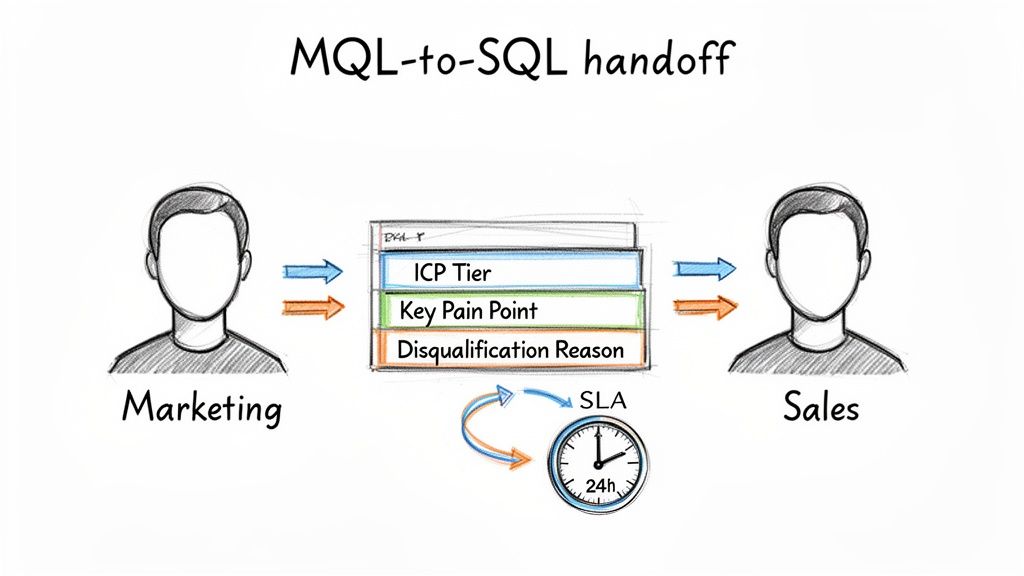
First, eliminate all ambiguity. The handoff from a Marketing Qualified Lead (MQL) to a Sales Qualified Lead (SQL) must be governed by a crystal-clear Service Level Agreement (SLA). This isn't a suggestion; it’s a contract between teams that holds everyone accountable.
Your SLA should define three things:
This agreement forces discipline and creates a reliable system. It stops leads from getting buried in a CRM and ensures marketing's momentum isn't wasted.
A lead's intent has a half-life. The value of a high-intent signal degrades with every hour that passes without meaningful engagement. Your operational process must be built to preserve that value, not let it decay.
When a lead is passed to a sales rep, it cannot be a blank slate. They need immediate context for an intelligent first conversation. This means marketing must populate a core set of CRM fields before routing.
Make these fields mandatory:
This data transfer ensures the sales rep isn’t flying blind. They know immediately if they’re talking to a high-fit, high-intent prospect.
For teams looking to get more efficient, integrating AI directly into the CRM can be a powerful move. It's worth looking into solutions that provide AI actions for Salesforce Leads to help automate routine work and keep the process smooth.
The handoff is not a one-way street. The most critical and often missed part of this process is a formal way for sales to give feedback to marketing. This is how your qualification model gets smarter.
Add specific fields in your CRM that sales must complete when they disposition a lead.
Marketing must review this data weekly. If many MQLs are rejected for "No Budget," it’s a clear signal to adjust lead scoring or content strategy. This closed-loop system is fundamental for any team serious about growth. For a deeper dive, see our guide on the 5 steps to align B2B marketing and sales.
This operational rigor is what separates high-growth companies from the rest. It turns lead qualification from a subjective art into a predictable science, ensuring every lead generated has the best possible chance to become revenue.
You cannot improve what you do not measure. Too many founders get trapped tracking vanity metrics like raw MQL volume, celebrating a flurry of activity while their pipeline quality stagnates.
This is a classic, resource-draining mistake.
A healthy lead qualification process isn't about sheer volume; it's about the velocity and value of the deals moving through your pipeline. To get a true diagnostic of your GTM engine, you must focus on a few critical, outcome-driven KPIs.
Stop obsessing over the top of the funnel. The real story is told in the conversion rates throughout the entire journey, from first interest to revenue.
Focus here:
The most powerful analysis comes from combining these conversion rates with source attribution. Don't just look at which channels bring in leads; figure out which ones deliver high-value customers that move quickly.
The crucial question isn't "Which channel generates the most leads?" It's "Which channel generates the most revenue per dollar spent, in the shortest amount of time?"
This means you need to analyze pipeline velocity and average deal size by lead source.
You might discover that organic search delivers fewer leads than paid campaigns, but those organic leads close twice as fast at a 30% higher contract value. That’s the kind of insight that lets you make smart, strategic bets with your capital.
Focusing on these metrics shifts the entire conversation from being busy to driving business outcomes.
Adoption fails when a new process feels like a mandate. If you want your sales team on board, you must build it with them, not for them.
Pull your sales leaders and top reps into the process from day one. Make them co-owners of the ICP definition, the lead scoring model, and the discovery questions. When they help build the engine, they are far more likely to trust and use it.
Next, connect the process to their compensation. When you tie bonuses to deal quality and pipeline velocity—not just raw deal volume—behavior changes almost overnight. Reps will naturally prioritize well-qualified leads because it directly impacts their income.
Finally, make it simple. The lead score, ICP tier, and critical context must be front-and-center in your CRM. If a rep has to hunt for information, they’ll ignore it. Friction is the enemy of adoption.
The biggest mistake is over-engineering the process. Many founders fall into the trap of trying to build the "perfect" system from day one. They spend weeks designing a 50-point lead scoring model with complex automation before they’ve proven the basics.
This is a recipe for analysis paralysis.
Don't do it. Start with a simple, "good enough" ICP and a basic three-tier scoring system—A, B, and C leads—based on five to seven core attributes. Get it into the hands of your team and see what happens.
The goal isn’t perfection; it’s momentum. A functional system that's actually implemented provides immediate value and, more importantly, a feedback loop for improvement. A perfect system that only exists on a whiteboard delivers nothing.
A founder must stay in the trenches qualifying leads until the patterns are so clear they are unmistakable. You need to handle this yourself until the process becomes repeatable and predictable.
In practice, this means personally handling the first 50 to 100 qualified conversations. You need to do this until you can confidently predict which types of leads will ghost and which will become viable opportunities.
Only after you have documented that entire process—your ICP, your scoring logic, the key disqualifying questions—can you consider hiring your first salesperson.
Handing this off too early is a primary reason first sales hires fail. The deep, intuitive understanding you gain from those initial calls is the exact knowledge required to train them for success. Do not short-circuit that learning process.
At Big Moves Marketing, we help B2B SaaS founders move past generic playbooks to build go-to-market strategies that create clarity and drive real revenue, not just busy work. If you're ready to build a growth engine that actually works, let's connect.
Explore Big Moves Marketing services and resources:



%20-%20white.svg)