%20png%20copy.avif)
Most founders still get the meaning of minimum viable product wrong. They think an MVP is a smaller version of the product they already want to build. That mistake burns time, muddies go-to-market, and gives teams false confidence.
An MVP isn't a product milestone. It's a market test.
If you treat it like a product milestone, you optimize for shipping. If you treat it like a market test, you optimize for learning. For B2B SaaS, that distinction matters more than most founders admit. Early on, your biggest risk usually isn't engineering. It's whether a specific buyer has a painful enough problem to care, respond, evaluate, and eventually pay.
That changes how you should think about scope, messaging, sales motion, and even capital allocation. The right MVP doesn't just tell you what to build next. It tells you whether this market deserves more of your company at all.
The popular advice is wrong. Your MVP is not the smallest version of your vision. It's the cheapest credible way to answer your most dangerous business question.
That question usually sounds less like product planning and more like GTM reality. Will finance teams switch from spreadsheets for this workflow? Will RevOps leaders trust an automated recommendation engine? Will Shopify merchants install something that only solves one painful task? If the answer is no, your roadmap doesn't matter.

Most founders start with features because features feel concrete. But features are downstream of assumptions. The essential work is finding the assumption that, if false, breaks the business.
Examples in B2B SaaS:
If you haven't identified the riskiest assumption, you're not designing an MVP. You're just reducing a backlog.
Practical rule: Before you scope anything, write one sentence that starts with “We need to learn whether...”
An MVP is financial discipline disguised as product work. It exists to stop you from spending engineering, design, and GTM effort on an idea the market hasn't validated.
For B2B teams, that means the MVP should often test demand, positioning, or buying intent before it tests software depth. Sometimes the right first move is a manual service, a narrow workflow, or a landing page tied to founder-led outreach. If that sounds unglamorous, good. Glamour is expensive.
If you're still defining your market thesis, this perspective is close to how I'd pressure-test an idea before scale. A useful companion is this take on how B2B SaaS founders should validate a startup idea.
The original point of the MVP concept wasn't to justify shipping rough software. It was to force teams to learn faster than they spend.
Eric Ries popularized the term in the Lean Startup movement and defined an MVP as the version of a new product that lets a team collect the maximum amount of validated learning with the least effort in his explanation of what an MVP is. That's the cleanest definition because it strips away the vanity founders attach to launch narratives.
That definition creates a useful distinction many SaaS teams blur.
An MVP is for learning.
An MMP is for earning.
Those are not the same job. When founders confuse them, they push a learning-stage idea into a revenue-stage expectation. Then they overbuild the onboarding, overpolish the interface, add integrations too early, and spend on demand generation before they've proven the buyer cares.
In practical terms:
Those are different gates. Treating them as interchangeable creates fake progress.
Validated learning is not collecting compliments in discovery calls. It is not hearing “I'd use this” in an interview. It is not a friendly prospect saying “keep me posted.”
It means getting evidence from real behavior. That could mean someone books a demo, agrees to a pilot, changes a workflow, uploads data, or tolerates manual delivery because the outcome matters enough.
Agile Alliance puts it clearly. An MVP is an experiment design, not a scaled-down finished product, and observing actual user behavior is more reliable than asking what people say they would do in its MVP glossary.
The market doesn't reward your idea for being coherent. It rewards your offer when buyers change behavior.
B2B founders often run into a specific failure mode. They build a product around user pain, then discover the buyer, security reviewer, admin, and operator each need something different before a deal can move.
That means your MVP has to test more than usability. It has to test whether the problem is painful enough to support a buying motion. That's a GTM question.
If you need better early evidence, don't just ask for feature feedback. Tighten your research process and learn how to run sharper conversations through a more rigorous user research approach.
Early-stage startups rarely fail because their MVP lacked a button or a cleaner dashboard. They fail because the experiment was poorly designed. The team thinks it learned something. It didn't.
That's the dangerous part.

This is the classic mistake. The team takes the full roadmap, removes some features, and calls the result an MVP.
That approach misses the point. A feature-light version of the final product is still product-first thinking. It often carries the same assumptions, same architecture burden, and same GTM confusion. You just shipped less of the wrong thing.
If your riskiest assumption is about buyer demand, you probably don't need a product suite. You need an experiment that tests whether anyone cares enough to engage.
Founders regularly decide what's “viable” based on taste, pride, or peer comparison. None of those are market evidence.
Viable should be defined by whether the user can reach a meaningful outcome. In B2B SaaS, that usually means solving one painful task clearly enough that an early adopter says, “This is useful now,” even if the delivery is narrow or manual.
A lot of pre-seed teams miss this because they anchor on ambition instead of evidence. That's why this piece on Founder Connects advice for early-stage startups is worth reading. It lines up with a pattern most operators eventually learn the hard way. Product-market fit doesn't fail because decks were weak. It fails because teams solve an unproven problem too expensively.
An MVP is not a debut. It's the first pass in a learning loop.
Once founders treat it like a launch, they start protecting the product from friction instead of exposing it to it. They avoid narrow ICPs, delay release for polish, and want broad market applause too early. That's how learning slows down.
Here's the blunt version:
Some teams hear “minimum” and ship something too incomplete to create value. Then they conclude the idea failed.
That's a false negative. The issue wasn't the market. The issue was the test.
An MVP can be extremely narrow, but it still has to be viable. If the user can't complete the core job, your experiment tells you nothing. Agile Alliance's view is useful here: the MVP can even be a landing page or a manually operated service if that's enough to test the core hypothesis, but it still has to generate validated learning from behavior, not opinions.
Operator's lens: If the customer can't experience the promised outcome, you haven't tested demand. You've tested patience.
For founders trying to separate product enthusiasm from real traction, sharper thinking about finding product-market fit is vital. The MVP should produce signal that helps you decide whether to narrow, reposition, or stop.
Not all MVPs should be software. That's the mistake product-heavy founders keep making.
The right experiment depends on what you're trying to learn. If you're testing willingness to pay, a concierge workflow often beats code. If you're testing messaging, a landing page can tell you more than a quarter of product development. If you're testing whether one acute pain point matters enough to change behavior, then a single-feature build can make sense.
Here's the clean way to think about it. Different MVP types answer different questions.
| MVP Type | Relative Cost | Time to Feedback | Primary Validation Goal |
|---|---|---|---|
| Concierge MVP | Low | Fast | Validate the problem, workflow, and willingness to engage with a human-delivered solution |
| Wizard of Oz MVP | Low to medium | Fast | Test the customer experience while handling fulfillment manually behind the scenes |
| Landing page or email MVP | Low | Fast | Test positioning, message resonance, and demand capture |
| Single-feature MVP | Medium | Medium | Validate whether one narrow use case creates enough value to drive repeat behavior |
| Piecemeal MVP | Low to medium | Medium | Simulate a workflow using existing tools like Airtable, Zapier, Notion, or spreadsheets |
That table is more useful than generic MVP advice because it forces a strategic choice.
A concierge MVP is ideal when the value is complex and trust matters. You manually deliver the outcome. That lets you learn what buyers ask for, what inputs they can provide, and whether the result is important enough to revisit. For B2B SaaS with workflow complexity, this is often smarter than building too soon.
A Wizard of Oz MVP looks automated to the customer, but your team handles fulfillment manually. That's useful when the front-end promise matters but the backend logic is still uncertain.
A landing page or email MVP is often dismissed by technical founders. That's a mistake. If your message doesn't attract the right conversations, your product probably won't rescue weak positioning. These experiments are especially effective when the risk is category clarity or problem framing.
A single-feature MVP makes sense when you've already developed conviction that the problem is real and the buying context is credible. Then the question becomes whether a focused product experience can solve one job well enough to create repeat usage.
A piecemeal MVP sits in the middle. You stitch together tools like Airtable, Zapier, forms, docs, and manual ops to mimic a productized workflow. It looks scrappy because it is scrappy. That's a feature, not a flaw.
Use code only when code is the shortest path to learning. Not when it feels like progress.
The best MVP format is the one that invalidates your bad assumptions fastest.
If your team is deciding which experiment fits your stage, this broader view of B2B SaaS go-to-market strategy helps because MVP design and GTM design are the same conversation early on.
Most MVPs go wrong before the build starts. The team picks features before it picks the question. That reverses the logic.
A useful MVP decision process starts with business risk, then works backward into the smallest credible test. Atlassian makes the right constraint explicit: a strong MVP includes only the core features needed to satisfy early adopters, because every non-essential feature increases build time and delays feedback in its guide to minimum viable products.
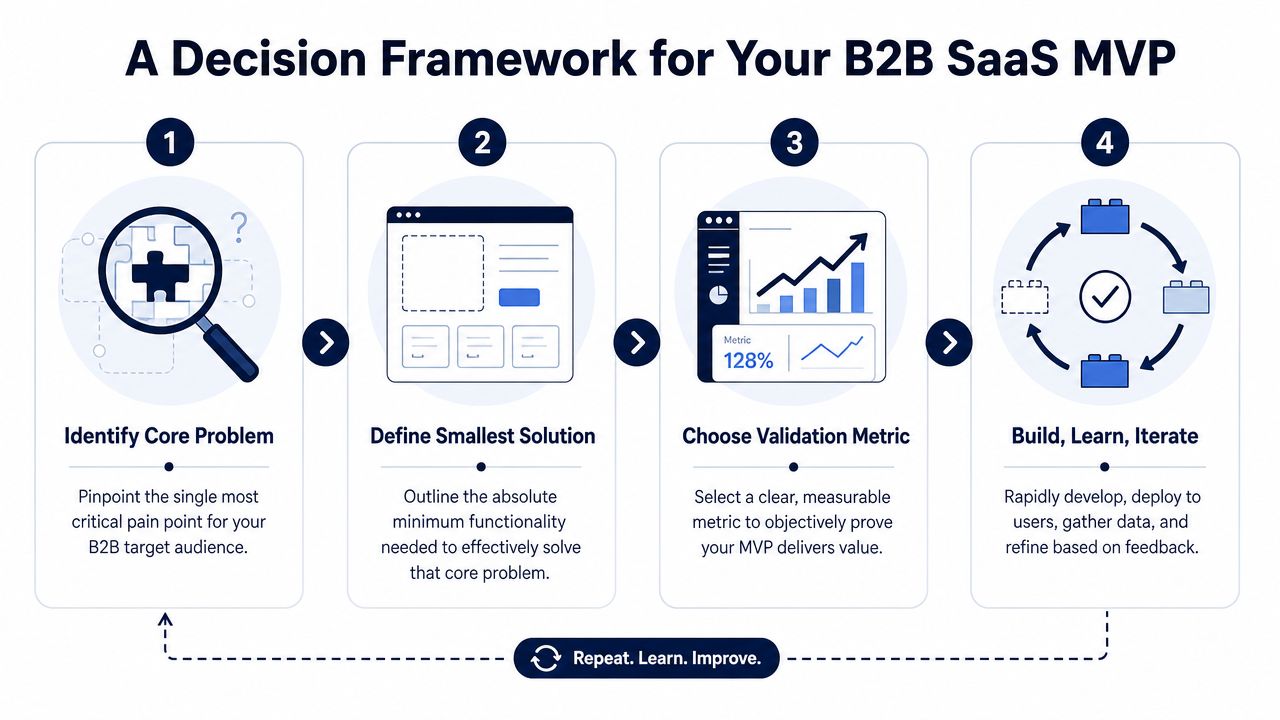
Don't start with “what should we launch?” Start with “what has to be true for this business to work?”
Pick one assumption. Not five.
Examples:
If you can't name the assumption, your MVP will drift into general product activity.
Viable isn't “usable enough.” Viable means the customer can achieve the core outcome in a way that proves the problem matters.
For a workflow product, that could mean the user completes the task faster, with less manual coordination, or with more confidence. For a reporting product, it could mean a stakeholder makes a decision from the output without asking for a spreadsheet export.
Ask one hard question: what minimum outcome would make an early adopter say this solved something real?
Now you choose the cheapest and fastest path to that outcome. Teams often get seduced by software at this stage.
Sometimes minimum is a single feature. Sometimes it's a Notion doc plus a form plus a manual service layer. Sometimes it's founder-led onboarding with no self-serve flow at all.
Use this filter:
Most founders wait until after release to decide what the signal means. That's sloppy. Decide in advance what outcomes would support a pivot, deeper investment, or a stop.
You don't need fake precision. Qualitative criteria are fine if they're concrete. For example:
Decision test: If the experiment succeeds, what specific next investment have you earned the right to make?
For teams still shaping the broader business logic, this is easier if you pressure-test the value proposition and operating assumptions inside a B2B business model canvas.
The most useful MVP examples aren't impressive because they were clever. They're useful because each one tested a specific market hypothesis with less effort than building the full product first.

Dropbox is the classic reminder that a hard technical product doesn't always need a hard technical MVP. The early explainer video worked as a demand test for a complicated product category. It didn't prove full product quality. It tested whether the promise was compelling enough to drive interest.
That distinction matters for B2B founders building infrastructure, workflow, or data products. If the value proposition can't create interest when explained clearly, adding more product depth won't automatically fix that.
Buffer's early website is still one of the cleanest examples of MVP thinking. The test wasn't whether the scheduling engine could work. The test was whether people would move toward a paid social publishing workflow based on the positioning alone.
That's a GTM lesson, not just a product lesson. Sometimes your first validation is whether the market wants the promise.
A short visual example can make that logic obvious:
The most underrated B2B MVP is the manual one.
A consultancy, analyst-led workflow, or hands-on data service can act as the first version of a software company if the founding team uses it correctly. Manually delivering the outcome lets you learn where buyers hesitate, which outputs they value, what inputs are messy, and what should never be automated.
That's the pattern behind many strong B2B wedges. The market validates the outcome first. The software comes later.
The diluted version of MVP thinking has done real damage. It gave founders an excuse to ship incomplete software and call it strategy. That's not strategy. That's avoidance.
The actual meaning of minimum viable product is tied to speed, cost control, and early-market validation, and the distinction between MVP and MMP matters because one is for learning and the other is for earning, as explained in NetSuite's overview of minimum viable product. If you ignore that distinction, you commit capital before you've earned the right to.
For B2B SaaS founders, the right mental model is simple. Your job isn't to release a smaller product. Your job is to remove uncertainty from the business in the cheapest credible way possible.
That means asking sharper questions. It means using manual workflows when they teach faster. It means narrowing the ICP instead of broadening the pitch. It means watching behavior, not applause.
Build less. Learn faster. Then spend.
If your team needs sharper thinking on positioning, GTM experiments, and how to turn early market signal into a real growth motion, Big Moves Marketing helps B2B SaaS founders and revenue leaders make better decisions before they waste budget on the wrong roadmap.




%20-%20white.svg)