%20png%20copy.avif)
Most B2B SaaS ideas fail for one simple reason: founders mistake building a product for building a business. They burn through capital and engineering cycles perfecting a solution for a problem nobody was desperate to solve.
Validation is not about seeking approval for your brilliant idea. It's the disciplined, unflinching process of finding hard evidence that a specific market has a painful, expensive problem—one they are actively trying to fix. It is the core de-risking function of an early-stage company.
This is not a checklist. It's a mental model for separating high-potential ideas from expensive hobbies.

Founders love to blame a weak product or tight-fisted VCs for their startup’s demise. The truth is simpler and more brutal: the number one killer is market indifference.
You build something elegant, powerful, and technically sound—and the market just shrugs. Your idea doesn't fail because the execution was poor. It fails because you solved a problem nobody was losing sleep over.
This isn’t an opinion. CB Insights data shows that "no market need" is the cause of failure for a staggering 42% of startups. You built a solution for a problem that wasn't a top-three priority for any budget holder.
Product-strong founders are especially prone to this trap. Your ability to build becomes a liability when it isn't disciplined by market evidence. You fall in love with the solution because that's your comfort zone, and you mistake interesting technical challenges for genuine market pain.
Validation isn't a perfunctory step you complete before the “real work” of building begins. It is the real work. It is the strategic function that separates companies that find a repeatable growth motion from those that flame out.
Seeking validation for your solution is a rookie mistake. Seeking evidence of their problem is the professional's game. You must become the world’s foremost expert on their pain before you ever mention your product.
This shift requires internalizing a few hard truths:
And it’s not just about market demand. Many SaaS ideas fail because their operational costs are unsustainable. For technical founders, understanding your cost structure early is non-negotiable. Taking time to review the top AWS cost optimization recommendations isn't a distraction; it's a practical step toward building a business that can survive its own success.
This guide provides a systematic process for idea validation. Before you can find finding product-market-fit, you first have to nail problem-solution fit. We are reframing the process around evidence, not excitement, so you don’t become another statistic.
You have a solution in mind. Your first instinct is to tell everyone about it to get validation.
Resist that urge. It's a catastrophic error.
Pitching your solution first is the most common—and fatal—mistake founders make. Your job isn't to get a "yes" for your product. It's to become the world's foremost expert on a high-value, urgent, and expensive business problem.
Founders who lead with a solution are not doing research; they're hunting for confirmation bias. They hear a polite "that sounds interesting" and mistake it for a buying signal. It’s not. It’s a gentle brush-off.
The difference between a SaaS company that scales and one that burns through cash often comes down to this: are you solving a "nice-to-have" annoyance or a "hair-on-fire" problem?
A nice-to-have might make it onto a spreadsheet for next year's budget planning. Maybe. A hair-on-fire problem gets VPs to reallocate budgets now and secures executive sponsorship.
Your entire validation process must be engineered to find that fire.
The rookie mistake is seeking validation for your solution. The professional move is seeking evidence of their problem. You must systematically map the pain, its organizational impact, and its financial cost.
This means you are not selling. You are a detective. You are not pitching. You are a journalist. The goal isn't a "yes" or "no" on your idea; it's a rich, detailed map of the problem space. We cover the nuances of this investigative mindset in our guide on how to conduct user research.
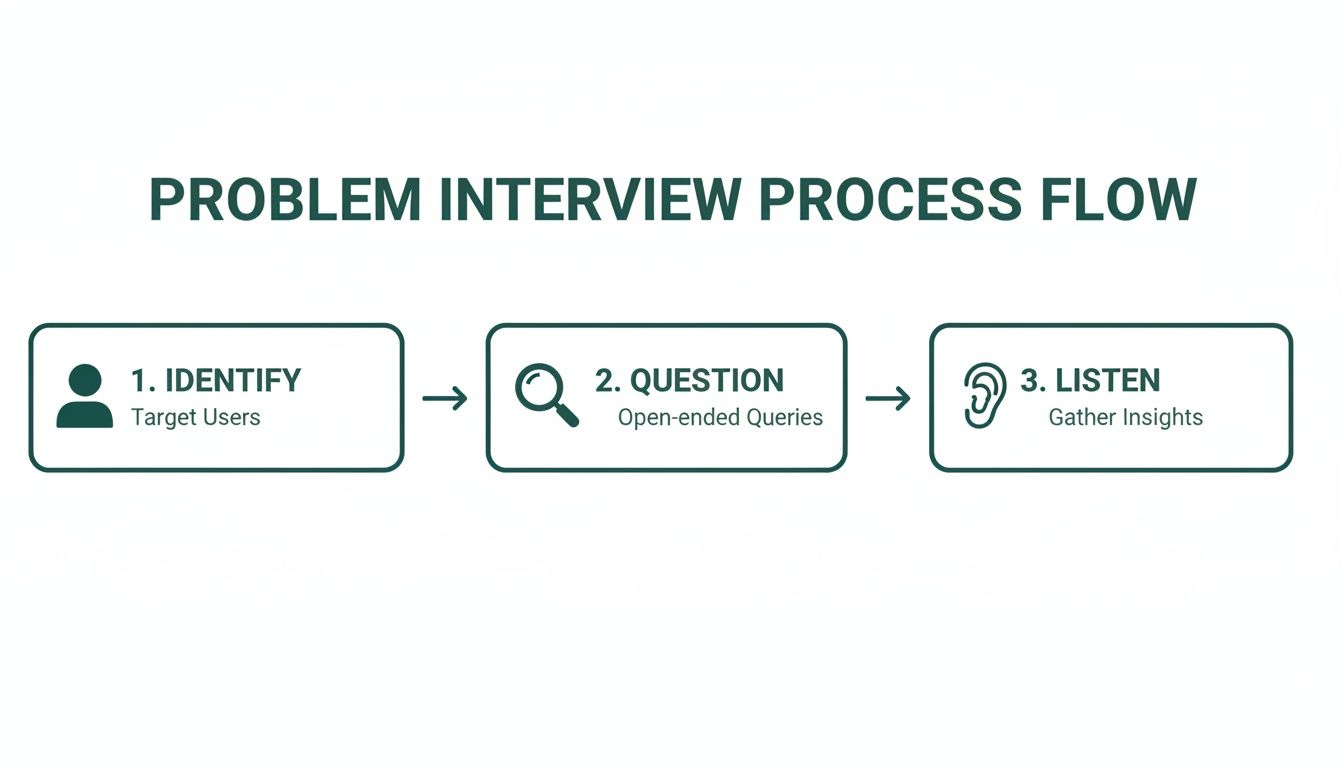
In your problem discovery interviews, every question must be a diagnostic tool. Your objective is to move the conversation from vague complaints ("this process is a pain") to quantifiable business impact ("this costs us $50,000 a quarter in wasted engineering time").
I’ve refined these four questions across work with dozens of B2B SaaS companies. They are designed to expose the true cost of inaction.
"Walk me through how you currently handle [the process]." This is gold. It forces them to detail their current workflow, revealing the manual steps, spreadsheet gymnastics, and communication breakdowns. This is where you uncover tactical pain.
"What happens when this process breaks?" Now you get to the consequences. Do deals get delayed? Does data get lost? Does the compliance team get involved? This moves the conversation from personal inconvenience to business risk.
"How much time does your team spend on this each week?" This is where you put a price tag on the pain. If a team of five engineers spends four hours a week on a manual task, that’s 20 hours of expensive talent down the drain. You can attach a dollar figure to that.
"If you had a magic wand, what would you change about this process?" This is the only "solution-oriented" question to ask. But notice the framing—it’s about their ideal outcome, not their opinion of your idea. Their answer tells you exactly what "value" looks like in their world.
Listen for the emotion behind their answers. Frustration, anger, resignation—these are the signals of a problem worth solving.
The best script is useless if you're talking to the wrong people. You need to get in front of two specific archetypes.
The Problem-Bearer: This is the end-user, the person whose daily workflow is broken. For a new sales tool, it's the Account Executive in the trenches. For a DevOps tool, it’s the platform engineer who gets paged at 2 AM.
The Budget-Holder: This is the economic buyer who signs the checks. Think VP of Sales or Head of Engineering. They might not live the tactical pain, but they feel its consequences in missed revenue targets and bloated budgets.
Getting access to these people is a validation test in itself. If a busy VP won't give you 20 minutes to talk about a problem, it’s likely not a top-three priority for them. Cold, honest feedback from the right persona is infinitely more valuable than warm, misleading praise from the wrong one.
You've completed the problem interviews. Your transcripts are overflowing with evidence of a costly, painful business problem. The temptation to start coding is almost unbearable.
Stop.
Jumping straight to a minimum viable product is the single most common—and expensive—mistake I see founders make at this stage. An MVP is a slow, costly way to validate your next assumption: will anyone actually commit to solving this problem with a new solution?
Before you write a line of code, you need to test for commitment. The real currency of early validation isn't features; it's tangible proof that your target market is willing to act.
Here are three high-impact, low-cost experiments designed to get that proof in a B2B context.
A Concierge MVP isn't a product. It's a high-touch, manual service. You are the "software," delivering the promised outcome for a handful of pilot customers entirely by hand.
If your idea is an automated analytics tool, you're the one in a spreadsheet building reports. If it’s an AI-powered lead enrichment platform, you're the human digging through LinkedIn and company websites.
The goal isn't scalability; it’s to prove the value of the outcome. Does your manual "solution" actually save the time you claimed it would? Does it deliver the insight they desperately need? Getting 3-5 pilot customers to agree to this manual test is a powerful validation signal.
This is a classic for a reason, but its power is in the execution. Build a landing page that looks and feels like a real product already exists. It should feature crisp messaging pulled directly from your problem interviews, high-fidelity mockups, and a single, clear call-to-action: "Request a Demo."
The mission here is to measure intent. Is your value proposition compelling enough to make a busy professional commit time to learn more?
A demo request is a micro-commitment. It signals that the pain you've described resonates and the solution you've hinted at is worth a 30-minute meeting. It's a far stronger signal than an email signup.
Your goal should be a 5-10% conversion rate from highly targeted traffic, like ads aimed at your specific ICP on LinkedIn. Anything less suggests the messaging isn't sharp enough or the problem isn't urgent.
This is the ultimate acid test. You are asking for money before the product is built. This experiment combines the storytelling of a landing page with the direct ask of a sales conversation.
Go back to the most promising prospects from your discovery interviews, armed with a simple pitch deck outlining the problem, your proposed solution, and the pilot program terms.
The offer is simple: a 3-6 month pilot program at a steep discount in exchange for becoming a foundational design partner. Your goal is to get 3-5 signed pilot agreements or Letters of Intent (LOIs). Securing a check or a contractual commitment is the strongest validation signal you can get. It is tangible proof that a business finds the pain so acute they are willing to invest real resources to solve it.
Choosing the right experiment depends on your resources and the signal strength you require. A landing page test gives fast directional feedback, but nothing beats a signed contract for proving commercial intent.
| Experiment Type | Resource Cost | Signal Strength | Best For Validating |
|---|---|---|---|
| Demo-Request Landing Page | Low (Time & a few hundred dollars in ad spend) | Medium | Value Proposition Resonance: Is the problem/solution compelling enough to warrant a conversation? |
| Concierge MVP | Medium (Significant founder time, low cash) | High | Solution Value & Workflow: Does the manual outcome actually solve the problem and fit their process? |
| Pre-Sale Pilot Agreement | High (Founder time, sales effort) | Very High | Willingness to Pay: Is the pain so acute that a business will contractually commit funds to solve it? |
Each of these experiments de-risks your idea in different ways. They build on each other, moving you from a vague hypothesis to a business with real market demand, all before you commit serious engineering resources.
This is the most uncomfortable—and most critical—part of validating your startup idea: confirming someone will pay for it.
Most founders get this backward. They build a product, sink months or years into it, and only then try to attach a price. This is a recipe for failure, leading to a graveyard of useful products with no viable business model.
Asking, "What would you pay for this?" is a useless question. It invites polite lies and hypothetical numbers that evaporate when a real budget holder is involved. The pricing conversation isn't about asking for a number; it's about uncovering the economic reality of the problem you're solving.
Your job is to triangulate a price point by understanding three things: how budgets are allocated, the perceived financial value of solving their pain, and what they're spending right now on inferior workarounds. This is a diagnostic session to map their financial pain.
You must get prospects to react to real numbers. A surprisingly effective method is adapting the Van Westendorp Price Sensitivity Meter for a direct, one-on-one B2B conversation.
Instead of a formal survey, weave its core questions into your discovery calls:
These questions force a gut reaction, turning a vague chat about "value" into a concrete exploration of budget thresholds.
The most powerful validation isn't someone saying your idea is great. It's a finance manager confirming they have a budget line item your solution could map to, or a VP admitting they're currently wasting $20,000 a month on the problem.
Before you can discuss a dollar amount, you have to understand how the customer expects to pay. The value metric—the "per whatever" you charge—is often more important than the price itself. Is your solution’s value tied to the number of users, the volume of data processed, the number of projects, or the outcomes you help them achieve?
Discuss this openly. Use framing questions that present concrete options:
You are not asking for permission. You are confidently presenting models and price ranges to gauge their reaction. Their pushback, follow-up questions, or silence—it's all data.
If they flinch at a per-seat model, you’ve just learned their value perception is tied to usage or outcomes, not headcount. If they compare your $15,000 price to a $1,000 utility tool, you have a major value perception gap to close.
This process validates the business model itself. For a more detailed breakdown of pricing models, see our guide on how to price a SaaS product. A validated idea has both a validated problem and a validated price tag.
Positive signals are not a finish line. Validation is the starting block for your go-to-market strategy.
Most founders stop at "we found a problem." But a validated idea is just a well-researched theory. It’s useless if you can't build a machine to find and close customers. This is where you turn early interest into a repeatable, data-backed sales motion.
This is the bridge from theory to pipeline.
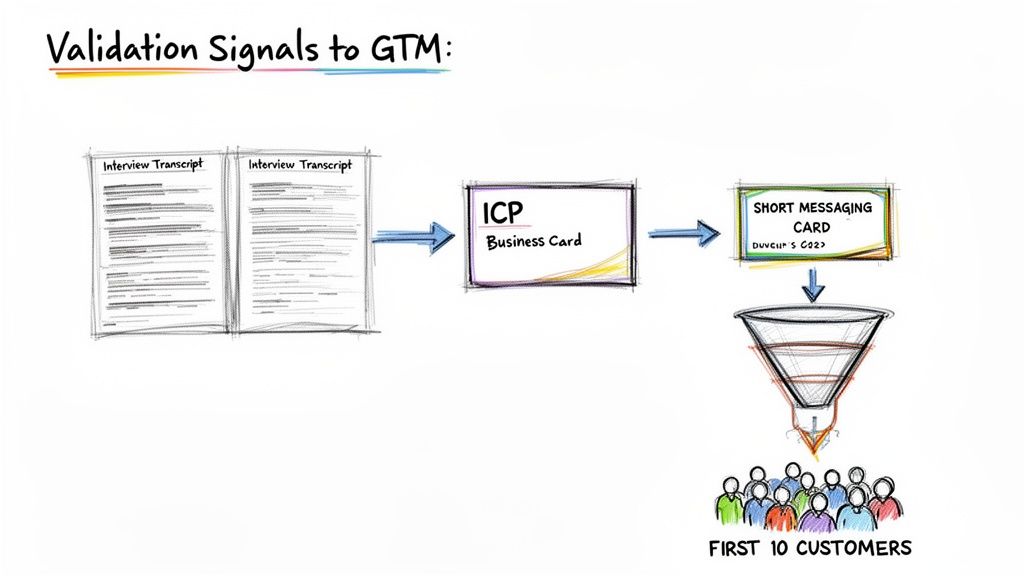
Your Ideal Customer Profile (ICP) cannot be a creative writing exercise. It must be a direct reflection of the people who gave you the strongest validation signals. Who responded to your cold outreach? Who leaned in during your interviews? Who signed the first pilot check?
Forget generic firmographics. Dig into the behavioral and situational signals you’ve already uncovered:
Your V1 ICP is not "mid-market companies." It’s "Heads of Revenue at 200-500 employee SaaS companies using Salesforce and struggling with a 6-month sales cycle." That specificity is your first GTM weapon.
Stop inventing clever marketing copy. Your highest-performing messaging is already written for you, buried in your interview transcripts. Your job is to excavate the exact words your prospects used to describe their world.
Your best marketing copy will almost always be a direct quote from a customer. They have already told you the words that will resonate most deeply with their peers.
Go back through your notes. Pull out the raw, unfiltered phrases they used to describe:
This is the language for your first pitch deck, landing page, and cold outreach. When a new prospect says, "It feels like you've been listening to our internal meetings," you’ve won. This is the first critical step in building a repeatable GTM motion, something we cover in our B2B SaaS Go-To-Market Strategy guide.
With a sharp ICP and customer-sourced messaging, you can build the bare-bones assets you need to acquire your first 10 customers. This isn't about fancy branding. It’s about creating brutally effective tools for a founder-led sales process.
This disciplined approach stops you from burning cash on random acts of marketing. It ensures every ounce of your early effort is aimed at a pre-validated market segment, dramatically increasing your odds of landing foundational customers.
Knowing how to validate an idea isn't an academic exercise. It’s the first, and most important, step in building a go-to-market engine that actually works.
Even with a clear roadmap, founders hit the same validation roadblocks. These are the patterns I've seen play out in the trenches with early-stage B2B teams.
There’s no magic number. Stop looking for one.
The goal is pattern recognition, not statistical significance. You are not running an academic study; you are de-risking a massive business decision.
The signal of "enough" is when you can predict what the next person in that specific segment is going to say about their problems. After about 15-20 deep interviews with a tightly defined persona, the patterns of pain, janky workflows, and business consequences become repetitive.
If you’re still hearing wildly different stories after 20 conversations, the problem isn't the number. It's your targeting. Your segment is too broad. Stop when the insights are saturated, not when you hit an arbitrary quota.
That's not a failure. It's a powerful validation signal. The market is telling you that the problem you think you're solving isn't urgent enough for a busy professional to give you 30 minutes.
Before you scrap the idea, analyze your outreach.
If you've sent 100 targeted, personalized emails and have zero meetings, the problem isn't your email template. The problem is your core assumption about the market's pain.
A busy executive's willingness to give you 30 minutes of their time for free is a powerful validation signal. It proves the problem is real enough to command their most valuable resource: attention.
No. A $50 gift card attracts people who want $50, not people desperate to solve a six-figure business problem. You contaminate your data pool with mercenaries, not motivated prospects.
The interview itself should be the value. A great problem discovery call feels like a productive, free strategy session for them. You're helping them articulate and quantify a problem they've been struggling with. That is valuable.
If you feel you must offer something, make it relevant. Offer a summary of the anonymized research findings or a guaranteed spot in the early access pilot. This selects for people who are genuinely invested in the problem space.
This question comes from a false premise. You never "stop" validating. Validation is a continuous loop, not a one-time gate.
You simply stop validating one assumption and start validating the next. You move from problem validation (interviews) to solution validation (a concierge MVP or clickable prototype) and then to willingness-to-pay validation (paid pilots).
The decision to write production-grade code should only come after you have multiple, compounding forms of evidence: the qualitative "why" from interviews, the quantitative "what" from experiments, and—ideally—a signed letter of intent or a pre-paid pilot agreement. Building is the last step, not the first.
At Big Moves Marketing, we help B2B SaaS founders move from assumption to evidence. If you need clarity on your go-to-market strategy and a proven playbook for validating your idea, let's talk. Learn more at https://www.bigmoves.marketing.
Explore Big Moves Marketing services and resources:





%20-%20white.svg)