%20png%20copy.avif)

Choose Intercom. For most B2B technology teams buying in 2026, it’s not close.
Intercom is actively developed, AI-first, and built to resolve support conversations at scale with its Fin agent. Drift, meanwhile, is being steered toward sunset under Salesloft ownership, with new business referred to a platform called 1mind. That’s not a knock on Drift’s legacy strengths in account-based routing and meeting booking. It’s a market reality.
Intercom is the stronger default purchase in 2026 because it remains actively developed and AI-first, while Drift’s ownership under Salesloft has frozen its roadmap and pushed new business toward 1mind.
| Point | Details |
|---|---|
| Default recommendation | Choose Intercom for new purchases; its Fin AI and roadmap are actively invested in, unlike Drift’s. |
| Drift’s real status | Salesloft has steered Drift toward sunset, with renewal price hikes reported in the 20–40% range. |
| Exception case | Salesloft-heavy sales orgs should evaluate 1mind before defaulting to Intercom. |
| Migration timeline | Budget 4 weeks and $5,000–$15,000 for a consultant-led migration off Drift. |
| Lower-cost alternative | HelpCrunch offers predictable pricing for small teams that don’t need enterprise AI depth. |
| Get migration support | Bigmoves helps design pilots, migrate messaging, and align your website for the new platform. |
The AI story is where Intercom and Drift genuinely diverge, and it’s the first thing to understand before you compare a single feature checklist.
Intercom’s Fin is built as an AI resolution engine. It reads support tickets, answers them, and Intercom bills you per resolved conversation on top of seat-based pricing. That structure means your invoice moves with your deflection rate — a good problem to have if Fin is actually closing tickets, a frustrating one if usage spikes without warning.
Drift’s AI, by contrast, was never built for support resolution. It was built for qualification: reading intent signals, routing accounts to reps, and booking meetings. That’s a sales pipeline job, not a customer lifecycle job, and it’s a fundamentally different use case than what Fin does.
If your evaluation criteria center on “can this AI handle inbound support volume,” Intercom wins by design. If your criteria center on “can this AI qualify inbound leads for sales,” you’re really asking whether Drift’s aging AI stack, now under Salesloft’s roof, still gets meaningful investment. The honest answer in 2026 is: not much. Teams piloting AI agents for either job should treat billing model as a first-class evaluation criterion, not an afterthought, since resolution-based billing changes your cost forecasting compared to flat seat pricing.

Yes, effectively. Salesloft’s move to steer Drift toward sunset, announced alongside a Clari-related update in early March 2026, changed the calculus for anyone still evaluating Drift as a standalone buy.
New standalone signups are hard to come by. Salesloft is referring prospective Drift customers to 1mind instead, and existing customers describe a frozen product roadmap with no meaningful feature investment since the acquisition closed. That’s a familiar pattern after a strategic acquisition: the acquirer folds the target’s technology into its own stack and lets the standalone product coast.
For buyers, this means Drift is no longer a “buy and grow with it” platform. It’s a legacy tool with a defined shelf life. If you’re currently on Drift, the roadmap question isn’t “what’s coming next” — it’s “how long until renewal forces a decision.” If you’re evaluating Drift fresh in 2026, you’re not really evaluating Drift. You’re evaluating whether 1mind, its designated successor, fits your stack.
Intercom’s status is the opposite story: continuous feature releases, an AI product (Fin) getting active investment, and no acquisition cloud hanging over its roadmap. That contrast alone should carry real weight in any RFP.
Neither platform publishes a simple price sheet, but the shape of what you’ll pay differs sharply between them.
Intercom runs a seat-plus-usage model. You pay for agent seats, then pay Fin resolution fees on top based on how many support conversations the AI actually closes. It’s transparent in structure even when the final number takes some math to project, and Intercom’s 14-day trial includes unlimited Fin resolutions, so you can model real usage before committing.
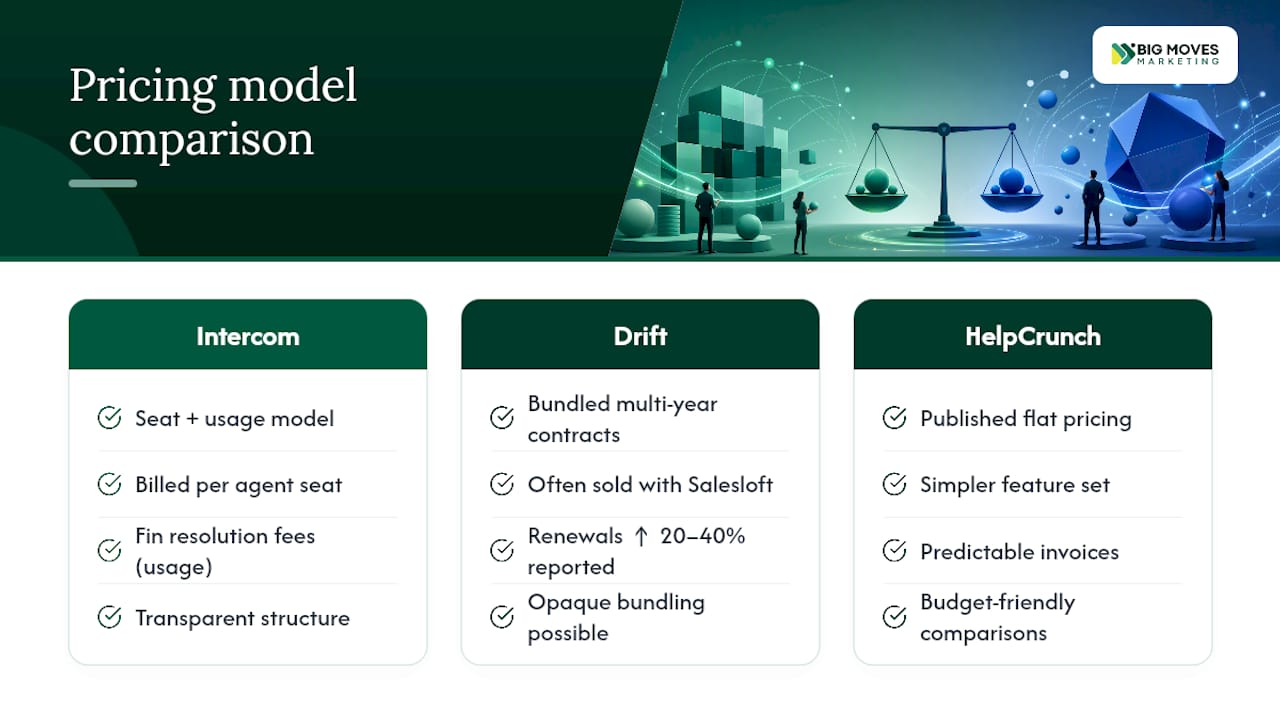
Drift’s pricing has moved the opposite direction. Contracts increasingly default to multi-year terms bundled into the broader Salesloft ecosystem, and renewal customers report price increases in the 20 to 40 percent range post-acquisition. That’s the kind of number that should trigger a procurement review well before your renewal date lands on your calendar.
If either platform’s opaque bundling worries you, HelpCrunch offers a useful contrast: predictable, published pricing with a simpler feature set, which is why it shows up repeatedly in comparisons from budget-conscious teams. It won’t match Intercom’s AI depth, but you’ll never get a renewal surprise.
Pro Tip: Ask any vendor for a 12-month cost projection based on your actual conversation volume before you sign, not a generic seat-count quote. That single number exposes more about total cost of ownership than any feature comparison.
Your existing stack should weigh heavily on this decision, maybe more than any feature checklist.
Intercom integrates broadly across Salesforce, HubSpot, Slack, and most major CRM and support tools, and its ecosystem keeps expanding alongside its AI roadmap. For product-led teams already running HubSpot for marketing and Salesforce for sales, Intercom slots in without much friction.
Drift’s strongest ecosystem fit today is Salesloft itself, for obvious reasons, plus the Salesforce-native workflows it built its ABM reputation on. That’s a real advantage if your sales org already lives inside Salesloft’s outreach cadences and you want chat-based routing feeding directly into those sequences. Outside that specific setup, Drift’s integration story has stalled along with its roadmap.
The practical takeaway: if you’re not a Salesloft shop, Intercom’s broader and more actively maintained integration list matters more than any single Drift feature. If you are deep in Salesloft outbound motions, evaluate 1mind and Salesloft’s own bundle before assuming you need a separate chat platform at all.
Migrating chat platforms mid-cycle is disruptive if you do it wrong, and it’s genuinely manageable if you don’t.
Start with a parallel run rather than a hard cutover. Keep Drift live while you configure Intercom (or whichever platform you’re moving to) in a staging environment, then run both simultaneously for two weeks. Track meetings booked, AI deflection rate, and agent workload across both systems side by side. That comparison tells you what you’re actually gaining or losing before you flip the switch, not after.
Budget realistically. A clean migration typically takes four to eight weeks with consultant support, and implementation spend often runs in the $5,000 to $15,000 range depending on how many custom bot flows and integrations you’re rebuilding. Skip the consultant and you’ll likely stretch that timeline, not shrink it.
Before you migrate anything, audit what’s actually working in your current Drift setup. Which playbooks generate qualified meetings? Which routing rules matter? Document those before you tear the platform out, because that institutional knowledge is what gets lost in a rushed switch. Teams that treat migration as a messaging and positioning exercise, not just a technical one, tend to come out ahead. That’s also the moment to revisit how your lead qualification process actually works, since a platform switch is a natural checkpoint to fix broken handoffs between marketing and sales.
Support quality is the one category where a platform’s own product philosophy shows up most clearly in how it treats you as a customer.
Intercom, as an AI-first support platform, generally applies its own product philosophy to its own customer support: Fin fields your first-line questions, and human escalation follows for complex cases. Users on G2 rate Intercom slightly higher than Drift on aggregate review scores, roughly 4.5 versus 4.4, a narrow gap but a consistent one across thousands of reviews.
Drift’s support has grown noticeably less predictable since the Salesloft acquisition. Customers report longer response windows and less clarity on escalation paths, which tracks with a product being wound down rather than actively staffed for growth. That’s not a knock on individual support reps. It’s what happens organizationally when a roadmap freezes.
For HelpCrunch, support responsiveness tends to reflect its smaller scale: fewer enterprise escalation tiers, but often faster human response for straightforward tickets simply because there’s less ticket volume competing for attention. If responsiveness during your own eventual support tickets is a dealbreaker, weigh recent user reviews over vendor marketing copy. Aggregate scores shift slowly, but the tone of the most recent thirty reviews tells you what’s happening right now.
The interface each platform gives your agents and your customers shapes daily adoption more than any spec sheet ever will.
Intercom’s agent inbox unifies conversations, help desk tickets, and product tour triggers in one workspace, which matters if your support and product teams work from the same queue. Customers get a consistent widget across your app and website, and the in-app product tour capability means onboarding messaging and support live in the same interface rather than two disconnected tools.
Drift’s interface was built around a sales rep’s daily workflow: intent alerts, account intelligence, and meeting scheduling front and center. It’s a genuinely well-built experience for that specific job, and G2 reviewers consistently praise its ABM and routing workflows. But it was never designed as a support agent’s daily tool, and that gap shows the moment you try to stretch it beyond sales.
HelpCrunch keeps things simpler on both sides: a straightforward agent dashboard and a lightweight chat widget, without the layered AI features either competitor offers. For a small team, that simplicity itself is often the better user experience, since there’s less to learn and less to misconfigure.
Security and compliance rarely make the shortlist of comparison criteria, and that’s a mistake for any B2B technology company handling customer data at scale.
Intercom publishes standard enterprise security documentation covering data encryption, access controls, and compliance certifications that most SaaS security reviews expect to see. Because it remains under active development, its security posture also gets continued investment, which matters if your legal or security team runs annual vendor reviews.
Drift’s compliance documentation still exists, but with the platform’s roadmap frozen, don’t expect meaningful new security investment going forward. That’s a real consideration if your procurement process requires evidence of ongoing security maintenance, not just a point-in-time certification.
Whichever platform you choose, get current SOC 2 or equivalent documentation directly from the vendor before signing, and confirm data residency terms match your customers’ regulatory requirements. Don’t rely on a comparison article, including this one, as your final compliance source.
Flexibility in bot design determines how much of your actual sales and support process you can encode into the platform, versus working around its limitations.
Intercom’s workflow builder lets you branch conversations based on user attributes, product usage data, and support history, and Fin can be scoped to specific topics or knowledge base articles so it doesn’t overreach into areas it shouldn’t answer. That granularity matters for B2B teams with complex product lines where a generic bot response does more harm than good.
Drift’s bot builder remains capable for its original purpose: qualifying leads through branching question flows and routing based on account tier or intent signals. It’s a mature toolset for that narrow job, built over years of ABM-focused development, even if it hasn’t evolved meaningfully since the acquisition.
HelpCrunch offers basic bot flows and auto-responses, adequate for FAQ deflection and simple routing, but without the depth either larger platform offers for complex, multi-branch logic. If your use case is straightforward, that’s not a limitation you’ll notice.
AI deflection rates get the headlines, but the analytics layer underneath determines whether you can actually prove ROI to your leadership team.
Intercom’s reporting covers conversation volume, response times, customer satisfaction scores, and engagement across in-app messages and product tours, giving marketing and product teams a shared view of the customer lifecycle. That breadth matters when you need to show a CFO that your support investment is reducing churn, not just closing tickets faster.
Drift’s analytics remain strongest around pipeline metrics: meetings booked, account engagement scores, and conversion from chat to opportunity. That’s exactly the reporting a sales-led org wants, and it’s a legitimate use case worth preserving if you migrate, by exporting historical data before any Drift sunset timeline forces your hand.
Whatever platform you land on, define your success metrics before implementation, not after. Meetings booked, tickets deflected, and time-to-resolution all mean different things depending on whether you’re running a sales-led or support-led motion, and measuring the wrong metric from day one wastes your first quarter of data.
Setup complexity scales with how much you’re trying to customize, not with the platform itself, and that catches a lot of teams off guard.
A basic Intercom deployment, seat setup, widget install, and a starter Fin knowledge base, can go live in a week or two. Layering in custom workflows, product tours, and deep CRM sync stretches that timeline to four to six weeks for most mid-market teams. Drift’s setup complexity follows a similar curve for its ABM routing rules and account scoring logic, though with less incentive now to invest heavily in a platform on a frozen roadmap.
HelpCrunch’s simpler feature set generally means faster setup, often live within days for a small team with straightforward needs.
The bigger time sink for any platform switch isn’t the software configuration. It’s rewriting your bot scripts, retraining your support team, and testing edge cases in your actual product before customers see them. Budget more time for that than for the technical install itself.
Most comparison articles treat Intercom and Drift as if they’re still competing head to head on features. They aren’t, not anymore, and pretending otherwise does buyers a disservice.
The Salesloft acquisition changed Drift from a product decision into a vendor-risk decision. That’s the framing conventional advice keeps missing: the question isn’t “which bot builder is better” anymore, it’s “which vendor still has a reason to invest in what I’m buying.” Intercom has that reason. Drift, under its current ownership structure, doesn’t, and no amount of legacy ABM strength changes that math for a new purchase.
Where I’d push back on the easy conclusion: don’t assume Intercom is right just because Drift is fading. If your entire go-to-market motion runs through Salesloft’s outbound cadences, evaluate 1mind honestly before you default to Intercom out of momentum. The right call depends on which job, support resolution or pipeline qualification, actually drives your revenue.
What I’d prioritize first: run the two-week parallel test before signing anything. Vendor demos oversell every time. Your own usage data won’t.
Picking between Intercom, Drift, and a lower-cost option like HelpCrunch is really a positioning question wearing a software decision’s clothes. Bigmoves helps B2B SaaS teams design the pilot, not just pick the platform.
We build the two-week parallel-run framework for you, migrate your existing bot flows and messaging without losing what’s already converting, and make sure your website and in-app experience are ready for whichever AI agent you choose. That’s the difference between a rushed platform swap and one that actually protects pipeline. Our website and go-to-market service covers exactly this: readiness work that aligns your messaging, your site, and your new conversational stack before launch, not after something breaks.
If you’re facing a Drift renewal deadline or just want a second opinion before you sign an Intercom contract, get in touch and we’ll map out your migration plan and pilot metrics together.
Intercom’s primary competitors include Drift, HelpCrunch, Zendesk, and Freshdesk, though Drift’s competitive position has weakened significantly since its acquisition by Salesloft.
Zendesk is built specifically for support ticketing and case management, while Drift’s strength was always sales qualification and meeting booking, not support resolution, so the two rarely compete for the same buying decision.
No. Intercom is still the company and platform name; Fin is Intercom’s AI resolution agent, a product feature within Intercom rather than a rebrand of the company itself.
In software buying conversations, “Intercom” typically refers interchangeably to its customer messaging platform, its help desk, and its Fin AI agent, since all three now ship as one integrated product.
Not necessarily immediately, but current Drift customers should start evaluating alternatives, including Intercom and 1mind, well before their next renewal date given reported price increases and the frozen product roadmap.




%20-%20white.svg)