%20png%20copy.avif)
The question, "How do we get more leads?" is a trap. It sends B2B SaaS teams into a spiral of tactical chaos—buying lists, running directionless ads, and spamming prospects on LinkedIn. This is the fastest way to burn cash and demoralize a sales team.
The real question, the one that builds a defensible business, is: "How do we build a system where our ideal buyers find us and are already convinced we're the right choice?"
The standard lead generation playbook is broken. It operates on a brute-force model where success is measured by vanity metrics like MQL volume.
I have seen this low-leverage motion exhaust the resources of dozens of early-stage and Series A-C companies. The entire process is built on the flawed premise that lead quantity is the path to growth. It ignores the far more critical factors of lead quality and buying intent.
The fundamental error is confusing lead capture with demand creation. Capturing existing demand—the small fraction of the market actively searching for a solution—is easy. It's also a commodity game with diminishing returns. Scalable growth comes from creating new demand by educating the market on a better way to solve their problem.
The objective is to escape the MQL hamster wheel and build a gravitational pull for the right buyers. Stop asking how to generate more leads. Start asking how you can become the inevitable choice for your ideal customer profile.
This isn't about working harder; it’s about applying leverage. It's a strategic shift from chasing prospects to making your company a destination for high-intent buyers.
How do you make this shift? It begins by dismantling the assumption that more activity equals more pipeline. It requires a disciplined focus on positioning and a commitment to educating your market, not just pitching to it.
Most companies start in a state of disorganized chaos. With the right strategy, they can move toward a focused system of demand creation.
This diagram illustrates that journey.
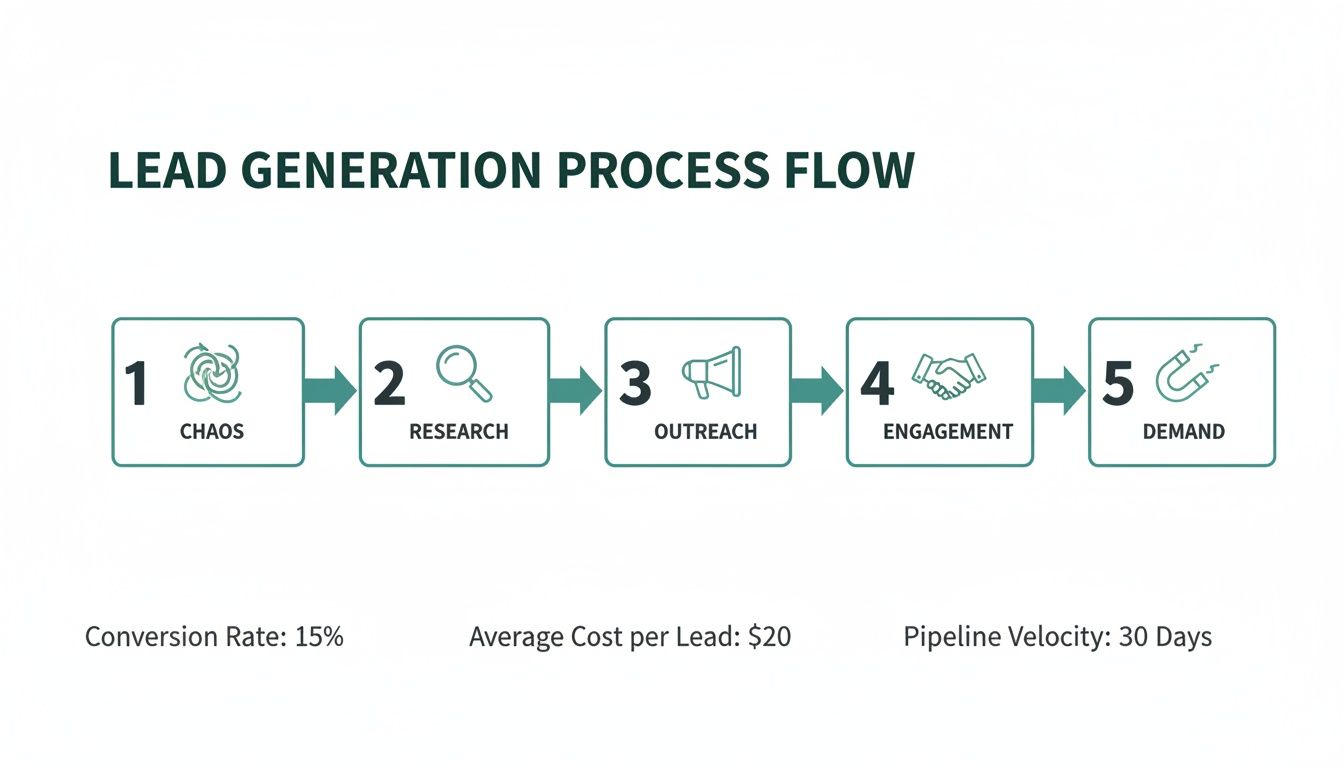
The path from chaos to demand isn't about adding more tactics. It's about adding a strategic layer that makes every marketing dollar and every hour spent more effective.
This table contrasts the common, low-leverage activities most companies default to with the high-leverage strategic imperatives that build a durable pipeline.
| Common Tactic (Low Leverage) | Strategic Imperative (High Leverage) |
|---|---|
| Running generic ads to cold audiences | Creating educational content for specific pain points |
| Buying contact lists for mass outreach | Building a proprietary audience through a newsletter |
| Gating all content to capture MQLs | Ungating most content to maximize distribution and trust |
| Focusing on lead volume (MQLs) | Focusing on pipeline velocity and deal quality |
| Measuring marketing by activity and clicks | Measuring marketing by revenue and pipeline contribution |
| Chasing prospects with outbound sequences | Attracting high-intent buyers with a strong POV |
Shifting from the left column to the right is how you build a moat around your business. This transition from chasing to attracting is where sustainable growth is born.
Consider the data: SEO-driven leads have a close rate of 14.6%, while outbound-sourced leads close at a dismal 1.7%. For an early-stage team, this means investing in content that solves a specific problem for your ICP is exponentially more valuable than cold calling.
I saw this firsthand with a client in the AI space. They were trapped in the outbound grind with a 13% MQL-to-SQL conversion rate. We shifted their focus to creating in-depth content. After ranking for a high-intent term, their conversion rate shot up to nearly 40%—all because they started attracting buyers who were already trying to educate themselves.
Building this gravitational pull isn't magic. It rests on two non-negotiable fundamentals.
A Painfully Specific ICP Definition: Go beyond job titles and company size. You must understand your Ideal Customer Profile’s deepest pains, their day-to-day frustrations, the metrics their boss judges them on, and the internal language they use to describe their problems. Without this, your message will be generic and invisible.
A Sharp, Defensible Point of View (POV): What do you believe about your market that your competitors don't? Educating the market isn't about writing another "Ultimate Guide." It's about having a strong perspective that challenges the status quo and logically guides the best buyers toward your unique solution.
This is the real work of demand creation. It's the critical inflection point for scalable growth that I’ve observed across more than 70 SaaS companies. For those ready to explore how to put this philosophy into practice, here are some proven demand generation tactics that align with this strategic thinking.
To go even deeper on this approach, see our complete guide to B2B demand generation.
A weak pipeline is almost always a symptom of weak positioning. If your message is generic, your leads will be, too.
Too many founders mistake lead generation for a tactical problem, believing the solution is more ads, more content, or more SDRs. In reality, it’s a strategic problem. It’s a failure to clearly and forcefully articulate your value.
The quality of leads you attract is a direct reflection of the clarity you project. When your pipeline is clogged with demo requests from the wrong company size, the wrong industry, or the wrong buyer persona, that’s not a broken lead form. It’s a broken message.
This is a core misalignment I’ve seen in dozens of growth-stage companies. They pour money into generating traffic but fail to invest in the one thing that turns that traffic into high-quality opportunities: sharp positioning.
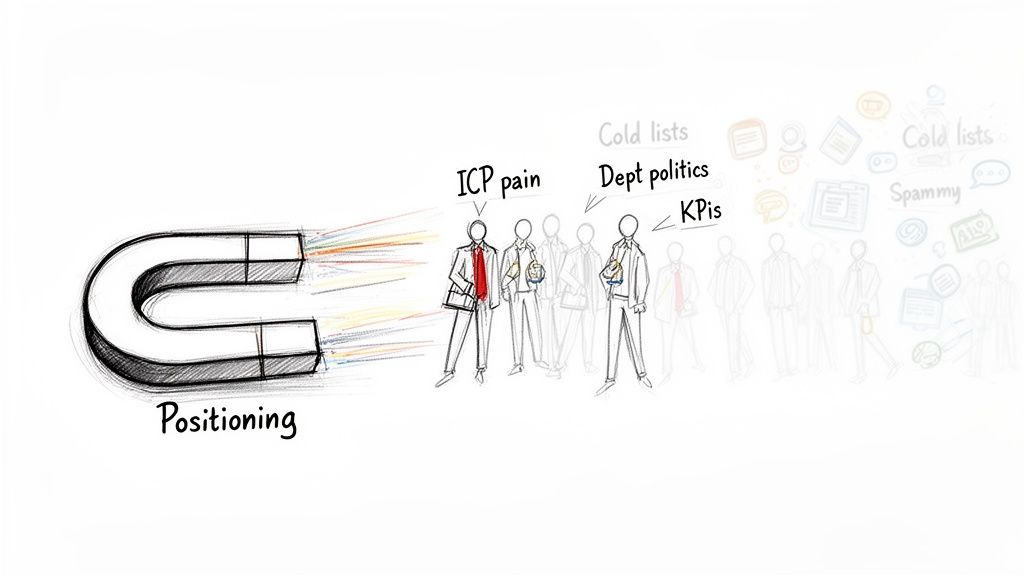
Positioning isn't a clever tagline. For a B2B SaaS leader, it's a series of deliberate, strategic choices that answer three critical questions for a skeptical buyer:
When you nail these three points, your ideal customers qualify themselves. They arrive on your website and think, "This is for us." Anyone who isn't a fit just as quickly disqualifies themselves. That is how you generate leads your sales team actually wants.
Most SaaS messaging is a wall of features and vague benefits. It fails the "so what?" test from the CFO or CRO who controls the budget.
To see if your positioning is strong enough to drive pipeline, audit your homepage and key landing pages. Ask yourself:
A strong message acts as a filter. It repels low-fit prospects and attracts high-intent buyers who are already halfway to believing you're the right solution for their specific, urgent problem. This is the foundation of an efficient growth engine.
Imagine you're an AI tool entering a crowded market. Generic messaging about "smarter insights" is a death sentence.
A winning position is: "While [Incumbent] gives you a 30,000-foot view, our tool gives Heads of Sales a real-time, deal-level risk assessment so they can save at-risk revenue this quarter."
That’s not marketing fluff. It’s articulating value in the language of the buyer’s P&L. To dig deeper, review the 5 pillars of B2B positioning that work.
Ultimately, knowing how to generate leads is less about tactical execution and more about strategic clarity. Fix the message, and you fix the pipeline.
Most B2B inbound marketing is a waste of time. Too many SaaS teams blog into the void, churning out generic "Ultimate Guides" and "Top 10" lists, hoping something sticks. This approach doesn't build a predictable pipeline. It fills your CRM with subscribers and low-quality MQLs.
A real inbound engine is a system of gravitational pull. It is meticulously designed to attract, educate, and convert buyers who are problem-aware and actively looking for a solution. It's about respecting their intelligence and anticipating their needs, turning your website into a strategic resource.
Forget arbitrary content quotas. The goal is to create assets with undeniable utility for your Ideal Customer Profile.
The most common mistake I see is creating "content" for search engines instead of creating tools for your buyer. A high-intent buyer—say, a Head of Sales at a Series B company—isn't searching for a 3,000-word history of their problem. They are looking for leverage. They want tools, frameworks, and insights that help them make a smarter decision, build a business case, or de-risk a purchase.
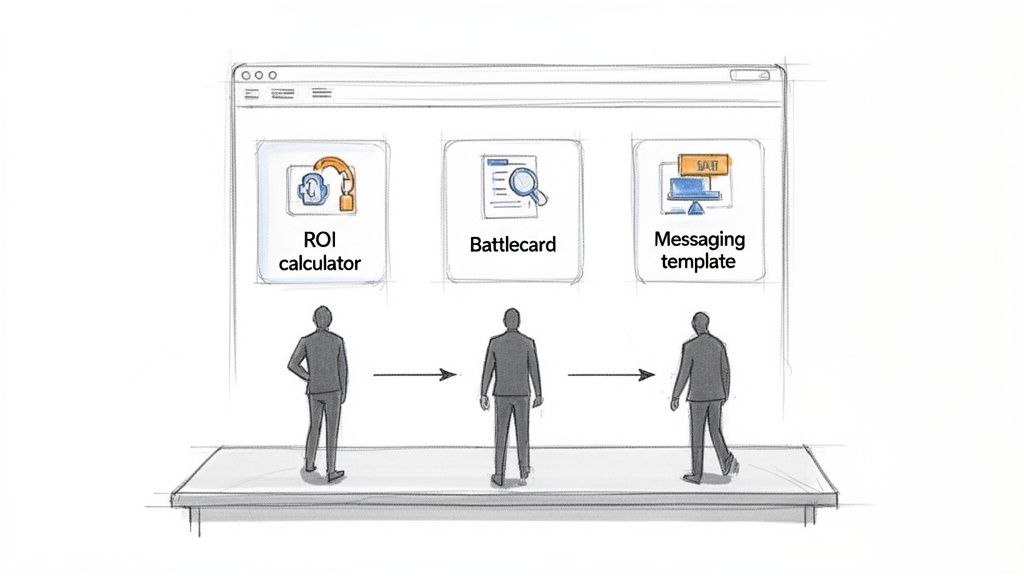
Instead of another blog post, build assets like these:
These are not lead magnets; they are sales acceleration tools. They stop being "marketing content" and become an indispensable part of your buyer's decision-making toolkit.
Your inbound engine should function like a consultation. Every asset must deliver a moment of clarity or a tangible piece of value that moves the buyer forward, with or without your direct involvement. This is how you build trust before a salesperson ever enters the picture.
Creating useful assets is only half the battle. They must be deployed at the right moment. A classic failure is offering a bottom-of-funnel calculator to a top-of-funnel visitor. It's a disconnect that kills conversion.
Instead, think through the logical sequence of questions your buyer asks:
Awareness ("Am I understanding this problem correctly?"): At this stage, they need frameworks and point-of-view articles that reframe their problem. Your sharpest, most challenging insights should live here, completely ungated.
Consideration ("What are the ways to solve this?"): Now, they need tools to compare options. This is the place for maturity models, honest vendor comparison guides, and case studies that mirror their situation.
Decision ("Why is this the best solution for us?"): Here, you provide tools to help them justify the purchase internally. This is where ROI calculators, implementation plans, and internal-champion battlecards become critical.
This structured approach ensures you're guiding the prospect with the right insight at the right time. To keep this engine running with ideas that resonate with your ICP, you can explore an Idea Database and adapt proven concepts with your unique point of view.
Designing a powerful inbound engine is about shifting from a publisher mindset to a product mindset. Every asset is a mini-product built to do a specific job for your buyer. To learn more about this philosophy, see our guide on B2B inbound marketing.
Let's be blunt: cold outbound is dead. The version most companies cling to—impersonal, volume-obsessed, and devoid of value—is a surefire way to torch your brand.
Strategic outbound isn’t about blasting lists. It's about opening specific doors with specific keys.
Most outbound fails because it's selfish. It screams, "Here's what I have, want to buy it?" A better approach assumes your prospect is busy, skeptical, and drowning in noise. You must earn their attention by proving you've done your homework.
Every piece of outreach must answer two questions from the prospect’s point of view: "Why are you contacting me specifically?" and "Why should I care about this right now?" This framework forces you to tie your solution to a prospect’s immediate world.
The key to making this work is using trigger events. These are public signals that a company is far more likely to be feeling the exact pain your product solves.
This research-driven approach transforms your outreach from a cold pitch into a timely, relevant consultation. You’re no longer a random vendor; you’re an informed advisor.
Forget mass emailing. For this surgical approach, your primary channels are LinkedIn and hyper-personalized email. The goal isn't to spam connections but to build authority and spark one-to-one conversations.
LinkedIn is a core engine for B2B lead generation. It's responsible for 80% of social media leads, and 62% of B2B marketers say it generates effective leads for a reason. Its business context is why visitors from LinkedIn convert at a higher rate on B2B sites than traffic from any other social platform.
Stop thinking of outbound as a numbers game. Start thinking of it as an intelligence operation. Your goal isn't a 1% response rate from 1,000 contacts. It's a 20% response rate from 50 perfectly chosen contacts.
In an early-stage company, the founders are the best salespeople. Their product knowledge and authentic passion are your most valuable assets. But they need a simple, repeatable playbook to ensure their outreach is an expert consultation, not a desperate sales pitch.
This "mini-playbook" should include:
This setup equips the team to have high-value conversations that generate qualified pipeline. It’s the difference between being another email in the spam folder and being a welcomed expert. For a deeper dive, learn how to build a complete outbound lead generation system.
Generating a lead isn't the finish line. The chasm between a marketing-generated "lead" and a sales-ready opportunity is where most growth engines break down.
I’ve seen it repeatedly in early and growth-stage SaaS companies. Marketing celebrates a record number of MQLs while Sales complains the leads are garbage. Both sides are right, and the business pays the price.
The problem starts with a weak definition of a lead. If your definition is just a name and an email from a company that fits your firmographics, you are setting your sales team up for failure. It’s a direct recipe for low morale and a stalled pipeline.
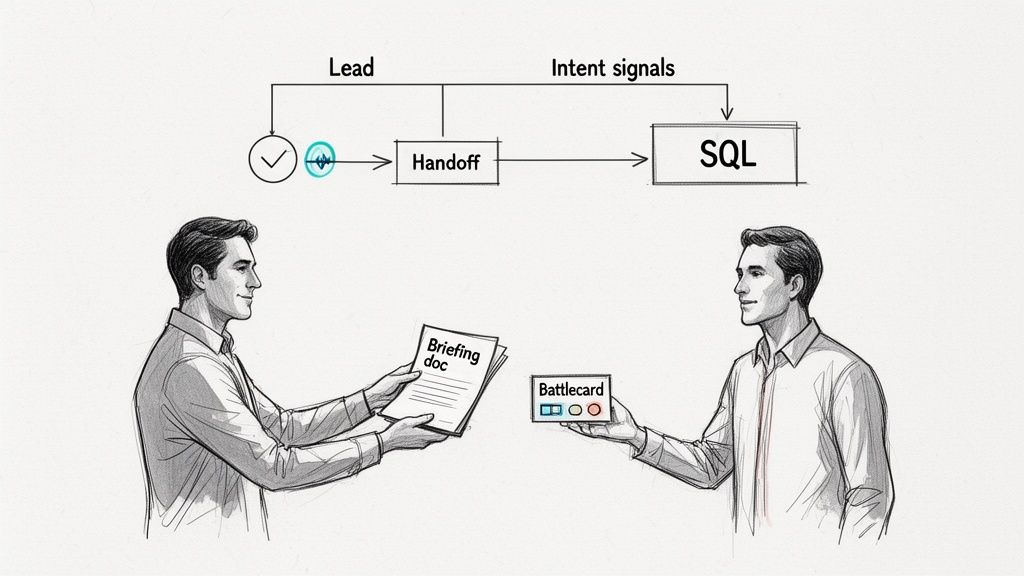
A true Sales Qualified Lead (SQL) isn't just a person. It's a person demonstrating behaviors that signal intent. Your job is to define and track those behaviors. Firmographics (company size, industry) tell you if they could be a customer. Intent signals tell you if they might be ready to become one.
What actions show a prospect is moving from passive research to active evaluation?
Your lead scoring model shouldn't be a complex academic exercise. It should be a simple, revenue-focused system that flags prospects based on these tangible, high-intent actions.
Once a lead is flagged as an SQL, the worst thing marketing can do is forward an email address to a sales rep. This is an abdication of responsibility. The AE is now flying blind, forced to start a generic discovery call from scratch and wasting the context the prospect has already shown.
A seamless handoff is a strategic imperative. It preserves buying momentum and gives your sales team the context they need for a valuable first conversation.
To bridge this gap, every qualified lead must be accompanied by a concise intelligence packet. This is non-negotiable. This packet gives the sales team the ammunition to transform a cold touch into a warm, consultative conversation.
This briefing document must contain:
This simple step changes the entire dynamic. The rep is having a relevant, helpful conversation from the first touchpoint. This is how you convert intent into real pipeline. To delve deeper, explore our guide on how to qualify B2B leads.
Real inbound lead generation is a long-term asset, not a short-term hack. Brace yourself for a 6 to 9-month ramp-up before you see a consistent, predictable flow of high-quality leads.
The first three months are foundational. This is where you do the deep work on your ICP, sharpen your positioning, and create core content that establishes your point of view. It’s the unglamorous part everyone wants to skip, and it’s why most inbound programs fail.
Around months four to six, you’ll start to see some pull. Your content ranks for long-tail keywords, and you begin building a small, dedicated audience. By months seven to nine, the flywheel starts to spin, and your content library begins generating leads on its own.
The goal isn’t a quick spike in junk MQLs to satisfy a board deck. It’s to build a permanent, revenue-generating machine that brings ideal buyers to you for years. Patience isn't a virtue here; it's a strategic advantage.
Neither. Your first and only focus should be on what I call “manual-bound.”
This is where the founders conduct highly personal, research-driven outreach to a hand-picked list of 50 to 100 perfect-fit potential customers. The point of this exercise isn't to sell; it's to learn.
These conversations are where you validate your entire go-to-market strategy. You test your messaging and get an unflinching education on your customer's real problems. The feedback from this phase is the bedrock for all future marketing.
Only after manually closing your first 5 to 10 customers and proving your message resonates should you systematize. At that point, run two tracks in parallel:
Trying to scale both from day one is a classic, costly mistake that destroys the focus you desperately need at the earliest stages.
Stop tracking vanity metrics. MQLs, website traffic, and content downloads are almost entirely useless for measuring what matters. They don't correlate to revenue and they encourage the wrong behavior—chasing volume over quality.
If you can't trace a KPI back to a dollar sign, get it off your dashboard.
The only metrics that matter are the ones that directly measure pipeline and revenue. Focus relentlessly on these three:
Tracking these forces an honest, revenue-focused conversation about what’s actually working.
The single biggest and most destructive mistake is outsourcing the thinking. Too many founders, under pressure to grow, hire a junior marketer or a cheap agency and give them an impossible task: "Go get us leads."
Lead generation is an output of strategy. If you, the founder, aren't crystal clear on your ICP, your positioning, and your value proposition, no amount of tactical execution will save you. A hired gun will just amplify a weak message, burning cash while delivering a pipeline full of unqualified prospects.
The founder must own the strategic foundation. You must do the hard work of defining who you serve, what unique problem you solve, and why your solution is the only logical choice. Only when that strategic clarity is rock-solid can you effectively delegate execution.
At Big Moves Marketing, we partner with B2B SaaS founders and GTM leaders to achieve this strategic clarity. We help you build the sharp positioning and effective go-to-market thinking required to generate a predictable pipeline and drive scalable growth. Find out more at https://www.bigmoves.marketing.
Explore Big Moves Marketing services and resources:

%20-%20white.svg)