%20png%20copy.avif)
The build vs. buy debate paralyzes early-stage teams. I’ve watched dozens of founders and their engineers burn cycles in this circular argument, framed as a false choice between technical purity and vendor dependency.
It’s a complete waste of time. The discussion misses the point entirely.
The real question isn't which is better, but where you require a proprietary advantage to win. For everything else, buying isn't just an option—it's a strategic necessity. Getting this wrong is a direct tax on your growth.
Founders consistently get anchored on the wrong variables. The conversation degrades into a tug-of-war between engineering, which reflexively wants to build, and finance, which defaults to the cheapest line item.
Generic pro/con lists only worsen the problem. They don't account for the reality of a B2B SaaS company navigating an evolving ICP, the chaotic demands of founder-led sales, or the non-negotiable need to maintain momentum. This isn't a productive discussion. It's a strategic distraction that signals a lack of clarity.
Stop asking, “Should we build or buy this?” Start asking a much sharper question: “Is this capability part of the core reason a customer chooses us over a competitor?”
This reframe kills the debate and shifts the focus from cost to leverage. It forces brutal honesty about what constitutes a core capability versus what is simply commodity plumbing.
The impulse to build everything from scratch is a common tell. It often signals a team that lacks a clear point of view on what truly matters to their customer. They get caught optimizing for technical control instead of market impact.
Treating a commodity function as a core problem is a classic—and costly—early-stage mistake. It burns your most valuable resource, engineering time, on solving problems the market has already commoditized. Your goal isn't to have the world's best in-house billing system; it's to acquire and retain paying customers.
When you're trying to win your next ten deals, a founder's time is far better spent learning how to give the best presentation than overseeing the development of an internal tool. Stop the debate. Start making strategic choices about where your team can create genuine, defensible leverage.
If you're stuck in the ‘build vs. buy’ debate, it's not because your team is indecisive. It's because your decision-making framework is broken. To get past circular arguments, you need to evaluate trade-offs grounded in the reality of a B2B SaaS startup, where speed, focus, and market feedback are the only currencies that matter.
This isn't about a textbook answer—it’s about making a justifiable call that aligns scarce resources with your strategy. The choice between custom software versus off-the-shelf solutions is common, but our framework cuts through the noise with four core pillars.
Forget abstract benefits. Every build vs. buy decision must be pressure-tested against these four questions. The answers will point to the right path for your company, right now.
This decision tree helps visualize the shift away from an outdated, cost-focused debate. The new frame is about strategic leverage and differentiation.
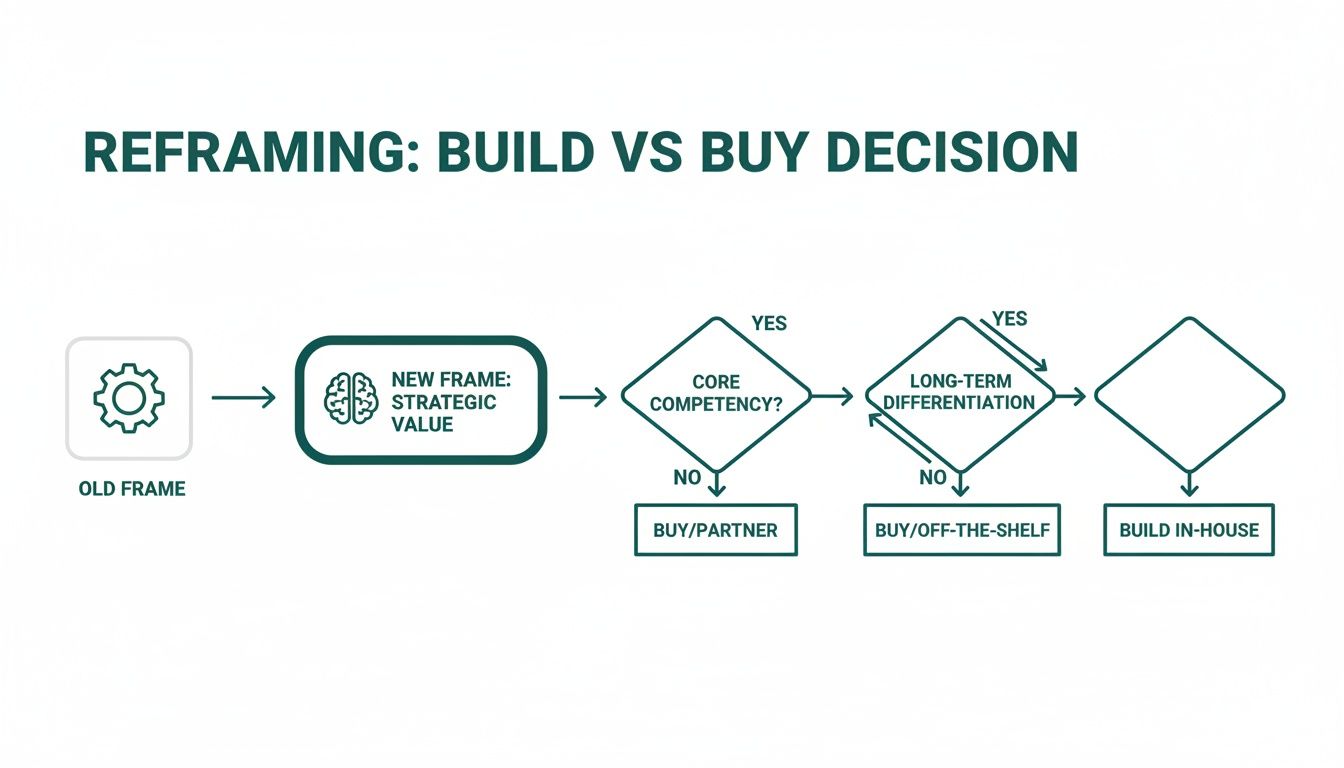
The key takeaway is that the decision process itself has to change. It’s no longer a tactical choice about resources; it's a strategic one about where to apply force to win your market.
This is your first and most important filter. If a capability isn't a core differentiator, the debate should end here. Ask your team these questions, and do not accept fuzzy answers:
If the answer to these is "no," you buy. It’s that simple. Building a non-strategic component is a critical error that diverts your best engineers to solving problems that have already been solved.
Founders consistently underestimate the long-term drag of a custom build. It’s not about the initial development sprint; it's the endless tail of maintenance, security patching, and bug fixes that follows.
The true cost of building isn't the initial engineering salaries. It’s the accumulated distraction of an engineering team forced to play defense on a non-core system instead of offense on the core product.
On the flip side, speed to market isn't just about launching faster. It's about the speed of learning. Buying a solution lets you test a hypothesis in the market almost immediately. You can validate a new workflow or sales motion in weeks with a vendor tool—a process that could easily take six months to build. That six-month delay is a catastrophic loss of learning in a competitive market.
Finally, you have to think about future constraints. A "buy" decision isn't always permanent. The right move today might be to buy a solution to get to market fast, with a plan to build a replacement once you hit product-market fit and have crystal-clear requirements.
But you also have to consider the opposite. If a capability is deeply intertwined with your core data model or a unique workflow, buying a rigid, off-the-shelf tool can create an unbreakable ceiling. You become handcuffed to your vendor’s roadmap. When you're assessing a "buy" option, you have to ask:
A practical build vs. buy framework forces these uncomfortable but necessary conversations. It shifts the discussion from emotional preferences to a rigorous, strategic assessment of trade-offs. This ensures every major resource allocation is a deliberate step toward market leadership, not just another line item on a roadmap.
Founders make the same mistake time and again in the build vs. buy debate: they dramatically underestimate the Total Cost of Ownership (TCO) for both paths. The back-of-the-napkin math—developer salaries versus license fees—is a dangerously shallow analysis. A decision made with incomplete data is almost guaranteed to be the wrong one.
Building isn’t just the upfront engineering cost. It's the technical debt that quietly accumulates, the ongoing maintenance that pulls your best engineers off the core product, and the strategic drag of a permanently distracted organization.
Likewise, buying isn't just the sticker price on a contract. It's the integration nightmares, the customization brick walls you’ll inevitably hit, and the predictable price hikes that come as your usage scales.
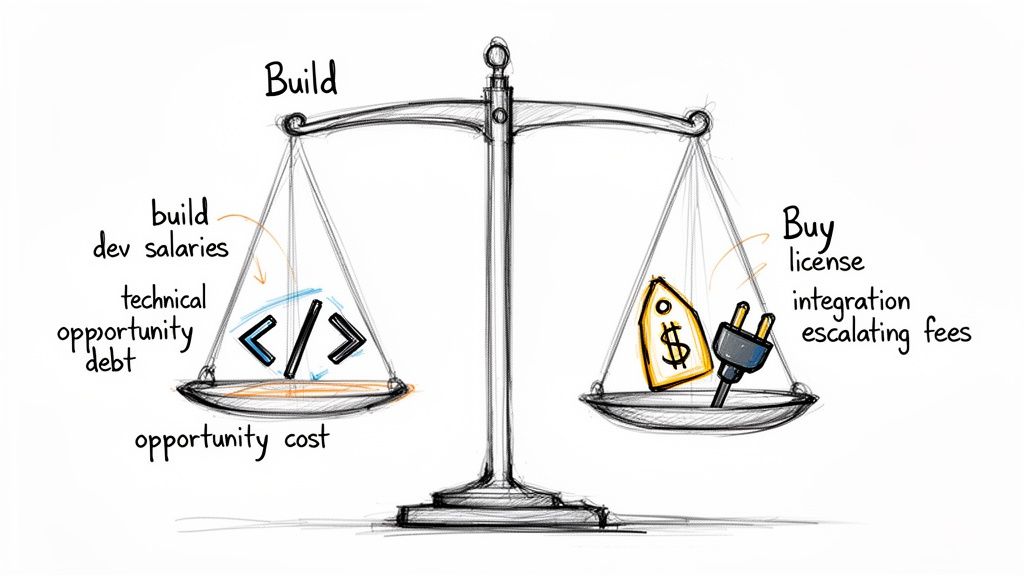
The biggest cost of building isn't financial. It’s opportunity cost.
Every hour your best engineer spends patching a non-differentiating internal tool is an hour they are not spending on the core product that actually wins you customers. Think of it as a direct tax on your innovation speed.
Beyond that, the financial bleed is real and persistent:
The "buy" path looks deceptively simple, but the real costs are buried in the contract's fine print and the operational friction it creates. That initial license fee is just the ticket to entry.
You have to factor in the rest:
The most insidious cost of buying is vendor lock-in. Once your data and processes are deeply embedded in a third-party system, the pain of migrating away becomes so high that you're held hostage by their roadmap and their pricing.
Let's put real numbers to this. Here's a realistic financial model comparing a custom build to a SaaS tool for a hypothetical B2B SaaS company over three years.
The initial sticker shock of building is significant. However, the escalating license fees for buying can narrow the gap over time. This simplified model doesn't even account for opportunity cost or the value of owning a strategic asset, which could dramatically shift the balance.
Ultimately, TCO analysis must be viewed through a strategic lens. Building can be cheaper long-term for core, differentiating functions that give you a competitive edge. Buying is almost always more economical for non-core capabilities, especially when you factor in the massive cost of delaying your time to market.
For an early-stage company, speed is a weapon. Time to market isn’t a metric; it's a critical variable that directly influences product validation, early revenue, and investor confidence. The obvious path to speed seems to be buying, but that's a dangerously shallow analysis.
The common thinking: buying is fast, building is slow. This is only true in the short term. While buying gets you a solution in weeks, it can introduce long-term rigidity that grinds your agility to a halt.
I've watched teams spend more time building workarounds for a vendor's limitations than they would have spent building a focused, custom solution. That’s the moment the initial speed advantage of buying completely evaporates.
Building is slower upfront. No debate. But when a capability is core to how your product creates unique value, that initial investment can unlock much faster iteration cycles down the line.
This "slow is fast" approach pays dividends when creating a unique product experience. Think of a custom onboarding flow that perfectly matches your user’s mental model, or a competitive battlecard system that integrates directly into your sales team’s workflow in a way no off-the-shelf tool can.
The core of the build vs. buy decision for agility isn't about initial deployment speed. It’s about your future ability to respond to market feedback without being constrained by a vendor's roadmap.
When you build a core function, you own the iteration cycle. When you buy it, you are outsourcing that cycle to a vendor who will never be optimized for your business.
Founders often confuse "time to market" with "speed to launch." They are not the same. Speed to launch is about getting a product out the door. Speed to learning is about how quickly you can test a hypothesis, gather feedback, and adapt.
Buying accelerates speed to launch. You can have a functional system live in weeks, valuable for testing non-core hypotheses.
Building can accelerate speed to learning. For core functions, a custom build—even a stripped-down one—allows you to make precise changes based on user feedback, without waiting for a vendor. For a deeper dive on this, check out our guide on building a Minimum Viable Product.
This distinction is crucial. Time-to-market is a hidden powerhouse in the analysis. Buying can slash deployment time, with 71% of teams choosing it for rapid value realization, according to Product School's leadership analysis. This allows you to test MVPs and iterate on sales strategies almost overnight.
However, a deeper look reveals how building can align perfectly with unique workflows, like a custom messaging framework that resonates with key decision-makers. The final decision must weigh the immediate need for a functional system against the long-term need for strategic flexibility. Buying gives you immediate velocity but can create a drag chute later. Building is an investment in future agility, but only if the capability is truly core to how you win.
The old build-versus-buy debate is dead. It’s a false choice that the sharpest B2B SaaS teams moved past long ago. Today, it’s all about a hybrid model: you buy the commodity stuff and build your strategic differentiators right on top.
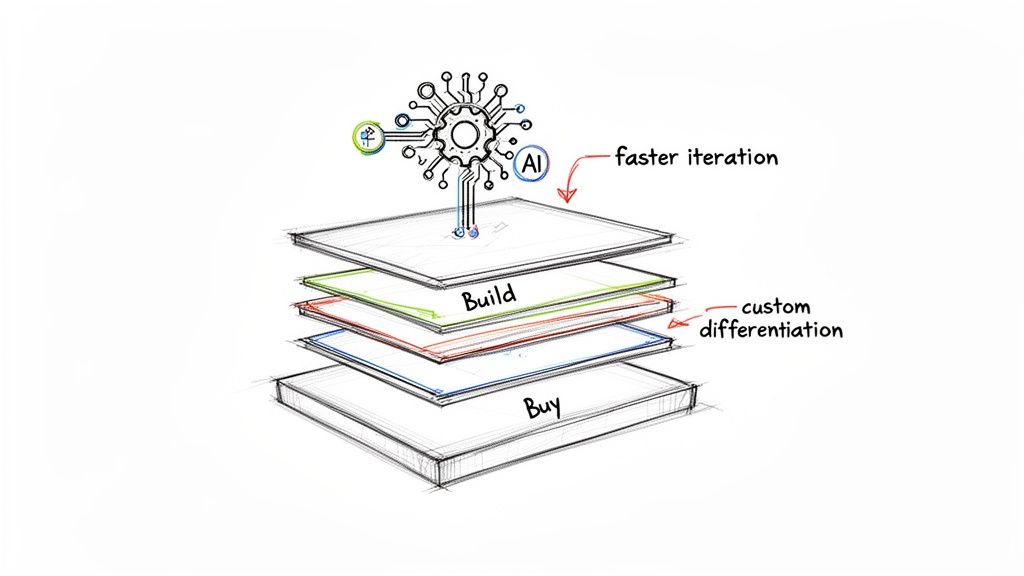
This "build on top of buy" approach treats vendor platforms as foundations, not finished products. The real magic happens when you use their APIs and infrastructure as a launchpad to create custom layers that house your unique IP and deliver your actual value proposition.
And now, AI is completely rewriting the economics of this decision. AI-powered code generation and sophisticated low-code platforms are slashing the cost and time it takes to build everything from internal tools to customer-facing features. This makes the "build" side of the equation more viable than ever for functions that truly move the needle.
For founders trying to get a handle on this, understanding how to approach building SaaS products with Generative AI is a massive advantage. We're no longer talking about a six-month engineering slog; we're talking about using AI to spin up tailored solutions in a fraction of the time.
I'm seeing more and more teams use AI-assisted development to rip out generic SaaS products and replace them with hyper-specific solutions. These custom-built tools integrate perfectly into their GTM motions and workflows, eliminating the friction and workarounds of off-the-shelf software.
This isn't a niche trend—it's accelerating. Recent data shows that 35% of teams have already replaced at least one SaaS tool with a custom build, and a staggering 78% plan to build more internal tools this year. The driving force? Developers are using AI to build bespoke solutions themselves, bypassing slow procurement cycles. You can see the full breakdown in the 2026 Build vs. Buy Report from Retool.
The modern build vs. buy decision is less about cost and more about control. AI gives you a lever to take back control over core workflows without the historical cost and time penalties.
For instance, I worked with one SaaS launch where we ditched a generic CRM for a custom-built integration that was perfectly aligned with their founder-led sales process. It was designed to surface the right objection-handling content at exactly the right moment. The result was a 20% reduction in their sales cycle time because the tool directly supported the way the team actually sold. This is the kind of outsized ROI you get from building for a strategic differentiator. You can explore more on this in our guide on using AI to power B2B enterprise SaaS growth.
The new reality is a hybrid one. Buy commodity tools to accelerate your time-to-value, but be aggressive in identifying where a custom-built, AI-assisted solution can create a proprietary advantage that your competitors simply can't replicate.
Strategy without execution is just theory. You’ve reframed, analyzed, and costed out the build vs. buy decision—now it’s time to commit and get moving.
There is no universally “correct” answer here, only the right choice for your specific context, right now.
The final call boils down to a simple, unflinching heuristic:
Build if this capability is in the top three reasons a customer chooses your product over a competitor's. Buy if it's a non-differentiating cost of doing business.
This isn't an engineering decision or a finance decision; it's a strategic leadership call. Your job is to make it and align the entire organization behind it.
Pressure test your final choice against these questions. The clarity of your answers will reveal the right path forward.
Once the decision is made, you have to socialize it effectively. Your engineering, product, and go-to-market teams need to understand the why behind the choice, not just the what.
Frame it in terms of clear-eyed trade-offs.
If you build, you are accepting a slower time to market in exchange for long-term control and differentiation. If you buy, you are prioritizing immediate speed and focus in exchange for potential future constraints. Articulate these trade-offs transparently to get buy-in from your team.
A well-communicated decision, even if it wasn't everyone's first choice, prevents second-guessing and ensures the whole team moves in the same direction. For more on this, our insights on creating a cohesive product launch plan template can help align your teams for execution.
The best build vs. buy decision is the one that maximizes your strategic advantage and minimizes wasted motion. It focuses your most valuable resources—engineering and leadership attention—on winning the market you’re in, not on re-solving problems the market has already figured out.
These are the questions I hear most often from founders wrestling with the build vs. buy decision. The answers usually cut through the common sticking points and internal debates.
Opportunity cost is everything. It's the single most critical, and most frequently ignored, factor in this entire debate.
The real question isn't "Can our engineers build this?" Of course they can. The question is, "What are they not building while they're doing this?" Building a non-core capability is a direct tax on innovation, and it's a steep one.
Imagine pulling your two best engineers off a core feature that could boost customer retention by 5%. If they spend the next six months building an internal analytics tool instead, the "build" option just came with a massive, hidden price tag. You have to quantify it by estimating the revenue or strategic value of the next best project on your roadmap—the one you're pushing aside.
If the value of that deferred project is greater than the long-term savings or strategic advantage of building, you should buy. It's that simple.
There's no magic revenue number or team size that triggers this switch. It's a gut feeling backed by data. You'll know it's time when the balance of three key factors tips over.
A common failure pattern is waiting way too long to make the switch. The pain of migrating away from a deeply entrenched vendor only gets worse with time. A "buy then build" strategy requires actively planning for the "build" phase from the beginning, not just vaguely hoping for it someday.
This is a pure leadership test. These disagreements almost always stem from different departments optimizing for their own local metrics. Engineering wants to build something cool with new tech. Finance wants the lowest number on the P&L this quarter. Sales just wants the feature yesterday.
Your job is to elevate the conversation. Force everyone to argue their case using a shared, objective framework.
Run the debate through the lens of strategic impact, total cost of ownership (TCO), and speed to market—metrics that matter to the entire business. You have to depersonalize the decision by making it about hitting company objectives, not about whose preference wins.
Use a decision framework to score each option against criteria everyone agrees on beforehand. The goal isn't to get to a happy consensus. It’s to make a clear, well-reasoned decision that everyone understands and can commit to, even if it wasn't their first choice. This is how you stop the endless debate and start moving again.
Making these critical growth decisions with clarity is what separates winning teams from those who get stuck. Big Moves Marketing helps founders and GTM leaders develop the positioning, messaging, and strategic frameworks to move faster and avoid wasted motion. If you need a partner to sharpen your thinking and accelerate your go-to-market, let's talk.
Explore Big Moves Marketing services and resources:





%20-%20white.svg)