Google Ads Demand Gen is a visual, audience-led campaign type built to reach buyers before they search, then optimize toward measurable actions. Google reports that advertisers adding it to existing Search and/or Performance Max campaigns generated 14% more conversions on average, but that result doesn't prove incremental pipeline for any specific company.
That distinction is where most B2B advice goes wrong. More attributed conversions can look like growth while the campaign intercepts buyers who were already on their way to Search, a demo request, or a sales conversation. The question isn't whether Demand Gen can produce conversions. It's whether it creates qualified opportunities that wouldn't otherwise have existed.
Demand Gen isn't just Discovery with a new label, and it isn't Search with pictures. Google introduced the campaign type on June 14, 2023, as an AI-powered successor to Discovery, designed to reach people before they actively search for a product. Google's launch announcement described a campaign built around visual surfaces and demand creation, not another way to capture existing keyword intent.
That difference changes what a B2B team should ask of the channel. Search responds to an expressed need. Demand Gen can introduce a solution while a buyer is watching a video, browsing a feed, or checking email. If the buyer's category is unfamiliar, or your product solves a problem they haven't started searching for, that earlier exposure can matter. But it also makes attribution less straightforward.
The weak tactic is to launch a Demand Gen campaign, optimize it for the easiest form submission, and declare success when the platform reports conversions. That rewards the system for finding people who'll complete a form, not necessarily accounts that match your ICP or progress to an opportunity. For a sales-led SaaS company, cheap leads can make the dashboard look healthier while sales acceptance stays flat.
The right question: What qualified pipeline did Demand Gen create that Search, existing brand demand, and your other channels wouldn't have created anyway?
A serious program treats Demand Gen as a potential source of incremental pipeline, then tests that claim against CRM outcomes and lift measurement. That means making deliberate choices about funnel role, audiences, budget, creative, and conversion feedback. It also means being willing to stop if the campaign can't show evidence beyond platform-reported conversions.
Demand Gen spans YouTube, YouTube Shorts, Discover, Gmail, Maps, and the Google Display Network, so planning it as a single placement or one generic awareness bucket misses the point. Google says its Display expansion can reach more than 90% of the global internet population across over 3 million sites and apps. Those surfaces create opportunities for discovery, but broad availability doesn't make every placement equally valuable for every B2B offer. Google's Demand Gen campaign guidance outlines the inventory and campaign capabilities.
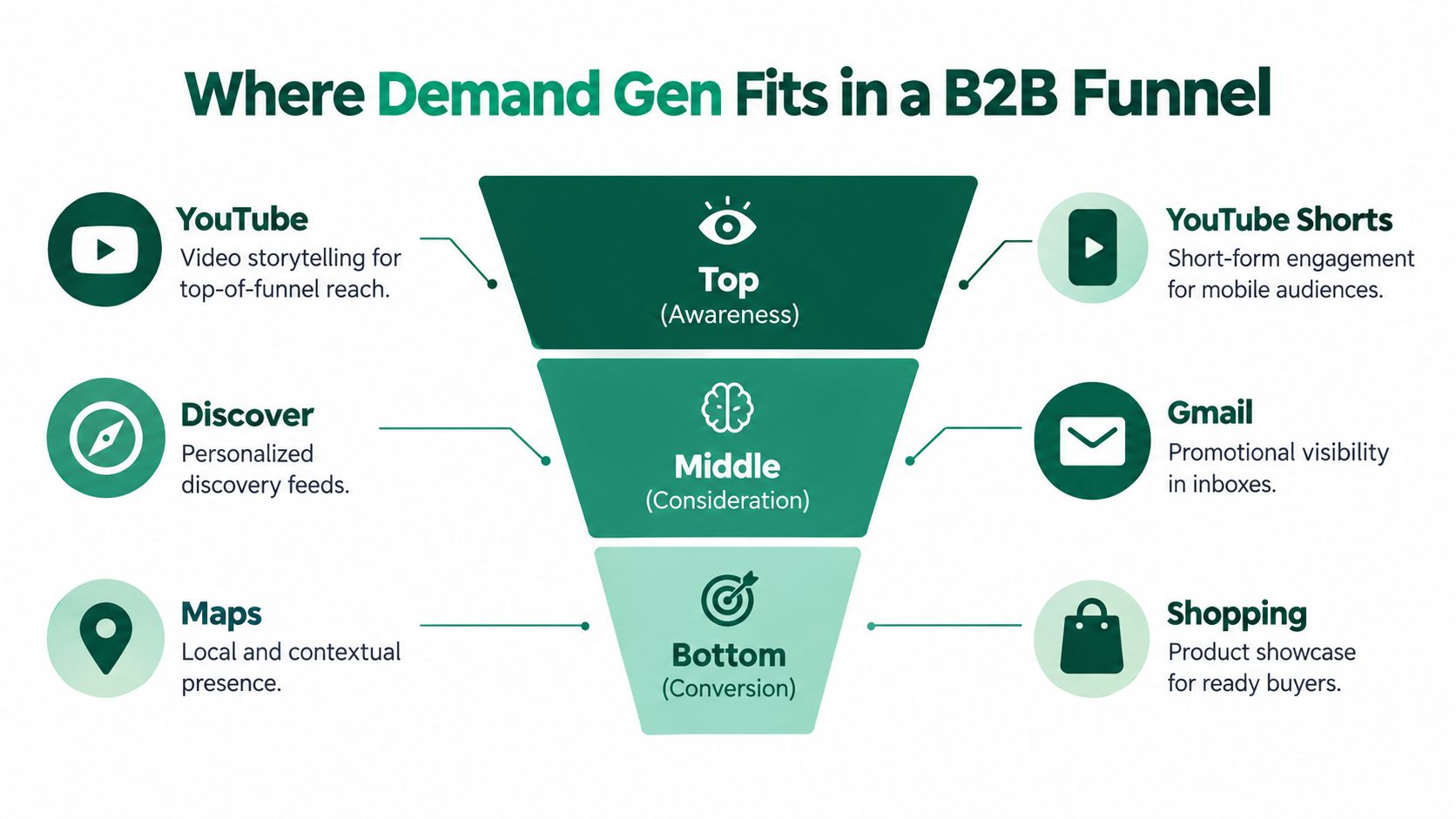
Think about the surfaces by the behavior they allow, not just by their names. YouTube can carry a product explanation or customer problem story. Shorts can introduce a concise point to a mobile viewer, but a vertical video that wins attention isn't automatically persuasive to a buying committee. Discover and Gmail offer feed and inbox visibility, while Maps and Display extend the campaign into other contexts. The job is to identify which formats and environments can move your specific buyer from recognition to evaluation.
Demand Gen uses audience signals and first-party data to guide delivery, rather than relying only on explicit keyword intent. That makes it a different operating model from Search. The campaign may be useful when you need to reach a well-defined audience before it has formed a search query, but it's a poor substitute for high-intent Search when buyers already know the category and are actively comparing vendors.
Use a funnel model that gives the campaign a clear role:
For a deeper view of how those stages connect, see Big Moves Marketing's guide to the B2B SaaS sales funnel. Keep the strategic boundary sharp: Demand Gen belongs in the plan when the goal is qualified pipeline creation beyond branded search volume. If the campaign exists only to fill an awareness line item, nobody has defined what success needs to look like.
The biggest audience mistake is asking automation to solve an ICP problem the business hasn't solved. If Sales can't agree on which accounts are qualified, broad targeting won't fix that disagreement. It'll scale it.
Start with custom segments built around approximately 10–15 search keywords that reflect audience interests, purchase intent, or conversion intent. These aren't a replacement for Search keywords. They're clues that help Google identify people whose behavior may resemble the buyers you care about. Pair them with first-party customer data when you have a usable list, and make sure the list reflects actual fit rather than everyone who's ever filled out a form.

Google introduced Lookalike segments in 2024 and lowered the minimum customer-list requirement from 1,000 users to 100, reducing the data threshold for smaller companies and early-stage advertisers. Google's update on Ads features makes lookalikes more accessible, but smaller list requirements don't make weak seed data useful. A list of poor-fit leads is still a poor model of your ideal customer.
For an early-stage team, use a tightly defined custom segment and the strongest first-party list available. Keep prospecting separate from remarketing so the campaign can't blend people who've never heard of you with people who have already visited your site or engaged with your content. If you need to sharpen the definition of your target account first, use a structured ideal customer profile template.
Only test optimized targeting after tracking has captured enough reliable conversion signal to give the system a meaningful direction. If you activate it while your conversion event is still a low-intent form submission, you're asking Google to find more people who submit low-intent forms. Mature accounts can test broader delivery, but interest targeting shouldn't become a substitute for a clear ICP and a credible seed list.
For a useful distinction between observed buyer behavior and static audience records, LeadBeast's explanation of intent signals offers a complementary perspective. The practical rule is simple: define who matters first, then widen the signal set in controlled tests. Don't mix prospecting and remarketing and call the blended result audience performance.
Choose the bid strategy based on the signal you can trust, not on which option sounds most conversion-oriented. Maximize Clicks prioritizes traffic and can help an early campaign gather delivery information. Maximize Conversions optimizes toward the conversion event you've configured, so it can be counterproductive if that event is cheap, easy, and disconnected from sales quality.
Target CPA adds a cost goal to conversion optimization. Google's published guidance recommends a daily budget of at least 15 times the target CPA. For a $200 target CPA, that means a daily budget of at least $3,000. Google's implementation guidance makes the constraint concrete: setting a tCPA without enough budget doesn't make the target achievable. It can instead restrict delivery and leave the team reading unstable results as a verdict on the channel.

Conversion-value bidding and Target ROAS make sense only when the values sent to Google represent meaningful differences in business value. If a demo request, an unqualified lead, and a sales-accepted opportunity all carry the same value, the system has no useful basis for prioritizing quality. If those values are guesses, value-based bidding can make the wrong decision with more confidence.
A practical sequence is to begin with a conversion goal that your tracking can validate, then bring qualified offline outcomes back from the CRM. Move toward value-based bidding only after the team can consistently distinguish lead quality and assign stable values to the stages that matter. Until then, a simpler strategy with honest measurement beats an advanced bid strategy fed by bad data.
Budget rule: Before launch, calculate whether the daily budget can support the target and still give the campaign room to deliver. If it can't, change the budget or choose a more suitable starting strategy. Don't pretend a target is a plan.
Budget and bids need enough stability for interpretation. Frequent edits make it harder to tell whether performance changed because of the strategy, the audience, or the latest intervention. Set the initial approach, document what would justify a change, and resist tinkering just because early results are uncomfortable.
Creative isn't decoration added after the audience and bid strategy are settled. It determines what the buyer sees, what the campaign can serve across formats, and whether a click represents actual interest. Static-only creative narrows the available experience. A video that tells a clear problem-to-solution story can communicate something a product image can't, while an image may be more legible in a fast-scrolling feed.
Google reports that advertisers using both video and image assets in Demand Gen campaigns achieve, on average, 6% more conversions per dollar than advertisers using image assets alone. Google's Demand Gen creative guidance supports using both formats as a cohesive narrative. Don't interpret that as a reason to upload miscellaneous assets. Format variety helps only when each asset makes a persuasive case for the same product and audience.
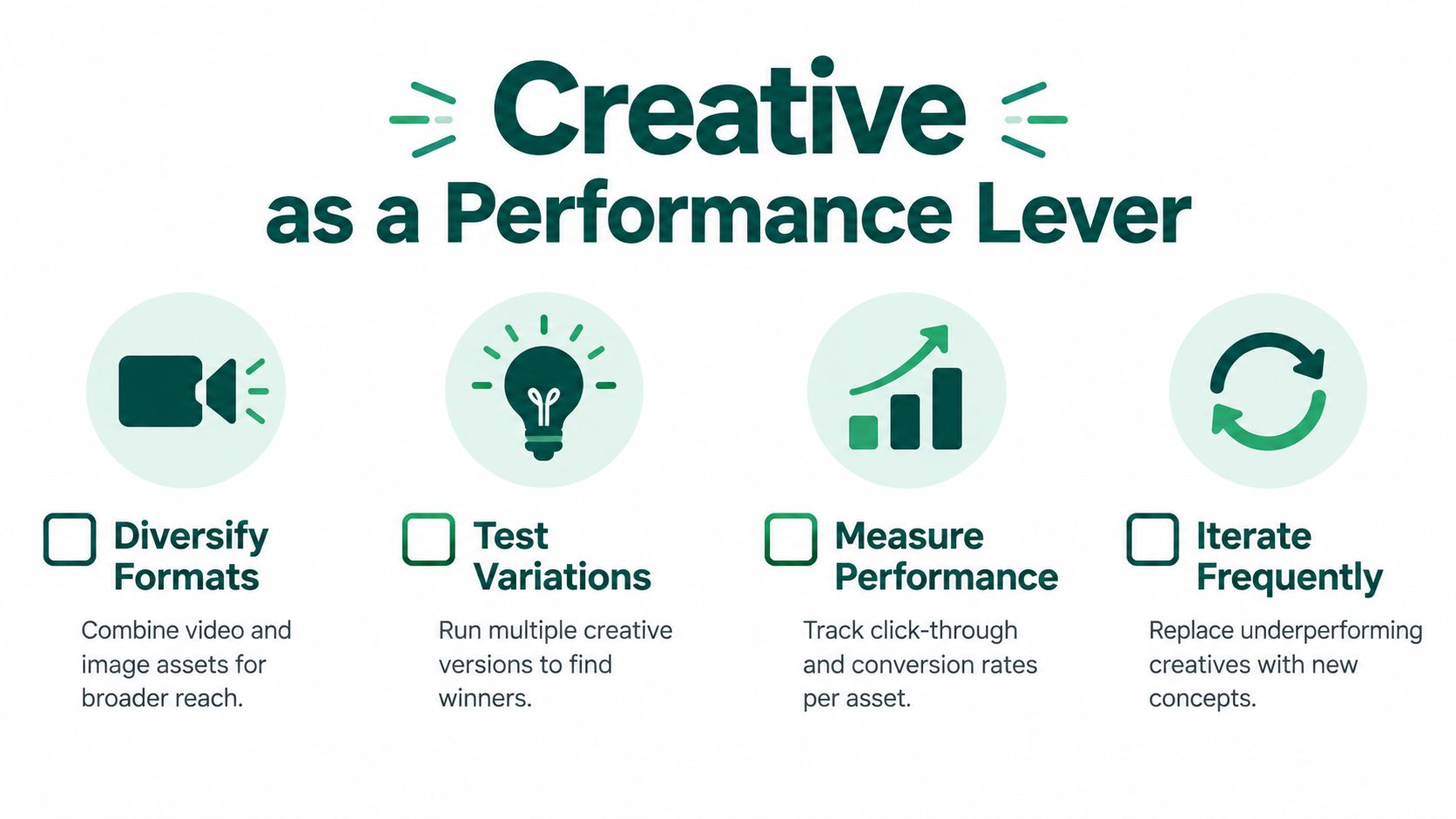
Hold the audience, bid strategy, landing page, and conversion event constant while changing the creative. That gives the team a better chance of learning whether the difference came from the message or from a simultaneous change in targeting or offer.
Test contrasts that matter to a B2B buyer:
Review performance by asset and format, including engagement and qualified conversion outcomes. A click-through rate can show that a creative attracted attention. It can't tell you whether the resulting lead became sales-accepted. Judge assets by qualified conversion rate and cost per sales-accepted lead where the data is available, not clicks alone.
Refresh when asset-level performance deteriorates, not because a calendar says it's time. Make sure each asset resolves to a mobile-usable landing page and that CRM status flows back into Google Ads. For message development, Big Moves Marketing's collection of B2B ad copy examples can help teams think beyond generic product claims.
A platform conversion is an observation, not proof of incrementality. A prospect may see a Demand Gen ad, later search your brand, and convert through a Search ad. Both campaigns can receive attribution credit depending on the measurement method. If the team adds those platform-reported conversions together, it may count the same journey more than once.
Start with CRM stages. Import qualified offline outcomes so Google can receive feedback about whether an initial lead became a marketing-qualified account, a sales-accepted opportunity, or a pipeline-generating account. That closes the gap between the event the campaign can observe and the outcome the business values. If your team uses lead forms, an operational reference such as the Google Ads lead form setup guide from AdManage.ai can support the capture process, but a form setup alone doesn't establish lead quality.
Different tools answer different questions. Data-driven attribution helps distribute credit across observed interactions. Conversion Lift can test whether exposure caused additional conversions against a comparison group. Brand Lift and Search Lift can help assess changes in brand response and search behavior. Those measures are not interchangeable, and none should be presented as revenue proof when the actual outcome is still unverified.
Google began rolling out view-through-conversion reporting in January 2025, bringing Demand Gen measurement closer to social advertising platforms. Google's documentation on view-through conversions makes it especially important to separate observed exposure from incremental outcomes. Set attribution rules deliberately, compare platform reporting with CRM records, and avoid adding overlapping view-through and Search credit as if they were separate opportunities.
For a Series A to C company, an incremental opportunity is a qualified opportunity that would not have entered the pipeline without the campaign's influence. That's harder to establish than a form fill, particularly when several people from an account encounter different channels over a long buying cycle. Use holdout tests where feasible, track assisted pipeline and lagged conversions, and report cost per incremental opportunity when the design supports that conclusion. Big Moves Marketing's guide to measuring marketing ROI provides a useful frame for tying channel decisions to business outcomes.
Report conversions as conversions. Call pipeline incremental only when the measurement supports that claim.
A useful Demand Gen pilot has distinct jobs, clean measurement, and a budget the bidding strategy can use. Don't collapse prospecting and remarketing into one campaign and then treat its blended CPA as a verdict. People who have already visited your website behave differently from new prospects, and the campaign should preserve that distinction.
Set up separate prospecting and remarketing campaigns. In prospecting, keep the initial audience definition focused on custom segments and suitable first-party lists. In remarketing, use relevant prior engagement and tailor the creative to what the audience has already seen. Keep conversion goals consistent with the campaign's role, and avoid giving both campaigns credit for the same business outcome without checking the attribution rules.
Set the budget from the target and bid strategy, not from an arbitrary pilot amount. If you choose Target CPA, apply the published budget guidance rather than assuming a smaller allocation will learn just as well. For other strategies, use a budget the business can sustain long enough to evaluate lead quality and pipeline, and agree in advance on what evidence would justify increasing spend.
Before launch, confirm that the CRM can distinguish qualified leads from unqualified submissions, the landing page works well on mobile, and each creative format has a clear message. A B2B SaaS Google Ads campaign checklist can help catch setup gaps, but the team still needs explicit ownership of outcomes.
At each review, compare platform conversions with CRM-qualified stages, sales acceptance, opportunity creation, and assisted pipeline. Look for evidence that the campaign is reaching new qualified accounts, not merely taking credit for existing demand. If the data shows form volume rising while opportunity quality stays flat, change the conversion signal or the audience before adding budget.
Stop optimizing solely to last-click form fills. Stop running one creative format because it's easier to produce. Stop presenting opaque platform reports as pipeline evidence. A defensible campaign makes the assumptions visible and gives the team a reasoned basis to continue, change, or pause investment.
Big Moves Marketing helps B2B SaaS leaders clarify positioning, choose growth priorities, and connect campaign decisions to measurable pipeline. If you're deciding whether Demand Gen belongs in your acquisition plan, visit Big Moves Marketing to discuss a more defensible approach.