%20png%20copy.avif)
Tired of chasing every possible lead? It's time to stop casting a wide net and start attracting your perfect business partners. To do that, you need something more strategic than a simple buyer persona. You need a blueprint that defines the exact type of company built to win with your solution.
This is where an ideal customer profile template becomes your single most powerful asset for predictable growth.

It's time for a critical shift in focus: from individuals to organizations. While buyer personas are useful, they get one thing wrong for B2B—they describe the people inside a company, not the company itself. An Ideal Customer Profile (ICP), on the other hand, zeroes in on the perfect company that's the absolute best fit for what you sell.
Think of it as a data-driven definition of your most profitable, successful, and valuable customer relationships. This isn’t about guesswork. It’s about identifying the specific firmographic, behavioral, and environmental traits that signal a high-value partnership just waiting to happen. For any B2B business, getting this distinction right is the difference between struggling and scaling.
A well-defined ICP acts as a compass for your entire organization, making sure every team—from marketing and sales to product and customer success—is working toward the same goal. When everyone shares a crystal-clear vision of the "perfect customer," your whole operation becomes incredibly efficient.
Here’s why building one is a complete game-changer:
An ICP is your strategic filter. It tells you which doors to knock on, while your buyer personas tell you how to talk to the person who answers. Both are essential, but the ICP absolutely must come first.
This guide moves past the typical limitations of personas to give you a clear, actionable path forward. We provide a downloadable ideal customer profile template and the steps to build a blueprint that attracts high-value accounts, not just leads.
Understanding the key differences between a B2B buyer persona and an ICP is the first step in sharpening your go-to-market strategy. Get ready to unlock a more focused, efficient, and profitable way to grow.
So, how do we get from a vague idea of a “perfect customer” to a practical tool that actually drives growth? The key is breaking it down into specific, measurable pieces of information. Your Ideal Customer Profile isn't just a rough sketch; it’s a detailed blueprint built from distinct categories of data.
Think of each data point as a signal. When you put them all together, they light up a clear path to the high-value accounts you should be focusing on. Let’s get past the theory and dig into the core data pillars that make up a truly robust ICP.
To really understand a potential customer, you need to look at the company from a few different angles. It’s the strategic blend of these data points that separates a game-changing ICP from a generic one that just collects dust. We're aiming for a comprehensive picture that combines a few key types of intelligence.
Here’s where your research should be focused:
Your goal isn't just to collect data points, but to understand the story they tell together. A company's revenue tells you about their budget, their tech stack tells you about their priorities, and their behavior tells you about their needs.
Let's walk through what this looks like in the real world. At the core, you’re trying to connect different data types to paint a complete picture of who you should be targeting and why they’re a great fit.
Here’s a simple breakdown of the essential data you'll need to gather and analyze to build out a truly useful B2B ICP.
Key Data for Your Ideal Customer Profile
Combining these different elements gives you a multi-dimensional profile that’s far more powerful than looking at any single metric on its own.
This process is really the first step in effective B2B customer segmentation, which allows you to group similar high-value accounts together. This detailed view ensures your sales and marketing teams aren't just targeting the right industry, but the exact companies within it that are primed to buy.
An ideal customer profile built on assumptions is a roadmap to nowhere. To create an ICP that genuinely fuels growth, you need to ground it in reality with a mix of hard data and real human insight.
This isn't just about guesswork; it's a practical research mission. You're trying to uncover the truth about who your best customers really are.
The good news? Your most valuable data is probably already sitting in your own systems. A deep dive into your CRM is the first step to finding the patterns that define your most successful, profitable, and happiest customers. This internal audit is your foundation.
Take a hard look at your top 10-15 clients. I’m talking about the ones who see immense value from your product, have a high lifetime value (LTV), and maybe even send referrals your way without you asking. These companies are your living, breathing ICP.
Analyze them across a few key dimensions to find the common threads that tie them together.
This initial analysis gives you a solid, quantitative baseline. Instead of a vague idea that your best customers are "mid-sized tech companies," your data might reveal they are, more specifically, "B2B SaaS companies with 50-200 employees that adopted our API integration within the first 30 days."
This visual breaks down how these data streams flow together, starting with broad company details and narrowing down to the specific actions that signal a great fit.
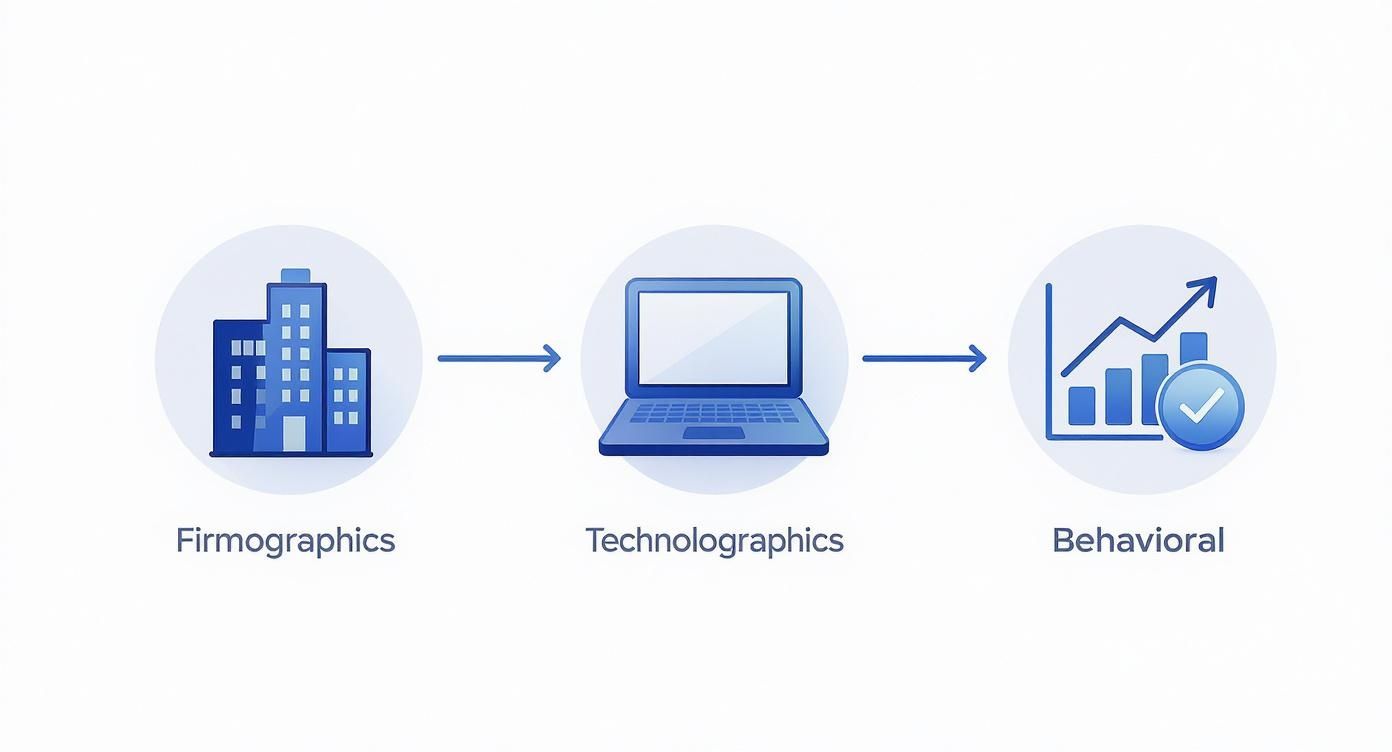
You can see how each layer adds crucial context. The flow from firmographics to behavioral data creates a much richer, more actionable profile than just company size alone.
Data tells you what your best customers look like, but it doesn't always tell you why they chose you. For that, you absolutely have to talk to them.
Conducting interviews with your top clients is the single most valuable thing you can do to uncover their true motivations, their real pain points, and the language they use to describe them.
Don't just ask about your product. Ask about their world. Your goal is to understand their business challenges, their decision-making process, and what a "win" looks like for them, completely separate from your tool.
This qualitative insight is what brings the numbers to life. It's how you move from knowing who to target to understanding how to talk to them in a way that resonates.
Finally, don't forget the goldmine of insights sitting with your sales and customer success teams. They talk to prospects and customers every single day, giving them an unparalleled, real-world perspective on the market.
Get them in a room. Organize a workshop to validate what you've found in your CRM data and customer interviews.
Ask them direct questions like:
This front-line intelligence adds a crucial layer of validation. It ensures your ICP isn't just statistically accurate but also reflects the real-world dynamics your teams navigate every day. This whole process is a core component of effective B2B market research, helping you confirm that your data points to a genuinely receptive and profitable audience.
Don't let your Ideal Customer Profile become another document collecting digital dust in a shared drive. That's a massive missed opportunity. The real magic happens when you actually put it to work, turning that research into the north star that guides every strategic decision you make.
When you operationalize your ICP, you transform how you attract, convert, and retain your best customers. It’s the difference between flying blind and navigating with a precise, data-backed map showing you exactly where your highest-value opportunities are waiting.
For marketing teams, a sharp ICP is a game-changer. Instead of spraying generic content into the void, you can create assets that speak directly to the specific pains and ambitions of a well-defined audience. Your ads, emails, and articles suddenly resonate on a much deeper level because they’re built for someone specific, not for everyone.
This is how you optimize your marketing, business development, and sales efforts for attracting new customers.
The impact on the sales team is immediate and profound. Reps can finally stop wasting precious time on poorly-fit leads and focus their energy exclusively on accounts that mirror your ICP. This unlocks a few powerful advantages:
The data backs this up. Companies with a clearly defined ICP have seen sales productivity jump by up to 20% and their sales cycle shrink by 15%. Those numbers aren't trivial—they represent a streamlined sales motion that closes better deals, faster.
Your ICP is the ultimate alignment tool. It creates a shared language and a common goal, ensuring that the leads marketing generates are the exact ones sales is excited to pursue.
But the value of your ICP doesn’t stop once the deal is signed. It's an indispensable tool for your customer success and product teams, too. When you consistently bring in customers who are a perfect fit for your solution, you're setting them up for success from day one.
Your customer success team can use the ICP to proactively spot upsell opportunities and design retention strategies that actually work. Because they understand the customer's core business goals, their guidance goes way beyond simple product support—they become true strategic partners. This foundational understanding is a key element in aligning sales and marketing with what happens after the sale.
And for your product team? The ICP provides an invaluable feedback loop. By analyzing the usage patterns and feature requests from your ideal customers, they can build a roadmap that solves real-world problems for your most valuable segment. This is how you drive future growth and stay ahead of the competition.
I’ve seen it happen dozens of times. A team puts in the work, builds out what they think is a solid ICP, and six months later, they’re right back where they started—frustrated that their marketing isn't landing and their sales team is talking to the wrong people.
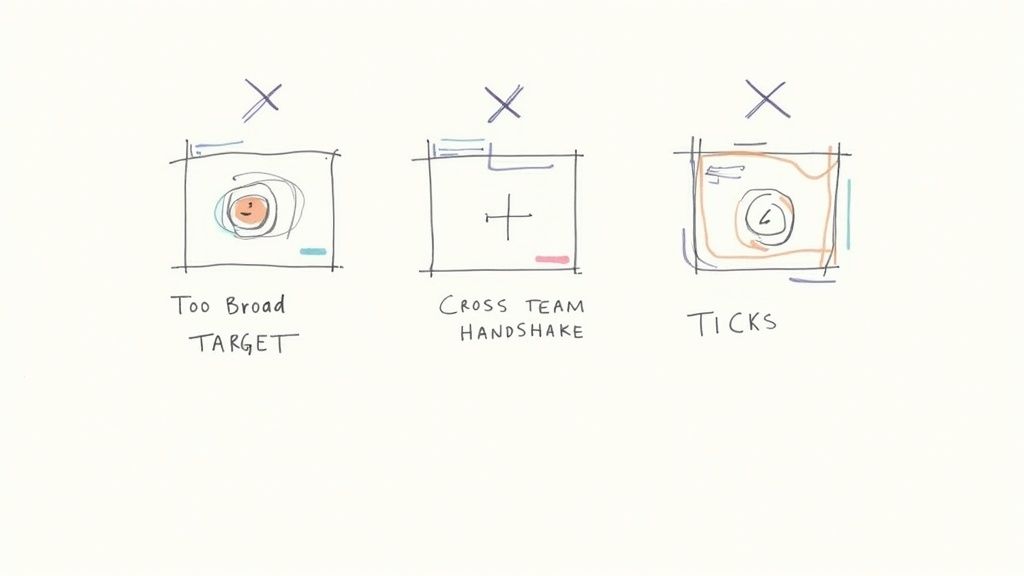
Crafting an ICP is a journey. But there are a few common pitfalls that can turn a promising start into a strategic dead end. Let's walk through the most frequent errors I see teams make and, more importantly, how you can sidestep them from the get-go.
This is, without a doubt, the single biggest mistake. Teams create an ICP that’s so broad it’s essentially useless.
Defining your target as "B2B companies with 100 to 700 employees" might feel safe, but it’s a recipe for generic messaging. A business with 101 employees operates in a completely different universe than one with 699. Their priorities, pain points, and decision-making processes are worlds apart. You can't speak to both effectively with the same approach.
The impulse to include everyone is a trap. True strategic focus comes from brave exclusion—deciding who you are not for is just as important as deciding who you are for. A great ICP should feel specific, almost uncomfortably so.
The Fix: Start small and get painfully specific. Instead of a massive employee range, tighten it up to something like 50-150 employees. Don't just say "the tech industry"; drill down to "early-stage FinTech SaaS." This kind of sharp focus is what allows your outreach, your content, and your product to feel hyper-relevant.
Another classic failure happens when one department—usually marketing—goes off and creates the ICP in isolation. This profile, built on assumptions instead of front-line reality, completely ignores the goldmine of insights your sales and customer success teams are sitting on.
The result? The sales team doesn't believe in the ICP, so they don't use it. It becomes another document collecting dust in a shared drive.
The Fix: Make building your ICP a team sport from day one.
This collaborative approach doesn’t just create a more accurate profile; it builds ownership across the entire organization. When everyone helps build it, everyone is invested in using it.
Finally, too many companies treat their ICP as a static document. They create it once, check the box, and file it away.
But markets shift. Your product evolves. The definition of your ideal customer will absolutely change over time. An outdated ICP can quietly lead your entire go-to-market strategy astray, pushing you to target companies that are no longer a good fit.
The Fix: Schedule regular check-ins. Your ICP should be a living, breathing document. I recommend revisiting and refining it every 6-12 months. Use new customer data, insights from your team, and market trends to make sure it remains a true north for your business.
As you wrap up your go-to-market strategy, a few questions always seem to pop up. Nailing down the answers to these can be the difference between a decent ICP and one that actually becomes the north star for your growth.
Let's clear up the most common points of confusion so you can put that template to work with confidence.
This one comes up a lot. They’re partners, but they solve completely different problems for a B2B company.
An Ideal Customer Profile (ICP) defines the perfect company to sell to—the account itself. It’s all about the firmographics: industry, revenue, employee count, and the tech they use.
A buyer persona, on the other hand, is a deep dive into the individual human being you need to persuade inside that company. It’s about their job title, their personal pain points, and what makes them tick.
Think of it this way: Your ICP tells you which doors to knock on. Your buyer personas tell you exactly what to say to the person who answers. You absolutely need both, but the ICP always, always comes first.
Your ICP is a living document, not a stone tablet you create once and forget about. As a rule of thumb, plan to formally review and tweak it every 6-12 months.
But don't wait for the calendar. You should also give it a refresh anytime your business hits a major milestone. This could be a new product launch, a major pivot in market trends, or your first expansion into a new vertical.
As you learn more about who you serve best, your definition of "ideal" will get sharper. Let your ICP evolve with your business.
Absolutely. In fact, most successful B2B companies do, especially if you sell to different industries, serve both SMBs and enterprise clients, or offer distinct product lines.
The profile of an ideal customer for your enterprise analytics platform is going to look wildly different from the one for your small business project management tool.
The trick is to avoid getting overwhelmed. Start by building out your primary ICP—the one that represents your absolute best, most profitable customer segment. Get that one right, then you can build out others for secondary markets. This focused approach is key to successfully identifying different B2B target markets without spreading your message too thin.
Ready to build the sales and marketing strategy that attracts your perfect customers? Big Moves Marketing specializes in helping B2B SaaS and AI startups go to market with the positioning and sales tools that drive real revenue. Let's build your growth engine together at https://www.bigmoves.marketing.
Explore Big Moves Marketing services and resources:



%20-%20white.svg)