%20png%20copy.avif)
Most B2B ad copy fails before the ad runs. Stronger verbs won't rescue an undefined buyer, unclear positioning, or a promise the landing page can't support. Clever headlines often make the internal marketing team feel better while leaving the prospect unsure what problem you solve, for whom, and why your approach deserves attention.
Treat ad copy as a compressed go-to-market decision. Every line chooses a buyer, a problem state, a level of intent, a proof standard, and a next action. Direct-response advertising has worked this way for more than 150 years, from Montgomery Ward's 1872 catalogue to Sears, Roebuck & Co.’s 1893 catalogue. Claude Hopkins later formalized measurable testing in Scientific Advertising, published in 1923. The channel changed. The discipline didn't. The history of direct-response advertising makes the principle clear: an offer, a call to action, and a response you can count still matter more than verbal decoration.
The eight ad copy examples below cover founder-led LinkedIn messaging, Google Search, LinkedIn Ads, display and retargeting, email nurture, content-led acquisition, webinars, and website continuity. Each example connects the line to a persona, buyer intent, strategic trade-off, rewrite option, and focused measurement plan.
Founder-to-founder outreach works when it sounds like market observation, not automated prospecting. The strongest opening names a problem the recipient likely recognizes in their current operating context, then offers a useful reframe before asking for time.
Practical rule: Don't lead with what you sell. Lead with the decision your prospect is struggling to make.
Consider this example:
Most B2B SaaS teams confuse positioning with messaging. You've probably built a website that lists features but doesn't clarify why you exist relative to how people actually buy. We've seen this stall growth at Series A in companies we've worked with. I can send over the diagnostic we use to separate the two.
The persona is a founder or senior marketing leader whose product is strong but whose category story remains vague. The problem is not “needing better copy.” It's the gap between internal product language and buyer understanding. The assumption challenged is that a feature-rich website creates market clarity. It often creates the opposite, especially when every page speaks to a different audience.
The trade-off is reach. This approach won't scale like a broad paid campaign, but it can create a higher-quality conversation for a high-ticket engagement. Research the prospect's recent launches, hiring, pricing changes, or category moves. Reference one specific observation. Don't ask for a call in the first sentence.
Keep the message under 150 words as a practical discipline. Test it first through warm introductions from advisors, investors, or existing customers. Measure qualified replies, progression to a relevant conversation, and eventual pipeline, not response volume alone. Big Moves Marketing's perspective on LinkedIn B2B marketing follows the same logic, relevance earns attention before persuasion begins.
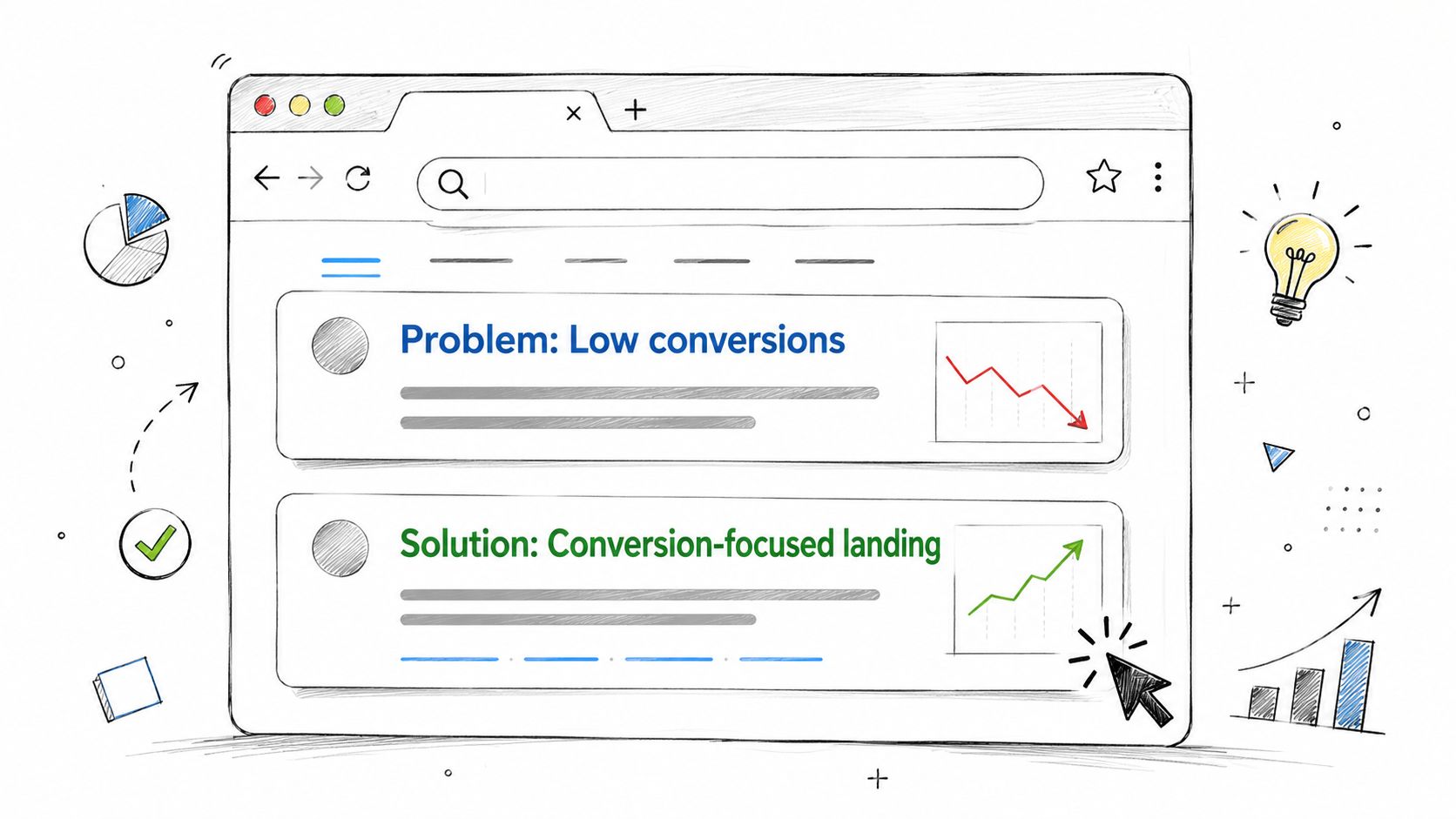
Search copy has an advantage social copy doesn't. The prospect has already declared a problem through the query. Your job isn't to manufacture awareness. It's to confirm relevance quickly and give the buyer a credible next step.
A clean structure looks like this:
The first headline mirrors the desired outcome. The second identifies the solution category. The description reduces uncertainty about who the offer is for and what happens next. This qualifies founders and marketing leaders searching for website help, while excluding buyers looking only for general Webflow development.
A large-scale analysis of more than 1 million Google ads found that shorter headlines generally outperform longer headlines on both CTR and conversion rate, while descriptions perform best at moderate length. The Google Ads analysis from Search Engine Journal supports a simple operating principle: put the offer and differentiation early, then remove claims that don't help the searcher decide.
Don't write one brand narrative and force it into every keyword group. Map high-intent terms to the problem state behind each query. A search for “B2B SaaS website agency” reflects a different decision from “SaaS website conversion audit.” Test distinct angles by cluster, then judge success by conversion rate and qualified pipeline. Neutral Google Search benchmarks put average CTR around 6.64% and average conversion rate around 8.18% across 23 categories, according to Webtonic's benchmark reporting. Use category benchmarks as context, not as a substitute for downstream analysis.
Your landing page must repeat the promise in the ad. If the ad says “conversion-ready site,” the page shouldn't open with a generic agency claim. Big Moves Marketing's B2B SaaS Google Ads campaign checklist is useful because search performance depends on message continuity, not headline creativity in isolation.
Content-led acquisition is often treated as a traffic program. For B2B SaaS, the better use is strategic qualification. A strong article helps the right buyer name a problem, understand its cause, and recognize why your approach differs before they ever enter a sales conversation.
Use an opening such as:
Why Most B2B SaaS Positioning Fails, and What Works Instead
That headline challenges a familiar assumption. It says the issue may not be weak messaging execution. It may be that the company hasn't decided how it wants buyers to categorize and choose it. The persona is a founder, CMO, or Head of Growth dealing with inconsistent demand, confusing sales conversations, or a website that attracts attention without creating movement.
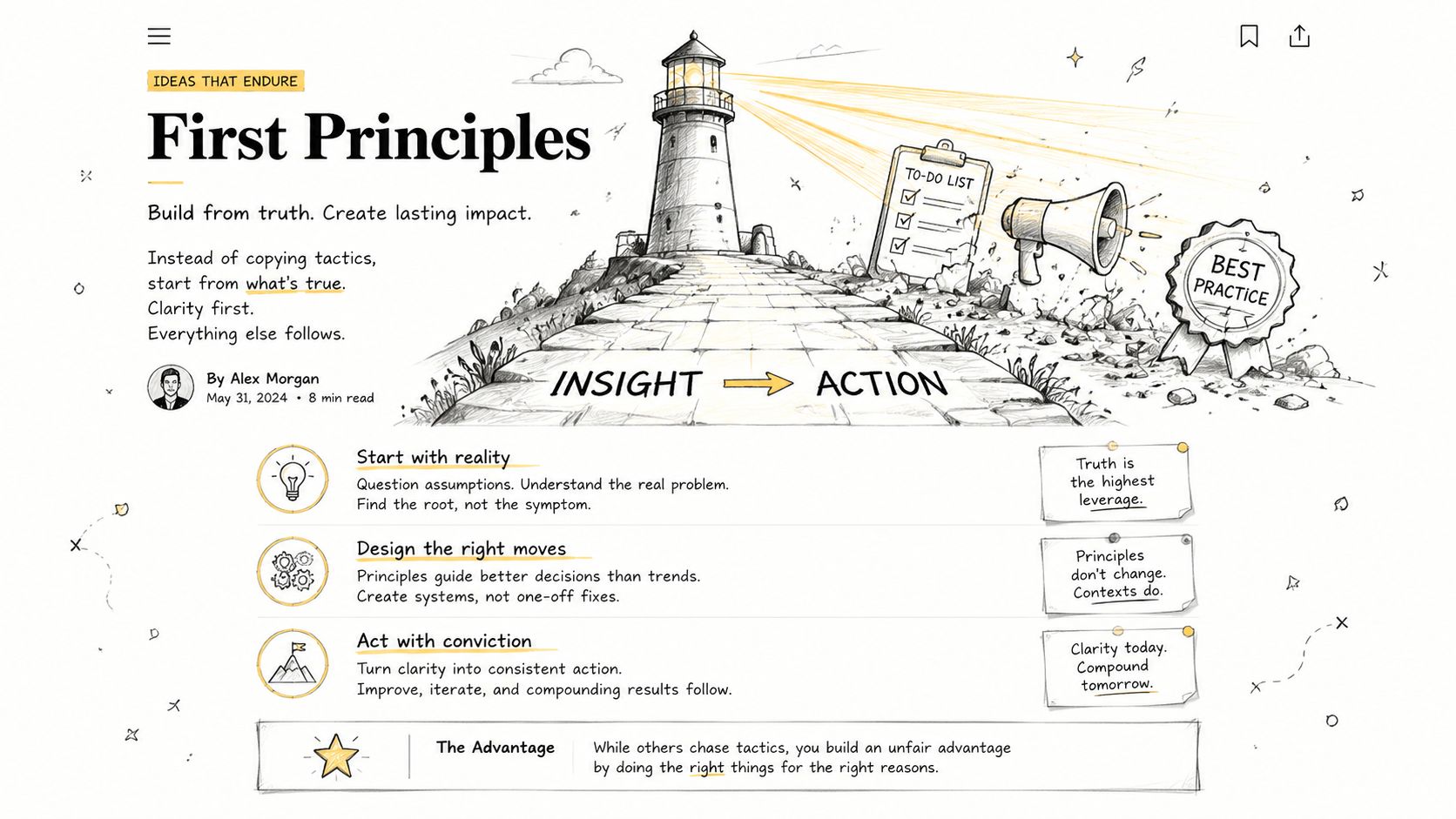
The article should then build a first-principles argument. Positioning determines the market context, competitive alternative, buyer, and reason to choose. Messaging expresses that decision. If the positioning is unresolved, rewriting the homepage or increasing publishing volume distributes the confusion across more channels.
A second example is The Fractional CMO Trap, Why Execution Without Strategy Kills Momentum. It qualifies leaders who don't need another task list. They need prioritization between board expectations, team capacity, positioning, and channel experiments. A third is Your B2B Website Isn't Closing Deals. Here's Why, which reframes the issue from visual design to copy clarity, buyer-stage alignment, and friction in the decision path.
Write for intent, not traffic volume. Use short paragraphs, clear headings, concrete scenarios, and a defensible point of view. Link the article to a relevant next step, such as Big Moves Marketing's content strategy for websites. Measure scroll depth, time on page, internal link clicks, engaged sessions, and assisted pipeline. Don't celebrate rankings if the content attracts people who can't buy.
Email nurture fails when every message asks for a meeting before the prospect has accepted the problem definition. A better sequence moves from recognition to differentiation, then to a conversation. Each email should solve one small problem or challenge one assumption.
A practical sequence might look like this:
This structure qualifies by problem and buyer type. A founder who needs senior prioritization should receive a different narrative from a demand-generation manager looking for campaign execution. Segment before writing. Don't send the same sequence to both and interpret low engagement as a copy problem.
The trade-off is patience. Education-first email may generate fewer immediate meetings, but it gives later CTAs a stronger context. Use clear subject lines instead of manufactured curiosity. Space messages 3 to 5 days apart, and end an inactive sequence after 5 to 8 emails. Track open rate, click rate, and meeting conversion against the stated targets of 25%+, 3%+, and 0.5% to 2%, respectively, from the plan's operating benchmarks. Treat those as working thresholds, not universal laws.
A clear unsubscribe link is mandatory. Honor it immediately. For practical guidance on segmentation, sequencing, and measurement, use Big Moves Marketing's B2B email marketing best practices.
LinkedIn targeting doesn't fix generic copy. It only makes generic copy more expensive in front of a more precisely selected audience. The platform works when the audience definition and the message reinforce each other.
A credible example for founders and senior marketing leaders is:
Headline: Most B2B Positioning Is Wrong
Body: We've worked with SaaS companies and repeatedly seen teams confuse messaging with positioning. The fix starts by defining the buyer, the alternative, and the reason to choose. See the framework.
CTA: See the framework
The line challenges an assumption without pretending every company has the same problem. It qualifies leaders who suspect their messaging is underperforming but don't want another generic copy audit. The strategic decision is to sell diagnosis before execution.
For a fractional CMO audience, try:
Headline: Your Fractional CMO Is Missing the Strategy
Body: Execution-only support can leave founders with activity but no clear priority. Review the operating model before adding another channel.
CTA: Learn the model
That version is intentionally less aggressive. “Costing you pipeline” may attract attention, but it also requires proof and can trigger defensive reactions. Use the sharper version only when your evidence and landing page support it.
Define the audience by title, company stage, industry, seniority, and relevant intent signals. Exclude existing customers. Use UTM parameters and control frequency so the same message doesn't become background noise. Test the strategic claim, not just punctuation or button color. Measure qualified click-through, lead quality, meeting progression, and pipeline contribution. LinkedIn is valuable when the copy makes the targeting feel intelligent. It fails when the audience knows they've been placed inside a broad campaign.
A webinar shouldn't sound like a disguised product demo. Senior B2B buyers register when they believe the session will help them make a decision they currently find difficult.
Lead with the outcome:
How to Position Your SaaS for Growth, The Framework That Works
Then make the agenda operational:
The persona is a founder, CMO, or Head of Growth facing stalled demand or inconsistent sales conversations. The assumption challenged is that more campaigns will solve a positioning problem. The trade-off is that a narrower promise may reduce casual registrations while improving attendee relevance and post-event conversion.
Other strong angles include Building a Demand Machine, From Zero to Repeatable Pipeline, with an agenda covering website, positioning, content, channel prioritization, and attribution. Another is Why Your B2B Website Isn't Closing Deals, and What Works Instead, focused on conversion gaps, site structure, user flow, and before-and-after analysis.
Registration forms should stay short. Ask for name, email, company, and title. Promote through LinkedIn, email, targeted ads, and direct outreach. Make the recording available within 24 hours, then send the replay, slides, and a soft next step within the same window. Measure registration rate, attendance, engagement, and movement into sales conversations.
Big Moves Marketing's webinar marketing guide for B2B SaaS and technology companies treats the event as part of a decision system, not an isolated content asset.
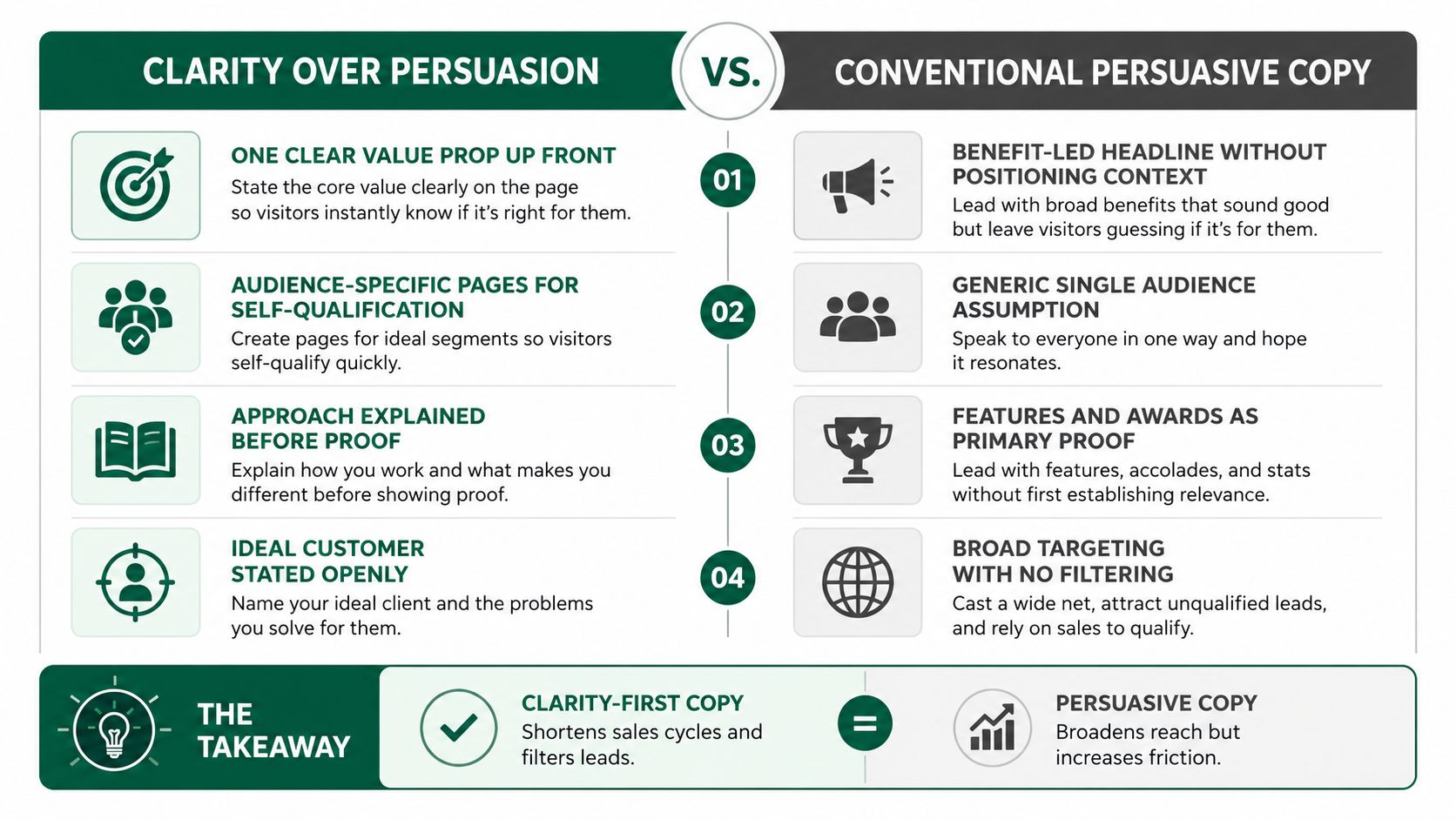
Your landing page doesn't need to persuade everyone. It needs to help the right buyer understand the offer quickly and disqualify the wrong buyer without a sales call.
A clear value proposition might read:
Strategic growth marketing and positioning for B2B SaaS founders and CMOs.
The supporting copy should state the stage and operating context:
For teams from pre-product through Series C that need clearer positioning, a conversion-ready website, and focused channel pilots.
Then explain the method in sequence. Start with positioning and messaging clarity. Build the website and content structure. Run targeted pilots. Track funnel impact. This gives the buyer a model of how work progresses, rather than forcing them to infer the process from a service list.
B2B SaaS websites average a 1.1% conversion rate in First Page Sage's 2026 benchmark, which means conversion-ready structure matters because the typical site converts only about one visitor in every 90 into a lead, as reported by YourWebTeam's B2B website statistics. The number isn't a reason to copy a benchmark. It's a reminder that unclear messaging has a measurable cost.
B2B websites also serve multiple jobs. Nielsen Norman Group's B2B website usability study says these sites must support complex buying processes, generate sales leads, and serve existing customers after purchase. Build pages for those stages instead of treating the homepage as the only important asset.
Use one primary CTA per page. Create audience-specific pages where the buying context differs. Refresh copy when the positioning or offer changes. For broader planning context, see this resource on startup go-to-market strategy.
The recurring pattern across these ad copy examples is simple. Positioning comes first, channel format comes second. If you reverse that order, you'll produce polished variations of an unresolved message.
Use the channel according to the buyer's mental state:
The most useful measurement plan follows the funnel, not the platform dashboard. Check whether the message reaches the intended persona, whether the click produces a qualified action, and whether that action progresses toward pipeline. Don't let high CTR excuse poor-fit leads.
Before publishing, ask four questions. What problem does the line name? Which persona does it qualify? Which assumption does it challenge? What downstream metric could prove or disprove the strategic claim? If you can't answer all four, the copy is probably performing cleverness rather than doing market work.
| Approach | Implementation Complexity 🔄 | Resources & Speed ⚡ | Expected Outcomes ⭐📊 | Ideal Use Cases | Key Advantages 💡 |
|---|---|---|---|---|---|
| LinkedIn Founder Direct: Problem Recognition + Positioning Clarity | High 🔄, deep research, custom founder-to-founder messaging; low scalability | Low media cost, high time per outreach; slow volume ⚡ | ⭐⭐⭐⭐ 📊 Very high intent, low volume; strong conversion for high-ticket offers | High‑ticket fractional CMO, positioning/messaging retainers, founder-led sales | Demonstrates earned authority; opens doors via insight (research last 6 months) |
| Google Ads Search: Problem + Solution Stacking in Headline | Medium 🔄, keyword mapping + tight landing page alignment; iterative optimization | Higher media spend; fast feedback loop (data in ~2 weeks) ⚡ | ⭐⭐⭐ 📊 CTR ~2–5%; conv 5–15%; CPL $50–200 (varies) | Lead gen, demo booking, product trial signups where intent is explicit | Captures search intent quickly; measurable attribution (prioritize landing match) |
| Content + SEO: Authority Anchoring Through First‑Principles Thinking | High 🔄, expertise-driven long form, consistent publishing to build authority | Moderate ongoing cost; long time‑to‑rank (8–16 weeks) ⚡ slow burn | ⭐⭐⭐⭐⭐ 📊 Evergreen authority; organic traffic 50–500/mo; conv 0.5–3% | Top/mid‑funnel education, positioning, long‑term brand authority | Hard to copy; pre‑educates prospects and supports sales (lead with contrarian insight) |
| Email Nurture: Progressive Value + Micro‑Positioning | Medium 🔄, sequence design, segmentation and testing required | Low cost per prospect; scalable; learning over weeks ⚡ | ⭐⭐⭐ 📊 Open 20–35%; click 2–5%; conv to meeting 0.5–2% | Mid‑to‑long sales cycles, webinar/event follow‑up, content nurture | Builds relationship before ask; value‑first sequencing reduces resistance |
| LinkedIn Ads: Audience Targeting + Skeptic‑Aware Messaging | Medium–High 🔄, precise targeting + frequent creative testing | Mid budget ($1k–3k/mo); moderate speed to optimize ⚡ | ⭐⭐⭐ 📊 CTR 0.5–2%; CPC $1–3; CPL $30–150; conv 5–15% | Targeted lead gen to decision‑makers, thought leadership, event promos | Reaches decision makers directly; skeptical tone and pattern recognition improve trust |
| Webinar + Event Copy: Authority Anchor + Outcome Promise | High 🔄, content development, rehearsal, production logistics | Moderate–high resource/time; execution effort upfront ⚡ | ⭐⭐⭐ 📊 Registration 1–3% of promotions; attendance 20–35%; SQL 5–15% of attendees | Complex offers, authority building, pipeline acceleration via teaching | Teaches not sells; reusable assets and high attendee quality (clear outcome required) |
| Website Copy + Landing Pages: Clarity Over Persuasion | Medium 🔄, requires upfront positioning clarity and audience pages | Moderate one‑time build, ongoing updates; steady ROI ⚡ | ⭐⭐⭐⭐ 📊 Shortens sales cycles, improves conversion and qualification | Foundational for B2B services and SaaS; shortens sales cycles and filters leads | Reduces friction and self‑qualifies prospects; single clear CTA per page recommended |
| Compilation: Common Themes, Consolidated Tips & When to Use Each Angle | Low–Medium 🔄, synthesis of heuristics; translation to playbooks | Low resources; quick to apply for planning and alignment ⚡ | ⭐⭐⭐ 📊 Better channel selection and consistency; reduces wasted spend | Strategy planning, channel selection, cross‑channel coordination | Consolidates rules of thumb (match message to intent, use specific proof, limit CTAs) |
The best ad copy examples aren't valuable because the phrases sound memorable. They're valuable because each line encodes a clear decision about the buyer, the problem, the stage, and the action. The copy works when those decisions are coherent across the channel and the destination.
Use search when the problem is already explicit. A buyer searching for B2B website conversion help doesn't need a brand manifesto. They need confirmation that you understand the problem and can address it. Use founder-led or LinkedIn messaging when relevance and credibility carry more weight than immediate scale. A specific observation about a company's market, category, or growth constraint can earn attention that a generic value proposition won't.
Use email when the buyer needs confidence to accumulate. A sequence can introduce the problem, explain the underlying cause, show how your approach differs, and then offer a conversation. Don't force a meeting before the prospect understands why the issue matters. Use landing pages as the continuity layer across every channel. The page should confirm the promise, explain the mechanism, provide credible proof, handle objections, and make the next action obvious.
Run every campaign through the same review sequence:
This discipline matters more as acquisition becomes less forgiving. Independent benchmark coverage reports that advertisers are paying about 40% more per click than three years ago, while conversion-rate gains have been modest. The same source reports that AI-generated ad copy lifted CTR by 8% to 15% in internal Google tests, which points toward rapid variation and testing, not static libraries of inspirational phrases. See MarketVantage's digital advertising analysis for that context. More variants won't fix bad positioning. They'll only help you discover which expression of a sound decision performs best.
A fractional CMO is a senior operating model, not a lightweight copywriting add-on. In 2026 market data, fractional CMOs typically charge about $8,000 to $25,000 per month and often work one to two days per week while owning the marketing function, according to Treetop Growth Strategy's fractional executive market data. The value lies in setting priorities, connecting positioning to execution, and stopping teams from wasting motion across disconnected channels.
Big Moves Marketing approaches this work as a strategic growth partner. The focus is clarity and prioritization before channel expansion, so founders and senior leaders can decide faster, test more deliberately, and connect marketing activity to pipeline. Audit one active campaign this week. Check message-to-persona fit, landing-page continuity, proof quality, and pipeline impact. If the copy fails any of those tests, rewrite the decision before rewriting the sentence.
Big Moves Marketing helps B2B SaaS leaders clarify positioning, build conversion-ready messaging, and choose focused growth programs across search, LinkedIn, content, email, webinars, and websites. Visit Big Moves Marketing to assess where your current ad copy and go-to-market motion are losing buyer clarity.


%20-%20white.svg)