Most B2B webinar programs measure the wrong moment. They celebrate the registration count, glance at the attendance rate, export a CSV and move on. The pipeline gets decided later, in the content choices made weeks before the event and the follow-up made in the 48 hours after it.
I have run webinar programs from both sides of that gap. For two years I supported the webinar operation at IBM Coremetrics, which ran three to four webinars a month: landing pages, invitation and reminder emails, follow-up flows and the handoff process with sales. Then I owned the webinar program at MathWorks for three years. It was a struggling program when I took it over. Within a few months it became one of the main sources of qualified leads for the sales teams I supported, and a meaningful contributor to revenue. We ran about two webinars a month. The volume was modest. The focus was education.
This guide combines that experience with the most current research on B2B buying and webinar performance. It covers the full system: what webinars are for, how to read the benchmarks, how to build content with sales, how to run promotion and operations, and how to turn attendees into pipeline.
Key takeaways
B2B buyers now do most of their deciding alone. 6sense's 2025 Buyer Experience Report, based on nearly 4,000 buyers, found that buyers make first contact with sellers when they are about 61% of the way through their buying process. That is earlier than the 69% the same research recorded in 2023 and 2024, but the decision still forms early: in the same study, the winning vendor sat on the Day One shortlist 95% of the time, and the pre-contact favourite won roughly four deals out of five.
Gartner's research points the same way. Buyers spend only 17% of their buying time meeting with potential suppliers. Split across three vendors, each gets about 5–6% of the buyer's attention. In a 2025 survey, Gartner found that 61% of B2B buyers prefer a rep-free buying experience overall — while still wanting seller input on the hard question of whether a product fits their situation.
That combination defines the webinar's role. Buyers want expert guidance. They want it without a sales call. A well-run webinar gives them exactly that: an hour with your best people, on their terms, before the shortlist hardens.
The 2025 Edelman–LinkedIn B2B Thought Leadership Impact Report surveyed nearly 2,000 professionals and found that more than 40% of B2B deals stall because the buying group cannot agree. The report focuses on "hidden buyers" — finance, legal, operations and other stakeholders who rarely take sales meetings. Among them, 95% said strong thought leadership makes them more receptive to sales and marketing outreach.
Webinars reach these people in a way cold outreach cannot. A champion forwards the recording to the finance lead. An engineer joins live because the topic is technical. One session can put your thinking in front of several members of the buying group at once.
A note on that source: Edelman and LinkedIn both have a commercial interest in thought leadership. The direction of the finding matches 6sense and Gartner, which is why I give it weight.
Webinar platforms report growing usage. Goldcast's 2026 benchmark, covering 26,190 webinars from 522 B2B organisations in 2025, found registrations nearly doubled year over year to 6.8 million, with average attendees per event rising from 51 to 102. Livestorm's survey of 853 go-to-market leaders found that 51% rate webinars as critical, with pipeline generation, brand awareness and customer expansion all cited as top 2026 goals by more than half of respondents.
Treat platform data as directional. Every vendor in this space benefits from showing growth. The consistent signal across vendors is that B2B teams keep investing in the format.
Forrester's Conrad Mills makes a point that saves many programs from disappointment: match each webinar's goal to its purpose, and judge it by measures that fit that purpose. An educational webinar for early-stage buyers should not be judged on demo requests the following week.
Most B2B programs need four or five formats working together.
| Format | Job it does | Best measured by |
|---|---|---|
| Educational session | Teaches a problem or method; builds trust with early-stage buyers | Attendance, watch time, questions asked, return attendees |
| Expert panel or debate | Shows category leadership; reaches hidden buyers | Registrations from target accounts, social reach of clips |
| Customer story | Proves outcomes with a peer's voice | Engagement from mid-stage accounts, sales use of the recording |
| Product deep dive or demo | Answers "will this work for us?" | Meetings booked, opportunities created |
| Customer or onboarding webinar | Drives adoption and expansion | Feature adoption, retention, expansion pipeline |
At MathWorks, almost everything we ran sat in the first row. Engineers and scientists came to learn how to solve a technical problem. The product appeared as the tool for the job, never as the subject. That choice made the sessions worth attending — and it made the leads better, because people who sat through an hour of applied teaching were usually working on exactly that problem.
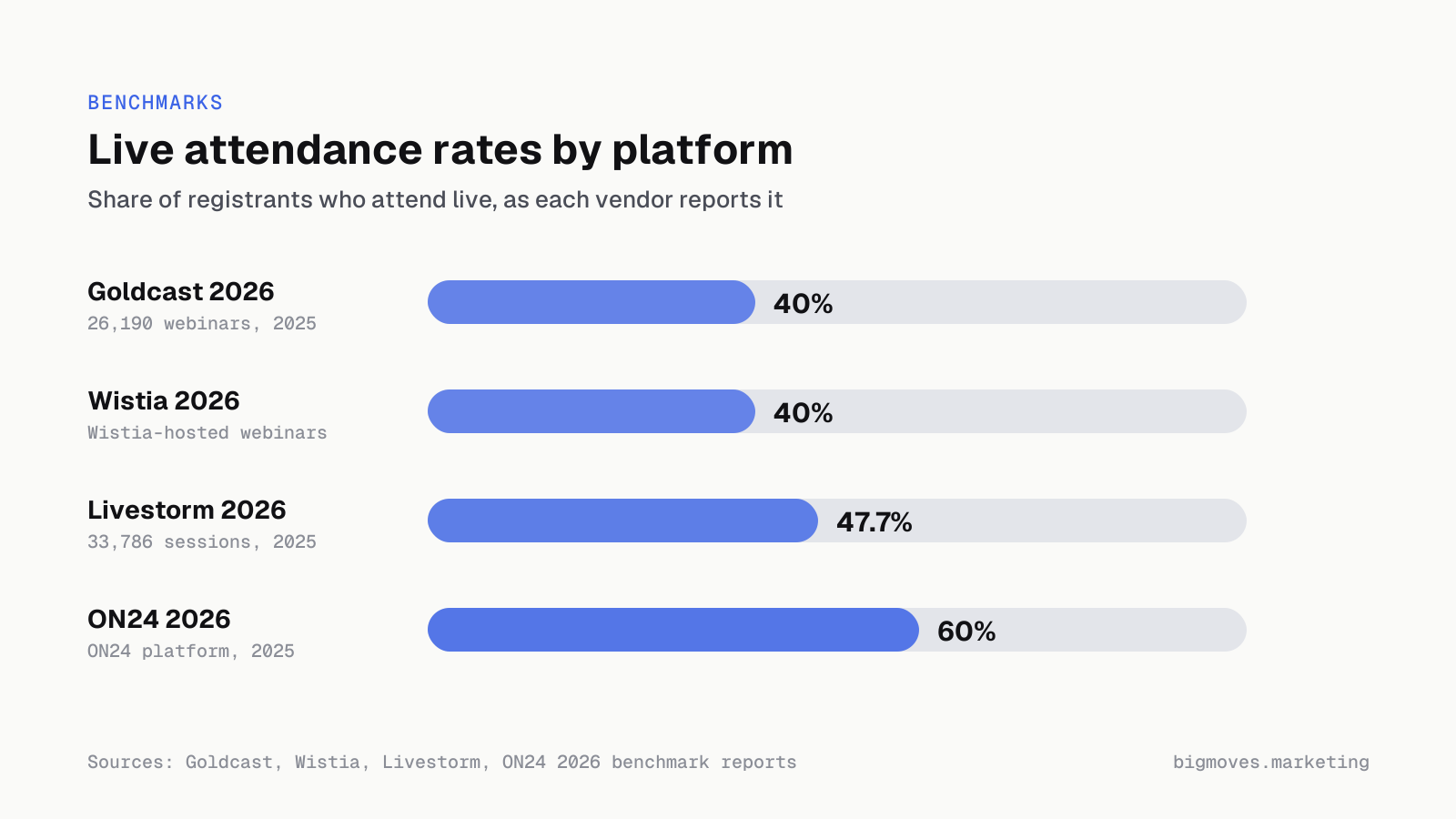
Ask five webinar platforms for the average attendance rate and you get five answers.
| Source | Data | Live attendance (registrants who attend) |
|---|---|---|
| Goldcast 2026 report | 26,190 webinars, 522 B2B organisations, 2025 | 40% (up from 33% in 2024) |
| Wistia 2026 benchmarks | Wistia-hosted webinars | About 40% |
| Livestorm 2026 report | 33,786 sessions, 2025 | 47.7% |
| ON24 2026 Digital Engagement Benchmarks | ON24 platform, 2025 | 60% |
Sources: Goldcast, Wistia, Livestorm, ON24.
The spread comes from three differences.
Two other numbers deserve attention. Livestorm found the average webinar ran 68 minutes, but average watch time was just 26 minutes — 38% of the session. And Goldcast found on-demand viewers completed 91% of what they watched, compared with 74% for live attendees. People who choose the replay usually choose it for a reason.
What to do with this: use the published range as a sanity check, not a target. If you sit at 25% live attendance, something is broken in your topic, timing or reminder flow. If you sit at 45%, you are in good company. From there, benchmark each webinar against your own last six.
This is where the MathWorks program turned around, so it gets the most space.
When I took over, the webinars were built the way many marketing teams build them. Marketing picked topics from the campaign calendar. Product managers presented features. Attendance was low, and sales did not trust the leads because they rarely matched real buying conversations.
The fix was not a better promotion plan. It was a different source of content.
I started meeting regularly with the sales team and the application engineers — the technical specialists who sat in customer meetings and solved real problems with the product. They knew which questions came up on every call. They knew which tasks customers found hard. They knew which misconceptions stalled deals.
Those conversations became the webinar calendar. Each topic answered a question customers were already asking. The application engineers often presented, because they could teach the method with real examples and handle hard technical questions live.
The results followed. Attendance rose because the topics matched real work. Lead quality rose because the people who attended were working on the problem the session solved. Sales trusted the follow-up because they had shaped the content.
The research supports this approach. In the Edelman–LinkedIn study, 85% of buyers said they value content that shows an understanding of their specific challenges. Forrester's guidance is to address a specific challenge with insight attendees cannot easily find elsewhere, and to bring in practitioners and customers rather than defaulting to a single company presenter.
Run this every month or quarter, depending on your cadence.
Before a topic goes on the calendar, check it against five questions.
A topic that passes all five rarely struggles for attendance.
At IBM Coremetrics, running three to four webinars a month taught me one lesson above all others: volume depends on systems. You cannot hand-build every landing page, invitation and reminder at that pace. You need templates, a fixed timeline and clear owners.
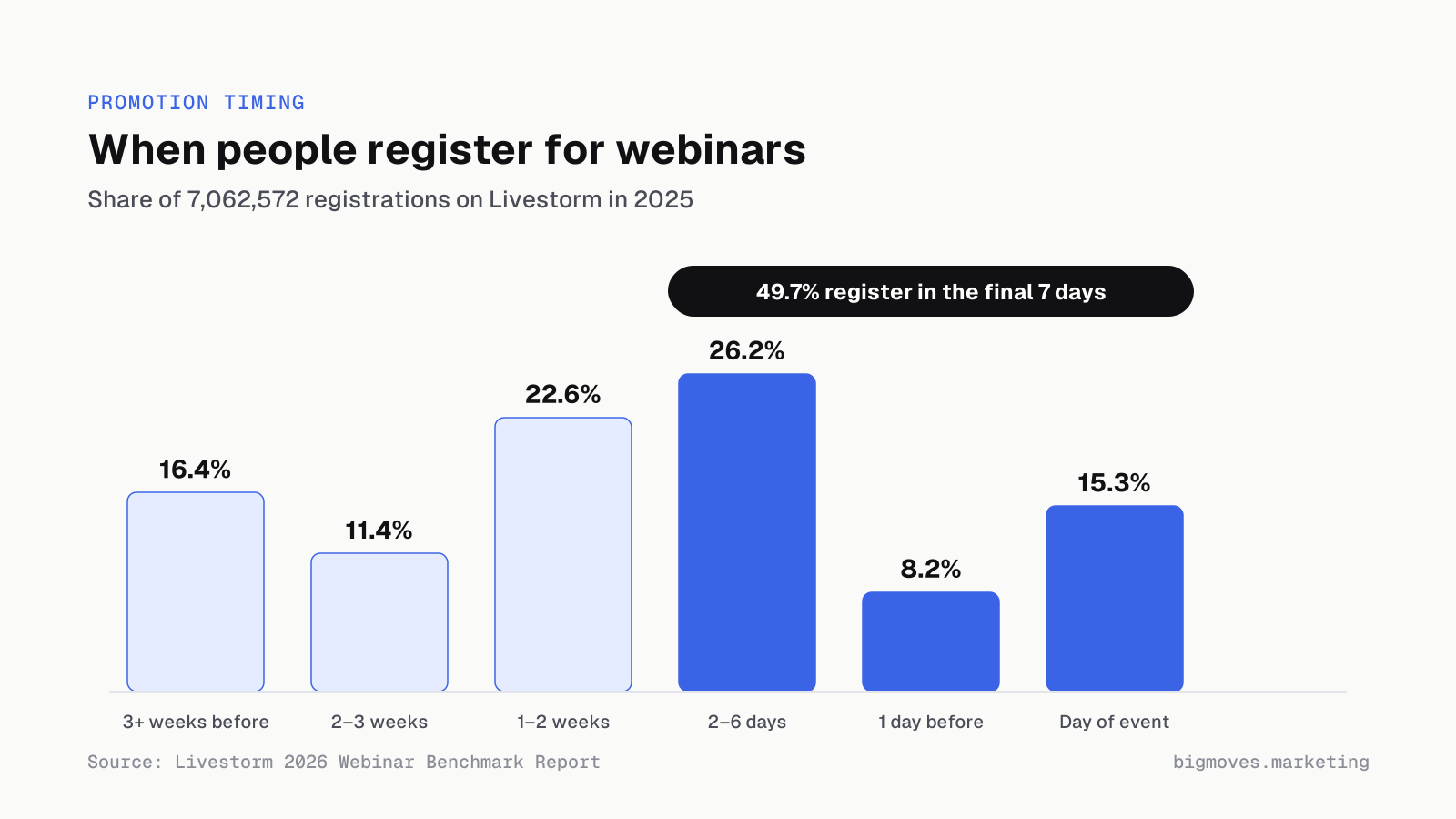
Livestorm analysed more than 7 million registrations from 2025 and found that 49.7% arrived in the final seven days before the event, with 15.3% registering on the day itself. Only 16.4% registered three or more weeks ahead.
That pattern shapes the whole promotion plan. Start three to four weeks out to build a base and reach busy executives who plan ahead. Then put your heaviest push — the second and third emails, the sales outreach, the speaker posts — into the final week.
Email dominates. In Livestorm's survey of go-to-market leaders, 86.3% named email as a top-three registration channel, well ahead of organic social (43.3%), communities and newsletters (32.6%) and the website or blog (32.5%). Forrester's analyst guidance also names email as the most important registration channel.
Some channels are underused. Sales outreach and speaker promotion each appear in the top three for fewer than one team in five, yet both put the invitation in front of people who already trust the sender. At MathWorks, a personal note from an account manager or application engineer often beat a marketing email for key accounts.
A practical channel mix:
Keep registration simple. Forrester's rule is to reduce friction: short forms, an immediate calendar invite and a consistent reminder schedule. A strong registration page includes:
At IBM Coremetrics, every webinar ran on the same email skeleton. That consistency let a small team run a high volume of events without errors.
| Timing | Purpose | |
|---|---|---|
| Invitation 1 | 3–4 weeks before | Announce the topic and the speakers |
| Invitation 2 | 10–14 days before | New angle: a key question the session will answer |
| Invitation 3 | 2–4 days before | Last call, with a short speaker video or quote |
| Confirmation | Immediately on registration | Calendar invite, join link, what to expect |
| Reminder | 1 week before | Agenda and a reason to attend live (live Q&A) |
| Reminder | 1 day before | Join link and start time |
| Reminder | 1 hour before | Join link |
| "We're live" | At start time | Join link for late arrivals |
The data disagrees here too, which is a useful finding in itself. Goldcast found Monday and Friday sessions recorded the highest attendance rates in 2025, while Livestorm's data put Tuesday narrowly ahead, with every weekday between 50% and 52%. Most teams schedule midweek by habit.
Start with a slot that suits your largest audience's time zone, then test. Your audience's habits matter more than any platform average.
Assign one owner for each line, every time.
The live hour matters, but most of its success is set up beforehand. A few principles carry most of the weight.
Teach early. Livestorm's data shows average watch time of 26 minutes. Put your most useful material in the first half. Skip long company introductions.
Build in participation. Polls, chat and live Q&A should be designed into the session, not bolted on. Forrester lists participation as a core design element. Livestorm found that chat appears in 90% of sessions but polls in only 28%. Polls are underused, and they double as segmentation data for follow-up: a well-designed poll on timeline or main challenge tells sales who to call first.
Vary the format. Interviews, panels, debates and live problem-solving hold attention better than a single presenter reading slides.
Give Q&A real time. At MathWorks, the Q&A was often the most valuable part. Attendees asked about their own projects, and the application engineers answered with specifics. Those questions also became the best follow-up material.
Close with one clear next step. Offer a resource, a deeper session or a conversation — matched to the format. An educational session might end with a guide or the next webinar in the series. A demo session can end with an offer to book time.
Follow-up is where most webinar value leaks. In Livestorm's survey, 38.2% of go-to-market leaders named post-event follow-up as a top challenge, and 21.8% struggled with data and attribution in the CRM. The same report notes that only 6–8% of its customers use native CRM integrations. Attendee data that never reaches the CRM cannot reach sales.
At both IBM Coremetrics and MathWorks, the follow-up worked because the rules were set before the webinar ran. Marketing and sales agreed:
Forrester's final rule makes the same point: connect webinar data to revenue systems and agree segmentation and follow-up with sales and operations.
Treat attendees according to what they did.
| Segment | Signal | Follow-up |
|---|---|---|
| Engaged attendees | Asked a question, answered intent polls, stayed most of the session | Personal outreach from sales or a specialist within one business day, referencing their question |
| Passive attendees | Attended but did not interact | Recording, a related resource and an invitation to the next session |
| No-shows | Registered but did not attend | Recording with a short summary and the three key points |
| On-demand viewers | Watched the replay | Tracked like live attendees; high completion signals strong interest |
| Target-account registrants | Any behaviour from a named account | Flagged to the account owner regardless of engagement |

The most cited research on response time comes from a 2011 Harvard Business Review study. Analysing 1.25 million leads across 42 US companies, the authors found that firms contacting a lead within an hour were nearly seven times more likely to qualify it than firms that waited even one hour longer.
Two caveats apply. The study is old, and it measured inbound web inquiries, not webinar attendees. An attendee who just watched an educational session has not asked to be called. The principle still holds for your highest-intent segment: when someone asks a specific question about their own situation or requests a conversation, reply the same day. For everyone else, relevance beats speed.
A spreadsheet of attendee names gives sales almost nothing to work with. Within 24 hours, send sales a short brief that includes:
At MathWorks, the briefs made follow-up feel like a continuation of the conversation, not a cold call. Sales could say "you asked about X — here's how other teams handle it", which is a far better opener than "thanks for attending".
| Timing | All attendees and no-shows | Engaged attendees |
|---|---|---|
| Same day | Thank-you email with recording and slides | Personal note from the presenter or specialist |
| Day 1–2 | — | Sales outreach referencing their question or poll answer |
| Day 3–5 | Related resource: guide, checklist or article | Offer of a working session or assessment |
| Day 10–14 | Invitation to the next webinar in the series | Follow-up on any open questions |
| Day 21+ | Move into the relevant nurture track | Sales owns the next step |
At MathWorks, lead generation was a secondary goal — and it became one of the strongest sources of qualified pipeline for sales. That is not a contradiction. The education built trust. The follow-up turned trust into conversations. Programs built only to collect leads tend to produce leads that sales ignores.
A webinar keeps working after the live hour if you plan for it.
Goldcast found that 89.1% of webinars were made available on demand in 2025, and on-demand viewing made up 15.9% of total viewership. Livestorm's data shows a clear access trade-off: public replays averaged 14.6 on-demand views, against 3.97 for replays restricted to registrants. A gated replay captures names. A public replay reaches more people. Choose based on the webinar's job.
Repurposing remains underused. In the same Livestorm survey, 14.1% of teams do not repurpose at all, and bandwidth is the main reason. Decide the derivative assets before the event:
At MathWorks, the recordings had long lives. Sales sent them to prospects working on the same problem months after the live event, and the best sessions became part of the standard nurture flow.
The platform matters less than the program around it, but the wrong choice creates friction at every step. Choose on four criteria, in this order.
For a side-by-side look at the main options, see our comparison of the best webinar platforms for marketing teams.
Measure each webinar against the job it was designed to do. A useful metric stack has three layers.
Audience metrics tell you whether the topic and promotion worked:
Engagement metrics tell you whether the content worked:
Revenue metrics tell you whether the program works:
Educational webinars deserve patience. Their influence shows up across a buying cycle that 6sense now measures at about 10 months on average. Review program-level revenue metrics each quarter, and use audience and engagement metrics to improve individual sessions.
Days 1–15: Foundations
Days 16–45: First webinar
Days 46–75: Second webinar and first review
Days 76–90: Set the rhythm
The fundamentals of a good B2B webinar have not changed in fifteen years. Teach something useful. Promote it to the right people. Follow up with care. What has changed is the buyer. They decide more on their own, earlier, and with more people involved. That makes an hour of genuine expertise more valuable than it has ever been.
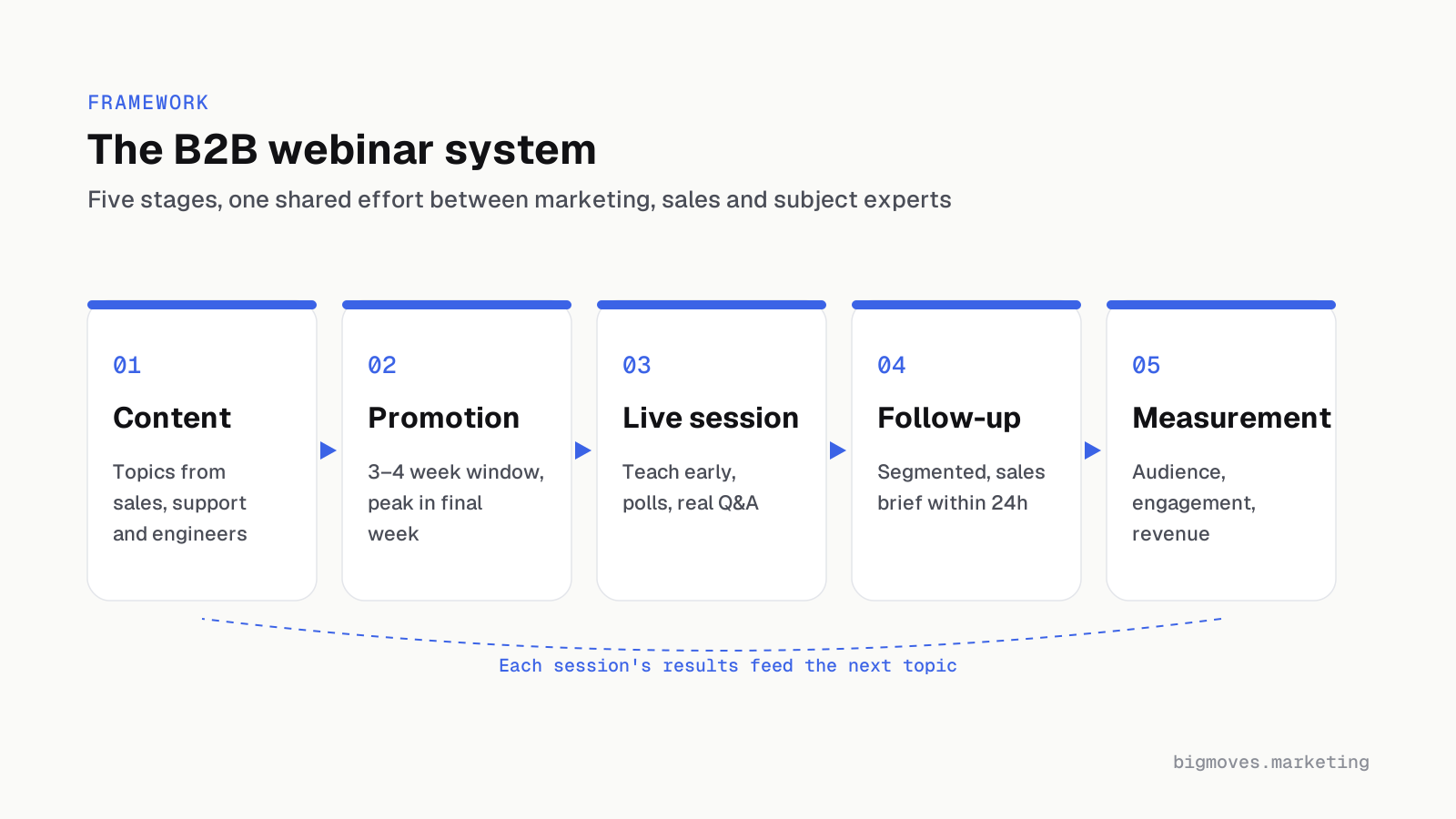
The programs that win treat webinars as a shared effort between marketing, sales and the experts who serve customers. Marketing runs the machine. Sales and specialists shape the content and own the conversations that follow. That partnership turned a struggling program at MathWorks into one of its best sources of qualified pipeline, and it works the same way for growth-stage B2B companies today.
Most B2B webinars are scheduled for 60 minutes. Goldcast's 2025 data shows a median of 60 minutes and an average of 56.8 minutes. Livestorm found average watch time of 26 minutes, so put the core teaching in the first half and use the second half for depth and Q&A.
Published averages range from about 40% (Goldcast, Wistia) to 48% (Livestorm) and 60% (ON24), depending on the platform and how attendance is counted. A cold-audience lead generation webinar at 35–45% live attendance is performing well. Track your own trend across sessions.
Start three to four weeks before the event. Livestorm's 2025 data shows half of all registrations arrive in the final seven days, so plan the heaviest promotion for the last week.
Run as many as you can do well. At MathWorks, two a month was enough to make webinars a leading source of qualified leads. A consistent monthly series beats an irregular burst of sessions.
It depends on the webinar's job. Livestorm found public replays averaged 14.6 on-demand views against 3.97 for gated replays. Gate the recording when capturing contacts matters most, and make it public when reach and sales enablement matter more.
Veb Bansal has spent more than 17 years in B2B marketing, including two years supporting the webinar operation at IBM Coremetrics and three years owning the webinar program at MathWorks. He has run more than 200 webinars for B2B technology companies. Today he helps growth-stage B2B companies build marketing programs that connect content to pipeline. See how he works with B2B teams and read client case studies.
November 27, 2026