%20png%20copy.avif)
Most B2B SaaS leaders believe global account management is just key account management with a bigger travel budget. This is a fundamental mistake, and it’s capping your growth with your most important customers.
Global account management (GAM) is not about selling to large customers in different countries. It's a C-suite discipline for treating a single, massive global entity as one strategic asset. Get this wrong, and you're not just underperforming; you're actively damaging your most valuable relationships.

I’ve seen it inside dozens of growth-stage SaaS companies. What they call a "global" strategy is a messy collection of regional sales motions stitched together. They apply the single-country key account playbook to a multinational enterprise and wonder why the results are dismal.
This approach doesn't just underperform. It actively creates problems that burn through your most valuable resources: time, capital, and team morale.
When you treat a global customer like a handful of disconnected regional deals, you invite chaos. Your team in Germany offers a different price, a different message, and a different success plan than your team in the United States. This isn't just confusing for the customer; it makes your entire company look disorganized and erodes trust.
The fallout from a broken global account strategy is painfully consistent. I see the same damaging patterns in company after company, hitting revenue and efficiency where it hurts most.
The core mistake is tactical execution without a strategic foundation. You're running a reactive, country-by-country sales motion when you need a proactive, unified global plan.
Fixing this isn't about hiring a few "Global Account Managers." It demands a fundamental shift in thinking at the leadership level—from a bottom-up, opportunistic approach to a top-down, deliberate strategy.
This means integrating sales, success, and even product into a cohesive team focused on the long-term value of one strategic account. It requires clear governance, aligned incentives, and a C-suite that understands this isn't just a sales initiative—it's a core business discipline.
Without this shift, your largest accounts will never reach their true revenue potential. They will remain a collection of siloed deals, not a strategic partnership.
Knowing you need a real global account management program is the easy part. Designing an organization that can execute it is where most companies fail. The common impulse is to hand someone the "Global Account Manager" title and hope for the best—a direct path to internal chaos and wasted capital.
There is no one-size-fits-all org chart. The right structure depends entirely on your reality: product complexity, average contract value (ACV), and, most critically, your customer's internal decision-making structure. Get this alignment wrong, and your GAM program is dead on arrival.
Two models dominate the landscape: the Centralized model and the Matrix model. Choosing between them means making deliberate trade-offs.
In a centralized setup, a dedicated Global Account Manager (GAM) and their team have direct authority and P&L responsibility for the entire global account. Regional sales teams act in a support role, often with a dotted-line report to the GAM for that specific account.
This structure delivers maximum control and consistency. The GAM can enforce global pricing, set the worldwide strategy, and give the customer a single point of contact. It’s a powerful model when your global customer has a highly centralized procurement team and makes all major buying decisions from a single headquarters.
The downside is a potential disconnect from regional markets. A GAM in New York might not grasp the competitive pressures or unique business needs of that customer’s subsidiary in Japan. This creates friction and missed local opportunities.
Centralized Model Best For: SaaS companies with high ACV (>$500k), complex products, and customers who use a top-down, centralized procurement process. It prioritizes consistency over local agility.
The matrix model is more common and, for most growth-stage SaaS companies, more realistic. The Global Account Manager acts as an orchestrator, not a direct commander. Regional sales teams keep their primary reporting lines and P&L responsibility within their territories.
The GAM's job is to build consensus, share intelligence, and guide a unified global strategy through influence. They don’t own the entire global number directly but are measured on the overall health, growth, and strategic penetration of the account.
This model allows for greater local agility. The regional teams are empowered to act on local market intelligence. The biggest risk? A lack of accountability. Without rock-solid governance and shared incentives, the GAM becomes a glorified project manager, begging for cooperation from regional teams focused only on local quotas.
To make the matrix model work, you must align compensation. Actionable insights on driving this behavior can be found in our guide on how to improve sales team performance. Split commissions and MBOs tied to global account success are non-negotiable.
Your choice should mirror your customer's structure. Forcing a centralized model onto a decentralized customer is a recipe for failure. Conversely, a weak matrix structure for a client with a powerful central procurement office is an abdication of strategic control. Analyze your customer first, then build your organization to match.
Not every large customer is a "global account." The most common and costly mistake founders make is promoting accounts into a GAM program based on revenue alone.
This is a reactive appeasement that grossly misallocates your most expensive sales and success resources.
True global account segmentation requires a rigorous framework that goes beyond simple firmographics. It’s about finding the few accounts with the structural and strategic DNA for a genuine global partnership. Without this discipline, you’ll end up with a portfolio of high-cost, low-potential accounts that drain resources.
The first filter is brutally simple: how does the customer buy?
A true global account thinks and acts globally. If their procurement is decentralized, with each regional office making its own purchasing decisions, they are not a global account. They are a collection of key accounts that happen to share a parent company.
Chasing a "global" deal in a decentralized organization is a fantasy that will burn cash and your team’s political capital.
Your segmentation framework must prioritize accounts that show specific, non-negotiable traits:
An account's potential is defined by its strategic value, not its current spend. An account with $500k ARR and a centralized global structure is a far better GAM candidate than a $2M account operating as a loose federation of regional fiefdoms.
This decision-making process clarifies whether you need a centralized or matrix approach, as this flowchart illustrates.
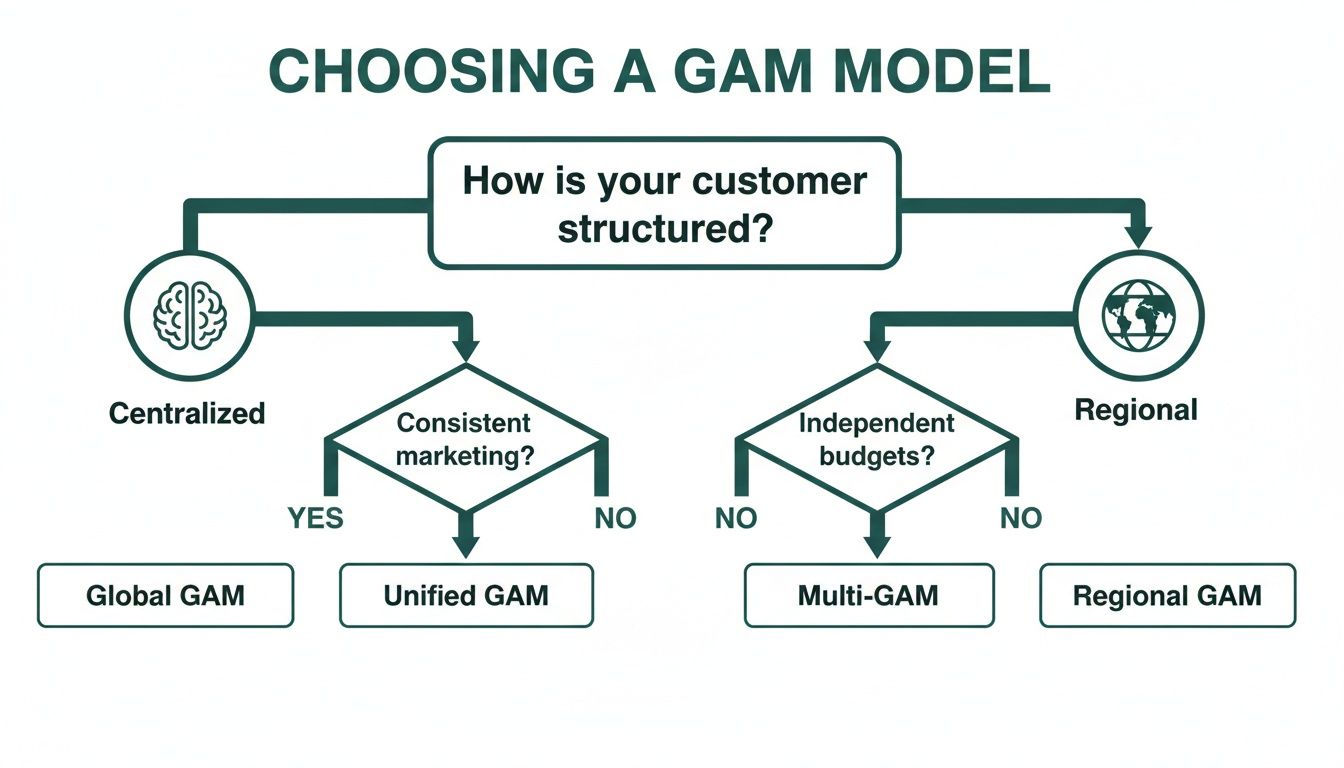
The flowchart drives home a critical point: the customer's internal structure is the primary driver for your GAM model, forcing a choice between centralized control and regional flexibility.
Once you’ve identified true global account candidates, you must codify the rules in a GAM Governance Charter. This is the single most important document for preventing the internal turf wars that plague most global account programs.
This is not a suggestion. It is the law.
The charter establishes a single source of truth and must explicitly define:
This governance is the bedrock for deploying more advanced strategies like Account-Based Marketing (ABM). The global ABM market is projected to exceed $1.6 billion by 2027, as companies see real results: 91% use intent data for targeting, and 84% use AI for personalization. These activities are impossible to coordinate at a global scale without a strong governance charter.
A clear charter turns a high-potential account into a predictable revenue engine. Our guide on implementing a strong marketing ABM strategy provides frameworks for aligning sales and marketing around these key accounts. Without this documented clarity, you are simply institutionalizing conflict.
A brilliant global account strategy will fall apart with a poorly designed comp plan. It’s the single most common failure point I see.
If your regional sales teams are only paid for local wins, you are directly incentivizing them to sabotage global deals. They have zero motivation to collaborate with a Global Account Manager (GAM) when it offers no personal upside and could put their own quota at risk.
The fix isn’t about being “fair.” It’s about building a system where the easiest path to a large commission check is through teamwork.
The most common mistake is layering a GAM program on top of a legacy, region-locked compensation structure. You're asking for one behavior while paying for another.
Your plan must financially reward both the global leader and the regional executors for shared success. This requires a multi-layered approach.
You cannot expect teams to collaborate globally if you only compensate them locally. The moment a regional rep sees a global deal as a threat to their income, your GAM strategy is dead. The comp plan must make them partners, not competitors.
A unified go-to-market plan isn't just about money; it’s about message discipline. The GAM owns the overarching strategic narrative, but that message must be adapted for local context by the regional teams.
This is critical during a product launch. The global value proposition—e.g., “reduce supply chain risk by 15%”—must be consistent. But the specific pain points and competitive landscape vary dramatically from North America to APAC.
Your GTM alignment checklist should include:
This structure creates a clear hierarchy of responsibility. The GAM steers the ship; the regional teams manage the engines. Without this clarity, your teams will spend more time fighting over strategy than executing it.
For a deeper dive into organizational alignment, our guide on building a powerful B2B SaaS go-to-market strategy provides a foundational blueprint.
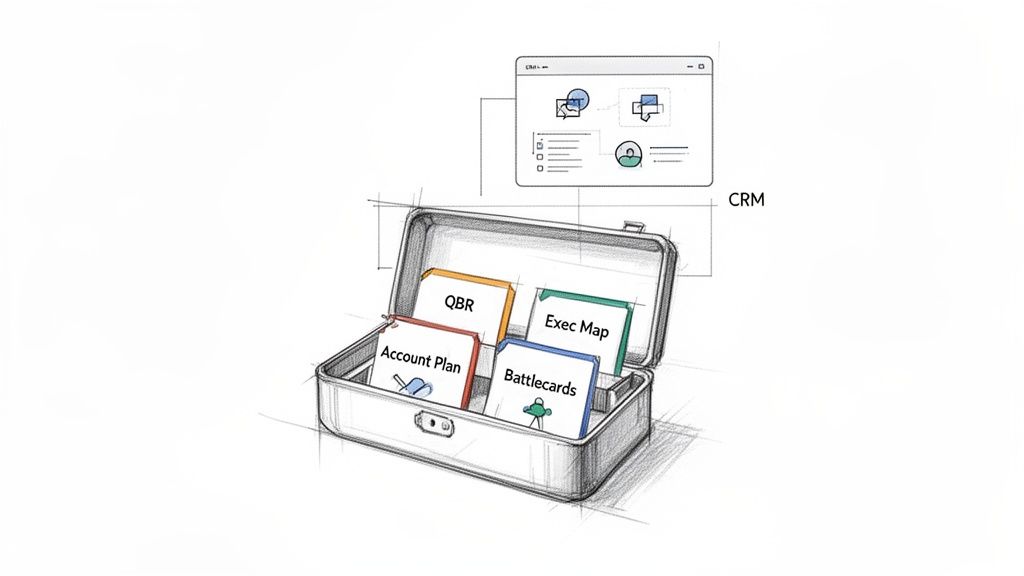
A great GAM strategy is just a PowerPoint deck until you give your team the tools to execute it. This is where high-level plans become the day-to-day work that closes global deals.
I see teams make two critical errors here: they either build a mountain of complex documents that nobody uses, or they throw their GAMs into the fire with nothing but a CRM login.
The right approach is a minimalist but powerful set of assets designed for consistency and a single source of truth across every region.
Your playbook is the operating system for your global accounts. It’s a set of living documents that prevent the chaos of every region doing its own thing. These four assets are essential.
If you’re building these from the ground up, our guide on what is a sales playbook provides a solid foundation.
A playbook is not a collection of suggestions. It is the tactical enforcement of your strategy. If a document doesn't drive a specific, unified action that supports the global plan, it doesn't belong.
Your playbook is only as good as the tech that brings it to life. The right stack provides the rails for execution, creating the single source of truth that prevents the data fragmentation that kills global deals.
Investing in solid internal tooling is not optional; it’s core infrastructure. At a minimum, your tech stack must deliver:
The market for these tools is exploding for a reason. Account management software is projected to grow from $13.5 billion in 2021 to $34.9 billion by 2033. This reflects the fact that 92% of B2B companies are leaning into account-based strategies and need the technology to execute. You can explore the full market analysis on Cognitive Market Research to understand the drivers.
Ultimately, your tooling and playbooks are about creating leverage. They are what allow a single GAM to orchestrate a complex, worldwide effort and ensure everyone is playing from the same sheet.
When I advise founders and revenue leaders on building a global account management program, the same hard questions always surface. These are the real-world hurdles you face when your biggest customers span the globe. Here are the straight answers.
The biggest mistake is starting too early. The trigger isn't a revenue number; it's customer complexity.
Your customers will tell you when it’s time. You’ll start hearing from your multi-million-dollar accounts—the ones with buying centers in different countries—asking for a single point of contact or unified global pricing. That’s your signal.
Building a GAM function before you get that market pull almost always leads to an expensive, overbuilt program with no clear ROI. Don't build it until they ask for it.
This is not a promotion for your top-performing salesperson. Quota-crushing skills are insufficient for this role.
The best Global Account Managers are business builders—think miniature General Managers for your most important accounts. They need a rare mix of strategic thinking, financial literacy, and C-suite presence. Critically, they must be able to lead a global team of peers who don’t report to them.
Look for experience in complex, multi-stakeholder program management, not just a track record of closing deals. This role is about orchestration, not just selling.
This skillset is vital. The global SaaS market is projected to hit $465.03 billion by 2026, and the average enterprise juggles 305 different apps. A GAM’s job is to navigate this complexity and secure a meaningful share of a customer's IT budget. Their strategic capability is far more valuable than their individual sales record.
Conflict is inevitable. The goal is not to avoid it but to channel it productively. The solution rests on two documents you must get right.
The Governance Charter: This is the law for your sales organization. It must spell out unambiguous rules of engagement for everything from account ownership and lead routing to the final escalation path in a dispute.
The Compensation Plan: You get what you pay for. The comp plan must financially reward both global and regional teams for collaboration. This means split commissions and shared bonuses for joint wins.
If you don't have these two pillars locked in, you are building a system that incentivizes internal conflict. Your GAM strategy will crumble before it gets off the ground.
At Big Moves Marketing, we help B2B SaaS founders and revenue leaders design the go-to-market strategies that turn high-potential accounts into predictable revenue. If you need to build a GAM program that actually works, let’s talk. Visit us at https://www.bigmoves.marketing.
Explore Big Moves Marketing services and resources:




%20-%20white.svg)