%20png%20copy.avif)

If you believe churn is a Customer Success problem, you're diagnosing the symptom, not the disease. Churn is a lagging indicator of a fundamental breakdown in your go-to-market strategy.
It's the final, painful result of a promise your marketing made, your sales team sold, and your product or onboarding experience failed to deliver. To reduce customer churn effectively, you must stop patching holes downstream and start preventing leaks at their source.
Most B2B SaaS founders I advise initially point to their Customer Success team when churn rates climb. They assume a better CSM, faster ticket response, or a polished QBR deck will fix it.
This is a fatal misdiagnosis. It’s like blaming the ER doctor for the car crash.
Your CS team is on the receiving end of issues that began months earlier, often during a prospect's first contact with your brand. By the time an account is flagged as "at-risk," the damage is done. Concentrating your efforts on the moment of cancellation is a reactive, low-leverage game you are destined to lose.
The real work to reduce customer churn happens at acquisition and onboarding. By the time an account is "at-risk," you are playing defense with a weak hand. The most resilient SaaS companies don't just "save" customers; they build a GTM system that prevents them from needing to be saved in the first place.
The relentless pressure to grow, especially for Series A–C companies, creates a convenient blind spot around retention. Teams celebrate new logos while cohort data quietly reveals those same customers are exiting in six months.
This happens because the real drivers of churn are baked into the growth engine itself.
In my experience advising SaaS leaders, churn consistently traces back to three upstream breakdowns that fester long before a renewal date is on the horizon:
These aren't CS problems. They are founder-level, go-to-market problems that demand a holistic view of the entire customer lifecycle.
You must connect the promises made during the sales cycle to the value delivered post-close. A first step is clarifying how these stages connect by mapping the B2B customer journey.
Fixing churn requires you to stop firefighting at the end of the journey and start architecting a better beginning. It’s about aligning your marketing, sales process, and product experience around a single, achievable promise. This is how you shift from a reactive "customer saving" motion to building a resilient growth model.
Before you can fix churn, you must stop guessing why customers leave.
Vague exit survey responses like “missing features” or “went with a competitor” are symptoms, not diagnoses. They are lazy answers that let both you and the departing customer off the hook, masking the real breakdown that occurred months ago. To build a retention strategy that works, you need to get forensic.
Most founders I work with either over-index on anecdotal feedback from one loud, lost customer or get lost in useless data. Your churn isn't one single problem; it's a portfolio of different failures.
Nearly every lost account can be sorted into one of five categories. Your first job is to stop looking at churn as a single number and start sorting every cancellation into these buckets. Only then will you see the real patterns.
Onboarding Failure: The customer never truly activated. They failed to hit the "aha!" moment and churned out of confusion or frustration within the first 60-90 days. This is a direct failure of your initial user experience.
Adoption Plateau: They onboarded, but their usage remained shallow. They're using one or two surface-level features but haven't embedded your product into their core workflow. When budget cuts loom, these "nice-to-have" tools are the first to go.
Strategic Mismatch: Their business changed. They were acquired, pivoted strategy, or eliminated the job function your software supports. This churn is often unavoidable, but tracking it is critical so you don't waste resources trying to fix a problem that isn't yours.
Competitive Loss: A competitor demonstrably solved their problem better, faster, or cheaper. This demands an unflinching look at your product gaps and value-to-cost ratio. It's rarely just about price.
Involuntary & Operational Churn: The customer didn't decide to leave. A failed credit card, a missed invoice, or a new billing contact caused an unintentional cancellation. This is the lowest-hanging fruit and can represent a shocking amount of revenue loss for early-stage companies.
Most of these failures stem from a broken promise—one that often starts with flawed positioning and is confirmed by a weak onboarding process.
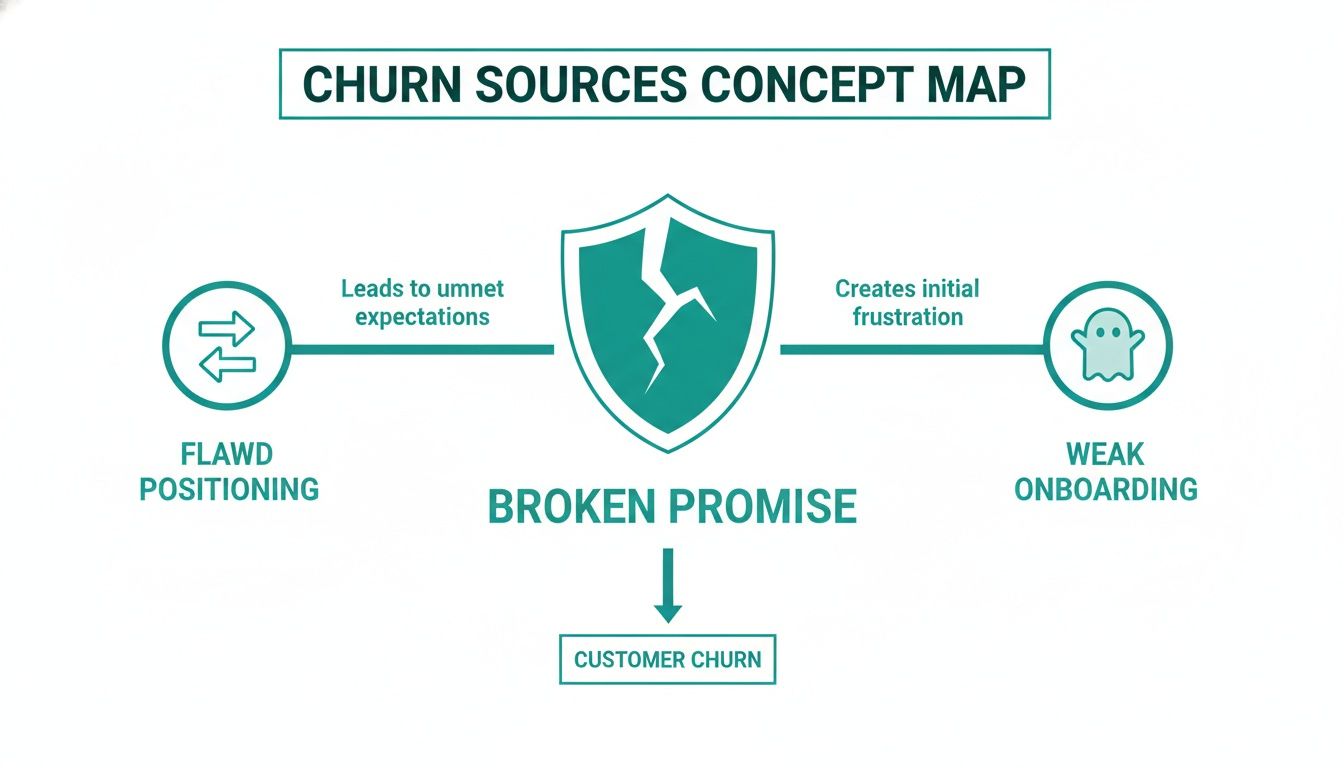
As you can see, churn is rarely a sudden event. It's the outcome of misaligned expectations that were never corrected by a powerful initial product experience.
How do you get this information? It's not by sending more automated exit surveys. They produce low-quality, generic data that won't drive decisions.
The most valuable churn insights I've ever helped a founder uncover came from a 15-minute phone call with a lost customer. Not an email, not a survey. A direct, frank conversation where the goal wasn't to win them back, but to understand precisely where we broke our promise.
You must combine these real conversations with hard data.
Pull product analytics to see where engagement dropped off. Review support tickets to find recurring points of frustration. Talk to your sales and CS teams—they are on the front lines and know the real story.
By mapping each churned account to one of the five categories and its corresponding journey stage, you move from a vague sense of loss to a precise, data-informed picture of where your growth engine is failing.
It can be useful to see how your numbers stack up against the market, but your internal trends matter most. For context, you can review typical SaaS churn rates in our analysis. This diagnosis is the foundation for any meaningful strategy to reduce customer churn.
A churn diagnosis is useless without a prescription. Once you understand the specific reasons customers leave, you can move from reactive panic to building systematic, proactive plays that prevent churn before it starts. Most teams try to do everything at once and accomplish nothing.
Don't be that team. Apply focused pressure on the one or two areas that will deliver the biggest return. Drawing from patterns across dozens of SaaS companies, there are three high-leverage areas you should almost always address first.

Involuntary churn—cancellations due to failed payments—is the lowest-hanging fruit. Fixing it requires no product changes, no strategic pivots, and no heroic saves from your CS team. It’s a pure operational leak, and plugging it provides an immediate revenue lift.
Many early-stage founders ignore it, assuming it’s a rounding error. It’s not. In B2B SaaS, involuntary churn can account for up to 40% of total churn. Smart teams that automate payment recovery are reclaiming up to 70% of that lost revenue.
While the average annual B2B SaaS churn rate is 3.5%, the 0.8% from involuntary churn is the easiest part to recover. Companies using modern recovery tools are seeing 2-4x better results and reporting retention boosts of 15% from this one initiative alone.
Your action is straightforward: implement a smart dunning management process. This isn't just sending one email when a card fails.
This is a non-negotiable function of a modern subscription business.
The first 30 days are where the war on churn is won or lost. I’ve seen it time and again: onboarding failure is the single biggest driver of early-stage churn. It happens because you failed to connect the user’s urgent pain to a specific, tangible "win" inside your product.
A generic product tour is not an onboarding experience.
Your goal is to engineer a value-realization window. Define the absolute minimum set of actions a new user must take to experience the core promise you sold them.
Stop thinking about "onboarding." Start thinking about "first value." What is the one tangible outcome a user can achieve in their first three sessions that proves your product works? Your entire initial user experience must be ruthlessly focused on getting them to that moment.
To execute this, you need to:
This is a company-wide effort. Sales should hand over a value-realization checklist during the kickoff call, aligning everyone on what success looks like in that first month. Our guide on effective customer onboarding practices offers a more detailed framework for structuring this process.
Not all your features are created equal. In every product, a handful of "sticky" features correlate directly with long-term retention. These are the workflows that become so embedded in a customer's operations that they can't imagine living without them.
Your job is to identify these features and systematically drive adoption. To truly reduce customer churn, you must first understand the deeper reasons customers leave. An AI-powered playbook to diagnose churn can be invaluable in uncovering these core drivers and pinpointing your stickiest features.
Once you know what they are, build plays to deepen engagement:
Implementing these plays is how you shift from a reactive, support-driven model to a proactive, value-driven one. You stop waiting for customers to complain and start actively guiding them toward the outcomes that make your product indispensable.
If you’re waiting for a renewal conversation to discover an account is at risk, you’ve already lost. That "we're not seeing the value" conversation is a formality. The real churn happened months ago as their product usage and belief in your solution slowly bled out.
I see this constantly. Founders treat churn like a sudden event, but it’s never a surprise. The signals are always in your product analytics if you know how to read them. This data is the only reliable, forward-looking pulse you have on the health of your customer base.

Most teams track logins. It’s easy to pull and feels like a signal of activity. But it’s almost completely useless.
A user logging in tells you nothing about the value they're getting. Logins don't differentiate between a confused 30-second session and a critical 45-minute workflow. That makes them a vanity metric.
To get ahead of churn, you need to measure what matters. Your engagement metrics must be predictive.
These are the inputs that create a real, predictive customer health score.
The fundamental shift is moving from lagging indicators (what happened) to leading ones (what's coming).
This isn't a theoretical exercise. It’s about rewiring your entire Customer Success motion to focus on the left column, not the right.
A useful health score isn't a black-box algorithm. It’s a simple, weighted model based on the behaviors you know lead to retention. Start by defining 3-5 key indicators.
For a B2B marketing automation tool, a score might look like this:
An account scoring below 60% is an immediate churn risk. The goal is to turn this data into action.
When a healthy account’s score drops by 20% or more in a 30-day period, it can't just update a chart. It must trigger an automated alert and a specific, pre-defined playbook for your Customer Success team. This is how you move from reaction to preemption.
This data-driven mindset must be wired into your team’s weekly rhythm. Your CSMs should start their week reviewing accounts that moved from "green" to "yellow," not by staring at a calendar of upcoming renewals.
This shift gives you the power to intervene weeks or even months before churn becomes a threat. An alert about declining usage is an opportunity for a CSM to reach out with a helpful tip. It becomes a value-add conversation, not a desperate "just checking in" call.
B2B SaaS teams that effectively operationalize product usage data achieve consistent 15% improvements in net revenue retention. Given that studies show software products lose a staggering 70% of users in the first three months, that 90-day cliff is where this battle is won or lost.
Product engagement is the truest signal of the value you're delivering. For a more in-depth look at what to measure, see our comprehensive guide to customer success metrics. Stop waiting for bad news and start listening to what your product is already telling you.
Top-tier B2B SaaS companies have a fundamentally different relationship with churn. They don't just plug a leaky bucket; they’ve engineered a growth engine so powerful that occasional leaks become almost irrelevant.
They've moved beyond the defensive game of keeping customers. They are laser-focused on actively growing them.
This is a complete shift in mindset, reorienting your entire post-sale strategy around Net Revenue Retention (NRR). While competitors are stuck on defense, you can build a primary growth machine fueled entirely by your existing customers. The best new business you’ll find is hiding in plain sight within your current customer base.
The core of this strategy is transforming your Customer Success function from a cost center into a profit center. This machine is powered by three expansion revenue streams: upsells, cross-sells, and strategic pricing.
The goal isn't to eliminate churn—some is inevitable. The goal is to build a system where expansion revenue from successful customers far outweighs revenue lost from the occasional poor-fit account. This is how the best-in-class companies achieve NRR figures well north of 120%.
This approach uses the same data you use to predict churn. The engagement metrics that flag a risk can just as easily signal a massive opportunity. A power user pushing plan limits isn't a problem; it's an upsell trigger. A team asking about a workflow your other product solves isn't a support ticket; it's a cross-sell signal.
To do this consistently, you must build expansion triggers directly into your customer journey. This moves your team from hoping for expansion to engineering it.
Upsell Triggers: Pinpoint usage patterns that show a customer is outgrowing their current plan—hitting an API call limit, adding more users than their tier allows, or repeatedly using an advanced feature. When a trigger is hit, it should automatically create a task for the account owner to start a conversation.
Cross-sell Triggers: Map your product suite to specific jobs-to-be-done. When a customer's behavior indicates they're trying to solve a problem that one of your other products handles, that's your cue. For instance, if a user in your analytics tool starts exporting data to build manual reports, it’s the perfect time to introduce your automated reporting module.
These triggers must be baked into your CRM and Customer Success platform, creating a repeatable process.
The most effective growth teams don't wait for the QBR to talk expansion. They use product data to surface opportunities in real-time, turning routine check-ins into strategic conversations about unlocking more value. Your CSMs should be equipped not just to answer questions, but to anticipate needs.
This requires tight alignment between Customer Success and sales enablement. When a CSM spots an opportunity, they need a tailored pitch deck and a simple playbook ready to go. You must arm them to have these commercial conversations with confidence.
As the B2B SaaS market has matured, a sharp focus on expansion has become the defining trait of market leaders. While recent benchmarks show median NRR has tightened to 101%, top performers are rewriting the rules by mastering expansion revenue. For companies over $50M in ARR, existing customers now account for a staggering 40% of new annual revenue. You can explore more insights on B2B SaaS startup benchmarks to see how the landscape is shifting.
By zeroing in on expansion, you're not just building a more efficient business; you’re also fundamentally improving the overall customer experience. You're proactively guiding your best customers toward greater success, which in turn makes them stickier, more valuable, and more likely to become your most passionate advocates.
I get these questions constantly from founders and revenue leaders. My goal isn't to give you generic benchmarks, but a clearer lens for making decisions based on what I've seen work—and what I've seen fail—in real-world B2B SaaS.
There is no single magic number.
If someone gives you one without asking about your average contract value (ACV) and ideal customer profile (ICP), they’re selling you snake oil. Context is everything.
If you’re selling a low-ACV product to SMBs, a monthly logo churn of 3-5% might feel survivable, but it’s a house on fire. It's unsustainable. Your customer acquisition cost (CAC) payback period will be too long to build a profitable business.
For companies selling to mid-market or enterprise customers, monthly logo churn must be below 1.5%. The real goal is under 1%. High contract values can mask the pain, but the underlying friction is still eroding your growth engine.
The metric that matters far more than logo churn is Net Revenue Retention (NRR). If your NRR is consistently over 100%, expansion revenue from successful customers is outgrowing revenue loss. A founder’s true north shouldn’t be some arbitrary churn percentage, but an economic model where LTV is multiples higher than CAC and NRR is fueling growth.
To get a handle on customer retention, start by developing a clear Understanding SaaS Churn Rates, how to measure them, and the core strategies to bring them down.
Almost never. This is one of the most common and damaging mistakes I see founders make.
Throwing a steep discount at a churning customer does two destructive things:
If a customer is leaving because they failed to get the value promised, cutting the price only delays the inevitable churn. It doesn’t fix the broken promise.
The only exception is a highly strategic account where a temporary, structured concession is part of a larger, formal "get-well plan." That plan must address the core issues of adoption and value realization, with clear milestones for both sides.
Instead of rushing to discount, use the churn conversation as a priceless diagnostic tool. The insights you gain are far more valuable than the temporary revenue you might save.
Day one. Not day 365.
Even before you have enough data to calculate a statistically significant churn rate, you need to be building the operational muscles for retention. This isn't about complex analytics; it's a founder-level obsession with the post-sale experience.
Your first ten customers are your most valuable focus group. Their churn is the purest signal you have about your product-market fit and the clarity of your value prop.
Don't wait for churn to appear as a problem in financial reports. By then, the issues—poor onboarding, misaligned sales promises, product gaps—are deeply embedded in your go-to-market motion and much harder to untangle.
Start by tracking leading indicators from the beginning:
This early focus isn't premature optimization. It's the foundational work required to build a resilient company, not just a leaky bucket of revenue.
At Big Moves Marketing, we partner with B2B SaaS founders to instill this kind of strategic clarity. We help you move beyond reactive fixes to build a go-to-market engine that prevents churn by design, turning retention into your most powerful growth driver. Learn more at https://www.bigmoves.marketing.
Explore Big Moves Marketing services and resources:





%20-%20white.svg)