%20png%20copy.avif)

Most B2B SaaS founders are told they need a sales playbook. It's meant to be the instruction manual for your revenue engine—a single source of truth that codifies what works so every new rep can execute with precision.
The reality? Most are dead on arrival. Digital dust collectors that reps glance at during onboarding and never open again, actively harming your ability to scale.
Founders hear "playbook" and dutifully compile scripts, buyer personas, and process docs into a monolithic Google Doc. They check the box, expecting this artifact to magically scale their sales motion.
It never works.
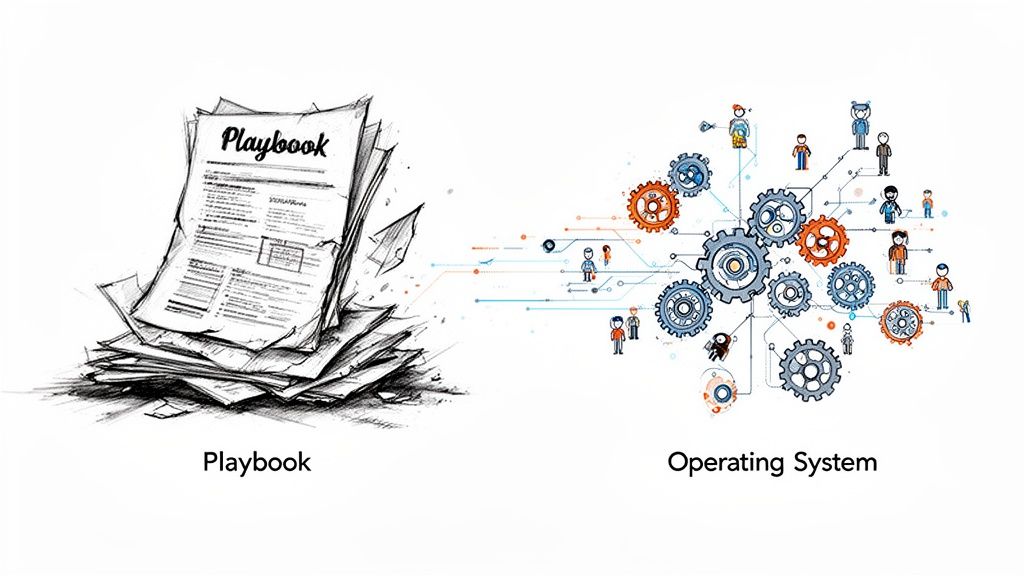
The problem isn't the concept of a playbook; it's the execution. Most are built as rigid, top-down instruction manuals. They completely ignore the dynamic reality of early-stage GTM, where the "rules" are invalidated quarterly by market feedback.
The result is a bloated, outdated document that reps ignore because it doesn’t reflect what’s actually happening on their calls. It doesn't help them win.
A playbook’s job isn't to turn reps into robots. It's to codify proven strategy, shorten the learning curve for the entire team, and ensure everyone tells the same sharp, differentiated story.
It is the bridge from chaotic, founder-led wins to a repeatable growth machine. To achieve this, you must treat it less like a book and more like an operating system for your revenue team.
The moment a sales playbook is treated as a finished project, it begins to lose value. Its utility is directly tied to its relevance, and relevance in a scaling SaaS company has a half-life measured in months, not years.
This mental model shifts everything. A static document creates compliance; a dynamic system drives performance. It forces a fundamental change in how you build, manage, and measure your playbook. It's the difference between a tool that gathers dust and one that actively determines whether you hit your number.
Market shifts render static playbooks obsolete overnight. The arrival of AI Overviews, for example, instantly broke the classic SEO playbook, forcing an entire industry to adapt or fall behind. Your sales environment is just as volatile.
The most effective playbooks aren’t encyclopedias. They are focused, living frameworks that give reps strategic clarity. This covers everything from your core messaging down to the tactical assets reps use daily, like a high-impact B2B SaaS sales deck template.
A playbook fails when it prescribes every action. It succeeds when it equips reps with the context and tools to make better decisions in the moment.
Forget the bloated PDFs. A modern sales playbook isn't a collection of scripts. It’s the codified Go-to-Market strategy for your entire revenue team.
Think of it as the source code for how your company acquires customers. It’s written for thinking, adaptable humans—not machines. A functional playbook provides the definitive, first-principles answers to four critical questions:
When these four pillars are clear, the playbook becomes a strategic weapon, not an administrative chore.
The fundamental reason most playbooks fail is their format. They're created, shoved into a shared drive, and then slowly die. An effective sales playbook is a dynamic operating system for your revenue engine—it adapts, learns, and gives your team leverage.
The table below breaks down the difference between the failed approach and the modern framework required for B2B SaaS growth.
This shift from a static document to a living system is what separates high-growth teams from everyone else. The playbook becomes the source of truth that powers consistent execution and continuous improvement.
A functional playbook is essential for navigating the jump from founder-led sales to your first revenue hires. The founder holds the entire GTM motion in their head—the context, nuance, and stories that win deals. The playbook’s primary job is to extract that institutional knowledge and translate it into a system others can execute.
The performance gap is undeniable. Research from Aberdeen shows that 42% of best-in-class companies use sales playbooks, compared to just 14% of laggards. Top companies see higher quota attainment, a 15% increase in customer retention, and lead conversion jumps of up to 25%.
A playbook isn't about forcing compliance; it's about scaling conviction. It ensures every rep can articulate the company's point of view with the same clarity and authority as the founding team.
Without a codified system, every new hire starts from zero. They reinvent the wheel, leading to massive performance variance, inconsistent market messaging, and a sales cycle that never shortens. Your ability to scale revenue is capped by your ability to replicate what works.
A strong playbook provides the structure for that replication. It gives reps the guardrails to operate effectively while allowing the autonomy required for complex B2B sales. This structure also creates a baseline for effective coaching. Leaders can finally diagnose issues in the process, not just in the person.
This is the foundational work required to build a predictable revenue engine. To see how these principles translate into a practical structure, explore our B2B sales playbook template and outline. It’s designed to build a true operating system, not another document destined for the digital dustbin.
A playbook is only as good as its content. Most templates are bloated with academic frameworks and theoretical fluff—useless to a rep on a live call. They become encyclopedias of information, not manuals for execution.
A revenue-driving playbook is a curated system of strategic assets, not a dumping ground for process docs. Every component must earn its place by helping your team shorten sales cycles, increase win rates, and forecast accurately. Anything else is noise.
Think of your playbook as the central nervous system for your Go-to-Market strategy, connecting who you sell to, what you sell, how you sell it, and how you win.

This visual makes a critical point: a playbook isn't a siloed sales document. It's the executable layer of your GTM strategy.
This is the non-negotiable starting point. Without clarity here, everything else is built on sand. This isn’t about creating generic personas; it's about codifying market reality.
This translates GTM strategy into the words your team uses. Consistency here is non-negotiable. It ensures every prospect hears the same powerful, differentiated story.
Your architecture must include:
A playbook’s primary function is to scale your company's point of view. Generic messaging forces reps to compete on features and price—a race to the bottom.
This is where strategy becomes action. "Plays" are step-by-step guides for key sales motions. "The Arsenal" is the collection of assets reps use to execute them.
Finally, the playbook needs a system to ensure it's used, measured, and improved. This transforms the playbook from a static document into a living part of your revenue engine.
A well-constructed playbook directly impacts rep productivity. With average rep turnover around 1.5 years and a typical three-month ramp time consuming nearly 25% of that tenure, a strong playbook gets new hires to full productivity faster. This can increase the ROI on each hire by as much as 50% by providing a ready-made library of scripts, content, and tools.
To see what makes a successful guide, explore these actionable sales playbook examples for B2B teams. The best are all built around these core, revenue-driving components.
Building a sales playbook too early is a classic founder mistake—premature optimization for a process that doesn't yet work. But waiting too long is just as damaging. You burn cash, frustrate your first sales hires, and bake bad habits into your culture that take quarters to fix.
The right time isn’t about funding rounds or headcount. It’s about hitting specific inflection points. The biggest myth is that you need perfect clarity before you start. A playbook isn’t a trophy you build after figuring everything out; it’s the tool you use to figure things out faster.
The most critical trigger is the transition from founder-led sales. When the founder is the only person who can close a deal, the business has a fatal bottleneck. The "playbook" is trapped inside their head—a mix of intuition, product knowledge, and personal relationships that can't be handed off.
This is the moment to start writing things down. The goal isn’t a perfect, 100-page document. It's a V1 that makes the founder's implicit knowledge explicit. Think of this first playbook as a log of your hypotheses—it should document the messaging, discovery questions, and objection handling that secured your first 10-20 customers. Without it, your first sales hires are set up to fail.
Your pre-product-market fit playbook isn't about creating a rigid process. It's about creating a system for learning. Every call, every demo becomes a data point that either validates or disproves your GTM theories.
The second signal appears after hiring your first two or three account executives. You will see a massive delta in performance. One rep crushes quota while another struggles to build pipeline. This isn't a hiring problem; it's a systems problem.
High variance in performance means success is driven by individual heroics, not a repeatable process. A playbook becomes essential for standardizing core activities. It sets a baseline for "good," letting you diagnose issues in the process, not just the person. It’s how you shift from managing people to managing a system.
Other clear signs it’s time:
For an early-stage company, the playbook is a hypothesis log. For a post-PMF company, it becomes a scaling machine. The second you see these signals, the clock is ticking. The cost of delay is measured in lost deals, wasted marketing spend, and inconsistent execution.
Staring at a blank page to build a sales playbook is a recipe for failure. Most leaders either over-engineer a 300-page encyclopedia no one reads, or they procrastinate until it's too late. Both are expensive mistakes.
The goal isn't perfection. It's a Minimum Viable Playbook (MVP)—a lean, practical guide that delivers immediate value and improves every quarter.
Like building a product, an MVP playbook isn’t a theoretical exercise. It’s a real-world tool built by codifying what already works inside your sales motion. This roots it in reality from day one. The process has five iterative steps.
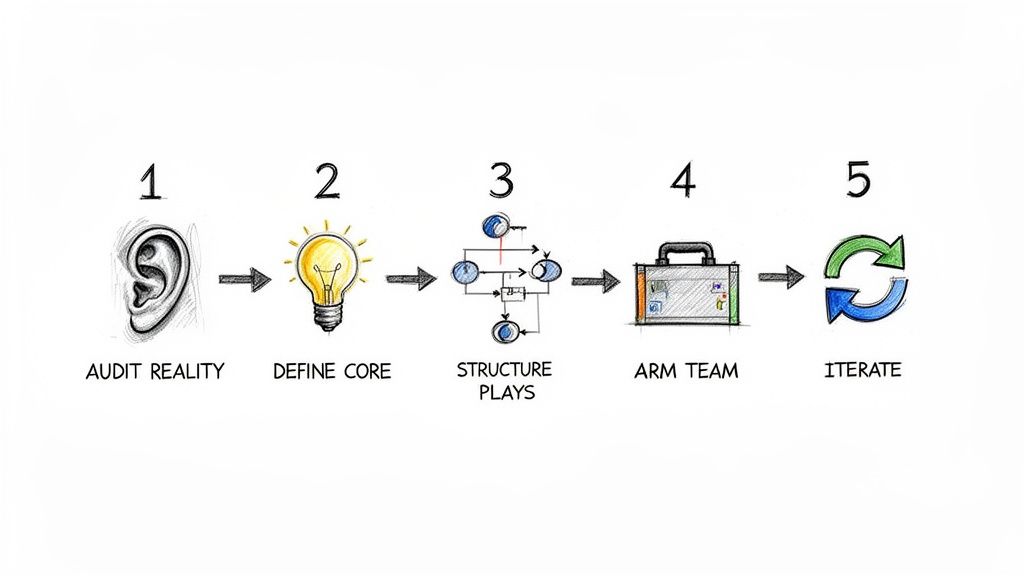
Your first playbook already exists. It’s in the habits of your top reps, the transcripts of their best calls, and the notes on your whiteboard. Your first job isn't to invent—it's to excavate.
Conduct a forensic audit of what's happening on the ground.
With this raw intel, codify the fundamentals. Translate observed winning behaviors into clear, strategic principles. You're building a baseline the entire team can execute.
Your core definition must include:
A "play" is a repeatable sequence of actions for a critical moment in the sales process. For your MVP, focus on the highest-leverage moments. Avoid complex decision trees. Start with simple, linear guides.
The point of a V1 play isn't to script every word. It's to provide strategic guardrails—a framework of key questions to ask, points to make, and outcomes to drive at each stage.
Focus on these foundational plays first:
With plays structured, create the tactical assets your team will use in the heat of battle. These are the practical tools that bring strategy to life.
For an MVP, you only need a few essentials:
This focused approach builds momentum. The consulting firm Alpharun uses a similar 5-step process and has seen clients increase win rates by 18% and improve new hire ramp efficiency by 50%. Success comes from tying the playbook directly to measurable outcomes.
The MVP playbook is the starting line. The final, most important step is creating a formal feedback loop so the playbook improves over time. It must be a living document that evolves with every sales call, market shift, and product update.
Schedule a quarterly playbook review. No exceptions. The entire team should analyze what's working, what's failing, and what needs an update. This ritual turns your playbook from a static PDF into a dynamic system that compounds your team's collective knowledge. The same iterative principles of building a minimum viable product are just as critical here.
A sales playbook without metrics is a philosophy, not a tool. Its value isn’t how it looks, but its direct impact on revenue velocity. If you can’t measure its effect on the numbers that matter, you’ve built an expensive document, not a performance asset.
Too many leaders stop at deployment, assuming the playbook will magically fix their sales process. This is a critical mistake. The real work begins after V1 goes live and demands an unflinching focus on a handful of core metrics.
Don’t chase vanity metrics. A successful playbook directly improves the core economics of your sales engine. You should see a measurable impact on these four leading indicators:
Tracking these KPIs isn't optional. For a deeper dive, our guide on how to measure marketing effectiveness offers a parallel framework useful for revenue leaders.
I’ve seen the same failures at dozens of SaaS companies. The playbook looks great in a presentation but has zero impact on the sales floor. It almost always comes down to one of these four unforced errors.
The most common failure is treating the playbook as a one-time project. It’s built, launched, and left to die in a shared drive. A playbook is a product, not a project. It needs a product manager—the head of sales—and a regular release cycle.
Here are the most common failure modes:
Avoiding these pitfalls requires discipline. A playbook’s success is a direct reflection of leadership’s commitment to building a scalable, data-driven revenue system.
Straight answers to the questions I hear from B2B SaaS leaders trying to build a sales playbook that actually works.
Think of your sales playbook like your product: if it’s not evolving, it’s dying.
The absolute minimum is a quarterly review. This is where you analyze performance data, listen to the team on the ground, and kill what isn’t working.
But that’s just the baseline. Any major GTM shift—a new ICP, a product launch, a competitor's move—should trigger an immediate, targeted update. A playbook that isn't iterated on is a dead document.
Revenue leadership. Period.
While sales enablement or product marketing will build assets, ultimate ownership must sit with the leader whose name is next to the revenue number. This is non-negotiable.
When sales leadership owns the playbook, it ensures alignment with quota. It forces use during pipeline reviews. It guarantees the feedback loop from the front lines is taken seriously. Without that ownership, the playbook is a theoretical exercise reps will rightfully ignore.
Treating the playbook as a static, one-and-done project.
I’ve seen it a hundred times. Leaders pour weeks into building a comprehensive encyclopedia. They launch it, check the box, and six months later wonder why performance hasn't budged.
Reps are ignoring it because it's overwhelming and disconnected from their daily reality.
The goal isn't a perfect, exhaustive document. It's a living system that evolves with your market and your team. A lean, execution-focused playbook that gets used and updated is infinitely more valuable than a "perfect" one gathering dust.
At Big Moves Marketing, I help B2B SaaS founders build the GTM strategy, positioning, and sales enablement assets required to move from founder-led sales to a scalable revenue engine. Learn more about my approach.
Explore Big Moves Marketing services and resources:



%20-%20white.svg)