%20png%20copy.avif)
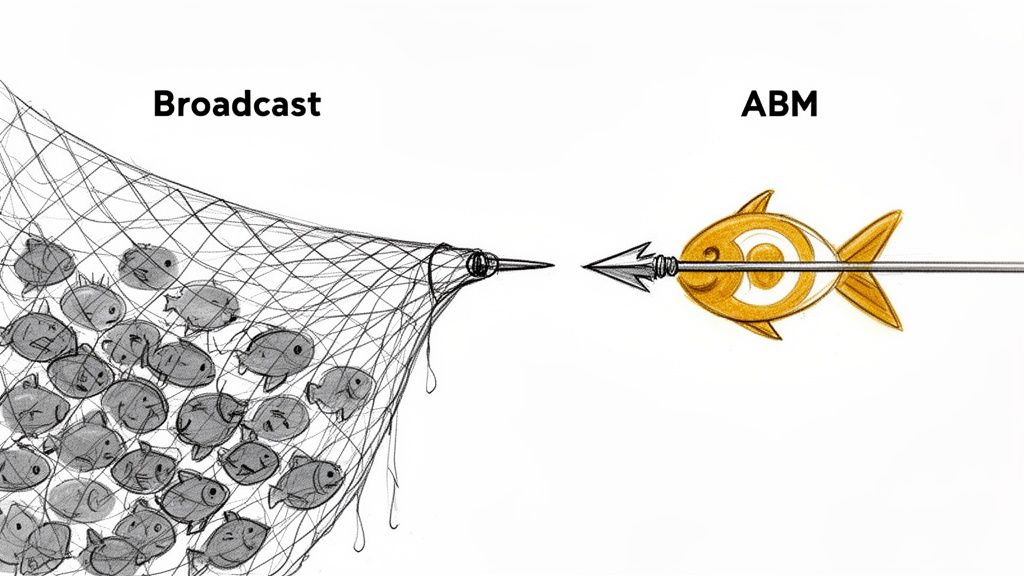
Tired of shouting into the void with mass marketing campaigns that barely move the needle? There's a better way. Account-based marketing, or marketing ABM, is a focused B2B strategy that completely flips the traditional marketing funnel on its head. Instead of casting a wide net for any and all leads, you’re using a spear to go after the specific, high-value accounts that can truly transform your business.
Think about traditional marketing like this: you're standing on a pier, throwing a massive net into the ocean. Sure, you catch hundreds of fish, but most are too small, not the right kind, or just plain irrelevant. You then have to spend precious time and energy sorting through the whole catch just to find a few prize winners. This is the old "spray and pray" method—generate tons of leads and hope a small fraction convert.
Now, picture an ABM marketer. They're more like a skilled spear fisher who has already identified a single, high-value fish from the shore. They study its habits, understand its environment, and then make a precise, targeted strike. All their energy is focused on landing that one perfect catch.
Account-based marketing treats individual accounts as their own unique markets. It's about depth, not just breadth, focusing your resources on the prospects most likely to become your best customers.
This focused approach is a game-changer for B2B SaaS and AI startups, especially when you're dealing with complex products and long sales cycles. Closing a deal isn’t about convincing just one person; it’s about building a consensus across an entire buying committee, from the CTO and head of product to the folks in finance.
One of the biggest wins with ABM is its power to finally get sales and marketing teams on the same page, right from the start. Instead of operating in their usual silos, they have to collaborate closely to:
This alignment ensures every marketing dollar and every sales hour is invested in opportunities that actually matter. It's no wonder that ABM is catching on; 70% of B2B marketers now have an active ABM program, with companies dedicating an average of 29% of their marketing budgets to the strategy. This isn't just a trend—it's a fundamental shift away from volume-based tactics toward high-impact, account-focused growth. This guide will show you how to join them.
For B2B SaaS founders, the only question that ever really matters about a strategy is its impact on the bottom line. Account-based marketing isn't just another buzzword; it's a powerful engine for real, sustainable growth. It's about generating revenue, not just a mountain of leads that go nowhere.
The real magic of marketing ABM is its incredible efficiency. Instead of casting a wide net and hoping for the best, you concentrate your firepower on a handpicked group of high-value accounts. This precision means you stop wasting time and money chasing prospects who were never going to be the right fit anyway.
That focus translates directly into higher-quality opportunities and a much more predictable revenue stream.
Forget chasing a high volume of small, uncertain leads. ABM is about landing the big fish.
When you invest in deep personalization and build genuine relationships within your target accounts, you're not just another vendor—you're a strategic partner. This focus on quality naturally leads to larger contract sizes and a healthier, more robust sales pipeline.
The numbers back this up in a big way. The global ABM market is projected to hit a staggering USD 3,811.4 million by 2030. For SaaS founders, that signals a massive shift in how the best companies win. In fact, a whopping 96% of marketers using ABM report average contract values over $51,000, with some seeing deal sizes jump by as much as 50%.
By treating each high-value account as a market of one, you're not just selling a product; you're co-creating a solution. This deep partnership unlocks greater revenue potential and cements long-term loyalty.
This strategic approach also dramatically speeds up the sales cycle. A key benefit of ABM is its direct impact on optimizing your sales pipeline. When your sales and marketing teams are perfectly in sync about which accounts to pursue and how to engage them, all the usual friction just melts away, letting deals close faster.
To really see the difference, let’s compare how ABM stacks up against the old-school approach across the metrics that truly matter.
The data is clear: ABM doesn't just incrementally improve results; it fundamentally changes the economic engine of your business, driving more predictable and profitable growth.
One of the most powerful—and often overlooked—benefits of adopting an ABM strategy is the incredible alignment it forges between your sales and marketing teams.
The age-old tug-of-war between lead quantity and lead quality simply evaporates. Suddenly, both teams are united by a single, shared goal: to win and grow a specific list of target accounts.
This unified approach is a game-changer. A solid 56% of companies report better sales and marketing alignment after implementing ABM, a shift that cuts wasted prospecting time in half. That newfound collaboration has a direct, positive impact on your marketing budget and overall efficiency.
If you're interested in smarter spending, you can explore some strategic lessons on how B2B SaaS companies can optimize marketing spend. This focus ensures every piece of content, every ad, and every sales call is part of a coordinated, high-impact plan designed to win your most important accounts.
Getting started with Account-Based Marketing isn't about flipping a switch and overhauling your entire marketing department. It’s more like building a custom playbook for a handful of your most important future customers. Forget thousand-page manuals; this is about a clear, actionable guide that turns your big-picture strategy into wins on the ground.
We can break the whole process down into three core phases: Identify, Engage, and Land & Expand. Each one builds on the last, creating a powerful momentum that gets your whole company—from sales to success—rowing in the same direction. This simple framework takes the mystery out of ABM, making it a powerful growth engine for any B2B SaaS team.
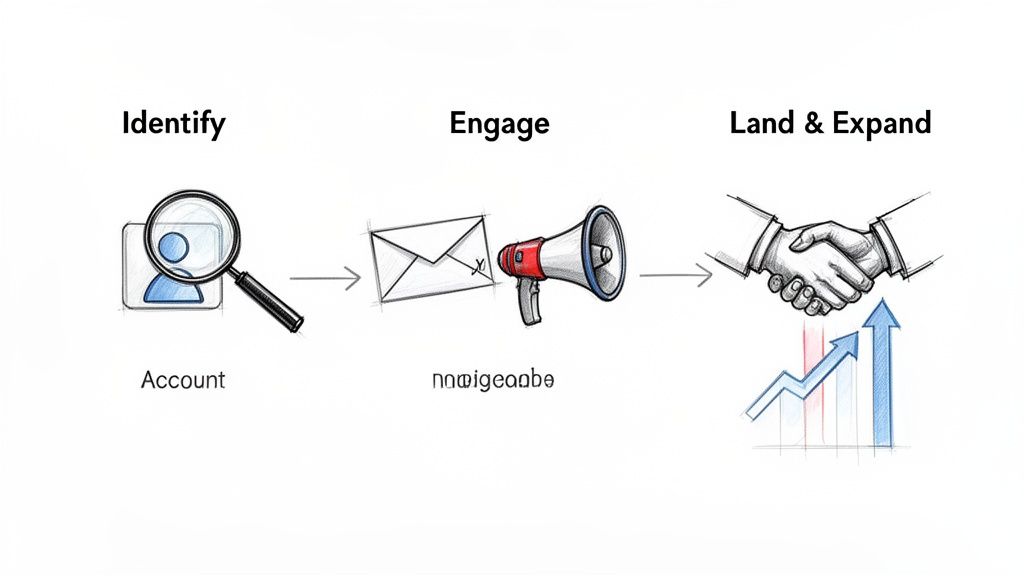
This first step is everything. Seriously. Before you can engage anyone, you have to know exactly who you’re talking to. The goal here is to move from a vague sketch of your customer to a crystal-clear, data-backed profile of the companies that can truly change the trajectory of your business.
This phase really comes down to two key moves:
Craft Your Ideal Customer Profile (ICP): This is the blueprint for your perfect customer. It goes way beyond basic demographics to include firmographics (like industry, company size, and revenue), technographics (the tech stack they’re already using), and crucial buying signals (like a recent funding round or hiring for a specific role). Your sales and marketing teams absolutely have to build this together.
Build Your Target Account List (TAL): With your shiny new ICP as your guide, you can now curate a list of your "dream" accounts. Start small and stay focused—maybe 10-20 companies that are a perfect match. This isn’t about casting a wide net; it’s about precision spearfishing.
This initial identification phase is where you win or lose in ABM. A tightly defined account list acts as your north star, ensuring every single marketing and sales action that follows is focused, efficient, and impactful.
Once you know who you’re targeting, it’s time to earn their attention. The Engage phase is all about ditching the generic, mass-market noise and starting meaningful conversations that speak directly to the challenges and goals of each specific account.
To pull this off, you need to nail two things:
Develop Personalized Content: Create assets that hit on the specific pains and priorities of your target accounts. This could be an industry-specific case study, a blog post that subtly points out a competitor's weakness, or a webinar built for a key decision-maker's role. Understanding the difference between content writing vs copywriting is critical here—you need to both educate and persuade.
Execute Multi-Channel Campaigns: Don't just hammer their inboxes. Reach your target accounts wherever they are, using a coordinated mix of channels like LinkedIn ads, clever direct mail, personalized video messages, and strategic sales outreach. The whole point is to create a consistent and compelling experience at every single touchpoint.
For B2B SaaS companies, the content you create is basically the currency of trust. If you need to build a more powerful content engine, dive into our guide on effective marketing for SaaS.
Closing the first deal isn't the finish line; it’s the starting block. The final phase of your ABM playbook is all about turning new customers into your biggest fans and unlocking long-term value. This is where ABM really pays off, driving major revenue growth far beyond that initial sale.
The "Land & Expand" motion is pretty straightforward:
Land the Initial Deal: This is a team sport. Marketing’s job is to provide the air cover and insights sales needs to get the deal across the line. Share every piece of engagement data and work together to create sales materials that hit home.
Expand the Footprint: Once a customer is on board, the real work begins. Your goal is to find opportunities for upselling, cross-selling, and introducing your solution to new departments or teams inside the organization. A successful first project can be your Trojan horse for enterprise-wide adoption.
By following this three-phase playbook, you're not just running a campaign; you're building a repeatable system for attracting, winning, and growing your most valuable customers.
Real personalization in ABM isn’t about just dropping a first name into an email template and calling it a day. Far from it.
It’s about creating experiences so specific and insightful that your target accounts feel like you’ve been sitting in their boardrooms. This is where you transform a generic marketing blast into a strategic conversation, proving you’ve done your homework and are genuinely equipped to solve their unique problems.
But this level of customization isn't an all-or-nothing game. It operates on a sliding scale, with different tiers of effort for accounts of varying strategic importance. Understanding these tiers is key to focusing your resources where they’ll make the biggest splash.
Your approach to personalization should directly correlate with the value and potential of the target account. Think of it as a spectrum, moving from a wide-angle lens to a microscopic focus.
One-to-Many: This is the lightest touch. You're tailoring content for broader segments of your account list based on things like industry-wide trends, common challenges for a specific role, or even shared technology stacks. It's not deeply individual, but it’s a massive leap forward from generic, one-size-fits-all marketing.
One-to-Few: Here, you group a small cluster of similar accounts together—maybe 5-10 companies in the same niche wrestling with identical pain points. You can then build a hyper-relevant campaign for that specific group, like a custom webinar that tackles a shared industry challenge or a case study featuring a lookalike company.
One-to-One: This is the pinnacle of ABM personalization, reserved only for your highest-value, tier-one accounts. Every single piece of outreach is meticulously crafted for one company, referencing their specific business initiatives, key executives, and goals pulled from their latest annual report or earnings call.
The goal of tiered personalization is to match your effort with the opportunity. By investing the most in your top accounts, you create deeply resonant experiences that cut through the noise and build genuine relationships with key decision-makers.
To make that real connection, you have to dig deeper than surface-level details. This is where account intelligence and intent data become your secret weapons. They give you a window into the specific pain points, shifting priorities, and buying signals happening inside an organization right now.
Getting this intelligence is one thing; knowing how to map it to the right people is another. It's a critical part of using buyer personas to accelerate your marketing and sales.
Once you have these insights, you can get creative. Imagine building a custom landing page for a top-tier account that features their company logo and speaks directly to challenges you know they’re facing, using language pulled straight from their own reports. Or, picture running personalized ads on a platform like LinkedIn that speak directly to a specific company or job title.
By weaving these deep insights into your campaigns, you stop being an interruption. You become a welcome, valuable part of their conversation.
In the world of traditional B2B marketing, we’ve been conditioned to chase volume. We celebrate big numbers like website traffic, lead counts, and cost-per-click. While these metrics look impressive on a dashboard, they often fail to answer the most important question: are we actually making money?
When you adopt an Account-Based Marketing strategy, you have to throw out that old rulebook. The game is no longer about catching the most fish; it's about landing the right fish. You’re no longer chasing a high quantity of leads; you’re pursuing deep, meaningful engagement within a handful of high-value accounts.
This means your metrics have to shift from vanity to value. Instead of asking, "How many leads did we get this month?" you start asking, "How deeply are we engaging our top 10 target accounts?" It's a fundamental change that allows you to prove the real impact of your efforts and get the entire leadership team excited about what you’re doing.
The first step in measuring ABM is to completely rethink your key performance indicators (KPIs). Your dashboard needs to tell a story of account-centric progress, not just a tally of individual lead actions. This isn’t just about adding a few new charts; it’s about changing how you view the entire customer journey, focusing on the health and forward momentum of the whole account, not just one person in it.
This is where personalization becomes your primary tool for driving engagement, which in turn moves the metrics that matter.

As you can see, the more focused your approach—moving from broad one-to-many tactics to hyper-focused one-to-one interactions—the more meaningful your engagement becomes. That engagement is what you need to start measuring.
Here are the key metrics that truly define ABM success:
The true power of ABM measurement is its ability to draw a straight line from your marketing activities to revenue. It replaces guesswork with clear, account-level data that tells a powerful story of growth and ROI.
Getting a handle on these new benchmarks is everything. For a deeper look at setting up your reporting for success, check out our guide on B2B marketing analytics for growth.
To make this shift crystal clear, let’s compare the old way with the new way.
The table below breaks down the critical differences between the volume-based metrics of the past and the value-based metrics that drive a successful ABM program.
As you can see, the focus moves from broad, often misleading numbers to precise indicators of progress within the accounts that can actually change the trajectory of your business. This is how you measure what truly matters.
We've covered a lot of ground, haven't we? From the core "what" and "why" of account-based marketing to the nitty-gritty of building playbooks, personalizing your outreach, and measuring what actually moves the needle for a B2B tech company like yours.
Think of it like this: you now have the map and the compass. But the real magic of ABM doesn't happen from studying the map—it happens when you take that first step on the trail. It's a fundamental shift in mindset, moving from shouting at a crowd to having meaningful conversations with the few businesses that can truly change the trajectory of your company.
This is how you stop competing on volume and start winning on value.
Your first step doesn't need a massive budget or a complete organizational overhaul. It just requires the courage to start small. Pick five dream accounts. Get your sales and marketing folks in a room (or a Zoom call). Build your very first personalized campaign together. That's it.
This isn't just another marketing strategy; it's a commitment to smarter, more intentional growth. For any B2B SaaS company that's serious about landing its most important customers, ABM provides the essential framework.
The era of spray-and-pray is over. Your first, deliberate move is waiting. Go on, take it.
Let's tackle some of the most common questions that pop up when B2B SaaS founders and marketers start digging into ABM.
Not at all. While giant enterprises get a lot of value from ABM, it’s arguably even more powerful for startups trying to be smart with every dollar.
Think about it: instead of spreading your limited budget thin across a huge, undefined market, ABM lets you focus all your firepower on a handpicked list of high-value accounts. You stop wasting cash on broad campaigns and can get a much higher return on your investment.
This is a "how long is a piece of string?" kind of question. The cost can vary wildly, but the good news is you don't need a massive budget to get started.
You can launch a pilot program with just a few target accounts using the tools you probably already have, like LinkedIn Sales Navigator and your CRM. Costs go up when you start adding specialized ABM platforms, intent data providers, and dedicated ad spend, but that’s the point. Start small, prove the ROI, and then scale up.
The real beauty of ABM is how scalable it is. It’s not about how much you spend, but how precisely you spend it. A well-targeted campaign on a shoestring budget can easily outperform a massive, unfocused traditional marketing spend.
You have to play the long game here. ABM is all about building deep, meaningful relationships within complex buying committees—it’s not about generating a flood of low-quality leads overnight.
You’ll likely see early signs of life, like a jump in engagement from your target accounts, within the first 90 days. But for a real impact on your pipeline and revenue, you should expect a 6-12 month timeframe. High-value deals just have longer sales cycles. This is a marathon focused on quality, not a sprint for quantity.
Ready to build a high-impact marketing strategy that attracts your dream customers? Big Moves Marketing specializes in helping B2B SaaS startups create the positioning and launch strategies that drive real revenue. Let's make your next big move together at https://www.bigmoves.marketing.
Explore Big Moves Marketing services and resources:


%20-%20white.svg)