%20png%20copy.avif)
Most B2B SaaS teams searching for a product launch timeline template are looking for a checklist. A Gantt chart they can copy-paste, pre-filled with generic marketing and engineering tasks. This is a strategic error, and it’s the primary reason so many well-engineered products launch to the sound of crickets.
A launch timeline viewed as a project plan is a liability. It creates a false sense of security, encouraging teams to measure progress by completed tasks instead of validated assumptions. This inevitably leads to a launch disconnected from market reality.
A strategic launch timeline is not an administrative tool. It's the operational blueprint for your entire go-to-market hypothesis. Its purpose is to force the sequencing and validation of core assumptions—about the customer, their problem, your messaging, and your channels—before you commit six-figure budgets and your team's focus to a public release.
The standard "marketing kicks off at T-minus 6 weeks" model is fundamentally broken. It treats the launch as a promotional event tacked onto the end of a development cycle. This is backward. A launch is a business process that begins months earlier, centered on de-risking every GTM assumption.
The most common and costly mistake is treating the launch as a marketing-led event that begins after the product is ‘code complete.’ A successful launch is a GTM function that starts months earlier with cross-functional validation. It's about pulling market risk forward, not pushing a finished product out the door.
This flawed, checklist-driven mindset guarantees predictable failures:
Reframing the timeline from a project management exercise to a strategic instrument changes the entire dynamic. Instead of tracking task completion, you begin tracking the validation of critical hypotheses.
For instance, your timeline shouldn't just contain the task "Write Landing Page Copy." It needs milestones that prove you're on the right track:
This approach ensures your product doesn't just ship on time; it launches with a pre-validated path to revenue. Each phase of the timeline is designed to answer a fundamental business question, not just to check a box. Moving from a task list to a validation framework is essential, and a well-designed product launch plan template serves as a strategic asset for this transition.
The timeline becomes a tool for forcing hard conversations early and making the dependencies between product, marketing, and sales explicit. It ensures that by the time you reach the final weeks, your GTM motion is an evidence-backed strategy, not a guess.
A high-impact B2B SaaS launch is not a single event. It's a sequenced campaign executed across four distinct phases, each with its own objective and set of required outputs. Treating your launch like a linear checklist is a recipe for failure.
Think of it as a series of cascading validations. Success in one phase earns the right to proceed to the next. This is a fundamental mindset shift from a task-based process to a hypothesis-driven one.
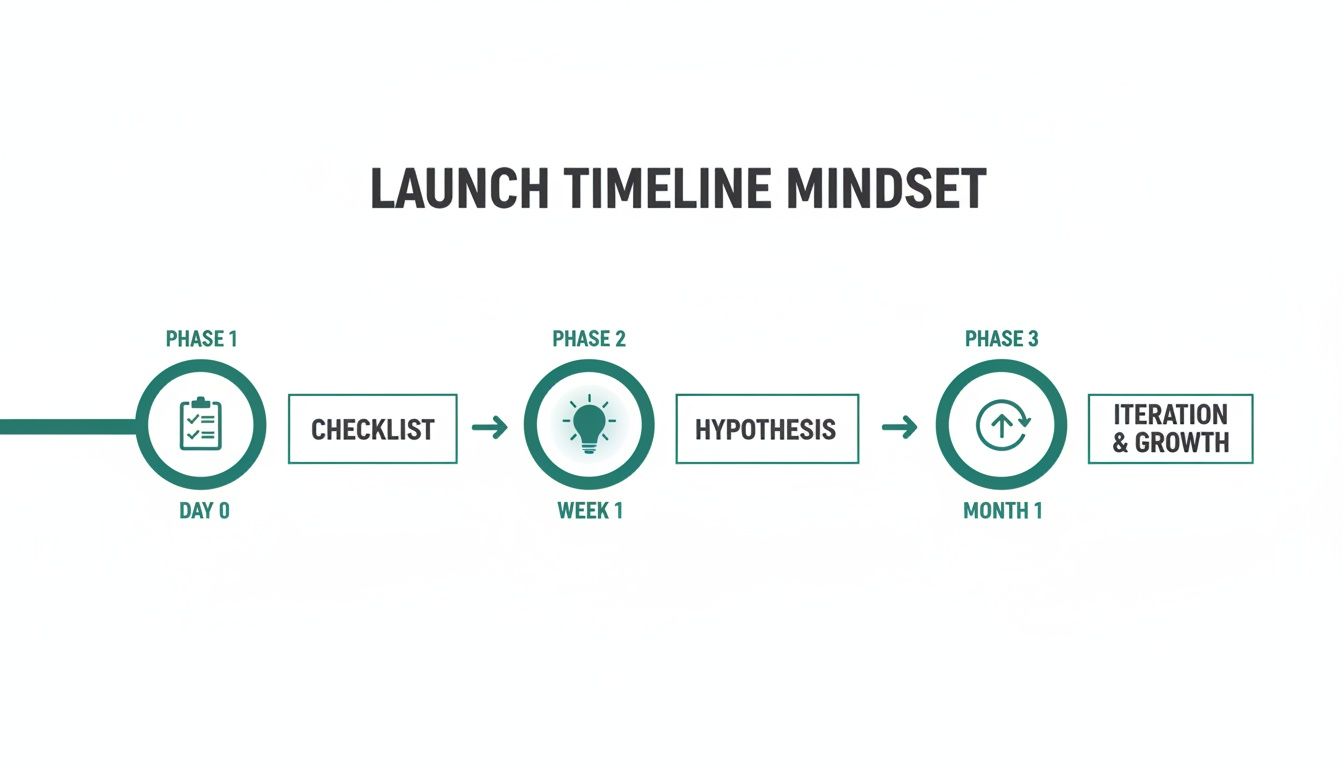
The image above illustrates the point. Your launch isn't a static set of tasks. It is a continuous cycle of testing assumptions, iterating based on real feedback, and building on that intelligence for growth. It is a strategic process, not an administrative one.
Here’s a high-level breakdown before we dissect each phase.
Now, let's unpack what must happen in each stage.
This is where launches are won or lost, long before a single marketing asset is created. The sole objective is to de-risk your go-to-market strategy by rigorously pressure-testing assumptions about your customer, their problem, and the value of your solution.
Focus your efforts here:
This phase is pure intelligence gathering. Rushing or skipping it means building your entire launch on a foundation of unverified internal beliefs.
Only after validating your positioning and messaging should you begin creating assets. This phase translates insights from Phase 1 into the tangible tools your GTM teams need to execute. Building assets without this validation leads to generic, ineffective materials.
Your focus shifts to equipping your teams. Key outputs include:
With assets in hand, the focus pivots to warming up the market. The objective is to build anticipation and generate a queue of qualified interest before the official launch day. A strong priming phase ensures you launch to an audience that’s already listening.
This is where you build momentum. Key activities include:
This strategic preparation is a critical component of a successful launch. For a deeper dive, review this guide on building a winning B2B Go-To-Market Strategy.
Launch week is about flawless execution, not improvisation. This final phase covers the launch itself and the critical 30 days that follow. The objective is to convert built-up momentum into measurable business outcomes, like pipeline and revenue.
This phase is defined by two elements: a pre-planned runbook and a rapid feedback loop.
The launch is the starting line, not the finish line. The market's initial reaction is the most valuable, unfiltered dataset you will ever receive. How you analyze and act on it in the first 30 days determines your long-term trajectory.
Workstreams include executing the launch-day communications plan, obsessively monitoring initial user activation and engagement metrics, and establishing daily stand-ups between sales, marketing, and product to share real-time market feedback. This rapid iteration cycle ensures insights from your launch immediately inform your GTM strategy.
Discover more about the required elements in our guide on how to launch a new product.
Product launches don’t fail on launch day. They fail twelve weeks earlier when foundational go-to-market assumptions go unchallenged.
This is the unglamorous, make-or-break validation phase. It's where you determine if you have an evidence-backed launch or an expensive learning experience. Most teams skip this part because they mistake product completion for launch readiness. They are not the same thing.
The goal here is not to start building marketing assets. It’s to systematically dismantle your internal assumptions with real-world feedback before spending a single dollar on demand generation.
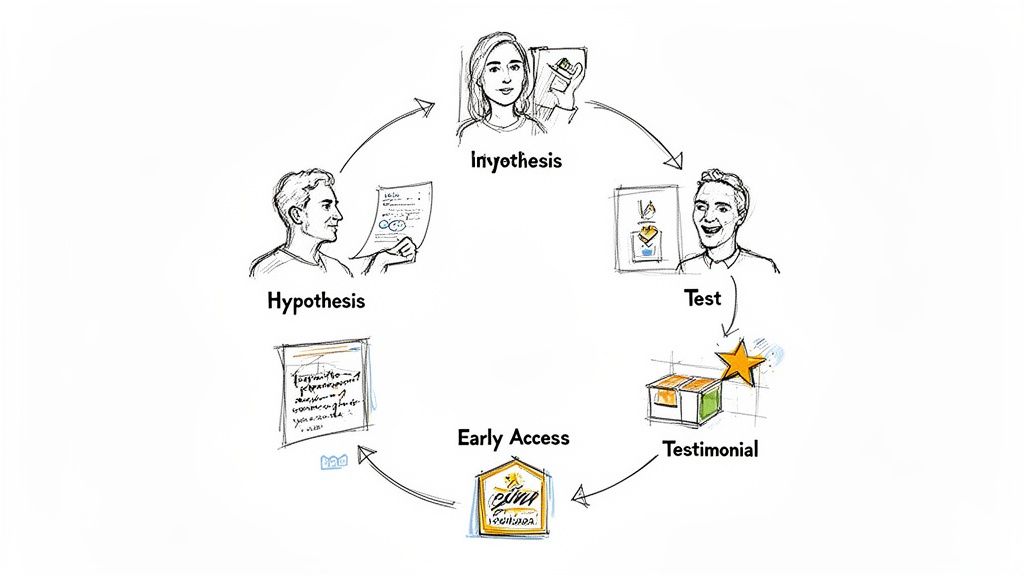
The first point of failure is almost always a shallow understanding of the customer's actual problem. Too many B2B SaaS teams build a solution and then search for a problem that fits. Your validation phase must reverse this.
Your mission is to conduct problem-discovery interviews, not feature-feedback sessions. This distinction is critical. Feature feedback elicits polite validation; problem discovery uncovers buying intent.
Your interview script should focus on their world, not yours. Ask questions like:
Listen for their language. If they describe the pain with genuine frustration and can quantify its business impact—in wasted hours, lost deals, or compliance risk—you have a strong signal. If the response is a lukewarm, "Yeah, that's kind of annoying," your GTM hypothesis is on thin ice.
Founders fall in love with their product. Customers fall in love with their problem being solved. The GTM validation phase is about ensuring those two things are perfectly aligned before you invest in telling the world.
Once you’ve confirmed the problem is real and painful, the next task is to find your unique angle. Most founders default to feature comparisons—a losing game.
A strong positioning wedge isn’t about being better; it’s about being different in a way that a specific market segment values.
To find it, map the competitive landscape not by features, but by strategic approach. Ask yourself:
Your opportunity exists in the gaps. If everyone sells a complex, sales-led solution to the enterprise, your wedge might be a simple, self-serve product for SMBs. If the dominant players are all-in-one platforms, your wedge could be a best-in-class point solution that does one thing exceptionally well.
The final piece of this phase is converting that intelligence into a high-fidelity early access program. The goal of this program is not bug hunting. It is to generate the social proof and pipeline momentum required for a successful public launch.
This means being highly selective. Your early access cohort should be a hand-picked group of 10-15 companies that perfectly match your validated ICP. In exchange for early, free access, you ask for two things: a detailed case study and a strong testimonial.
A well-scoped MVP is essential here, allowing you to gather tangible feedback without over-investing in unproven features. Understanding how to build an MVP that validates your idea can prevent serious missteps during this critical stage.
By the end of this validation phase—weeks before the public sees your product—you should have:
This is the unglamorous but essential work that underpins every successful B2B SaaS launch. It’s how you shift from hoping your launch will work to knowing it will.
A launch that acquires users who churn in 30 days is a catastrophic failure. Yet, most product launch timeline templates treat onboarding and user activation as a post-launch task for customer success. This is a profound strategic error.
The most critical metric for a new product's survival is Time-to-Value (TTV): the time it takes a new user to realize the core benefit they were promised. If your launch plan doesn't obsessively engineer to shrink this window, you’re acquiring future churn statistics.
Your timeline must treat TTV as a critical GTM workstream. The goal is to ensure a new user's first 15 minutes are spent experiencing a meaningful win, not navigating a configuration maze. This drives early adoption, reduces churn risk, and generates the positive initial signals needed for momentum.
Before you can shorten the path, you must define the destination. The "first value" milestone is the specific, tangible outcome that makes a user think, "Aha, this is what I was promised." It is not logging in or completing a setup wizard.
It is a moment of clear utility.
Product and marketing must agree on this single milestone. It's a critical GTM decision. Once defined, you work backward and embed tasks into your launch timeline to get users there—fast.
Optimizing for TTV is a cross-functional effort that must be planned and resourced weeks before launch. It impacts product, marketing, and all customer-facing teams.
Your product launch timeline template must include specific tasks for this:
The correlation between TTV and business success is direct. Research from the latest B2B SaaS trends report shows that time-to-value delivery has a strong correlation with overall business performance, yet 40% of SaaS products are poor at delivering it. Companies excelling at TTV have 38% higher performance scores and 62% better conversion rates.
The best marketing in the world cannot save a product with a 45-minute setup process. Your launch budget is wasted if the initial product experience bleeds users faster than your campaigns can acquire them.
A fast TTV is your most potent marketing asset. It creates advocates from new users, fuels word-of-mouth, and provides the ROI proof needed to convert trial users to paying customers. Our guide on designing effective customer onboarding best practices offers a more tactical framework. Engineering this into your launch isn't optional—it's the point.
Theory is insufficient. Execution is what separates a successful launch from a fizzle. That's why we're providing the exact product launch timeline template we use to guide B2B SaaS launches.
This is not a generic project plan. It's a strategic playbook forged from real-world launches, designed for early and growth-stage companies. Its purpose is to force the right conversations at the right time, ensuring GTM validation work directly informs asset creation and launch execution.
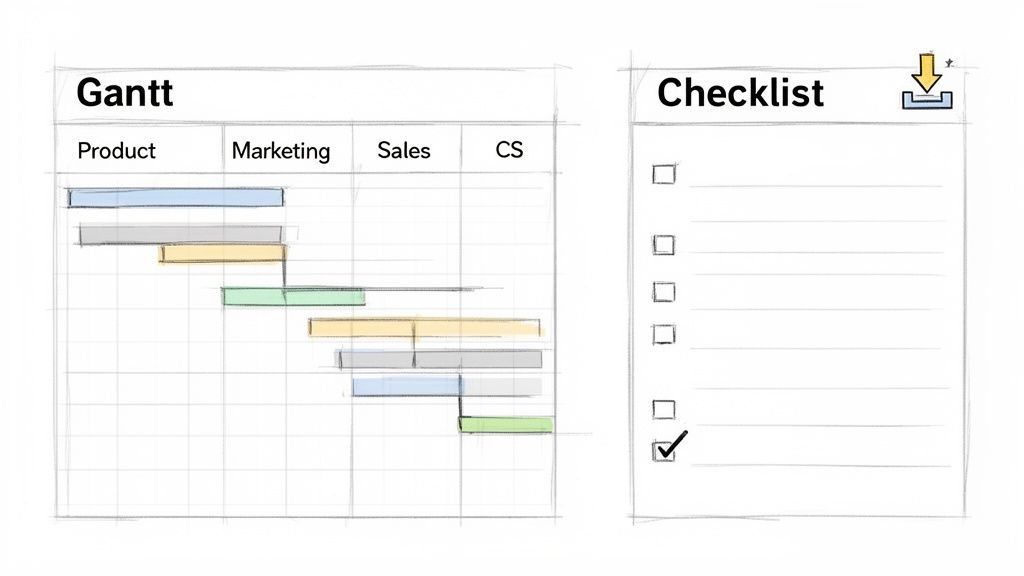
We offer it in two formats: a Gantt chart for visualizing dependencies and a simple checklist for execution-focused teams. Both contain the same core tasks and milestones.
The template is organized around the four launch phases: GTM Validation, Asset Development, Market Priming, and Execution & Iteration. Each phase is broken into specific workstreams with dependencies mapped out.
Inside, you'll find dedicated sections for each team:
This structure is intentional. It makes ownership clear and prevents common failure modes, like marketing creating assets for a product that is still changing, or sales receiving a new deck 48 hours before they are expected to sell.
This template is a starting point, not a rigid mandate. Adapt it to your specific context.
For a Stealth MVP: Condense the GTM Validation phase from eight weeks to four. The goal is hyper-focused: prove one core value proposition with a hand-picked group of 10-15 ideal customers. The "Market Priming" phase is minimal; it's about converting that small group into your first case studies.
For a Major GA Launch: Use the full 16-week timeline. This provides the runway for deep market validation, building a complete arsenal of sales and marketing assets, and running a multi-channel campaign to build a solid waitlist.
For a New Feature Launch: The timeline shortens to 4-6 weeks. Your GTM validation is laser-focused on existing power users to confirm the feature delivers value. Asset creation is lighter—a blog post, an in-app announcement, and updated help docs, not a massive campaign.
The principle is constant: validate the value proposition and enable the GTM teams before you announce anything to the market. Skipping phases is not an option; compressing them is.
The template includes a pre-launch readiness checklist—your "go/no-go" gate. It forces every team to confirm that their deliverables are complete, tested, and ready. This operational discipline separates a smooth, impactful launch from a chaotic fire drill.
The launch is complete. The real work begins.
The market’s initial reaction is the most raw, unfiltered dataset you will ever receive. Many teams fixate on the vanity buzz of launch day—press mentions and social shares—while ignoring the quiet signals that predict business viability.
The first 30 days are about converting initial energy into a sustainable growth engine. This requires a disciplined, rapid-fire feedback loop between your product, your first users, and your sales team. It's time to shift from execution to analysis, looking for the truths the market is revealing.
Your post-launch dashboard must be ruthless. Filter out every vanity metric. The only numbers that matter now measure user commitment and business impact.
Track these signals obsessively:
These metrics are unflinching. For a deeper dive into the numbers that matter, review our guide to essential SaaS marketing metrics.
Data tells you what is happening. Direct conversations with early users tell you why. For the first month, establish a direct, unfiltered line of communication between your GTM team and your first wave of users.
Conduct a daily 15-minute stand-up with sales and customer success. The agenda has one item: "What are we hearing from prospects and new users?" Document every objection, question, and feature request. This is where you find the gaps between your positioning and how the market actually perceives your product.
This feedback is invaluable. It’s how you discover that a key value proposition is falling flat, or that a critical feature is buried. Acting on these insights quickly—updating a sales deck, tweaking onboarding copy, clarifying a help doc—is how you iterate toward a stronger GTM motion.
The stakes have never been higher. As buyers consolidate their tech stacks, your new product must deliver immediate, undeniable value to survive. The SaaS consolidation trend shows the average number of apps per company is decreasing. Your launch plan must account for this by turning post-launch signals into rapid, decisive action.
Let's address common questions that arise when we help B2B SaaS teams build a product launch plan.
For a B2B SaaS launch intended to have a meaningful business impact, you need a minimum of 16 weeks (4 months).
I've seen teams attempt to cram a launch into 6 or 8 weeks. It always ends with them skipping the critical GTM validation work. They launch a product based on internal assumptions, not validated customer pain. This is the number one reason launches generate a week of noise and zero sustained pipeline. The extra time isn't for buffer; it's for de-risking the entire launch.
Treating a launch as a marketing event that begins once the product is "code complete." This is a recipe for failure.
A launch that drives revenue is a Go-to-Market function. It must start months earlier with deep collaboration between product, sales, and marketing. The early work is about validating the market problem and nailing the positioning. Skipping this foundational work is why so many launches feel successful on day one but fail to move any business metric a month later.
For a feature launch, compress the timeline—do not skip the phases. The principles remain the same, but the scope is tighter.
The core strategy is unchanged: validate the value and enable your GTM teams before you announce the feature to your user base.
At Big Moves Marketing, we help B2B SaaS founders align product, positioning, and GTM strategy to launch with confidence and drive revenue growth. Let's discuss how to de-risk your next launch.
Explore Big Moves Marketing services and resources:





%20-%20white.svg)