%20png%20copy.avif)

A go-to-market strategy isn't a marketing plan. It’s a series of high-stakes business decisions that align your entire company—product, marketing, and sales—around a single objective: building a predictable revenue engine. Most B2B SaaS teams get this wrong.
Most B2B go-to-market strategies are just a collection of disconnected tactics masquerading as a plan. I’ve seen this pattern play out in dozens of early-stage SaaS companies. Founders scramble to get a pricing page live, build a sales deck, and draft a list of channels, but there’s no unifying logic holding it all together.
The result is predictable: wasted motion, confusing messaging, and a launch that falls flat.
The core problem is treating GTM as a sequence of marketing tasks instead of a set of interlocking strategic decisions. This flawed approach leads directly to the same failure points, over and over again.
The diagram below breaks down the three most common symptoms of a broken GTM I see in B2B SaaS.
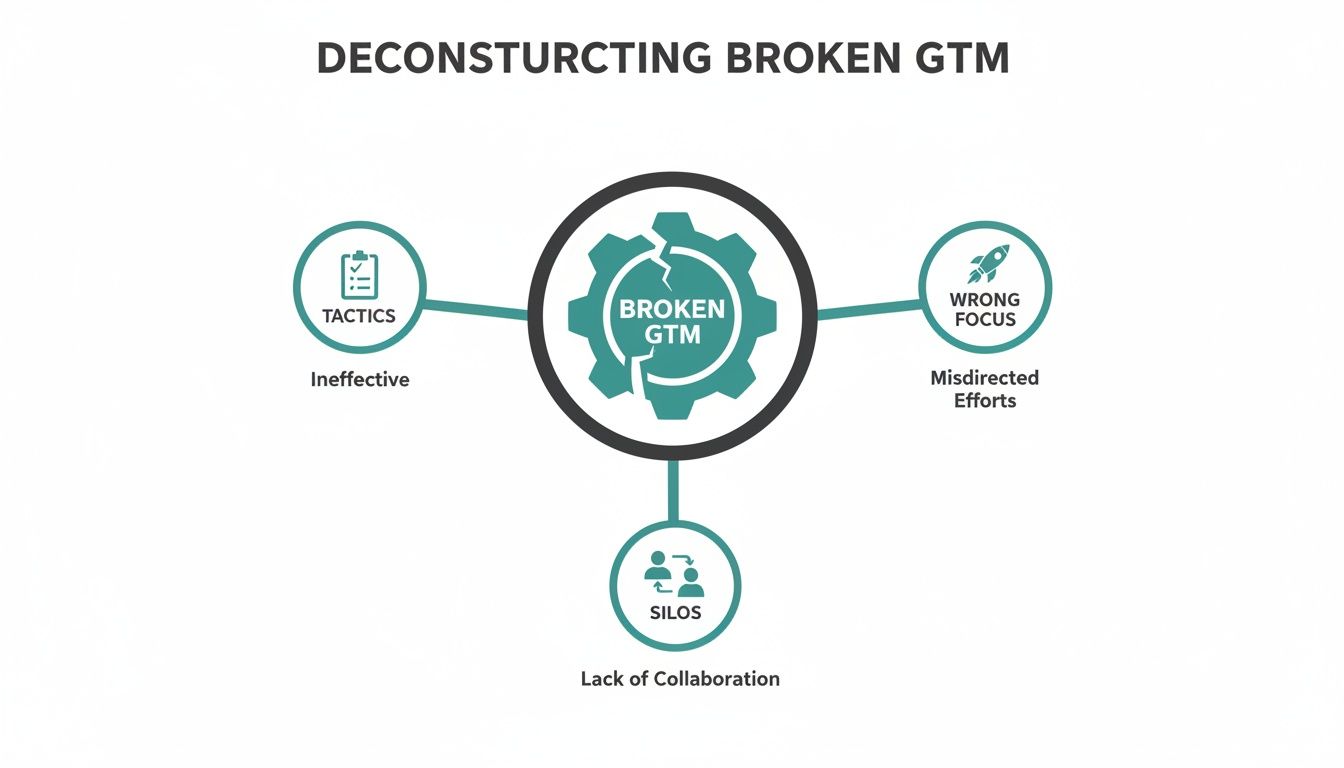
This visual breaks down the central failure into its core components: a focus on tactics over strategy, mistaking a product launch for a go-to-market plan, and critical organizational silos.
A broken go-to-market strategy almost always suffers from at least one of these issues:
The fundamental error is believing that more activity—more content, more ads, more outreach—will fix a flawed strategic foundation. It won’t. It just accelerates waste.
To fix a broken GTM, you must reframe the problem from a tactical list to a set of decisions that build a true revenue engine. For a deeper look at the required components, you can consult this Ultimate Go to Market Strategy Template.
Your Ideal Customer Profile (ICP) is the single most critical input for your entire B2B go-to-market strategy. Yet, most teams get it wrong. They stop at superficial firmographics like company size and industry, creating a profile so broad it’s strategically useless.
This is a fatal error.
A true ICP is not a demographic snapshot; it's a high-resolution picture of operational reality and buyer psychology. It moves past generic personas to pinpoint the accounts that have a burning, urgent need for your solution right now. Superficial data tells you who could buy, not who will.
This shallow approach leads to marketing that speaks to no one, sales cycles that drag on forever, and a product roadmap disconnected from revenue.
To build a high-resolution ICP, you must ask questions that reveal genuine buying intent. This is about identifying triggers, not just traits. Dig into these areas:
A weak ICP describes an account. A strong ICP describes a problem inside an account and the conditions that make solving it an urgent priority. This distinction is everything.
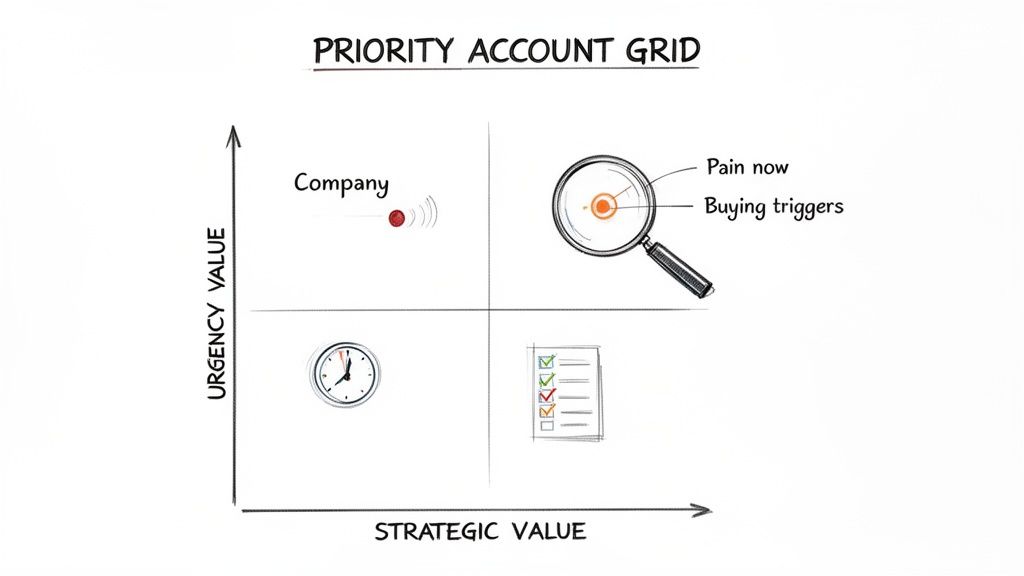
Instead of a flat persona document, build a dynamic ‘Priority Account Grid’. This simple matrix plots accounts on two critical axes: Problem Urgency (how badly they need you now) and Strategic Value (how much they contribute to your long-term goals, like breaking into a new vertical or securing a marquis logo).
This grid forces prioritization. Not all "ideal" customers are created equal. An account with extreme urgency but lower strategic value might be a perfect target for an initial sales push to get quick wins. In contrast, a high-strategic-value account with lower urgency requires a longer-term nurturing approach.
Powerful tools can help you find these segments. For example, Mastering LinkedIn Sales Navigator for B2B success shows you how to find prospects based on specific triggers and roles.
This level of precision is the foundation for everything that follows. It focuses your messaging, dictates your channel strategy, and gives your sales team the clarity they need to win. Without it, your go-to-market strategy is built on sand.
Let's get one hard truth out of the way: your product is not your positioning. Many B2B SaaS founders learn this far too late. They fall back on feature-led messaging, forcing prospects to connect product capabilities to their own business problems.
This approach creates friction and kills momentum. Effective positioning removes that friction. It doesn't just describe what your product is; it builds a case for why it matters right now to the right person. Without this, your go-to-market strategy is just adding to the noise.
The result of weak positioning is what I call “feature soup”—a long, bland list of capabilities that fails to create urgency or separate you from the pack. Your sales deck turns into a product tour, and your website reads like a technical manual. It’s a fast track to becoming a commodity.
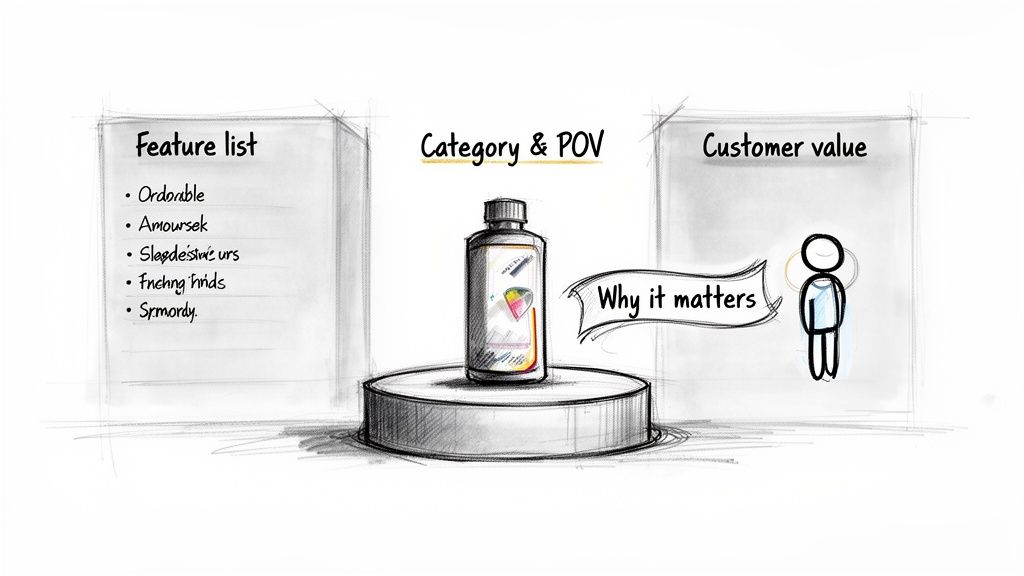
Great positioning isn’t built on features. It’s built on a sharp, compelling point of view (POV). Your POV isn't a tagline; it’s a core belief about a fundamental shift in your customer's world—a shift that makes your solution newly relevant. It reframes their problem and introduces a new game that only you can help them win.
This core narrative becomes the source code for your marketing and sales material. It’s the definitive answer to the prospect's unspoken question: "Why should I care about this today?"
To build this, translate your product’s functions into a strategic argument:
The biggest mistake is thinking your job is to sell a product. Your job is to sell a new perspective. The product is just the proof that this new perspective is achievable.
Generic value claims are the enemy of an effective go-to-market strategy for B2B. Phrases like "actionable insights" or "data-driven decisions" have been used so much they've lost all meaning. They’re table stakes, not differentiators.
Your messaging must be sharp and specific. Instead of saying your product "optimizes workflows," say it "eliminates 10 hours of manual data entry for finance teams closing their monthly books." The first is a vague promise; the second is a concrete outcome that justifies a budget.
Nailing this messaging is a foundational step. To formalize this process, our guide on how to write a positioning statement provides a necessary blueprint. Without it, you’re just guessing.
Your pricing is one of the most powerful—and misunderstood—levers in your go-to-market strategy. Too many founders treat it like an accounting problem, based on internal costs and competitor prices. This is a massive strategic mistake.
Pricing isn't just a number; it’s a form of communication. How you package and price your product tells your Ideal Customer Profile (ICP) what you value and what success with your solution looks like.
Get this wrong, and you'll create friction, confuse buyers, and kill deals before they start. Your pricing model must scale directly with the tangible value your customer receives.
Far too many B2B SaaS companies default to a per-seat model because it’s easy. The problem? If your product’s value isn’t tied to the number of users, you’ve created a disconnect between what you charge and what you deliver.
Your pricing model must be anchored to a value metric—the specific unit of consumption that drives business results for your customer.
Common pricing models include:
The most common mistake is over-complicating pricing. Founders build a "perfect" model that captures every edge case, but the result is a spreadsheet so complex that prospects can't figure out what they’d pay. Simplicity sells.
Effective packaging guides customers on a journey. Each tier should solve a progressively more valuable business problem, creating a natural incentive to upgrade. Our guide to value-based pricing explains how to connect these tiers directly to customer outcomes.
This isn’t about what your competitors charge. It’s about quantifying the outcome you deliver and capturing a fair share of that value. If you can help a customer save $1 million in operational costs, basing your price on a competitor who only saves them $50,000 is a failure of strategy, not just math.
Your pricing should make a confident statement about the business impact you deliver.
In a world of infinite marketing channels, focus is your greatest advantage. Chasing every new trend is a recipe for burning cash and diluting your effort. I’ve seen countless early-stage companies spread themselves thin across five channels, executing all of them poorly, instead of mastering one or two that actually work.
The impulse to be everywhere is strategically flawed. Your channel mix shouldn't be a speculative bet on what’s popular; it must be a direct consequence of your Ideal Customer Profile (ICP), deal size, and sales model. A disciplined approach is a core component of an effective go-to-market strategy b2b.
Most teams fail to distinguish between two fundamentally different types of channel activity, which leads to ineffective strategies.
Demand Capture: This is about intercepting active buying intent. Think paid search or G2 listings. The buyer already has a problem and is actively researching solutions. These channels are critical for capturing low-hanging fruit and showing short-term ROI.
Demand Creation: This involves educating the market to generate future demand. This includes activities like publishing thought leadership, hosting a podcast, or building a community. The buyer isn't looking for you, so you must earn their attention and convince them a problem is worth solving.
An over-reliance on demand capture starves your future pipeline. An over-reliance on demand creation without a way to convert intent leads to high vanity metrics but low revenue. A balanced portfolio is required.
Your GTM fundamentals should dictate your channel choices, not the other way around.
For high ACV (Annual Contract Value) products with complex sales cycles, your strategy should center on channels that build relationships and allow for deep education. Think targeted outbound, executive events, and deep-dive content. Performance marketing alone will not close a six-figure deal.
For lower ACV products with a faster, higher-velocity sales motion, the focus shifts to channels that can operate at scale. This is where SEO, targeted paid social, and product-led growth (PLG) motions become your engine.
Recent data shows where many B2B marketers are placing their bets. While 96% of marketers now use AI, the core channels remain focused. 48% of paid media budgets go to Google for high-intent demand capture. Meanwhile, 91% of B2B marketers use content marketing, with over half increasing their investment in thought leadership to create demand. You can explore more B2B marketing statistics and trends on seoprofy.com.
The critical error is picking channels based on competitor activity or marketing hype. Your strategy must be built from first principles: Where do my specific buyers go to solve this specific problem? Go there, and only there, until you have proof of repeatable success.
Start with a maximum of two channels—one for capture, one for creation—and commit to mastering them. Only after you’ve built a predictable engine in those channels should you consider adding a third. To delve deeper into this disciplined approach, read our guide on choosing effective B2B channels.
This focus prevents wasted motion and forces you to build a GTM engine that works.
Your go-to-market strategy is only as good as your sales team’s ability to use it on the front lines. This is where sales enablement comes in—the critical bridge between high-level strategy and the conversations that close deals.
Too many founders mistake sales enablement for an asset factory, churning out decks and one-pagers that gather digital dust. That’s a failure of purpose. The goal isn’t to produce collateral; it's to operationalize your positioning and messaging so that every salesperson can win, consistently.
A well-oiled enablement engine ensures every seller can articulate your value with conviction. It’s the difference between a sales team that’s guessing and one that’s executing a proven playbook. The result? Shorter sales cycles, higher win rates, and a revenue engine you can forecast.
The real measure of sales enablement isn’t the number of assets created. It’s the percentage of reps who can confidently and independently beat the competition in a live deal.
To build this engine, focus on the assets that directly help salespeople advance and close deals. Everything else is a distraction. Start with these three core components:
These tools are not static; they are living documents that must be constantly refined with feedback from reps in the field. To structure these critical assets, check out our detailed guide on sales enablement best practices.
This is how you turn a GTM strategy into revenue.
Your go-to-market strategy is not a static artifact. It’s a battle plan, and no battle plan survives first contact with the market. It's a living system that demands constant measurement and iteration.
It's easy to get addicted to vanity metrics—website traffic, social media followers—that tell you nothing about the health of your revenue engine. This is a critical error. A successful go-to-market strategy b2b is built on a ruthless focus on metrics that directly correlate to revenue and efficiency. Without the right data, you’re flying blind.
To know if your GTM is working, shift your gaze from top-of-funnel activity to pipeline health and unit economics. These are the numbers that tell you if you're building a sustainable business.
Your core GTM dashboard should track:
Your GTM strategy isn't truly validated until the numbers prove it. Until then, it's just a set of well-researched hypotheses. The market always delivers the real verdict.
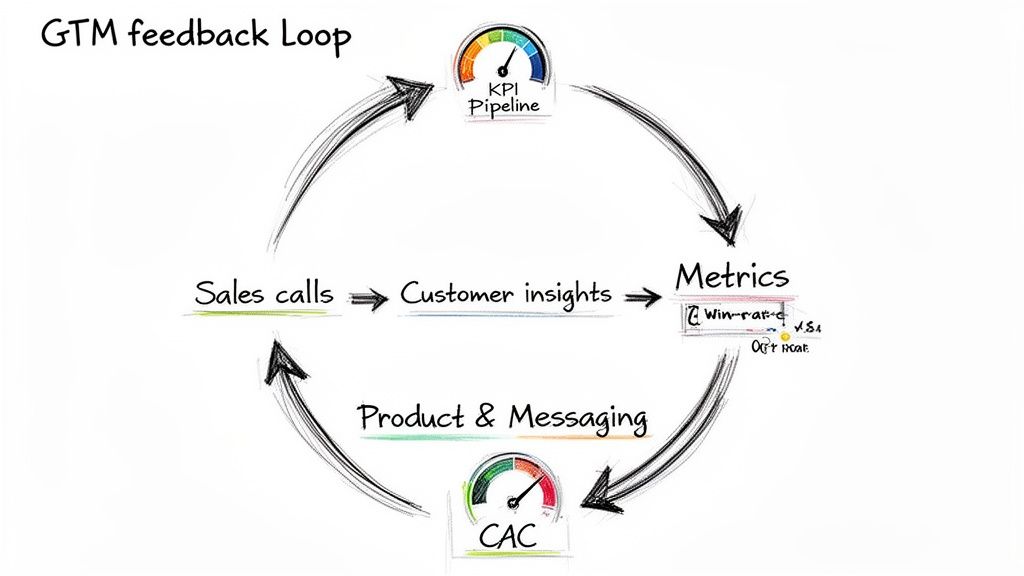
Measurement is only half the battle. The real work is systematically feeding those insights back into your strategy. This is the GTM feedback loop—a structured process for turning raw market data into smart strategic adjustments.
This loop pulls in both qualitative and quantitative data: sales call recordings from tools like Gong, customer interviews, churn data, and rigorous win/loss analysis. These inputs are then used to continuously refine your ICP, sharpen your messaging, and optimize your channel mix.
For instance, if sales call analysis reveals prospects are consistently confused about a key feature, that's direct feedback for marketing and product. If churn data shows customers who bought for "Use Case A" are leaving at alarming rates, that's a signal to de-prioritize that segment in your GTM efforts.
This creates a culture of continuous improvement where strategy evolves based on market reality, not internal assumptions. It closes the gap between what you think the market wants and what it proves it will pay for. This iterative process is what separates a GTM plan that looks good on paper from one that drives predictable, scalable revenue.
In my work with founders, a handful of high-stakes questions about go-to-market strategy come up in almost every conversation. These aren't academic debates; getting them wrong is the fastest way to burn capital, while getting them right builds a real revenue engine.
Let’s tackle the most common ones head-on.
A marketing plan is purely tactical. It answers “how” and “where” you’ll spend money to generate leads—the channels you’ll use and the campaigns you’ll run.
A GTM strategy is the foundational business logic that comes first. It’s the strategic layer that aligns your product, pricing, sales, and marketing around a single, hyper-specific market opportunity. Your go-to-market strategy for B2B defines the “who” (your ICP) and the “why” (your differentiated positioning). Marketing’s job is to execute that strategy, not invent it on the fly.
You need a formalized, documented GTM strategy the moment you transition from founder-led selling to hiring your first sales or marketing professional. This is a critical, non-negotiable inflection point.
Bringing on a new hire without a documented strategy is one of the costliest and most common mistakes I see founders make. You are effectively setting them up to fail. Without a clear ICP, a defined messaging framework, and a focused channel strategy, they’re just guessing. This inevitably leads to months of wasted salary, burned runway, and zero momentum.
The single biggest execution mistake is scaling channel spend before you have message-market fit. It’s a classic trap: a founder gets a flicker of positive feedback and immediately decides to pour money into LinkedIn ads or content, hoping to douse the spark with gasoline.
This almost never works.
You’re amplifying a message that hasn’t been proven to resonate with a well-defined ICP. The result is a catastrophically high Customer Acquisition Cost (CAC) and a pipeline clogged with low-quality, slow-moving deals that never close.
First, validate your positioning and messaging with a small, surgically targeted audience. Use founder-led sales or small-scale, manual outreach to confirm that your core value proposition creates genuine urgency. Only after you have hard evidence—signed contracts from the right kind of customers—should you even think about scaling a channel. Anything else is just lighting money on fire.
Ready to stop guessing and build a GTM strategy that drives real revenue? Big Moves Marketing partners with founders to provide the positioning, messaging, and sales enablement clarity needed to win. Find out how we can help you build a revenue engine that works.
Explore Big Moves Marketing services and resources:
June 26, 2026





%20-%20white.svg)