%20png%20copy.avif)
Most advice about a business advisor for startup founders is lazy. It treats advisors like a badge of seriousness. Get a few recognizable names, put them on a slide, collect occasional opinions, and assume you're now “well supported.”
That thinking burns time, equity, and focus.
A startup advisor is not there to motivate you, admire the product, or recycle generic startup wisdom. They're there to improve decision quality when the cost of being wrong is high. That matters because 9 out of 10 startups fail within their first year according to Karl Hughes on startup advisors. If your company is a B2B SaaS startup, those failures usually don't come from a lack of hustle. They come from repeated unforced errors in positioning, go-to-market, pricing, hiring, and capital allocation.
The right advisor helps you avoid those errors earlier. The wrong one adds noise while you pay in equity.
Founders usually make one of two mistakes.
They either delay getting outside help because they think advisors are a luxury, or they recruit one too early for the wrong reason. In both cases, they misunderstand the job.
A real advisor is a decision-quality asset. They bring external pattern recognition, force sharper trade-offs, and help you see what your team is too close to see. In B2B SaaS, that usually means one of three things: you're chasing the wrong buyer, measuring the wrong motion, or funding the wrong priorities.
The value isn't “having someone smart to talk to.” Plenty of smart people are useless in startup environments because they speak in abstractions. Founders don't need more abstract strategy. They need a person who can look at a messy pipeline, weak discovery calls, confused messaging, or inflated forecasts and say, clearly, what's broken.
Practical rule: If your advisor can't help you make a hard trade-off, they aren't acting like an advisor. They're acting like an interested observer.
This is why generic mentor advice fails. Mentors often optimize for encouragement and broad perspective. That's fine. But if you're building a company, you need someone who can challenge assumptions that are currently driving spend, roadmap, and hiring.
The biggest misconception is that an advisor's primary job is access. Founders chase logos, former operators with big titles, or people who seem investor-friendly. Then they realize those people are rarely close enough to the actual operating problem.
For a B2B SaaS company, the highest-value advisor often isn't the most famous person in the room. It's the one who can spot a broken GTM motion before you waste two quarters scaling it.
That usually looks like this:
A business advisor for startup teams should reduce error rates in those areas. If they don't, the relationship is cosmetic.
Most founders start with the wrong question. They ask, “Who should advise us?” The better question is, “What specific failure mode are we trying to prevent or correct?”
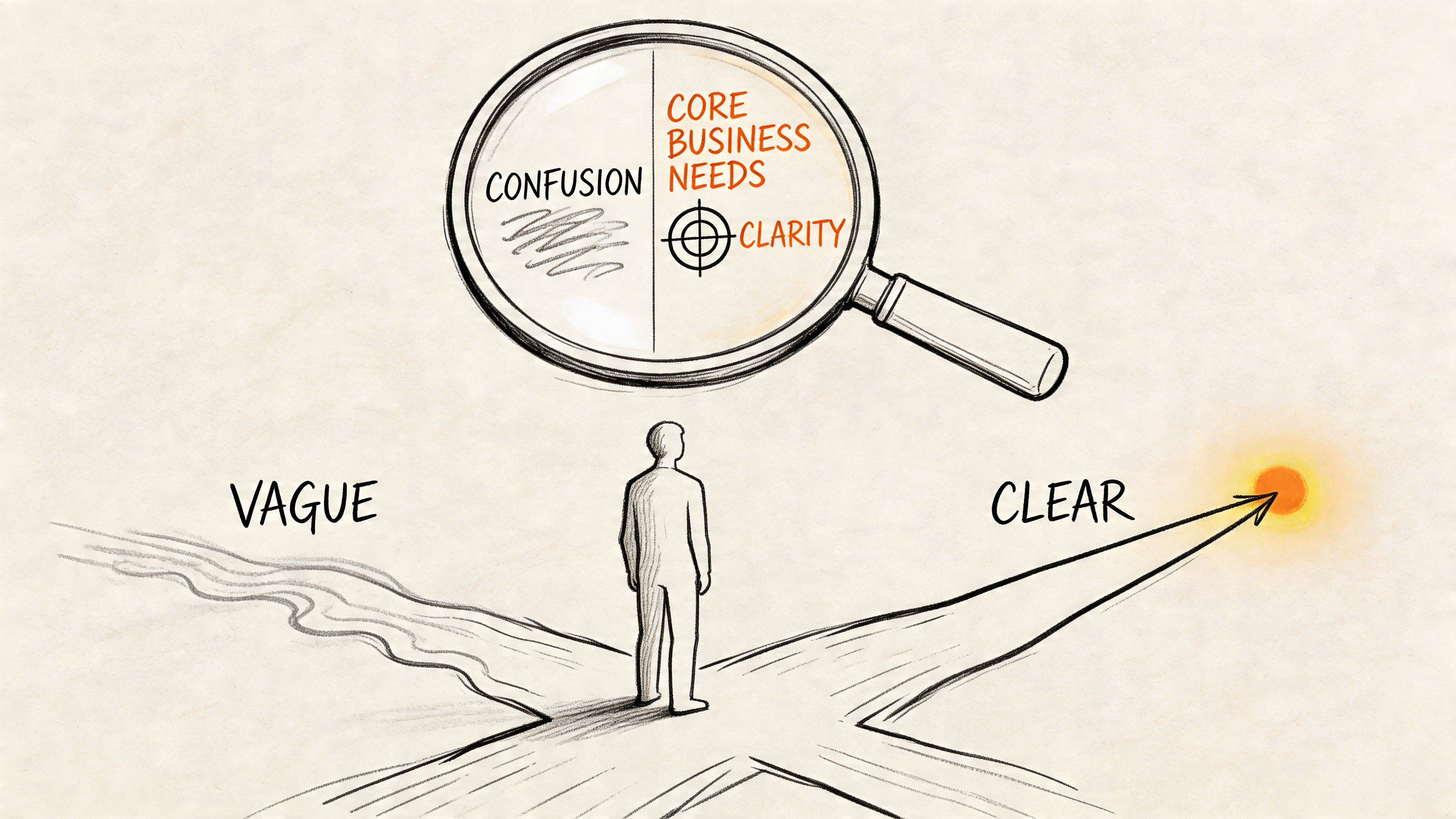
If you skip that diagnosis, you'll hire a strong person for the wrong problem. That's common in SaaS. A founder with weak pipeline blames demand gen, hires a marketing-flavored advisor, and ignores that the underlying issue is a muddy ICP. Another founder hires a fundraising advisor when the deeper problem is that the product story still isn't credible to buyers.
Your first move is to isolate the current bottleneck. Not your broad ambition. Not your long-term wish list. The current bottleneck.
A business advisor for startup companies should be mapped to the constraint that's most limiting growth right now. If the problem is founder-led sales not translating into a repeatable motion, don't bring in someone whose main value is investor intros. If your team is shipping product into a market that still doesn't understand the category, don't start with an outbound playbook.
I’ve written before about the difference between strategic guidance and general external help in this piece on business consultant for startups. The short version is simple. You need the right kind of intervention, not more external voices.
Founders tend to fall into one primary bucket.
You have traction signals, but every deal requires too much explanation. Buyers don't anchor to a clear problem. Sales calls feel educational when they should feel confirmatory.
You likely need an advisor who can pressure-test category framing, ICP definition, message hierarchy, and competitive contrast. This is common pre-PMF and right after PMF, when teams try to broaden appeal too early.
The team is busy. Pipeline still feels fragile. Leads come in from scattered channels, but there's no coherent motion connecting targeting, messaging, sales process, and conversion.
Frequently, founders confuse motion with progress. A good advisor should ask uncomfortable questions about funnel integrity, qualification discipline, and channel fit. They should make your GTM look simpler, not more complex.
The product is strong, but user adoption or expansion isn't matching the promise. This often happens with technical founders who built a capable product but haven't translated capabilities into buyer-relevant outcomes.
You need someone who can bridge product language and commercial language. Not a feature enthusiast. Not a generic growth advisor.
A useful checkpoint before you keep reading:
You've got some traction, but the next set of decisions has bigger consequences. Hiring, expansion, forecasting, pricing, and investor communication all need to get tighter.
A specialized advisor can help management focus on the metrics that matter. A lot of teams get sloppy here. They start reporting confidence instead of reality.
Some problems don't require an advisor. They require founder discipline.
Use this filter:
| Situation | What it usually means |
|---|---|
| You want someone to “keep us accountable” | You probably need internal operating discipline first |
| You want intros because growth feels slow | Your story may still be weak |
| You want “marketing advice” | You need to name the exact GTM failure |
| You want a sounding board for every decision | You may be avoiding clear ownership |
If you can't describe the problem in one sentence, you're not ready to hire an advisor. You're still in diagnosis.
Founders often overcomplicate this. The goal isn't to build a perfect advisory board. The goal is to identify the highest-stakes blind spot and recruit someone who has seen that exact movie before.
Founders waste a lot of time looking for a “great advisor.” That label means nothing. In B2B SaaS, you need a person who solves a specific bottleneck at your current stage, under your current constraints.
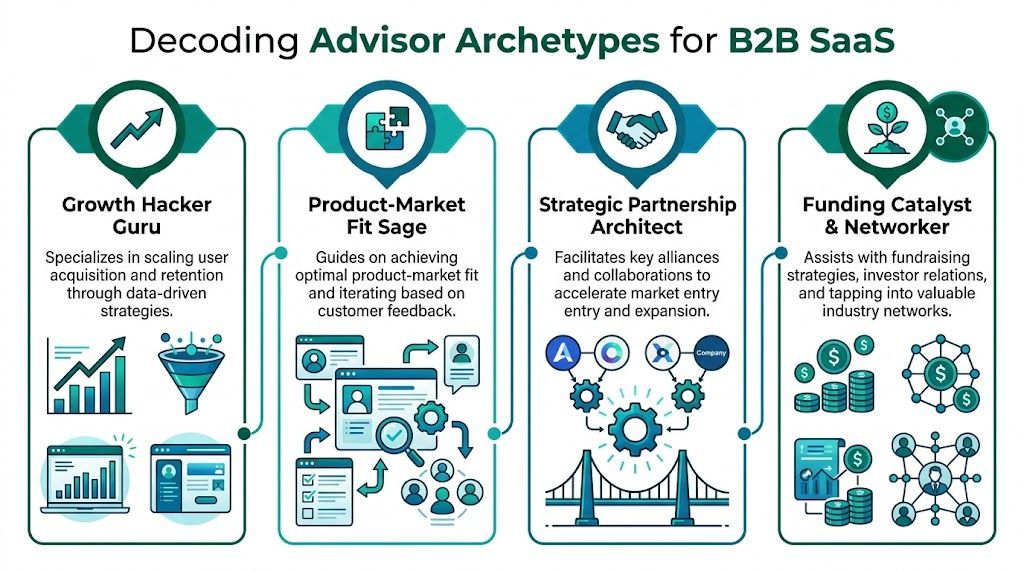
Treat advisor selection like a key hire. Define the job. Match it to the failure mode. Set a scope, cadence, and scorecard. If you skip that work, you will end up with a vanity advisor. Good logo on the website. No material effect on the business.
Hire this archetype when revenue problems trace back to message, channel, pipeline quality, sales process, or conversion friction. The right GTM advisor can diagnose where demand creation breaks, where qualification gets sloppy, and where founder-led sales stops being repeatable.
This person should be able to look at your funnel and say, with precision, whether you have a targeting problem, a positioning problem, a pipeline generation problem, or a sales execution problem. If they stay abstract, they're not the one.
A common founder mistake is hiring a broad “growth” personality here. You do not need someone posting hot takes about brand. You need someone who has built pipeline in a SaaS motion that looks like yours.
This archetype matters earlier than many founders admit. A decent product with weak positioning bleeds cash. You pay for traffic, demos, and sales cycles that never had a fair chance to convert.
A strong product and positioning advisor helps you tighten the story around buyer pain, urgency, alternatives, category context, and proof. They should force hard choices. Who is this for? Who is it not for? What problem gets solved first? Why should a buyer switch now?
If your team keeps adding features to fix a conversion problem, you likely need this archetype.
Use this advisor only when capital is a near-term strategic requirement. Not because fundraising feels prestigious. Not because your investors told you to “start building relationships.”
The right person sharpens the narrative, pressure-tests the plan, identifies weak spots in diligence, and opens doors that actually match your stage and story. The wrong one gives broad deck feedback, name-drops investors, and burns your time.
For a grounded perspective on what real strategic advisory work looks like, Poornima Ramaswamy, Founder/CEO of PivotX Advisors is worth listening to.
This is the least glamorous archetype and often the one that creates the most value once the company starts getting messy. You need this person when handoffs break, reporting gets inconsistent, managers solve the same problem three different ways, and leadership meetings produce activity instead of decisions.
A good operational scaling advisor simplifies execution. They tighten planning, ownership, cross-functional coordination, and metric definitions. They do not add process for the sake of process.
| Archetype | Best used when | What they should improve | Bad sign |
|---|---|---|---|
| GTM advisor | Pipeline is inconsistent or sales is hard to repeat | ICP clarity, channel focus, qualification, conversion points | Starts with tactics before diagnosing buyer friction |
| Product and positioning advisor | Buyers do not quickly understand the value | Market story, differentiation, messaging, category framing | Talks features more than buying decisions |
| Fundraising and network advisor | You need capital soon and the raise has real consequences | Investor narrative, diligence readiness, targeted introductions | Focuses on optics over fundability |
| Operational scaling advisor | Team complexity is slowing execution | Planning rhythm, reporting quality, role clarity, handoffs | Creates more meetings than decisions |
Archetype fit is only half the job. Engagement model matters just as much.
A GTM advisor should usually work against a defined commercial problem for a fixed period, such as refining ICP, rebuilding sales stages, or tightening pricing and packaging input. If your gap is broader and you need someone to actively shape demand strategy with operating accountability, a fractional CMO engagement for B2B SaaS growth strategy is often the better call.
A product and positioning advisor works best around a clear strategic output. Messaging architecture, category narrative, segmentation decisions, launch framing, or win-loss pattern analysis. Do not keep this vague.
A fundraising advisor should be time-bound and tied to a fundraise window or preparation cycle. If there is no active financing objective, wait.
An operational scaling advisor should be attached to a concrete operating issue. Forecast accuracy, planning cadence, decision rights, or cross-functional breakdowns. If you cannot name the operational friction, do not hire this person yet.
Charisma is cheap. Pattern recognition is not.
Ask questions that force specificity:
Strong candidates answer with situations, constraints, and trade-offs. Weak candidates answer with general principles and polished stories.
Compensation should follow scope and expected involvement. Carta's guidance on FAST agreements and startup advisor equity is a better benchmark than founder folklore. If someone asks for meaningful equity in exchange for occasional availability and vague strategic input, pass. That is not alignment. It is expensive ambiguity.
Founders waste absurd amounts of time chasing advisor prestige. Prestige does not fix pricing, tighten a sales process, or sharpen product positioning. Relevance does.
The best advisor candidates are usually a little hard to find. They are busy operating, investing selectively, or helping a small set of companies where their judgment clearly matters. If someone is loudly marketing themselves as a startup advisor to everyone, assume you are looking at a broad offer with shallow fit.

Start with founders who solved the problem you have now, not the one you hope to have later. Ask for names tied to a specific outcome. Who helped tighten enterprise discovery? Who fixed a broken outbound motion? Who improved retention after a messy onboarding experience? Specific referrals produce specific candidates.
Operators beat personalities in this search. A former VP Sales who built a repeatable mid-market motion is usually more useful than a well-known startup celebrity. The same goes for product leaders who have handled roadmap discipline, pricing owners who have reset packaging, and finance operators who have cleaned up planning and forecasting inside a scaling SaaS company.
If you are early and still learning how to evaluate these relationships, broad guides like how to find a mentor for your startup can help with the basics. Then raise the bar. A SaaS advisor is not just a mentor with opinions. You need someone who has made hard calls in a company that looks enough like yours for the lessons to transfer.
A few sourcing channels consistently produce better signal:
Founders overrate conversational ease. A pleasant call proves almost nothing. You are hiring for judgment under constraint.
Use a simple scorecard and force yourself to write it down after every conversation. Three categories are enough:
Do not turn this into a culture test disguised as rigor. If the person has not handled your kind of problem in your kind of business, keep looking.
The first call should answer a narrow set of questions fast.
The last question matters more than founders think. High-signal advisors know their lane. Low-signal advisors claim broad usefulness and stay vague on constraints.
Run a paid trial session or a tightly scoped working discussion around an existing issue. Use something messy and current. A weak pipeline conversion pattern. Confused packaging. A product area with low activation. A board deck that hides the underlying GTM problem.
Do not ask for polished advice. Watch how they diagnose. Strong advisors ask for context, pressure-test assumptions, and identify the decision that is key. Weak ones rush to familiar playbooks and generic recommendations.
Serious advisors improve decision quality first. Tactics come after that.
At this stage, vanity advisors get exposed.
Ask each candidate what they would want in a monthly packet, what they would cut, and which metric would make them uncomfortable enough to push for action. The point is not whether they pick your exact KPI set. The point is whether they can separate signal from dashboard clutter.
Good advisors narrow focus. They know a founder cannot run a business off twenty equally important charts. If a candidate keeps expanding the dashboard, they are adding noise, not helping you make better decisions.
Some misses are obvious. Others are expensive because they sound impressive in the room.
Cut candidates quickly if you see any of these:
One more rule. If your problem is execution bandwidth more than judgment, hire a specialist firm or consultant instead of handing out advisor equity. The right answer is often a service model, not an advisor seat. Compare the trade-offs against startup consulting firms for strategic and execution support before you commit.
Founders often over-negotiate compensation and under-define scope. That's backwards.
The primary risk isn't paying slightly too much. The primary risk is vague expectations. Vague expectations create dead relationships that linger on your cap table and in your calendar.
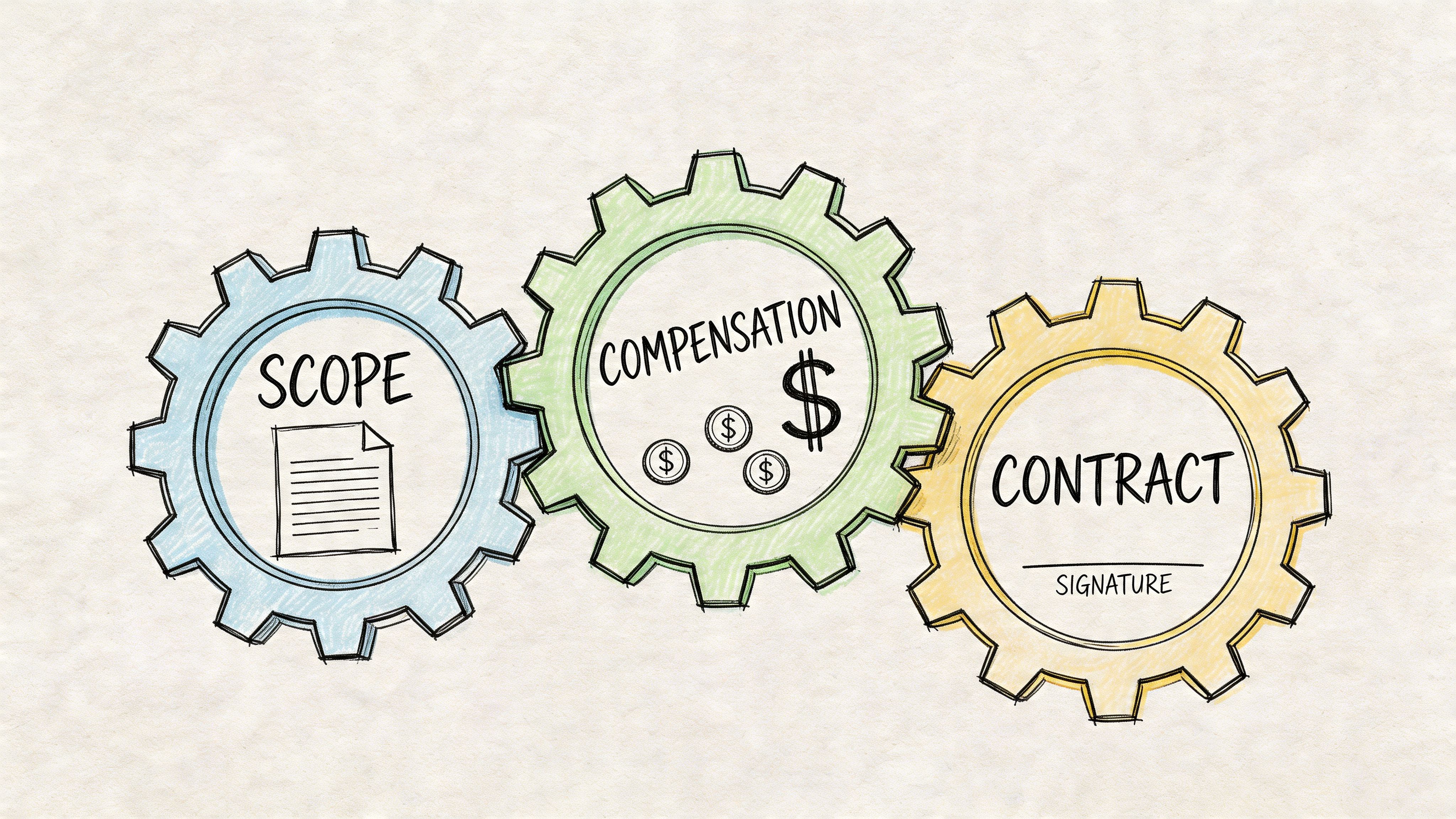
There are three reasonable structures.
Equity-only works when you're early, cash-constrained, and the advisor's role is strategic rather than operational.
Cash-only works when you're buying targeted expertise for a defined issue.
Hybrid works when the advisor is giving material time and sustained involvement.
What matters is alignment between compensation and the actual ask. Monthly calls and occasional feedback don't justify a bloated grant. High-touch support on major GTM or fundraising decisions may.
Don't compensate for reputation. Compensate for expected contribution under a defined scope.
Use a one-page scope before any legal docs get finalized.
Include:
Many founders finally realize they don't need an advisor. They need better internal discipline or a functional leader.
If your advisor is helping with pricing or packaging work, make sure the scope connects to how the business captures value, not just how it explains value. A pricing conversation without commercial context is wasted effort. That's also why a sharper grounding in value-based pricing often improves advisor conversations.
A good agreement makes ambiguity hard.
That means clarifying confidentiality, deliverables, vesting, ownership of work product if relevant, conflicts, and how either side can end the arrangement. More importantly, it should force agreement on the metrics and definitions used to assess the business.
SaaS teams regularly get basic revenue framing wrong. A common mistake is calculating ARR by multiplying one month of bookings by twelve or including non-recurring fees. Advisors should help ensure ARR, MRR, and CAC are tracked accurately for investors and internal forecasting, as outlined by Carta's startup metrics guidance.
If your advisor can't help keep those definitions clean, they can accidentally increase confusion while sounding impressive.
A clean structure is not bureaucracy. It's how you turn “advice” into useful operating input.
Most advisor relationships fail after the agreement is signed. Not because the person was wrong, but because the founder treated the relationship as passive.
That's a mistake. A business advisor for startup companies only becomes useful when the founder runs the engagement with discipline.
Don't start with a casual intro call and a vague promise to “keep them updated.” Give them a briefing pack.
It should include your current positioning, ICP assumptions, sales motion, core metrics, pipeline snapshot, product roadmap themes, and the top decisions you're trying to make in the next quarter. Keep it concise. Dense beats polished.
Then give context about your actual environment. This part matters more than most founder advice acknowledges. Guidance has to fit your company, your market, and your operating constraints. Applying a generic urban VC playbook to a company in a different ecosystem is a common mistake, especially in underserved or non-metro contexts, as argued in this piece on entrepreneurship in rural and underserved communities.
A good advisor meeting is not a status update. It's a decision meeting.
Use a simple structure:
If you're onboarding customers well, you already understand the principle. Clarity upfront creates better outcomes later. The same discipline behind strong customer onboarding best practices applies here. Good inputs produce better adoption, whether you're onboarding a customer or an advisor.
The founder owns the brief. The advisor owns the judgment. If both sides are fuzzy, the relationship decays fast.
A strong cadence also prevents a common problem. Advisors drifting into generic commentary because they aren't being asked precise enough questions. Give them high-quality context, then ask for high-consequence thinking.
Founders who get real value from advisors don't treat them like décor. They treat them like precision tools.
That means diagnosing the constraint before recruiting anyone. It means choosing the right archetype instead of the most recognizable name. It means vetting for applied judgment, not smooth conversation. It means tying compensation to scope and managing the relationship with the same seriousness you'd bring to a key executive hire.
The wrong advisor costs you twice. Once in equity, and again in delayed clarity.
The right advisor compresses learning, sharpens trade-offs, and helps you avoid expensive detours. That's the point. Not prestige. Not optics. Better decisions under pressure.
If you're serious about bringing in a business advisor for startup growth, act like you're designing part of the company's decision system. Because you are.
If you want a strategic partner who helps your team think more clearly about positioning, GTM, messaging, and growth decisions before you waste cycles on the wrong motion, talk to Big Moves Marketing. The work is direct, structured, and built for B2B SaaS teams that need sharper decisions, not more noise.
Explore Big Moves Marketing services and resources:




%20-%20white.svg)