%20png%20copy.avif)

Most advice about startup consulting firms starts in the wrong place. It starts with the directory, the shortlist, the credentials, the brand names.
That’s backward.
Founders usually get burned by consultants long before the first invoice. They get burned when they hire someone to think for them. They want a consultant to resolve internal ambiguity, settle founder disagreement, define the market, write the narrative, choose the channel, and save time. What they’ve really done is outsource judgment.
A good consultant doesn’t rescue a confused company. They amplify whatever is already there. If your team has a sharp problem definition, they can accelerate it. If your team has muddled priorities, weak positioning, and no internal alignment, they’ll formalize the mess into a deck and bill you for the privilege.
For B2B SaaS teams, that mistake is expensive because the underlying problems are usually strategic, not cosmetic. You don’t have a “consultant selection” problem. You have a decision quality problem.
The popular advice says hire expertise early. That’s incomplete. Hire expertise after you’ve earned the right to use it well.
The reason is simple. 75% of venture-backed startups fail, and the biggest causes are strategic. 34% fail because of lack of product-market fit, and 22% fail because of ineffective marketing and go-to-market execution according to DesignRush’s startup failure statistics roundup. If your startup is misreading the buyer, misframing the product, or pushing the wrong motion, a consultant can help. But only if you know what question you need answered.
Most founders don’t.
They say things like:
That’s why startup consulting firms often disappoint. The firm didn’t necessarily fail. The client came in with vague pain, a loose budget, and hidden political constraints.
Practical rule: If you can’t explain the problem crisply in a few sentences, you’re not ready to hire. You’re ready to diagnose.
For some teams, external structure does help. If you need a tighter way to align goals and execution across leadership, 5 reasons to hire an OKR consultancy is worth reading. Not because OKRs solve everything. They don’t. But because forced clarity beats broad ambition every time.
The same logic applies to startup advisors. If you’re considering outside help, start with internal decision hygiene first. That’s why I’d point founders to this thinking on startup advisory. The useful question isn’t “who should we hire?” It’s “what kind of client are we about to be?”
A consultant should do one of three things.
If you expect salvation, you’ll buy theater.
If you expect amplification, you’ll hire better.
The phrase startup consulting firms is useless unless you break it into categories. The market is too broad for generic advice. The global management consulting industry is valued at over USD 1 trillion as of 2025, with more than 700,000 firms operating worldwide, which makes filtering mandatory, not optional, as noted by Consulting Success.
Most founders don’t need more options. They need a disqualification framework.
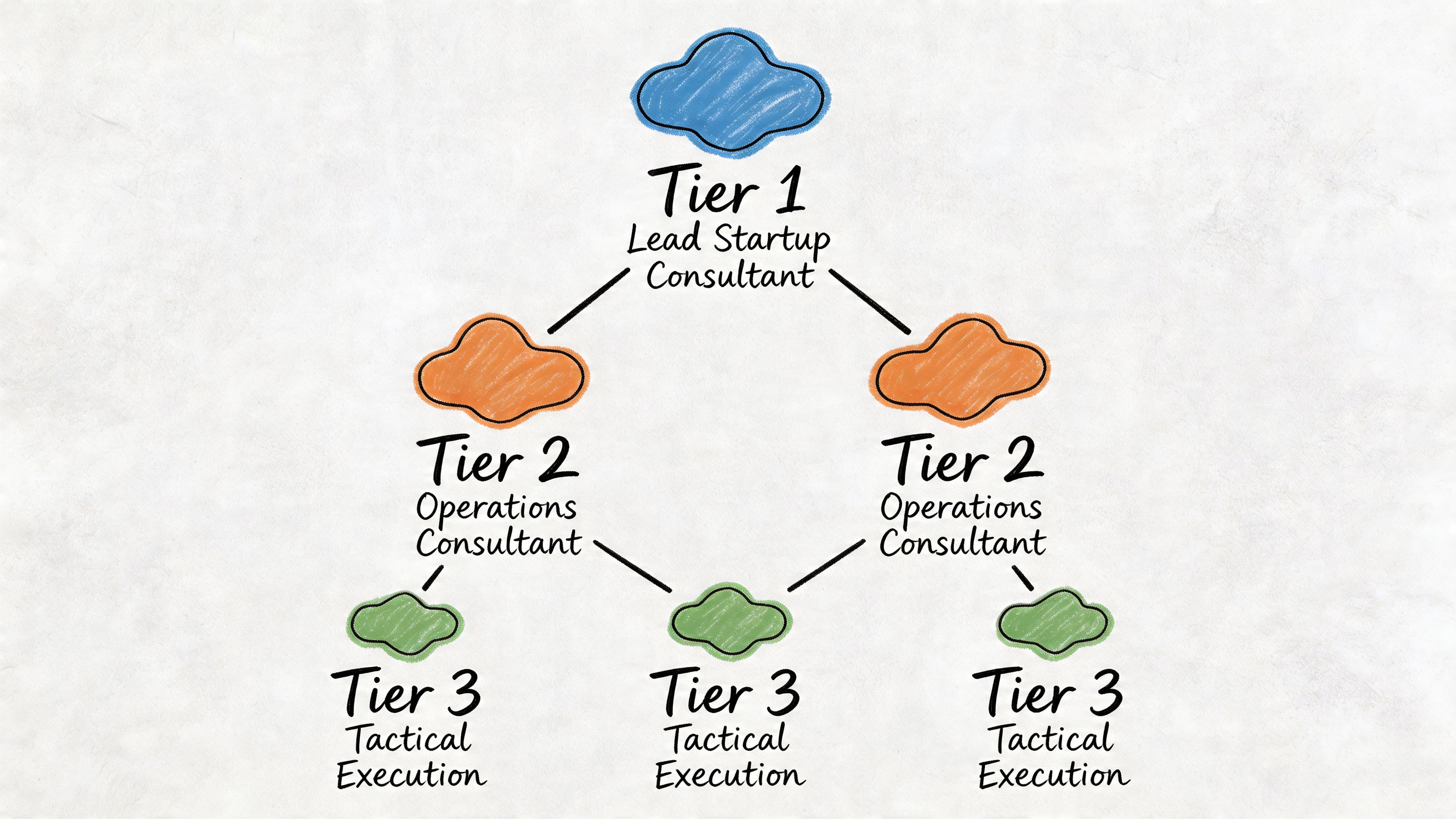
These firms sell confidence, structure, and organizational legitimacy.
That can matter if you’re a late-stage company navigating board politics, a major market entry, or enterprise transformation. It usually does not matter if you’re a B2B SaaS founder trying to fix ICP confusion, weak narrative-market fit, poor founder-led sales conversion, or channel prioritization after a messy seed-to-Series A transition.
Here’s the problem. Early-stage startups don’t suffer from lack of frameworks. They suffer from lack of grounded judgment under uncertainty.
Tier one firms often bring polished process, research-heavy outputs, and teams that are strong at synthesis. But many early-stage companies don’t need a synthesis machine. They need someone who can look at a rough website, a confused deck, a half-working outbound motion, and say: your real problem is that buyers don’t understand why this exists.
That’s operator work. Not presentation work.
Use them if:
Avoid them if:
Often, a lot of startups get trapped.
An execution agency often presents itself as a consultancy because “consultant” sounds more senior than “agency.” But if the core offer is content production, ad buying, design throughput, SDR staffing, or campaign operations, then that’s execution capacity, not strategic consulting.
That’s not bad. It’s just different.
If you already know your ICP, your category framing, your core narrative, your sales motion, and your demand strategy, then execution help can be useful. If you don’t know those things, an execution-heavy partner usually turns your ambiguity into expensive activity.
Typical signs:
That’s how startups end up “doing marketing” without improving go-to-market.
The right way to use this tier is narrow. Bring them in after the strategic decisions are made. Not before.
A founder who needs help with positioning and hires a channel team usually gets more content around the wrong message. A founder who needs pricing clarity and hires paid media support usually gets more traffic to an offer the market doesn’t want.
A short video on the consulting field helps make this distinction clearer:
For most B2B SaaS companies from early stage through growth stage, this is the sweet spot.
You want someone with enough altitude to think strategically and enough operator depth to know what breaks in practice. Someone who understands how positioning affects the homepage, how the homepage affects demo conversion, how founder-led sales calls expose messaging gaps, and how demand gen falls apart when the market story is fuzzy.
This is usually a specialist advisor, a fractional leader, or a small partner built around senior operator judgment.
Hire people who can diagnose across the chain, not people who only optimize one link.
This tier tends to work best when the consultant has lived inside the types of decisions you’re facing:
One option in this category is a strategic growth partner like Big Moves Marketing, which works on positioning, messaging, websites, and demand generation for B2B SaaS teams through scoped advisory and fractional CMO-style support. That model makes sense when the bottleneck is not raw execution volume but GTM clarity tied to action.
When you evaluate startup consulting firms, don’t ask “which firm is best?”
Ask:
Most founders choose with the wrong lens. They buy reputation when they need precision. Or they buy activity when they need diagnosis.
That’s why so many engagements look productive and still fail.
A weak brief creates a weak engagement. It also attracts the wrong consultants.
This is the part founders skip because it feels slower than outreach. It isn’t slower. It’s the only part that protects the company from paying for borrowed certainty. An estimated 80% of consulting startups fail within the first two years, often because they confuse expertise with business skill and rely on flawed operating models, according to Consulting Business School. Founders should assume some providers are polished but structurally weak. A clear client-defined scope is how you expose that.
Don’t build a huge brief. Build a one-page document.
The point isn’t documentation. The point is forced clarity. If your team can’t fit the mission on one page, the engagement is probably too vague, too broad, or too political to outsource cleanly.
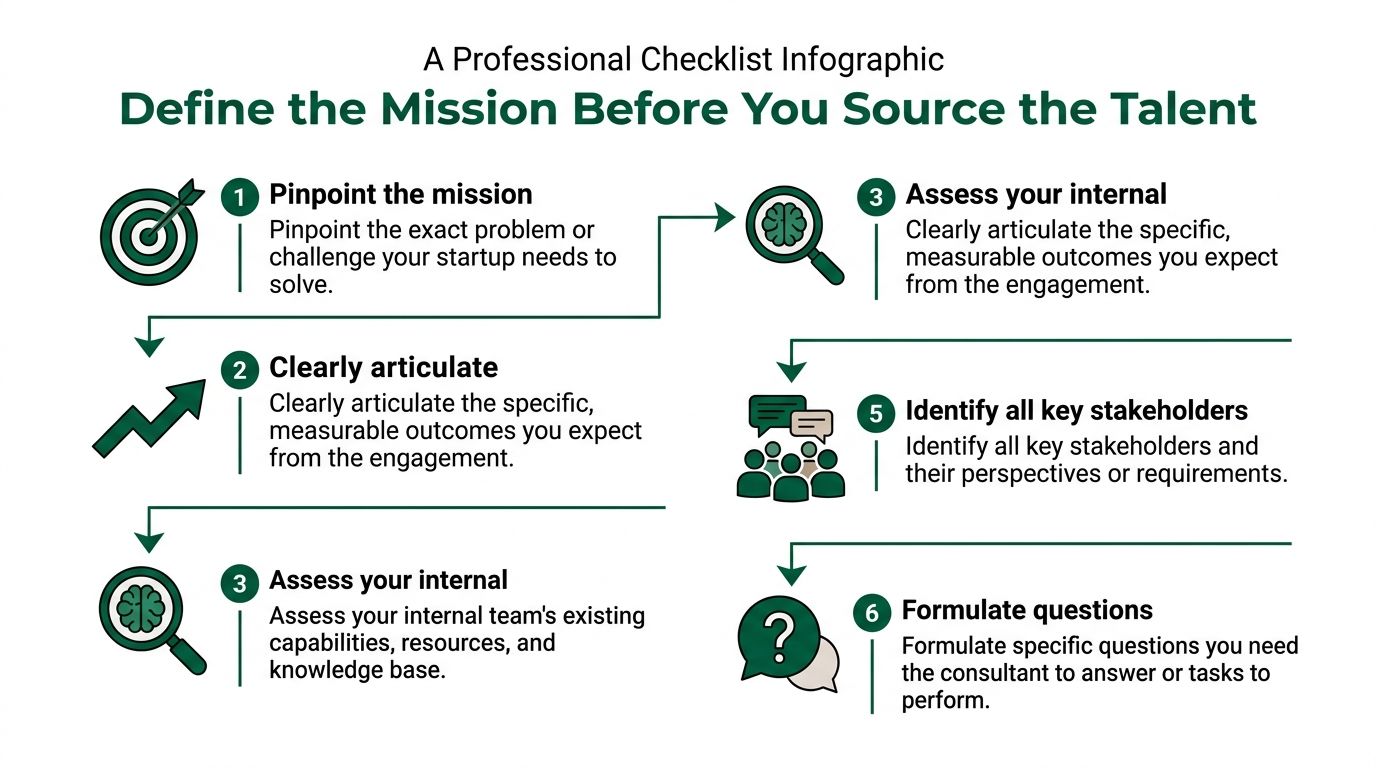
A good scope on a page does two things at once.
If you need help sharpening the problem before the hiring step, founder teams can borrow some useful thinking from this guide on how to validate a business idea. The point isn’t startup theory. It’s discipline. Validation beats assumption.
Use this structure.
Write one sentence. No fluff.
Bad version: “We need help with marketing.”
Better version: “We have product interest, but prospects don’t understand why we’re different from adjacent tools, and sales calls keep collapsing at problem framing.”
That sentence already tells a senior consultant far more than a broad “growth” request ever will.
Describe what should be true after the engagement.
Examples:
Many teams get sloppy when they ask for deliverables instead of changed conditions. Decks, docs, workshops, and messaging files are means. Not outcomes.
Your consultant should answer hard questions, not just produce artifacts.
Examples:
A strong list of questions changes the conversation. It stops the engagement from turning into content production with strategic language layered on top.
This part matters more than founders think.
Deliverables are what you expect to receive.
Anti-deliverables are what you explicitly do not want.
Example:
Anti-deliverables save money. They stop the consultant from filling the void with impressive-looking waste.
Strong consultants work better with constraints.
List:
Internal politics surface. Don’t hide them. A consultant can’t help with alignment if you pretend alignment already exists.
Avoid vanity metrics unless the engagement is directly tied to a mature, measurable funnel.
For early strategic work, success usually looks like:
If you want a useful framing on internal clarity versus mission language, this piece on mission statement vs purpose is relevant. Founders often confuse identity language with operational direction. They’re not the same.
A consultant can’t save you from a vague mandate. They can only make it more expensive.
Let’s make this concrete.
Say you run a B2B AI startup. The product can automate part of the operations workflow for mid-market teams. Demos happen. Follow-up stalls. Prospects say the product is “interesting” but don’t move.
Your scope on a page might look like this:
| Element | Example |
|---|---|
| Core problem | Prospects don’t connect the product to an urgent business problem, and our message sounds like generic AI automation |
| Future state | We can explain the product in language buyers repeat back to us, and the website plus sales narrative align around one commercial story |
| Questions to answer | Which buyer feels the pain most? What are we competing against in the buyer’s head? Is our “AI” framing helping or hurting trust? |
| Expected deliverables | Positioning diagnosis, revised homepage narrative, buyer pain map, sales talk track, pilot recommendations |
| Anti-deliverables | No brand workshop, no logo work, no broad social strategy, no channel execution before message clarity |
| Success definition | Team alignment on ICP and narrative, cleaner demos, stronger discovery calls, testable GTM direction |
That’s enough to source the right talent.
It also makes it easier to reject the wrong talent. Anyone who responds to that with a cookie-cutter workshop plan or channel-first recommendation has already told you they don’t understand the assignment.
The consulting market is getting noisier, not cleaner. The business consulting market is projected to grow to over USD 273 billion by 2031, according to Intel Market Research. More firms will enter. More polished operators will package themselves as strategic advisors. That means your selection process can’t depend on charisma, referrals, or a pretty deck.
It has to be founder-led and diagnostic.
Most hiring calls with startup consulting firms are too polite. Founders ask for background, process, and references. Consultants answer with category-safe language and a light case study tour. Everyone leaves feeling good. Nobody has learned much.
That’s a mistake.
You’re not buying biography. You’re buying judgment under uncertainty.
A strong consultant should be able to look at your public materials, ask a few sharp questions, and form an initial point of view. Not a final answer. A point of view. If they can’t do that, they probably need your brief to do the thinking for them.
Use the call to stress-test how they reason:
If you want a broader view of what a startup-specific advisor should look like, this perspective on a business consultant for startups is directionally useful. The bar should be commercial judgment, not generic advisory posture.
Don’t ask “what’s your process?”
Ask questions that force live thinking.
Based on our website and a few minutes of research, what’s your first diagnosis of our biggest GTM issue?
Good consultants will answer with a hypothesis and its limits. Weak ones will dodge.
What do you think we’re overestimating?
This reveals whether they can challenge leadership without hiding behind diplomacy.
If we hired you, what would you refuse to do in the first month?
Serious people know what not to touch yet.
What additional data would change your view?
Strong operators know which missing inputs matter.
Tell me about a founder who rejected your main recommendation. What happened next?
You want someone who can handle disagreement without becoming soft or dogmatic.
Where do startup teams usually waste money when solving this problem?
Good answers here are usually specific and uncomfortable.
How would you decide whether this is a positioning issue, an ICP issue, or an execution issue?
This exposes whether they can separate layers of the problem.
The first call should create useful tension. If it feels like a smooth sales presentation, you probably learned too little.
Use this table during calls. It’s more useful than a generic scorecard.
| Red Flag (Warning Signs) | Green Flag (Positive Indicators) |
|---|---|
| Leads with credentials and logos | Leads with diagnosis and questions |
| Talks about frameworks before your problem is clear | Tries to narrow the actual problem first |
| Promises fast results without constraint discussion | Talks about trade-offs, limits, and sequencing |
| Uses heavy jargon to create authority | Uses plain language that clarifies the issue |
| Has one process for every client | Adapts the approach to stage, motion, and team reality |
| Pushes execution before strategic decisions are made | Separates strategy work from production work |
| Avoids challenging founder assumptions | Respectfully challenges weak thinking early |
| Can’t say what success would look like in your case | Defines success in operational terms, not vague transformation language |
| Needs long discovery before offering any view | Can form an early hypothesis and explain what would validate it |
| Seems eager to stay indefinitely | Acts like the job should create independence over time |
Founders overvalue famous client names and undervalue reference quality.
The useful reference isn’t “they worked with a company I know.”
The useful reference is “they improved the way the team thought and operated.”
Ask former clients:
Those answers tell you whether the consultant creates clarity or just temporary momentum.
A bad engagement structure can ruin a good consultant. Such a situation causes founders to lose control after making a decent hire.
The problem is that most content on startup consulting firms doesn’t give founders a serious ROI framework, especially for GTM and demand generation work. Management Consulted’s discussion of startup business consultants reflects that broader gap. Founders are left comparing vague claims instead of defining what an engagement is supposed to change.
That’s why structure matters as much as selection.
Most engagements fit one of three shapes. None is universally right. The right one depends on the problem.
Best when the problem is narrow and definable.
Examples include repositioning a product, rebuilding core messaging, diagnosing funnel friction, revising the homepage narrative, or preparing a launch strategy for a specific motion.
This model works when:
It fails when the problem is still moving. If your startup is still changing ICP, pricing, channel, and sales motion at the same time, a fixed project often becomes too rigid.
Best when the problem is recurring but not executive-level.
A retainer can work if you need steady strategic support across a quarter or two, especially when internal teams need review, guidance, and prioritization rather than a full-time leader.
This model works when:
It fails when founders use it as a substitute for decision ownership. Then the consultant becomes the default tie-breaker for everything.
Best when the startup needs senior operating judgment embedded into a function.
This is often the right structure for B2B SaaS companies with no full-time CMO or CRO equivalent, a founder still holding too much GTM context, and a real need to turn strategy into operating rhythm.
A fractional model can be strong if you need:
For some teams, that may point to a fractional CMO for startups. For others, it may be a specialist advisor with limited embedded time. The label matters less than the decision rights and expected outputs.
Most founders measure the wrong thing.
They count deliverables because deliverables are visible. A strategy doc. A workshop. A messaging framework. A test plan. Those matter, but they are not the return.
The return is what becomes easier, faster, cleaner, or more repeatable because of the work.
Use a simple before-and-after logic:
| Dimension | Before engagement | After engagement |
|---|---|---|
| Decision speed | Leadership debates the same GTM questions repeatedly | Team reaches decisions faster with shared criteria |
| Message quality | Product language is feature-heavy and inconsistent | Commercial language is clearer and reusable |
| Execution focus | Teams spread effort across too many motions | Teams stop lower-value work and focus on fewer bets |
| Sales consistency | Calls vary widely by rep or founder | Core story holds across website, demos, and follow-up |
That’s a better ROI model than asking whether the consultant “delivered.”
The highest-value consulting engagement leaves the company stronger after the consultant exits.
That means your team should gain:
Don’t ask whether the consultant did good work. Ask whether your team can now do better work without them.
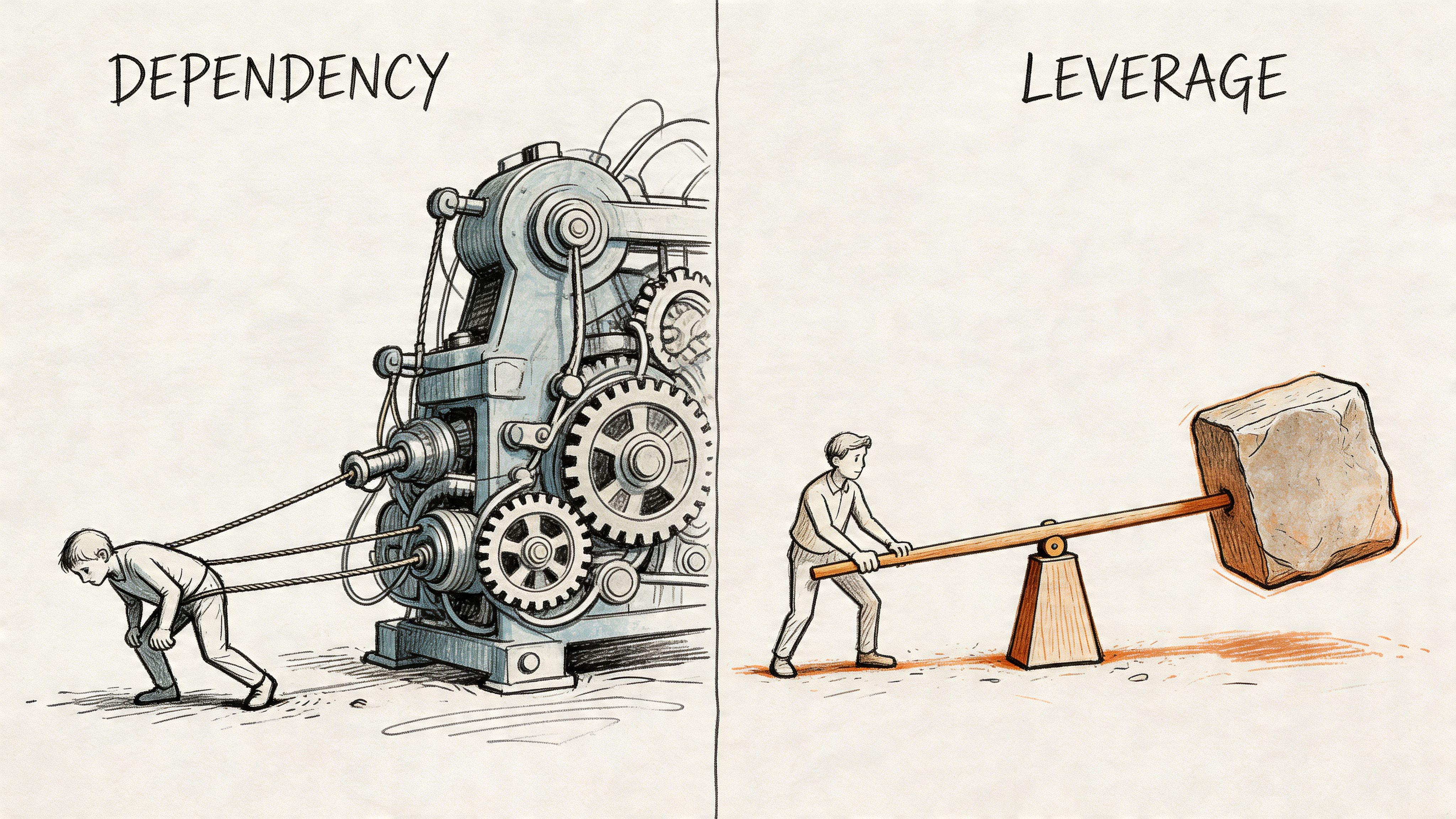
This is the difference between advantage and dependency.
Dependency looks like this: the consultant becomes the interpreter of your own market, every decision routes through them, and the team loses initiative.
The value is created differently: the consultant helps the company build a clearer operating system, codifies the thinking, and hands over tools the team can keep using.
If the engagement creates permanent reliance, it was structured badly. Even if everyone liked each other.
A successful consulting engagement should end cleanly.
Founders often judge success by how valuable the consultant felt during the project. That’s the wrong frame. Judge success by whether the team can carry the work forward after the consultant leaves.
That means planning the exit before the midpoint.
Make the final phase explicit:
If your company is also heading into financing conversations, tie the exit work to how the story gets told externally. This perspective on approach for fundraising for B2B SaaS startups 2025 is relevant because investor narrative drift often starts when internal GTM language is still unsettled.
The cleanest outcome is simple. The consultant becomes unnecessary for this class of problem.
That’s not a failure of the relationship. That’s proof the engagement worked.
Hire a consultant when the mission is bounded. You need diagnosis, strategic clarity, or a specific intervention.
Hire a fractional executive when the problem lives inside ongoing operating cadence. You need leadership, prioritization, cross-functional coordination, and repeated decisions over time.
If you’re asking someone to attend leadership meetings, shape quarterly priorities, manage external partners, and guide the team week after week, you probably don’t want a pure consultant.
Usually, no.
Equity makes sense when someone is taking real long-term responsibility with meaningful strategic contribution that compounds over time. Most consultants are not doing that. They are solving a specific problem for a defined period.
If the work can be scoped and paid for, pay for it. Don’t use equity to compensate for weak cash planning or vague expectations.
Good. That’s part of the job.
The founder should stay in control. But disagreement has to be handled like an operating issue, not an ego issue. Ask the consultant to state:
Then make the call. A useful consultant won’t need blind obedience. They’ll need a serious decision process.
Yes, but in a limited way.
They can sharpen the story, tighten positioning, improve the market narrative, and help connect GTM logic to investor communication. They cannot replace founder conviction, fix weak fundamentals, or manufacture traction through better slides.
If you hire a consultant expecting them to “get you funded,” you’re already drifting into fantasy.
If your team needs sharper positioning, cleaner messaging, or a tighter go-to-market decision process before you spend on more activity, Big Moves Marketing is one option for B2B SaaS founders who want strategic clarity tied to execution, not more consultant theater.
Explore Big Moves Marketing services and resources:




%20-%20white.svg)