%20png%20copy.avif)
A fractional CMO is a senior marketing executive you engage part-time. They aren't junior marketers learning on your dime; they are experienced operators who build the strategic growth systems B2B SaaS companies need to scale.
Most B2B founders make the same gut-wrenching mistake. The product is ready, investor pressure is mounting, and the impulse is to hire a mid-level marketing generalist to “get the word out.”
The logic feels sound—"we need someone to do the marketing"—but it's backward. You're putting tactical execution before strategic direction.
The outcome is painfully predictable. Your new marketer gets busy. They launch a blog, post on LinkedIn, maybe burn cash on Google Ads. You see a flurry of activity, but it all feels disconnected. There’s no measurable impact on qualified pipeline, and certainly not on revenue.
After six to nine months of wasted salary and zero meaningful traction, you're right back where you started. Except now, you’re out significant cash and more skeptical of marketing than ever.
The problem isn't a lack of effort. It’s the absence of a coherent go-to-market strategy. A junior marketer can execute a playbook, but they can't write it from scratch. They lack the pattern recognition to answer the foundational questions that separate a high-growth SaaS company from a forgotten one:
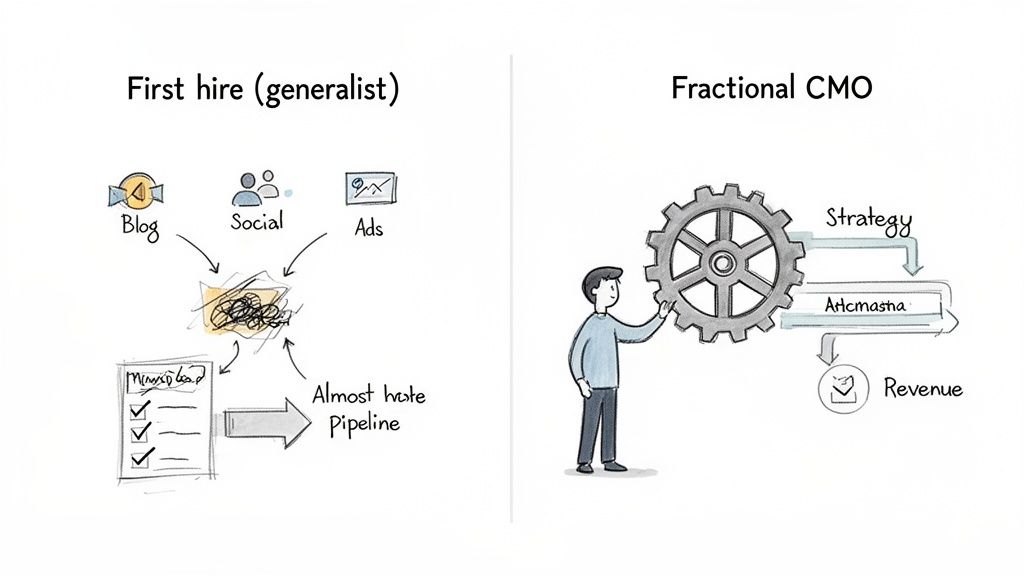
Expecting a marketing manager to define your GTM strategy is like asking a construction crew to also be the architect. They're entirely different skill sets. Without an architectural blueprint, you get a chaotic, unstable build that ultimately needs to be torn down.
In marketing, this "tear down" is the strategic debt you accumulate—wasted time, squandered budget, and lost market opportunities. You can find more detail on this topic when you read also about how to build a B2B marketing team structure.
This is where the fractional CMO model provides a critical advantage. Instead of hiring an executor, you bring in the architect first.
A fractional CMO doesn’t just manage tasks; they build the entire operating system for growth. Their first job is to install the strategic framework—the positioning, messaging, and demand generation model—that makes every future marketing dollar and hire effective.
They provide the senior-level thinking required to connect marketing spend directly to pipeline and revenue.
By engaging a fractional CMO, you're not just hiring a person; you are buying a proven system. You get the strategic leadership needed to build a repeatable growth engine, steering clear of the "random acts of marketing" that plague so many early-stage companies.
It ensures that when you do hire your first full-time marketer, they are stepping into a well-defined role with clear goals, a solid plan, and a genuine chance to succeed.
Let’s be clear: you’re not hiring a content creator, an ads manager, or a social media specialist. A true fractional CMO isn’t a tactical executor you hand a to-do list.
They are a senior strategic partner focused on one thing: architecting a predictable growth engine for your B2B SaaS company. Their value isn't in doing all the marketing work, but in ensuring all the right work gets done, effectively, and in lockstep with your business goals.
The entire focus shifts from completing tasks to building scalable systems. Think of them as the architect of your go-to-market strategy, defining the blueprint that your team or freelancers will build from.
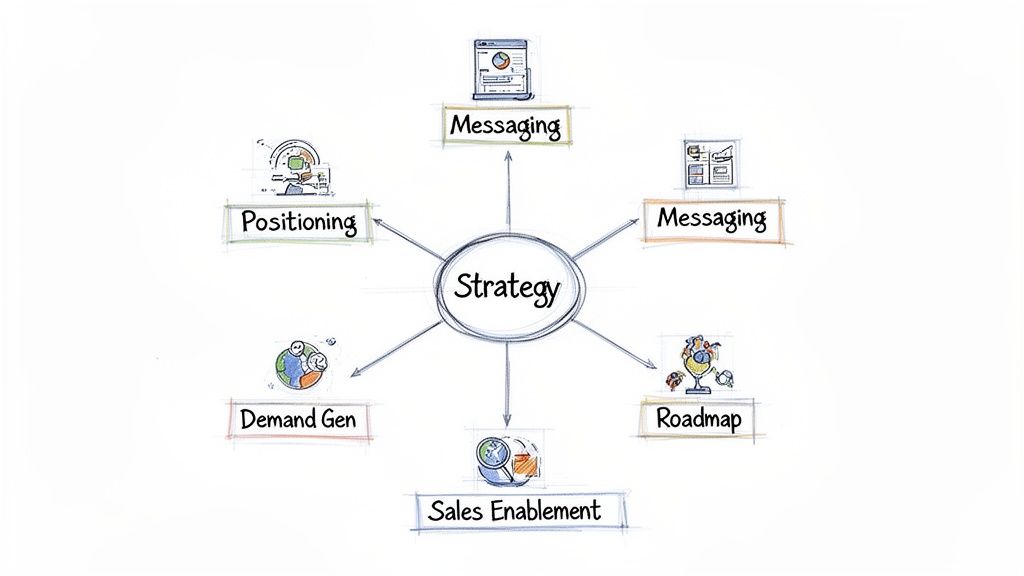
Before a single campaign is launched or a dollar is spent on ads, a fractional CMO gets brutally honest about the foundational questions that make or break a startup. They don’t just ask, “What should we do?” They ask, “Why are we doing it, and how will it generate revenue?”
This is where the real work begins. Key strategic deliverables include:
A fractional CMO doesn’t just "run ads." They design a multi-channel demand model built specifically for your market, deal size, and sales cycle. It's about designing a machine, not just pulling levers and hoping for the best.
This system defines:
For most B2B SaaS founders, content is a massive part of this. A fractional CMO can architect a complete strategy guide to Content Marketing for SaaS that connects content creation directly to demand.
The fractional CMO’s job is to stop the "random acts of marketing." They install a repeatable process that reliably generates qualified opportunities, connecting every dollar of marketing spend to a potential dollar of ARR.
A seasoned fractional CMO knows that marketing’s job doesn’t end when a lead is passed to sales. They work to bridge the all-too-common gap between the two teams, making sure the sales team is armed to win.
Their role here is to increase pipeline velocity and close rates by delivering:
This is where the flexible, senior nature of the role becomes invaluable. When market conditions shift, a fractional CMO can pivot the strategy quickly. In uncertain economic times, this agility is a massive advantage for SaaS startups that need to adapt fast.
Ultimately, a fractional CMO provides the strategic oversight and systems-thinking that founders don't have the time or specialized expertise to implement themselves. This is a very different role than a general B2B marketing consultant, who might tackle a specific project. The fractional CMO owns the entire growth strategy, ensuring every single marketing initiative serves the one goal that matters: scalable revenue growth.
Making the call on strategic leadership is one of the highest-stakes decisions a founder can make. Engage a fractional CMO too soon, and you burn precious capital on strategy you aren’t ready to execute. Wait too long, and you rack up immense strategic debt—missed opportunities, muddled positioning, and a stalled growth engine that’s a nightmare to rebuild.
Timing is everything. After working with dozens of B2B SaaS companies, I’ve seen that the need for a fractional CMO isn't tied to company age or headcount. It’s triggered by specific, painful inflection points.
There are three classic signals that tell you it's time to bring in senior marketing leadership. Spotting them is the difference between proactively building a growth machine and reactively trying to fix a broken one.
You’ve launched. Your product is live, and initial feedback from a handful of friendly beta customers is positive. But the broader market’s response? Crickets.
Demos are a struggle to book, prospects don’t get what you do, and your early marketing efforts feel like shouting into a void.
This is the classic post-launch disconnect. The problem isn't your product—it's the absence of a coherent go-to-market strategy.
At this stage, your challenges are foundational:
A fractional CMO steps in here to architect the GTM fundamentals. Their first job is to define a razor-sharp market position, build a messaging framework that connects with a specific buyer, and map out the initial channels to get market traction. This isn't about running more ads; it's about giving your product a fighting chance to be understood and valued.
Most successful SaaS companies get their start with founder-led sales. A founder's passion, deep product knowledge, and personal network are a powerful combination for landing the first 10, 20, or even 50 customers. But this model has a hard ceiling.
You’ve hit the plateau when growth flattens because you, the founder, have become the bottleneck. You can't be in every demo and on every sales call. The "playbook" for what works lives entirely in your head, and every attempt to hire a salesperson or marketer has failed because there's no system for them to plug into.
This is the point where you have to stop being an individual selling a product and start being a company building a market. The hustle that got you to your first $1M in ARR will not get you to $10M.
A fractional CMO is brought in to codify what works and build a scalable, repeatable engine to replace the founder-centric chaos. They diagnose the system's failure points and build the marketing infrastructure needed for the next growth stage—a demand generation model that doesn’t depend on your personal capacity.
You're preparing for your next funding round—usually a Series A or B. At this stage, investors are no longer betting on just a great idea and a strong team. They need to see a clear, credible path to market leadership and a massive return.
A compelling growth narrative is non-negotiable. You need to answer tough questions with confidence:
Engaging a fractional CMO months before you start pitching investors is a power move to build this exact narrative. They install the models, metrics, and dashboards that prove you have a deliberate plan for growth. They help translate your early traction into a story of impending market dominance, showing investors you’re not just growing—you have a machine that can predictably turn their investment into market share.
Without it, you're just another startup with a good product, not a truly fundable business.
Founders often get stuck viewing a fractional CMO through the lens of traditional hiring. They see a line-item expense instead of what it is: an investment in strategic capability that directly impacts valuation and revenue.
The economics aren't about cost; they're about capital efficiency.
You’re buying senior-level thinking, pattern recognition from dozens of other SaaS companies, and a tested go-to-market playbook—all without the fully loaded cost of an executive hire. This distinction is critical for any B2B startup trying to grow smarter, not just bigger.
The financial model of a fractional CMO is designed to give early-stage companies access to C-suite talent they couldn't otherwise afford. It decouples strategic leadership from the heavy, fixed cost of a full-time employee.
Engaging a fractional CMO isn't a one-size-fits-all expense. The pricing is tied directly to the scope and the level of involvement needed to hit your objectives.
Typical monthly retainers for a quality fractional CMO range from $3,000 to $20,000. That may seem high, but let's put it in perspective. This often represents a 50-70% cost reduction compared to hiring a full-time Chief Marketing Officer.
When you factor in salary, bonuses, benefits, and equity, a full-time CMO's total compensation package can easily run between $200,000 and $450,000 annually in the US market.
The table below gives a clear picture of just how efficient a fractional engagement can be for a B2B SaaS startup.
As you can see, the fractional model gives you the strategic horsepower you need while preserving precious capital for other critical growth areas like product development and sales.
There are three common engagement structures:
As the market for fractional executives matures, more creative pricing models are appearing. These hybrid structures are designed to directly align the fractional CMO’s compensation with your company's success.
A popular setup combines a smaller base retainer with performance-based incentives. For example, a $5,000 monthly base might be paired with bonuses tied to hitting specific, measurable outcomes.
This isn't about rewarding vanity metrics. A performance component must be tied to numbers that directly influence revenue and enterprise value—things like MQL volume, pipeline growth, or a lower Customer Acquisition Cost (CAC).
The infographic below shows the three key business inflection points that usually signal it's time to bring in a fractional CMO: Launch, Plateau, and Fundraise.
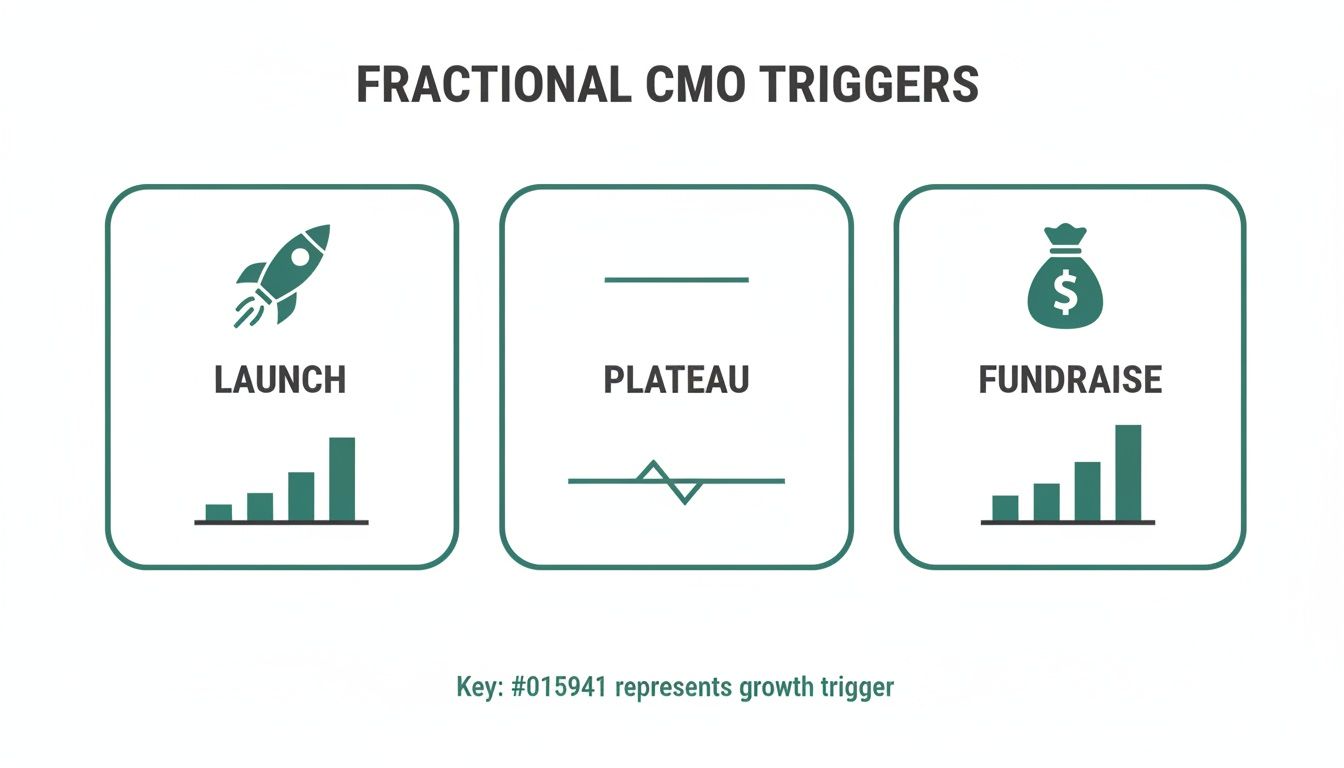
Each of these triggers represents a moment where strategic debt can pile up fast without senior marketing leadership. This is where the economics of a fractional hire become incredibly compelling.
When evaluating the cost, it's also helpful to understand how a fractional leader thinks about budget allocation for specific channels. It’s worth looking into how they approach things like Pay Per Click management pricing to ensure you’re getting transparency and value.
Ultimately, the fee for a true fractional CMO is an investment in avoiding costly mistakes. The right leader can save you hundreds of thousands in mis-hires and wasted marketing spend. Knowing how to connect that spend to actual results is key. For a deeper look, check out our guide on how to measure marketing ROI.
The economic question isn't "Can we afford a fractional CMO?" It's "Can we afford to build our growth engine without one?"
The term "fractional CMO" has been watered down. It’s now used by everyone from career freelancers seeking a new title to agency owners who spotted a branding opportunity.
This creates a trap for founders. You think you’re hiring a strategist to architect your growth engine, but you wind up with a tactician who just wants to run a few campaigns.
Your job during the vetting process is to slice through the noise and evaluate how they think, not just what they’ve done. A deck of logos means nothing if they can't diagnose your specific go-to-market challenges from first principles. You're looking to distinguish between someone who executes tasks and someone who builds systems. The first offers temporary help; the second delivers sustained leverage.
Standard interview questions are useless here—they won’t expose a tactician in strategist's clothing. You have to push past their polished resume and directly test their thinking. Their answers should reveal a history of recognizing go-to-market patterns across multiple B2B SaaS companies.
Here’s what I ask to separate the doers from the architects:
Diagnostic Process: "Walk me through your first 30 days. What information do you need, who are you talking to, and what's the first tangible output I should expect?" A strategist will outline a diagnostic process centered on your business model, customer interviews, and the competitive landscape. A tactician will jump straight to channel audits and campaign ideas.
Strategic Trade-offs: "Our biggest competitor is better funded and has more features. How would you approach our positioning and demand generation?" Listen for talk of trade-offs. A true partner will discuss niching down, focusing on an ICP where you can win, or building a brand around a contrarian point of view—not just "outspending" with ads.
Demand Philosophy: "Describe your philosophy on building a demand engine for a company at our stage." A weak answer revolves around a specific channel they happen to like, such as SEO or LinkedIn ads. A strong answer is about building a model—how to capture existing demand while creating new demand, and how you’ll balance short-term pipeline with long-term brand building.
A candidate who can't articulate clear strategic trade-offs isn't a strategist. They're a generalist waiting for you to provide the strategy. True leadership involves making hard decisions about what not to do.
Spotting a tactician is just as important as finding a strategist. Watch for these warning signs during your conversations. These red flags point to a fundamental mismatch with the strategic needs of a growing SaaS company.
Key Red Flags:
Vetting a fractional CMO is less about finding someone who has worked in your exact niche and more about finding someone who has repeatedly solved your specific problem. Founders often overvalue direct industry experience and undervalue go-to-market pattern recognition. For a different perspective, you might be interested in our thoughts on hiring an agency for B2B marketing and the different vetting process that requires.
As a founder, you're wired for immediate results. When you bring on a strategic advisor like a fractional CMO, the impulse is to stare at lagging indicators like revenue and cost-per-lead within the first few weeks.
This is a mistake.
The real value a fractional CMO delivers in the first 90 days isn't found in the metrics you're used to watching. It's in the leading indicators—the foundational fixes that make all future growth possible. You aren't renting a campaign manager; you're embedding a strategic architect. Their first job is to diagnose, plan, and build the systems your B2B SaaS company lacks.
Judging them on instant pipeline is like judging an architect by how many bricks they've laid on day one. The first 90 days are about creating clarity and building momentum, not closing a flood of new deals.
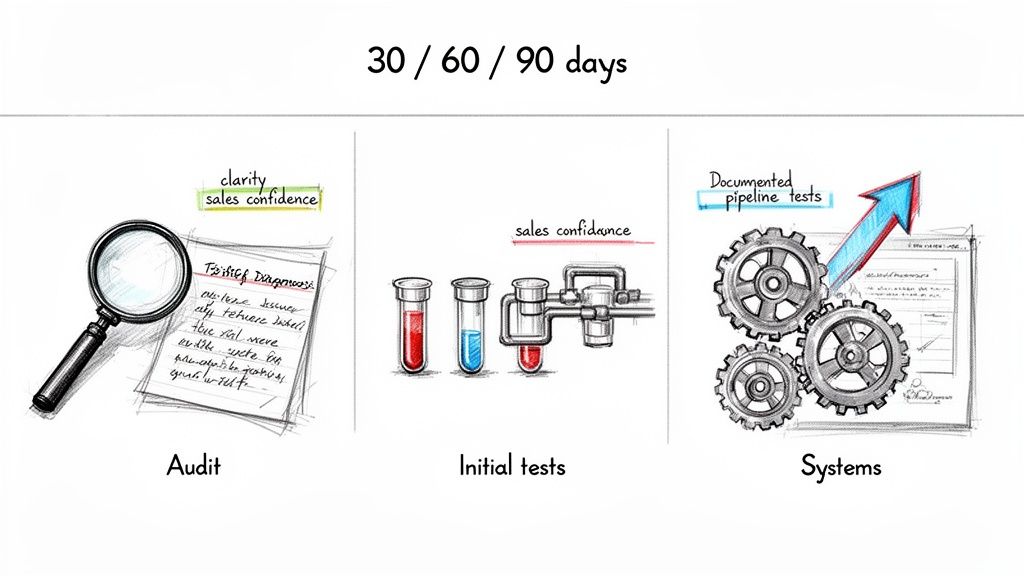
The first 30 days are a deep dive into the business. A true fractional CMO doesn’t show up with a pre-canned playbook. They listen, learn, and diagnose.
With a clear diagnosis in hand, the second month is for building the strategic framework. This is where the core assets that will guide all future marketing and sales efforts are forged.
Key deliverables during this phase often include:
The most powerful outcome of this phase is clarity. Your team shifts from asking, "What should we do?" to confidently stating, "This is exactly what we need to do next." For most startups, this shift alone is a massive step forward.
By the 90-day mark, strategy starts turning into action. This isn't about launching a dozen new initiatives at once. It’s about starting the right one or two high-impact experiments to validate the new strategy and begin building repeatable processes.
Success here is about momentum. You should see a testable plan for pipeline growth in motion. You’ll also notice a tangible uptick in sales team confidence because they finally have a clear message and a plan they believe in. The focus is on progress, not perfection. You can explore more on this topic in our guide on how to measure marketing effectiveness.
This structured approach is precisely why fractional CMOs can deliver results faster than a traditional hire. In fact, return on investment data shows fractional CMOs deliver measurable results 40-60% faster than new full-time executives, with SaaS firms often reporting 5-7x ROI in the first year. You can discover more about these impressive fractional CMO returns.
Let's cut through the noise. When B2B SaaS founders weigh this decision, the same pointed questions always come up. Here are the straight answers.
No, and confusing the two is a dangerous mistake. It’s the difference between hiring a task-doer and hiring an owner.
A part-time marketer is an executor. You give them a to-do list—write blog posts, run ads—and they check the boxes. A fractional CMO is a senior executive who owns your entire growth strategy. They are accountable for answering the toughest questions in your business, from core positioning and messaging to designing the demand generation engine that fuels your sales team.
The "fractional" part refers to their time commitment and cost, not the seniority or strategic impact of their work.
You're probably too early if you're still pre-product. If you don't have something to sell and have no real-world feedback to define a viable Ideal Customer Profile (ICP), any strategic work is purely theoretical. A fractional CMO needs a real product and a real market to build upon.
The right time is usually one of two moments:
A fractional CMO can't invent a market for a product that doesn't exist. They are hired to connect a viable product to the right market, systematically and at scale. It's about engineering growth, not pulling it out of thin air.
A fractional CMO is the architect, and an agency is the specialized construction crew.
A fractional CMO provides strategic leadership that sits inside your company, acting as a member of your executive team. An agency provides the execution horsepower for a specific marketing channel, like running your Google Ads, managing your LinkedIn presence, or handling SEO.
The fractional CMO creates the blueprint. They set the overall strategy, build the marketing plan, and then determine which resources—whether an agency, freelancers, or your first internal hire—are needed to execute it effectively. They manage those resources; they don't replace them.
Direct niche experience is rarely the most important factor. It’s far more critical that they have a proven, repeatable track record of solving the same type of GTM problem for B2B SaaS companies at your exact growth stage.
The challenge of moving from founder-led sales to a scalable demand engine is a problem with recognizable patterns, whether you're selling to HR tech buyers or DevOps teams. Strong pattern recognition of these common growth hurdles is more valuable than narrow industry knowledge.
A true strategist applies first-principles thinking to any B2B SaaS context. They are hired to solve the problem type, not just serve the industry type.
Tired of seeing marketing activity with no revenue to show for it? At Big Moves Marketing, we help B2B SaaS founders install the positioning and GTM strategy that drives pipeline and makes every sales hire more effective. If you’re ready to build a growth engine, not just a marketing to-do list, see how we can help at https://www.bigmoves.marketing.





%20-%20white.svg)